EVOLUTION
Chapter 15Chapter 15
Charles Darwin
Question for Thought
 Earth has millions of other kinds ofEarth has millions of other kinds of
organisms of everyorganisms of every
imaginable shape, size, and habitat.imaginable shape, size, and habitat.
This variety of living things is calledThis variety of living things is called
biologicalbiological
diversitydiversity. How did all these different. How did all these different
organisms arise?organisms arise?
 How are they relatedHow are they related??
In your own words, describe
what YOU think the theory of
evolution means…
Darwin’s Theory of Evolution
 EvolutionEvolution, or change over time, is the, or change over time, is the
process by which modern organisms haveprocess by which modern organisms have
descended from ancient organisms.descended from ancient organisms.
 A scientificA scientific theorytheory is a well-supportedis a well-supported
testable explanation of phenomena thattestable explanation of phenomena that
have occurred in the natural world.have occurred in the natural world.
How do you think Darwin came
up with his theory?
Voyage of the Beagle
Voyage of Beagle
 Dates:Dates: February 12th, 1831February 12th, 1831
 Captain:Captain: Charles DarwinCharles Darwin
 ShipShip: H.M.S. Beagle: H.M.S. Beagle
 Destination:Destination: Voyage around the world.Voyage around the world.
 Findings:Findings: evidence to propose aevidence to propose a
revolutionary hypothesis about how liferevolutionary hypothesis about how life
changes over timechanges over time
Patterns of Diversity
 Darwin visited Argentina and Australia which hadDarwin visited Argentina and Australia which had
similar grassland ecosystems.similar grassland ecosystems.
 those grasslands were inhabited by very differentthose grasslands were inhabited by very different
animals.animals.
 neither Argentina nor Australia was home to theneither Argentina nor Australia was home to the
sorts of animals that lived in European grasslands.sorts of animals that lived in European grasslands.
Patterns of Diversity
 Darwin posed challenging questions.Darwin posed challenging questions.
 Why were there no rabbits in Australia, despite theWhy were there no rabbits in Australia, despite the
presence of habitats that seemed perfect for them?presence of habitats that seemed perfect for them?
 Why were there no kangaroos in England?Why were there no kangaroos in England?
Living Organisms and Fossils
 Darwin collected the preserved remains ofDarwin collected the preserved remains of
ancient organisms, calledancient organisms, called fossilsfossils..
 Some of those fossils resembled organisms thatSome of those fossils resembled organisms that
were still alive today.were still alive today.
Living Organisms and Fossils
  
 Others looked completely unlike any creature he hadOthers looked completely unlike any creature he had
ever seen.ever seen.
 As Darwin studied fossils, new questions arose.As Darwin studied fossils, new questions arose.
 Why had so many of these species disappeared?Why had so many of these species disappeared?
 How were they related to living species?How were they related to living species?
Fossils
The Galapagos Island
 The smallest, lowest islands were hot,The smallest, lowest islands were hot,
dry, and nearly barren-Hood Island-sparsedry, and nearly barren-Hood Island-sparse
vegetationvegetation
 The higher islands had greater rainfall andThe higher islands had greater rainfall and
a different assortment of plants anda different assortment of plants and
animals-Isabela- Island had richanimals-Isabela- Island had rich
vegetationvegetation..
The Galapagos Island
 Darwin was fascinated in particular by the landDarwin was fascinated in particular by the land
tortoises and marine iguanas in the Galápagos.tortoises and marine iguanas in the Galápagos.
 Giant tortoises varied in predictable ways fromGiant tortoises varied in predictable ways from
one island to another.one island to another.
 The shape of a tortoise's shell could be used toThe shape of a tortoise's shell could be used to
identify which island a particular tortoiseidentify which island a particular tortoise
inhabited.inhabited.
Animals found in the Galapagos
 Land TortoisesLand Tortoises
 Darwin FinchesDarwin Finches
 Blue-Footed BoobyBlue-Footed Booby
 Marine IguanasMarine Iguanas
Animals
The Journey Home
 Darwin Observed that characteristicsDarwin Observed that characteristics
of many plants and animals varyof many plants and animals vary
greatly among the islandsgreatly among the islands
 Hypothesis:Hypothesis: Separate species maySeparate species may
have arose from an original ancestorhave arose from an original ancestor
Ideas that shaped Darwin’s
Thinking
 James Hutton:James Hutton:
 1795 Theory of1795 Theory of
Geological changeGeological change
 Forces changeForces change
earth’s surfaceearth’s surface
shapeshape
 Changes are slowChanges are slow
 Earth much olderEarth much older
than thousands ofthan thousands of
yearsyears
Ideas that Shaped Darwin’s
Thinking
 Charles LyellCharles Lyell
 Book:Book: Principles ofPrinciples of
GeographyGeography
 Geographical featuresGeographical features
can be built up or torncan be built up or torn
downdown
 Darwin thought ifDarwin thought if
earth changed overearth changed over
time, what about life?time, what about life?
Lamarck
Lamarck’s Theory of Evolution
 Tendency toward Perfection(GiraffeTendency toward Perfection(Giraffe
necks)necks)
 Use and Disuse (bird’s using forearms)Use and Disuse (bird’s using forearms)
 Inheritance of Acquired TraitsInheritance of Acquired Traits
 Are you still paying Attention?Are you still paying Attention?
Population Growth
 Thomas MalthusThomas Malthus--
19th century English19th century English
economisteconomist
 If population grewIf population grew
(more Babies born(more Babies born
than die)than die)
 Insufficient livingInsufficient living
spacespace
 Food runs outFood runs out
 Darwin applied thisDarwin applied this
theory to animalstheory to animals
Publication of Orgin of Species
 Russel Wallace wroteRussel Wallace wrote
an essay summarizingan essay summarizing
evolutionary changeevolutionary change
from his field work infrom his field work in
MalaysiaMalaysia
 Gave Darwin the driveGave Darwin the drive
to publish his findingsto publish his findings
Natural Selection & Artificial
Selection
 Natural variationNatural variation--differences among--differences among
individuals of a speciesindividuals of a species
 Artificial selectionArtificial selection- nature provides the- nature provides the
variation among different organisms, andvariation among different organisms, and
humans select those variations they findhumans select those variations they find
usefuluseful..
Evolution by Natural Selection
 The Struggle for ExistenceThe Struggle for Existence-members of-members of
each species have to compete for food,each species have to compete for food,
shelter, other life necessitiesshelter, other life necessities
 Survival of the FittestSurvival of the Fittest-Some individuals-Some individuals
better suited for the environmentbetter suited for the environment
Struggle For Existence &
Survival of The Fittest
Natural Selection
 Over time, naturalOver time, natural
selection results inselection results in
changes in inheritedchanges in inherited
characteristics of acharacteristics of a
population. Thesepopulation. These
changes increase achanges increase a
species fitness in itsspecies fitness in its
environmentenvironment
Descent
 Descent with ModificationDescent with Modification-Each living organism has-Each living organism has
descended, with changes from other species over timedescended, with changes from other species over time
 Common DescentCommon Descent- were derived from common ancestors- were derived from common ancestors
Evidence of Evolution
 The Fossil RecordThe Fossil Record
 Geographic Distribution of LivingGeographic Distribution of Living
ThingsThings
 Homologous Body StructuresHomologous Body Structures
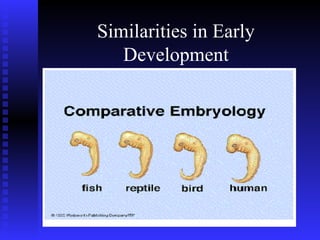
 Similarities in Early DevelopmentSimilarities in Early Development
Evidence for Evolution
 The Fossil RecordThe Fossil Record--
Layer show changeLayer show change
 GeographicGeographic
Distribution of LivingDistribution of Living
ThingsThings
 Homologous BodyHomologous Body
StructuresStructures
 Similarities in EarlySimilarities in Early
DevelopmentDevelopment
Evidence of Evolution
 The Fossil RecordThe Fossil Record
 GeographicGeographic
Distribution ofDistribution of
Living Things-Living Things-similarsimilar
environments haveenvironments have
similar types ofsimilar types of
organismsorganisms
 Homologous BodyHomologous Body
StructuresStructures
 Similarities in EarlySimilarities in Early
DevelopmentDevelopment
Homologous Structures
 Homologous StructuresHomologous Structures-structures that-structures that
have different mature forms in differenthave different mature forms in different
organisms, but develop from the sameorganisms, but develop from the same
embryonic tissueembryonic tissue
Evidence for Evolution
 Vestigial organsVestigial organs-organs that serve-organs that serve
no useful function in an organismno useful function in an organism
 i.e.) appendix, miniature legs, armsi.e.) appendix, miniature legs, arms
Similarities in Early
Development
Summary of Darwin’s Theory
 Individuals in nature differ from oneIndividuals in nature differ from one
anotheranother
 Organisms in nature produce moreOrganisms in nature produce more
offspring than can survive, and many ofoffspring than can survive, and many of
those who do not survive do not reproduce.those who do not survive do not reproduce.
Summary of Darwin’s Theory
 Because more organisms are produce thanBecause more organisms are produce than
can survive, each species must struggle forcan survive, each species must struggle for
resourcesresources
 Each organism is unique, each hasEach organism is unique, each has
advantages and disadvantages in theadvantages and disadvantages in the
struggle for existencestruggle for existence
Summary (cont.)
 Individuals best suited for the environmentIndividuals best suited for the environment
survive and reproduce most successfulsurvive and reproduce most successful
 Species change over timeSpecies change over time
Summary (cont.)
 Species alive today descended with modificationSpecies alive today descended with modification
from species that lived in the pastfrom species that lived in the past
 All organisms on earth are united into a singleAll organisms on earth are united into a single
family tree of life by common descentfamily tree of life by common descent
Evolutionary ideas

Evolutionary ideas

  • 1.
  • 2.
  • 3.
    Question for Thought Earth has millions of other kinds ofEarth has millions of other kinds of organisms of everyorganisms of every imaginable shape, size, and habitat.imaginable shape, size, and habitat. This variety of living things is calledThis variety of living things is called biologicalbiological diversitydiversity. How did all these different. How did all these different organisms arise?organisms arise?  How are they relatedHow are they related??
  • 4.
    In your ownwords, describe what YOU think the theory of evolution means…
  • 5.
    Darwin’s Theory ofEvolution  EvolutionEvolution, or change over time, is the, or change over time, is the process by which modern organisms haveprocess by which modern organisms have descended from ancient organisms.descended from ancient organisms.  A scientificA scientific theorytheory is a well-supportedis a well-supported testable explanation of phenomena thattestable explanation of phenomena that have occurred in the natural world.have occurred in the natural world.
  • 6.
    How do youthink Darwin came up with his theory?
  • 7.
  • 8.
    Voyage of Beagle Dates:Dates: February 12th, 1831February 12th, 1831  Captain:Captain: Charles DarwinCharles Darwin  ShipShip: H.M.S. Beagle: H.M.S. Beagle  Destination:Destination: Voyage around the world.Voyage around the world.  Findings:Findings: evidence to propose aevidence to propose a revolutionary hypothesis about how liferevolutionary hypothesis about how life changes over timechanges over time
  • 10.
    Patterns of Diversity Darwin visited Argentina and Australia which hadDarwin visited Argentina and Australia which had similar grassland ecosystems.similar grassland ecosystems.  those grasslands were inhabited by very differentthose grasslands were inhabited by very different animals.animals.  neither Argentina nor Australia was home to theneither Argentina nor Australia was home to the sorts of animals that lived in European grasslands.sorts of animals that lived in European grasslands.
  • 11.
    Patterns of Diversity Darwin posed challenging questions.Darwin posed challenging questions.  Why were there no rabbits in Australia, despite theWhy were there no rabbits in Australia, despite the presence of habitats that seemed perfect for them?presence of habitats that seemed perfect for them?  Why were there no kangaroos in England?Why were there no kangaroos in England?
  • 12.
    Living Organisms andFossils  Darwin collected the preserved remains ofDarwin collected the preserved remains of ancient organisms, calledancient organisms, called fossilsfossils..  Some of those fossils resembled organisms thatSome of those fossils resembled organisms that were still alive today.were still alive today.
  • 13.
    Living Organisms andFossils     Others looked completely unlike any creature he hadOthers looked completely unlike any creature he had ever seen.ever seen.  As Darwin studied fossils, new questions arose.As Darwin studied fossils, new questions arose.  Why had so many of these species disappeared?Why had so many of these species disappeared?  How were they related to living species?How were they related to living species?
  • 14.
  • 15.
    The Galapagos Island The smallest, lowest islands were hot,The smallest, lowest islands were hot, dry, and nearly barren-Hood Island-sparsedry, and nearly barren-Hood Island-sparse vegetationvegetation  The higher islands had greater rainfall andThe higher islands had greater rainfall and a different assortment of plants anda different assortment of plants and animals-Isabela- Island had richanimals-Isabela- Island had rich vegetationvegetation..
  • 16.
    The Galapagos Island Darwin was fascinated in particular by the landDarwin was fascinated in particular by the land tortoises and marine iguanas in the Galápagos.tortoises and marine iguanas in the Galápagos.  Giant tortoises varied in predictable ways fromGiant tortoises varied in predictable ways from one island to another.one island to another.  The shape of a tortoise's shell could be used toThe shape of a tortoise's shell could be used to identify which island a particular tortoiseidentify which island a particular tortoise inhabited.inhabited.
  • 18.
    Animals found inthe Galapagos  Land TortoisesLand Tortoises  Darwin FinchesDarwin Finches  Blue-Footed BoobyBlue-Footed Booby  Marine IguanasMarine Iguanas
  • 19.
  • 20.
    The Journey Home Darwin Observed that characteristicsDarwin Observed that characteristics of many plants and animals varyof many plants and animals vary greatly among the islandsgreatly among the islands  Hypothesis:Hypothesis: Separate species maySeparate species may have arose from an original ancestorhave arose from an original ancestor
  • 21.
    Ideas that shapedDarwin’s Thinking  James Hutton:James Hutton:  1795 Theory of1795 Theory of Geological changeGeological change  Forces changeForces change earth’s surfaceearth’s surface shapeshape  Changes are slowChanges are slow  Earth much olderEarth much older than thousands ofthan thousands of yearsyears
  • 22.
    Ideas that ShapedDarwin’s Thinking  Charles LyellCharles Lyell  Book:Book: Principles ofPrinciples of GeographyGeography  Geographical featuresGeographical features can be built up or torncan be built up or torn downdown  Darwin thought ifDarwin thought if earth changed overearth changed over time, what about life?time, what about life?
  • 23.
  • 24.
    Lamarck’s Theory ofEvolution  Tendency toward Perfection(GiraffeTendency toward Perfection(Giraffe necks)necks)  Use and Disuse (bird’s using forearms)Use and Disuse (bird’s using forearms)  Inheritance of Acquired TraitsInheritance of Acquired Traits  Are you still paying Attention?Are you still paying Attention?
  • 27.
    Population Growth  ThomasMalthusThomas Malthus-- 19th century English19th century English economisteconomist  If population grewIf population grew (more Babies born(more Babies born than die)than die)  Insufficient livingInsufficient living spacespace  Food runs outFood runs out  Darwin applied thisDarwin applied this theory to animalstheory to animals
  • 28.
    Publication of Orginof Species  Russel Wallace wroteRussel Wallace wrote an essay summarizingan essay summarizing evolutionary changeevolutionary change from his field work infrom his field work in MalaysiaMalaysia  Gave Darwin the driveGave Darwin the drive to publish his findingsto publish his findings
  • 29.
    Natural Selection &Artificial Selection  Natural variationNatural variation--differences among--differences among individuals of a speciesindividuals of a species  Artificial selectionArtificial selection- nature provides the- nature provides the variation among different organisms, andvariation among different organisms, and humans select those variations they findhumans select those variations they find usefuluseful..
  • 30.
    Evolution by NaturalSelection  The Struggle for ExistenceThe Struggle for Existence-members of-members of each species have to compete for food,each species have to compete for food, shelter, other life necessitiesshelter, other life necessities  Survival of the FittestSurvival of the Fittest-Some individuals-Some individuals better suited for the environmentbetter suited for the environment
  • 31.
    Struggle For Existence& Survival of The Fittest
  • 32.
    Natural Selection  Overtime, naturalOver time, natural selection results inselection results in changes in inheritedchanges in inherited characteristics of acharacteristics of a population. Thesepopulation. These changes increase achanges increase a species fitness in itsspecies fitness in its environmentenvironment
  • 33.
    Descent  Descent withModificationDescent with Modification-Each living organism has-Each living organism has descended, with changes from other species over timedescended, with changes from other species over time  Common DescentCommon Descent- were derived from common ancestors- were derived from common ancestors
  • 34.
    Evidence of Evolution The Fossil RecordThe Fossil Record  Geographic Distribution of LivingGeographic Distribution of Living ThingsThings  Homologous Body StructuresHomologous Body Structures  Similarities in Early DevelopmentSimilarities in Early Development
  • 35.
    Evidence for Evolution The Fossil RecordThe Fossil Record-- Layer show changeLayer show change  GeographicGeographic Distribution of LivingDistribution of Living ThingsThings  Homologous BodyHomologous Body StructuresStructures  Similarities in EarlySimilarities in Early DevelopmentDevelopment
  • 36.
    Evidence of Evolution The Fossil RecordThe Fossil Record  GeographicGeographic Distribution ofDistribution of Living Things-Living Things-similarsimilar environments haveenvironments have similar types ofsimilar types of organismsorganisms  Homologous BodyHomologous Body StructuresStructures  Similarities in EarlySimilarities in Early DevelopmentDevelopment
  • 37.
    Homologous Structures  HomologousStructuresHomologous Structures-structures that-structures that have different mature forms in differenthave different mature forms in different organisms, but develop from the sameorganisms, but develop from the same embryonic tissueembryonic tissue
  • 39.
    Evidence for Evolution Vestigial organsVestigial organs-organs that serve-organs that serve no useful function in an organismno useful function in an organism  i.e.) appendix, miniature legs, armsi.e.) appendix, miniature legs, arms
  • 42.
  • 43.
    Summary of Darwin’sTheory  Individuals in nature differ from oneIndividuals in nature differ from one anotheranother  Organisms in nature produce moreOrganisms in nature produce more offspring than can survive, and many ofoffspring than can survive, and many of those who do not survive do not reproduce.those who do not survive do not reproduce.
  • 44.
    Summary of Darwin’sTheory  Because more organisms are produce thanBecause more organisms are produce than can survive, each species must struggle forcan survive, each species must struggle for resourcesresources  Each organism is unique, each hasEach organism is unique, each has advantages and disadvantages in theadvantages and disadvantages in the struggle for existencestruggle for existence
  • 45.
    Summary (cont.)  Individualsbest suited for the environmentIndividuals best suited for the environment survive and reproduce most successfulsurvive and reproduce most successful  Species change over timeSpecies change over time
  • 46.
    Summary (cont.)  Speciesalive today descended with modificationSpecies alive today descended with modification from species that lived in the pastfrom species that lived in the past  All organisms on earth are united into a singleAll organisms on earth are united into a single family tree of life by common descentfamily tree of life by common descent