Jiraporn sri-on  Emergency medicine Bangkok metropolitan administration and vajira hospital
Outline Shock Pathophysiology Determinants of oxygen delivery Shock syndromes Hemodynamic monitoring Case discussion
Question   #1 Which of the following is necessary in the definition of shock? (a) Hypotension (b) Tissue hypoxia (c) Use of pressors (d) Multiple organ dysfunction
Question #1 Which of the following is necessary in the definition of shock? (a) Hypotension (b)  Tissue hypoxia (c) Use of pressors (d) Multiple organ dysfunction
Shock a multifactorial syndrome resulting in inadequate tissue perfusion and cellular oxygenation. Lead to tissue hypoxia anaerobic metabolism activation of an inflammatory cascade organ dysfunction  hypotension Irin and Rippe,s Intensive care medicine 6 th edition chapter161 Michael L. Cheatham Ernest F. J. Block
Pathophysiology Oxygen demand can’t be evaluate Determined by metabolic demand Oxygen uptake (VO 2 )  or Oxygen supply (O 2  uptake) VO 2  = DO 2  * ERO 2
Oxygen delivery (DO 2 )  Oxygen extraction ratio (ERO 2 ) proper distribution, SVR Pathophysiology (O 2  uptake) VO 2  = DO 2  * ERO 2
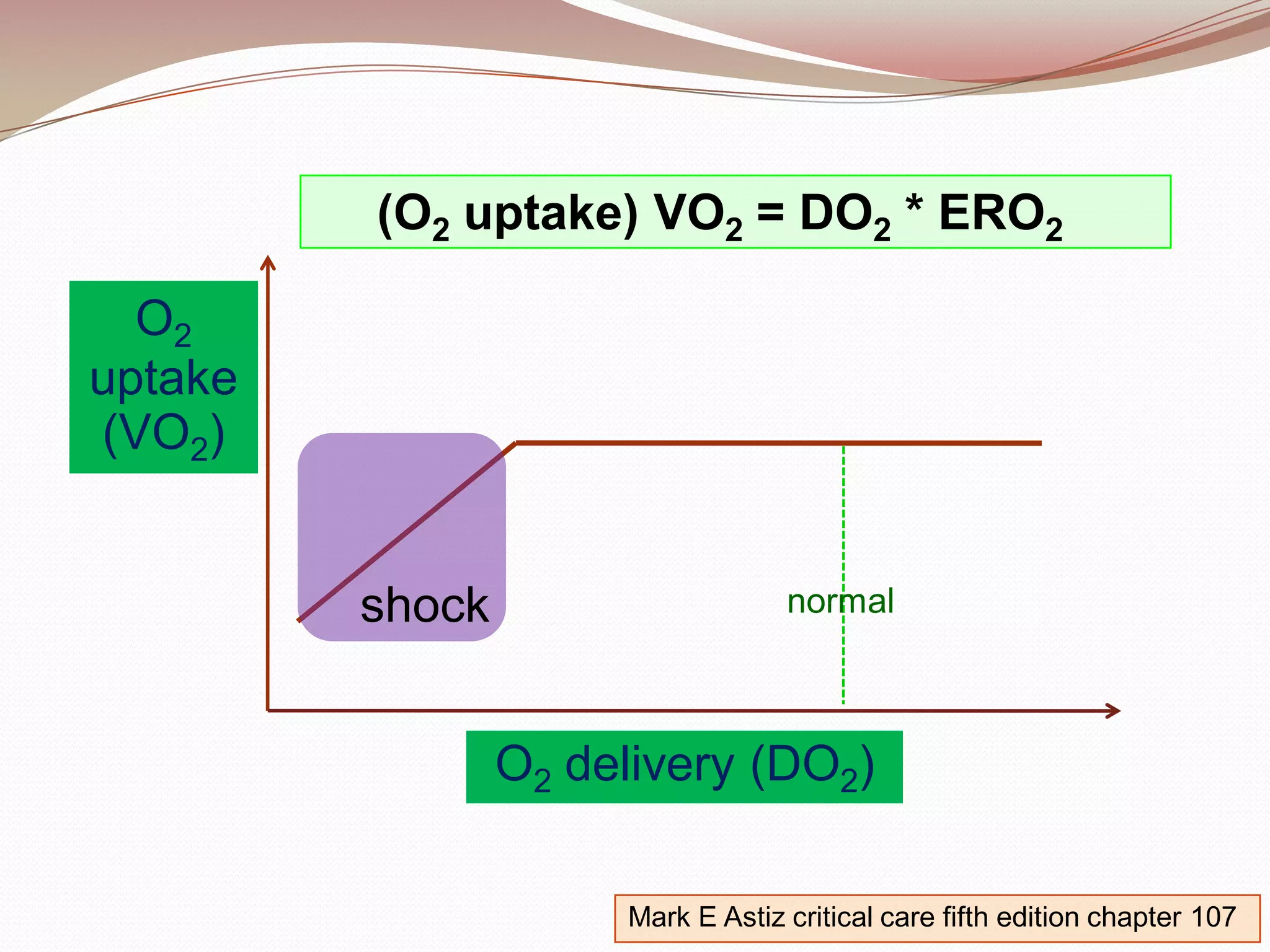
Mark E Astiz critical care fifth edition chapter 107 O 2  uptake (VO 2 ) O 2  delivery (DO 2 ) (O 2  uptake) VO 2  = DO 2  * ERO 2 normal shock
Question #2 Which is  the least  important determinant of O2 delivery(DO2) ? (a) Hemoglobin level (b) Cardiac output (c) PaO 2 (d) SaO 2
Question #2 Which is  the least  important determinant of O2 delivery(DO2) ? (a) Hemoglobin level (b) Cardiac output (c)  PaO 2 (d) SaO 2
Oxygen Delivery (DO2) = Cardiac Output x  Oxygen Content = CO x  [(1.3 x Hb x SaO 2 ) + (0.003 x PaO 2 )] Hb concentration CO  SaO 2   % of O 2  in artery PaO 2  (minimal)   pressure of O 2  in artery Inadequate DO 2  occurs most often because of low cardiac output
Cardiac Output Determined by: Stroke volume Heart rate Stroke volume determined by Preload Afterload Contractility CO = SV * HR SV ~  Preload * Contractility Afterload
Conclusion Shock lead to tissue hypoxia Oxygen uptake (VO 2 ) <   Oxygen demand O 2  uptake (VO 2 )   = O2 delivery (DO2) * O2 extraction ratio (ERO2) O2 delivery (DO2)    =  Cardiac Output  x  Oxygen Content   =  [SV x HR]  x  [(1.3 x Hb x SaO 2 ) + (0.003 x PaO 2 )] SV ~ (Preload * Contractility) / Afterload
Classification of shock Hypodynamic CO  Hyperdynamic  CO Mark E Astiz critical care fifth edition chapter 107
Classification of shock Hypodynamic hypovolemic   (hemorrhagic , nonhemorrhagic) cardiogenic  obstructive  ( PE,cardiac temponade ,tension pneumothorax) Mark E Astiz critical care fifth edition chapter 107 O2 delivery (DO2)  = Cardiac Output x  Oxygen Content =  [SV x HR]  x [(1.3x  Hb  x SaO 2 ) + (0.003x PaO 2 )] SV ~  Preload  * Contractility Afterload
Classification of shock Hypodynamic hypovolemic   (hemorrhagic,  nonhemorrhagic ) cardiogenic  obstructive  ( PE,cardiac temponade ,tension pneumothorax) Mark E Astiz critical care fifth edition chapter 107 O2 delivery (DO2)  = Cardiac Output x  Oxygen Content =  [SV x HR]  x [(1.3x Hb x SaO 2 ) + (0.003x PaO 2 )] SV ~  Preload  * Contractility Afterload
Classification of shock Hypodynamic hypovolemic  (hemorrhagic, nonhemorrhagic) cardiogenic   obstructive  ( PE,cardiac temponade ,tension pneumothorax) Mark E Astiz critical care fifth edition chapter 107 O2 delivery (DO2)  = Cardiac Output x  Oxygen Content =  [SV x  HR ]  x [(1.3x Hb x SaO 2 ) + (0.003x PaO 2 )] SV ~  Preload *  Contractility Afterload
Classification of shock Hypodynamic hypovolemic  (hemorrhagic, nonhemorrhagic) cardiogenic  obstructive   (  PE ,cardiac temponade ,tension pneumothorax) Mark E Astiz critical care fifth edition chapter 107 O2 delivery (DO2)  = Cardiac Output x  Oxygen Content =  [SV x HR]  x [(1.3x Hb x SaO 2 ) + (0.003x PaO 2 )] SV ~  Preload (left heart)  * Contractility Afterload (right heart)
Classification of shock Hypodynamic hypovolemic  (hemorrhagic, nonhemorrhagic) cardiogenic  obstructive   ( PE,  cardiac temponade , tension pneumothorax) Mark E Astiz critical care fifth edition chapter 107 O2 delivery (DO2)  = Cardiac Output x  Oxygen Content =  [SV x HR]  x [(1.3x Hb x SaO 2 ) + (0.003x PaO 2 )] SV ~  Preload  * Contractility Afterload
Classification of shock Hypodynamic hypovolemic  (hemorrhagic, nonhemorrhagic) cardiogenic  obstructive   ( PE,cardiac temponade , tension pneumothorax ) Mark E Astiz critical care fifth edition chapter 107 O2 delivery (DO2)  = Cardiac Output x  Oxygen Content =  [SV x HR]  x [(1.3x Hb x SaO 2 ) + (0.003x PaO 2 )] SV ~  Preload  * Contractility Afterload
O2 extraction ratio (ERO2) proper distribution Hyperdynamic   CO  but improper distribution, SVR  distributive sepsis  adrenal insufficiency anaphylaxis O 2  uptake (VO 2 ) = O2 delivery(DO2) * O2 extraction ratio(ERO2)
Diagnosis   of Shock Low BP or a rapid, thready pulse. without hypotension Oliguria or mental status change Peripheral cyanosis and pallor, cool skin Tachycardia  Metabolic acidosis and elevated lactate
53-year-old female with Hx of hyperthyroidism At 15.20 น .  4/8/52 Case discussion
CC:fever with dyspnea Vital signs : T 37.2, BP 80/50, PR 100, RR 24   Oxygen Sat. 100% (RA)
Initial Management IV access with NSS starting with 1000 ml loading in 15 minutes On cardiac monitoring Collecting blood samples for laboratory studies include : CBC, BUN, Cr, electrolytes, BS, lactate Hemoculture x 2, TFT, cardiac markers
HPI She has had low grade fever (unmeasured) with dry cough for 2 weeks prior to presentation. The cough became worse when she laid down during the night. She walked up the stairs at home and developed very short of breath which  made her come to our ED.
PMHx  : Hyperthyroid [PTU(50)2x2 + Propranolol]  She has skipped the medication  for nearly 2 weeks. ALL   : NKDA FHx  : 2 Sisters with diabetes. SHx  : Occasional alcohol   Regular use of over-the-counter drugs   (for relieving pain, fatigue and muscle strain)
General :  Alert, middle-aged woman with moderate discomfort,shortness of breath and sweating. HEENT :   Mild pallor, anicteric sclera, no exopthalmos, no lid retraction, mild pharyngeal erythema. CVS :   mildly tachycardic, regular rhythm, no heart murmurs or gallops, no heaving.
RS :   Clear bilaterally Abdomen :   Soft, not tender, liver and spleen not palpable. Ext :  No leg edema or tenderness Skin :  No abnormal skin rash
 
CBC  :   Hb 13.9, Hct 40, WBC 12000 (N64/L26)   PLT 417000, Band 0 Blood Chemistry Electrolyte :  Na 123 ,  K 5.6 , Cl 87, CO 2  21   Cal 9.7, Mg 2.9, PO 4  6.6 BUN 23, Cr 0.8,  BS 751 Lactate 5.0 CPK 984 ,  Trop-T 4.28 ,  CK-MB 179 LFT  AST 3164  ALT 2016  ALP 223  TB 0.6  DB 0.3  TP 5.3  Alb 2.3   Urinalysis  : Glu 4+
Echo bedside : EF 40% IVC 1.4 Global hypokinesia with mild MR,  mild TR RV not enlarge
Differential diagnosis
Management Fluid resuscitation CVP Antibiotic Echocardiography
Fluid Challenge Test  Initial CVP  <8 8-15 >15 cm H 2 O PAOP <12   12-16 >16 mm Hg Volume & Rate  200 mL/10 min  100 mL/10 min  50 mL/10 min   During infusion,  CVP rises >5 cm H 2 O or  PAOP rises >7 mm Hg Yes  No   Stop challenge  Complete the volume Wait 10 min   Wait 10 min  CVP change   >5   3-5   < 2 3-5   < 2 PAOP change  >7  4-7  < 3 4-7   < 3
CVP and Blood Volume (BV) Normal CVP -  Normovolemia -  Hypovolemia c venoconstriction, ventricular dysfunction -  Hypervolemia c hyperdynamic heart function Low CVP -  Absolute or relative hypovolemia (vasodilatation) -  Hyper-, hypo-, or normovolemia c hyperdynamic heart or negative ITP High CVP -  Hypervolemia -  Hypo- or normovolemia c positive ITP, ventricular dysfunction, obstruction of blood flow  (TS, PS, cardial tamponade)
ข้อบ่งชี้ของ   Central Venous Line 1. CVP measurement and monitoring 2. Lack of peripheral vein  3. Rapid venous access 4. Administration of drugs   4.1  Hyperosmolar solution: TPN, hypertonic glucose 4.2 Irritating solution: extreme pH, cancer chemotherapy,  KCl >40 mEq/L  4.3 Vasopressor: high dose dopamine, NE, adrenaline 5. Frequent blood sampling 6. Insertion of other catheters
Inotropic  use:Commonly used First-Line Agents Michael M .  Givertz James C .  Fang   :Irwin and Rippe’s Intensive care medicine 6 th  edition 2008 pp 335 Cause of Hypotension Pulmonary Capillary Wedge Pressure Cardiac Output Systemic Vascular Resistance Preferred Agent(s) Unknown ? ? ? Dopamine Hypovolemia ↓ ↓ ↑ None a Decompensated heart failure ↑ ↓ ↑ Dopamine, dobutamine Cardiogenic shock ↑↔ ↓ ↑ Dopamine Hyperdynamic sepsis ↓↔ ↑ ↓ Norepinephrine, dopamine Sepsis with depressed cardiac function ? ↓ ↓ Dopamine, norepinephrine plus dobutamine Anaphylaxis ? ? ↓ Epinephrine Anesthesia-induced hypotension ? ? ↓ Phenylephrine, ephedrine b a Volume resuscitation with intravenous fluids and/or blood products recommended. b For obstetric patients.
Ultrasound:Estimation of central venous pressure Robert F.reardon and Scott A.joing : Emergency ultrasound  pp 129  IVC size (cm) Respiratory change RA pressure  (cm) <1.5 Total collapse 0-5 1.5-2.5 > 50% collapse 5-10 1.5-2.5 <50% collapse 11-15 >2.5 <50% collapse 16-20 >2.5 No change >20
IVC measurement demonstrating normal IVC collapse. IVCDmax (expiration)  17.9 mm; IVCDmin (inspiration)  8.9  mm. IVC-CI : IVCDmax– IVCDmin/IVCDmax:  (17.9 – 8.9)/17.9;  50% collapse.
Take Home Points Shock is defined by inadequate tissue oxygenation, not hypotension Oxygen delivery depends primarily on CO, Hb and SaO 2  (not pO 2 ) Volume expand with crystalloids and blood, if indicated; then add vasoactive drugs to improve vital organ perfusion Early treatment of shock is critical
 

Approach to Shock and Hemodynamics

  • 1.
    Jiraporn sri-on Emergency medicine Bangkok metropolitan administration and vajira hospital
  • 2.
    Outline Shock PathophysiologyDeterminants of oxygen delivery Shock syndromes Hemodynamic monitoring Case discussion
  • 3.
    Question #1 Which of the following is necessary in the definition of shock? (a) Hypotension (b) Tissue hypoxia (c) Use of pressors (d) Multiple organ dysfunction
  • 4.
    Question #1 Whichof the following is necessary in the definition of shock? (a) Hypotension (b) Tissue hypoxia (c) Use of pressors (d) Multiple organ dysfunction
  • 5.
    Shock a multifactorialsyndrome resulting in inadequate tissue perfusion and cellular oxygenation. Lead to tissue hypoxia anaerobic metabolism activation of an inflammatory cascade organ dysfunction hypotension Irin and Rippe,s Intensive care medicine 6 th edition chapter161 Michael L. Cheatham Ernest F. J. Block
  • 6.
    Pathophysiology Oxygen demandcan’t be evaluate Determined by metabolic demand Oxygen uptake (VO 2 ) or Oxygen supply (O 2 uptake) VO 2 = DO 2 * ERO 2
  • 7.
    Oxygen delivery (DO2 ) Oxygen extraction ratio (ERO 2 ) proper distribution, SVR Pathophysiology (O 2 uptake) VO 2 = DO 2 * ERO 2
  • 8.
    Mark E Astizcritical care fifth edition chapter 107 O 2 uptake (VO 2 ) O 2 delivery (DO 2 ) (O 2 uptake) VO 2 = DO 2 * ERO 2 normal shock
  • 9.
    Question #2 Whichis the least important determinant of O2 delivery(DO2) ? (a) Hemoglobin level (b) Cardiac output (c) PaO 2 (d) SaO 2
  • 10.
    Question #2 Whichis the least important determinant of O2 delivery(DO2) ? (a) Hemoglobin level (b) Cardiac output (c) PaO 2 (d) SaO 2
  • 11.
    Oxygen Delivery (DO2)= Cardiac Output x Oxygen Content = CO x [(1.3 x Hb x SaO 2 ) + (0.003 x PaO 2 )] Hb concentration CO SaO 2  % of O 2 in artery PaO 2 (minimal)  pressure of O 2 in artery Inadequate DO 2 occurs most often because of low cardiac output
  • 12.
    Cardiac Output Determinedby: Stroke volume Heart rate Stroke volume determined by Preload Afterload Contractility CO = SV * HR SV ~ Preload * Contractility Afterload
  • 13.
    Conclusion Shock leadto tissue hypoxia Oxygen uptake (VO 2 ) < Oxygen demand O 2 uptake (VO 2 ) = O2 delivery (DO2) * O2 extraction ratio (ERO2) O2 delivery (DO2) = Cardiac Output x Oxygen Content = [SV x HR] x [(1.3 x Hb x SaO 2 ) + (0.003 x PaO 2 )] SV ~ (Preload * Contractility) / Afterload
  • 14.
    Classification of shockHypodynamic CO Hyperdynamic CO Mark E Astiz critical care fifth edition chapter 107
  • 15.
    Classification of shockHypodynamic hypovolemic (hemorrhagic , nonhemorrhagic) cardiogenic obstructive ( PE,cardiac temponade ,tension pneumothorax) Mark E Astiz critical care fifth edition chapter 107 O2 delivery (DO2) = Cardiac Output x Oxygen Content = [SV x HR] x [(1.3x Hb x SaO 2 ) + (0.003x PaO 2 )] SV ~ Preload * Contractility Afterload
  • 16.
    Classification of shockHypodynamic hypovolemic (hemorrhagic, nonhemorrhagic ) cardiogenic obstructive ( PE,cardiac temponade ,tension pneumothorax) Mark E Astiz critical care fifth edition chapter 107 O2 delivery (DO2) = Cardiac Output x Oxygen Content = [SV x HR] x [(1.3x Hb x SaO 2 ) + (0.003x PaO 2 )] SV ~ Preload * Contractility Afterload
  • 17.
    Classification of shockHypodynamic hypovolemic (hemorrhagic, nonhemorrhagic) cardiogenic obstructive ( PE,cardiac temponade ,tension pneumothorax) Mark E Astiz critical care fifth edition chapter 107 O2 delivery (DO2) = Cardiac Output x Oxygen Content = [SV x HR ] x [(1.3x Hb x SaO 2 ) + (0.003x PaO 2 )] SV ~ Preload * Contractility Afterload
  • 18.
    Classification of shockHypodynamic hypovolemic (hemorrhagic, nonhemorrhagic) cardiogenic obstructive ( PE ,cardiac temponade ,tension pneumothorax) Mark E Astiz critical care fifth edition chapter 107 O2 delivery (DO2) = Cardiac Output x Oxygen Content = [SV x HR] x [(1.3x Hb x SaO 2 ) + (0.003x PaO 2 )] SV ~ Preload (left heart) * Contractility Afterload (right heart)
  • 19.
    Classification of shockHypodynamic hypovolemic (hemorrhagic, nonhemorrhagic) cardiogenic obstructive ( PE, cardiac temponade , tension pneumothorax) Mark E Astiz critical care fifth edition chapter 107 O2 delivery (DO2) = Cardiac Output x Oxygen Content = [SV x HR] x [(1.3x Hb x SaO 2 ) + (0.003x PaO 2 )] SV ~ Preload * Contractility Afterload
  • 20.
    Classification of shockHypodynamic hypovolemic (hemorrhagic, nonhemorrhagic) cardiogenic obstructive ( PE,cardiac temponade , tension pneumothorax ) Mark E Astiz critical care fifth edition chapter 107 O2 delivery (DO2) = Cardiac Output x Oxygen Content = [SV x HR] x [(1.3x Hb x SaO 2 ) + (0.003x PaO 2 )] SV ~ Preload * Contractility Afterload
  • 21.
    O2 extraction ratio(ERO2) proper distribution Hyperdynamic CO but improper distribution, SVR distributive sepsis adrenal insufficiency anaphylaxis O 2 uptake (VO 2 ) = O2 delivery(DO2) * O2 extraction ratio(ERO2)
  • 22.
    Diagnosis of Shock Low BP or a rapid, thready pulse. without hypotension Oliguria or mental status change Peripheral cyanosis and pallor, cool skin Tachycardia Metabolic acidosis and elevated lactate
  • 23.
    53-year-old female withHx of hyperthyroidism At 15.20 น . 4/8/52 Case discussion
  • 24.
    CC:fever with dyspneaVital signs : T 37.2, BP 80/50, PR 100, RR 24 Oxygen Sat. 100% (RA)
  • 25.
    Initial Management IVaccess with NSS starting with 1000 ml loading in 15 minutes On cardiac monitoring Collecting blood samples for laboratory studies include : CBC, BUN, Cr, electrolytes, BS, lactate Hemoculture x 2, TFT, cardiac markers
  • 26.
    HPI She hashad low grade fever (unmeasured) with dry cough for 2 weeks prior to presentation. The cough became worse when she laid down during the night. She walked up the stairs at home and developed very short of breath which made her come to our ED.
  • 27.
    PMHx :Hyperthyroid [PTU(50)2x2 + Propranolol] She has skipped the medication for nearly 2 weeks. ALL : NKDA FHx : 2 Sisters with diabetes. SHx : Occasional alcohol Regular use of over-the-counter drugs (for relieving pain, fatigue and muscle strain)
  • 28.
    General : Alert, middle-aged woman with moderate discomfort,shortness of breath and sweating. HEENT : Mild pallor, anicteric sclera, no exopthalmos, no lid retraction, mild pharyngeal erythema. CVS : mildly tachycardic, regular rhythm, no heart murmurs or gallops, no heaving.
  • 29.
    RS : Clear bilaterally Abdomen : Soft, not tender, liver and spleen not palpable. Ext : No leg edema or tenderness Skin : No abnormal skin rash
  • 30.
  • 31.
    CBC : Hb 13.9, Hct 40, WBC 12000 (N64/L26) PLT 417000, Band 0 Blood Chemistry Electrolyte : Na 123 , K 5.6 , Cl 87, CO 2 21 Cal 9.7, Mg 2.9, PO 4 6.6 BUN 23, Cr 0.8, BS 751 Lactate 5.0 CPK 984 , Trop-T 4.28 , CK-MB 179 LFT AST 3164 ALT 2016 ALP 223 TB 0.6 DB 0.3 TP 5.3 Alb 2.3 Urinalysis : Glu 4+
  • 32.
    Echo bedside :EF 40% IVC 1.4 Global hypokinesia with mild MR, mild TR RV not enlarge
  • 33.
  • 34.
    Management Fluid resuscitationCVP Antibiotic Echocardiography
  • 35.
    Fluid Challenge Test Initial CVP <8 8-15 >15 cm H 2 O PAOP <12 12-16 >16 mm Hg Volume & Rate 200 mL/10 min 100 mL/10 min 50 mL/10 min During infusion, CVP rises >5 cm H 2 O or PAOP rises >7 mm Hg Yes No Stop challenge Complete the volume Wait 10 min Wait 10 min CVP change >5 3-5 < 2 3-5 < 2 PAOP change >7 4-7 < 3 4-7 < 3
  • 36.
    CVP and BloodVolume (BV) Normal CVP - Normovolemia - Hypovolemia c venoconstriction, ventricular dysfunction - Hypervolemia c hyperdynamic heart function Low CVP - Absolute or relative hypovolemia (vasodilatation) - Hyper-, hypo-, or normovolemia c hyperdynamic heart or negative ITP High CVP - Hypervolemia - Hypo- or normovolemia c positive ITP, ventricular dysfunction, obstruction of blood flow (TS, PS, cardial tamponade)
  • 37.
    ข้อบ่งชี้ของ Central Venous Line 1. CVP measurement and monitoring 2. Lack of peripheral vein 3. Rapid venous access 4. Administration of drugs 4.1 Hyperosmolar solution: TPN, hypertonic glucose 4.2 Irritating solution: extreme pH, cancer chemotherapy, KCl >40 mEq/L 4.3 Vasopressor: high dose dopamine, NE, adrenaline 5. Frequent blood sampling 6. Insertion of other catheters
  • 38.
    Inotropic use:Commonlyused First-Line Agents Michael M . Givertz James C . Fang :Irwin and Rippe’s Intensive care medicine 6 th edition 2008 pp 335 Cause of Hypotension Pulmonary Capillary Wedge Pressure Cardiac Output Systemic Vascular Resistance Preferred Agent(s) Unknown ? ? ? Dopamine Hypovolemia ↓ ↓ ↑ None a Decompensated heart failure ↑ ↓ ↑ Dopamine, dobutamine Cardiogenic shock ↑↔ ↓ ↑ Dopamine Hyperdynamic sepsis ↓↔ ↑ ↓ Norepinephrine, dopamine Sepsis with depressed cardiac function ? ↓ ↓ Dopamine, norepinephrine plus dobutamine Anaphylaxis ? ? ↓ Epinephrine Anesthesia-induced hypotension ? ? ↓ Phenylephrine, ephedrine b a Volume resuscitation with intravenous fluids and/or blood products recommended. b For obstetric patients.
  • 39.
    Ultrasound:Estimation of centralvenous pressure Robert F.reardon and Scott A.joing : Emergency ultrasound pp 129 IVC size (cm) Respiratory change RA pressure (cm) <1.5 Total collapse 0-5 1.5-2.5 > 50% collapse 5-10 1.5-2.5 <50% collapse 11-15 >2.5 <50% collapse 16-20 >2.5 No change >20
  • 40.
    IVC measurement demonstratingnormal IVC collapse. IVCDmax (expiration) 17.9 mm; IVCDmin (inspiration) 8.9 mm. IVC-CI : IVCDmax– IVCDmin/IVCDmax: (17.9 – 8.9)/17.9; 50% collapse.
  • 41.
    Take Home PointsShock is defined by inadequate tissue oxygenation, not hypotension Oxygen delivery depends primarily on CO, Hb and SaO 2 (not pO 2 ) Volume expand with crystalloids and blood, if indicated; then add vasoactive drugs to improve vital organ perfusion Early treatment of shock is critical
  • 42.