Mansoura Annual Orthopedic Surgery Department Conference - October 2019
Damage Control
Orthopedic
(DCO)
By: Abdallah El Azanki
Assistant Lecturer / Clinical Fellow
Department of Orthopedic Surgery
Mansoura University Hospital
Mansoura Annual Orthopedic Surgery Department Conference - October 2019
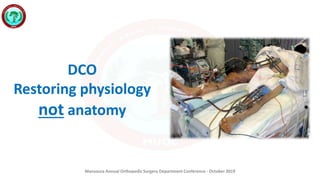
DCO
Restoring physiology
not anatomy
Mansoura Annual Orthopedic Surgery Department Conference - October 2019
What is DCO?
 Approach:
Stabilizes orthopedic injuries  Physiology improvement.
 Control of hemorrhage
 Management of soft-tissue
injury
 achievement of provisional
fracture stability
 Avoids “second hit” of a major
orthopedic procedure
 Delays definitive fracture
treatment
 Overall condition of the
patient is optimized.
Mansoura Annual Orthopedic Surgery Department Conference - October 2019
Previously ,DCO was concerned about Femur fracture only
but
Lately new locations have been added to the DCO concept:
pelvis fractures spine fractures upper limb injuries
Mansoura Annual Orthopedic Surgery Department Conference - October 2019
 Two injuries ≥ to 3 on AIS and one or more additional
variable from five physiologic parameters:
 Hypotension (Sys. BP ≤ 90 mm Hg)
 Level of consciousness (GCS ≤ 8)
 Acidosis (base excess ≤ -6.0)
 Coagulopathy ( INR ≥ 1.4 or PTT ≥ 40 sec)
 Age ≥ 70 years
Polytrauma Patient - PTP
(New Berlin)
Mansoura Annual Orthopedic Surgery Department Conference - October 2019
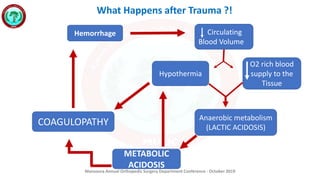
Hemorrhage Circulating
Blood Volume
Hypothermia
Anaerobic metabolism
(LACTIC ACIDOSIS)
METABOLIC
ACIDOSIS
COAGULOPATHY
O2 rich blood
supply to the
Tissue
What Happens after Trauma ?!
Mansoura Annual Orthopedic Surgery Department Conference - October 2019
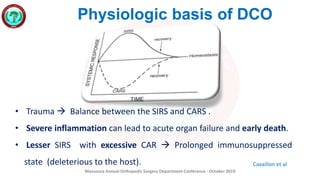
Physiologic basis of DCO
• Trauma  Balance between the SIRS and CARS .
• Severe inflammation can lead to acute organ failure and early death.
• Lesser SIRS with excessive CAR  Prolonged immunosuppressed
state (deleterious to the host). Cavaillon et al
Mansoura Annual Orthopedic Surgery Department Conference - October 2019
 Body Temp > 38° or < 36° C
 Heart Rate > 90 /min
 Resp. Rate > 20 /min or PaCo2 <32 mmHg
 WBC > 12000/mm³
 > 10% immature Neutrophils
SIRS Diagnostic Criteria ( 2 or more)
1992 consensus of ACCP
Mansoura Annual Orthopedic Surgery Department Conference - October 2019
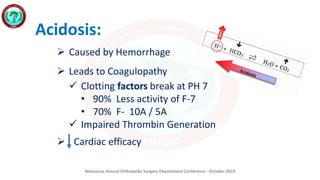
Acidosis:
 Caused by Hemorrhage
 Leads to Coagulopathy
 Clotting factors break at PH 7
• 90% Less activity of F-7
• 70% F- 10A / 5A
 Impaired Thrombin Generation
 Cardiac efficacy
Mansoura Annual Orthopedic Surgery Department Conference - October 2019
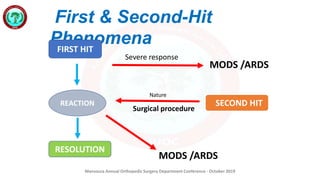
First & Second-Hit
PhenomenaFIRST HIT
SECOND HITREACTION
RESOLUTION
FIRST HIT
MODS /ARDS
Severe response
Surgical procedure
MODS /ARDS
Nature
Mansoura Annual Orthopedic Surgery Department Conference - October 2019
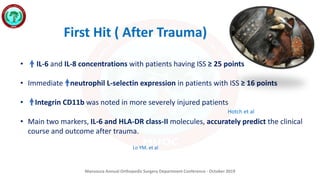
• IL-6 and IL-8 concentrations with patients having ISS ≥ 25 points
• Immediate neutrophil L-selectin expression in patients with ISS ≥ 16 points
• Integrin CD11b was noted in more severely injured patients
• Main two markers, IL-6 and HLA-DR class-II molecules, accurately predict the clinical
course and outcome after trauma.
First Hit ( After Trauma)
Hotch et al
Lo YM. et al
Mansoura Annual Orthopedic Surgery Department Conference - October 2019
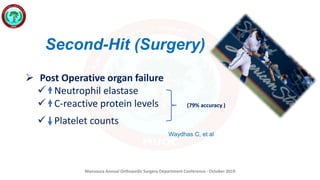
 Post Operative organ failure
 Neutrophil elastase
 C-reactive protein levels
 Platelet counts
Waydhas C, et al
Second-Hit (Surgery)
(79% accuracy )
Mansoura Annual Orthopedic Surgery Department Conference - October 2019
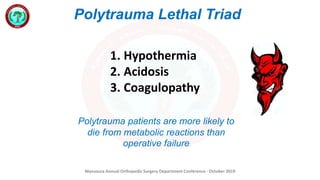
Polytrauma Lethal Triad
1. Hypothermia
2. Acidosis
3. Coagulopathy
Polytrauma patients are more likely to
die from metabolic reactions than
operative failure
Mansoura Annual Orthopedic Surgery Department Conference - October 2019
DCO…..How do we get there?
ATLS Protocol “ A,B,C,D”s
 Absolute Emergency
 Relative Emergency
 Life threatening Vs Limb Threatening Injuries
 Diagnosis
 Work with General Surgery Colleagues / Trauma Team
Mansoura Annual Orthopedic Surgery Department Conference - October 2019
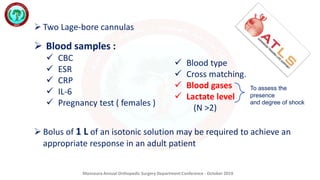
 Blood samples :
 CBC
 ESR
 CRP
 IL-6
 Pregnancy test ( females )
To assess the
presence
and degree of shock
 Two Lage-bore cannulas
 Blood type
 Cross matching.
 Blood gases
 Lactate level
(N >2)
 Bolus of 1 L of an isotonic solution may be required to achieve an
appropriate response in an adult patient
Mansoura Annual Orthopedic Surgery Department Conference - October 2019
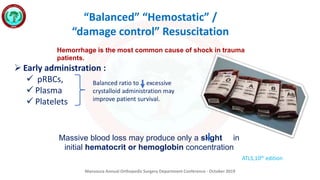
 Early administration :
 pRBCs,
 Plasma
 Platelets
“Balanced” “Hemostatic” /
“damage control” Resuscitation
Balanced ratio to excessive
crystalloid administration may
improve patient survival.
Massive blood loss may produce only a slight in
initial hematocrit or hemoglobin concentration
Hemorrhage is the most common cause of shock in trauma
patients.
ATLS,10th edition
Mansoura Annual Orthopedic Surgery Department Conference - October 2019
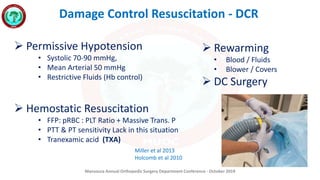
Damage Control Resuscitation - DCR
 Permissive Hypotension
• Systolic 70-90 mmHg,
• Mean Arterial 50 mmHg
• Restrictive Fluids (Hb control)
 Hemostatic Resuscitation
• FFP: pRBC : PLT Ratio + Massive Trans. P
• PTT & PT sensitivity Lack in this situation
• Tranexamic acid (TXA)
Miller et al 2013
Holcomb et al 2010
 Rewarming
• Blood / Fluids
• Blower / Covers
 DC Surgery
Mansoura Annual Orthopedic Surgery Department Conference - October 2019
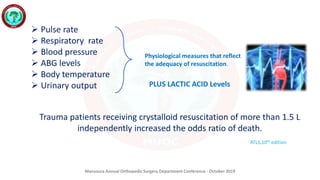
Trauma patients receiving crystalloid resuscitation of more than 1.5 L
independently increased the odds ratio of death.
 Pulse rate
 Respiratory rate
 Blood pressure
 ABG levels
 Body temperature
 Urinary output
ATLS,10th edition
Physiological measures that reflect
the adequacy of resuscitation.
PLUS LACTIC ACID Levels
Mansoura Annual Orthopedic Surgery Department Conference - October 2019
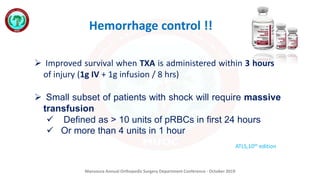
 Small subset of patients with shock will require massive
transfusion
 Defined as > 10 units of pRBCs in first 24 hours
 Or more than 4 units in 1 hour
 Improved survival when TXA is administered within 3 hours
of injury (1g IV + 1g infusion / 8 hrs)
ATLS,10th edition
Hemorrhage control !!
Mansoura Annual Orthopedic Surgery Department Conference - October 2019
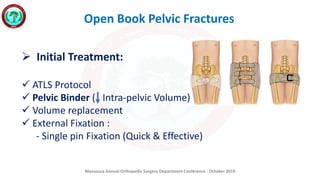
Open Book Pelvic Fractures
 Initial Treatment:
 ATLS Protocol
 Pelvic Binder ( Intra-pelvic Volume)
 Volume replacement
 External Fixation :
- Single pin Fixation (Quick & Effective)
Mansoura Annual Orthopedic Surgery Department Conference - October 2019
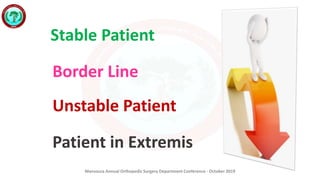
Stable Patient
Border Line
Unstable Patient
Patient in Extremis
Mansoura Annual Orthopedic Surgery Department Conference - October 2019
Borderline Patients
Louisville criteria for borderline
 pH < 7.24
 Temp <35°C
 Coagulopathy
 Operative time > 90 mins
 Transfusion > 10 units P-RBC’s
 Geriatric patients
Mansoura Annual Orthopedic Surgery Department Conference - October 2019
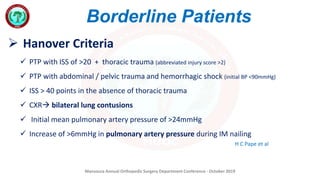
Borderline Patients
 Hanover Criteria
 PTP with ISS of >20 + thoracic trauma (abbreviated injury score >2)
 PTP with abdominal / pelvic trauma and hemorrhagic shock (initial BP <90mmHg)
 ISS > 40 points in the absence of thoracic trauma
 CXR bilateral lung contusions
 Initial mean pulmonary artery pressure of >24mmHg
 Increase of >6mmHg in pulmonary artery pressure during IM nailing
H C Pape et al
Mansoura Annual Orthopedic Surgery Department Conference - October 2019
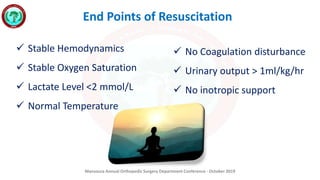
End Points of Resuscitation
 Stable Hemodynamics
 Stable Oxygen Saturation
 Lactate Level <2 mmol/L
 Normal Temperature
 No Coagulation disturbance
 Urinary output > 1ml/kg/hr
 No inotropic support
Mansoura Annual Orthopedic Surgery Department Conference - October 2019
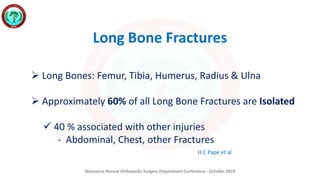
Long Bone Fractures
 Long Bones: Femur, Tibia, Humerus, Radius & Ulna
 Approximately 60% of all Long Bone Fractures are Isolated
 40 % associated with other injuries
- Abdominal, Chest, other Fractures
H C Pape et al
Mansoura Annual Orthopedic Surgery Department Conference - October 2019
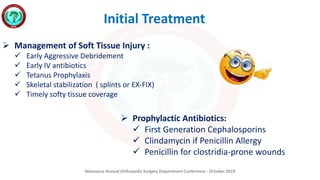
Initial Treatment
 Management of Soft Tissue Injury :
 Early Aggressive Debridement
 Early IV antibiotics
 Tetanus Prophylaxis
 Skeletal stabilization ( splints or EX-FIX)
 Timely softy tissue coverage
 Prophylactic Antibiotics:
 First Generation Cephalosporins
 Clindamycin if Penicillin Allergy
 Penicillin for clostridia-prone wounds
Mansoura Annual Orthopedic Surgery Department Conference - October 2019
When to interfere ?? After DCO
 Pape et al 2001
 Definitive Surgery 2-4 days post injury
 Inflammatory response ( IL-6)  5-8 days post injury
 Ogura et al 1999
 PMNL ( measure of oxidative activity ) and IL-6 were markedly
between 2-13 days post injury
 O’ Brien et al 2003
 Pulmonary / Inflammatory function depends on initial lung
injury rather than timing of surgery
Mansoura Annual Orthopedic Surgery Department Conference - October 2019
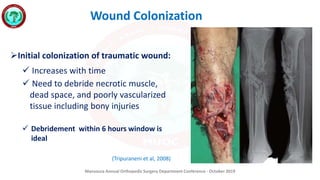
Wound Colonization
Initial colonization of traumatic wound:
 Increases with time
 Need to debride necrotic muscle,
dead space, and poorly vascularized
tissue including bony injuries
 Debridement within 6 hours window is
ideal
(Tripuraneni et al, 2008)
Mansoura Annual Orthopedic Surgery Department Conference - October 2019
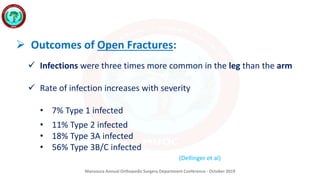
 Outcomes of Open Fractures:
 Infections were three times more common in the leg than the arm
 Rate of infection increases with severity
• 7% Type 1 infected
• 11% Type 2 infected
• 18% Type 3A infected
• 56% Type 3B/C infected
(Dellinger et al)
Mansoura Annual Orthopedic Surgery Department Conference - October 2019
Summary
 DCO is a partnership with Trauma surgery
 Part of the resuscitation process
 Timing of procedures depends on resuscitation Status
 DCO seeks to avoid provoking a severe inflammatory response.
 (Primary mediators are IL-6/8)
Mansoura Annual Orthopedic Surgery Department Conference - October 2019
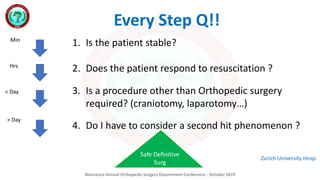
1. Is the patient stable?
2. Does the patient respond to resuscitation ?
3. Is a procedure other than Orthopedic surgery
required? (craniotomy, laparotomy…)
4. Do I have to consider a second hit phenomenon ?
Min
Hrs
< Day
> Day
Safe Definitive
Surg
Zurich University Hosp.
Every Step Q!!
Mansoura Annual Orthopedic Surgery Department Conference - October 2019
 Stable Definitive surgery
 Borderline DCO vs ETC
 Unstable Resuscitate / DCO
 In extremis Life saving surgery
Mansoura Annual Orthopedic Surgery Department Conference - October 2019
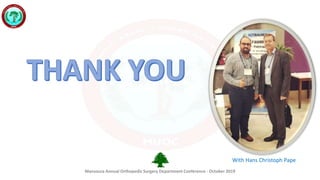
With Hans Christoph Pape

Damage Control Orthopedic DCO #dr_azanki

  • 1.
    Mansoura Annual OrthopedicSurgery Department Conference - October 2019 Damage Control Orthopedic (DCO) By: Abdallah El Azanki Assistant Lecturer / Clinical Fellow Department of Orthopedic Surgery Mansoura University Hospital Mansoura Annual Orthopedic Surgery Department Conference - October 2019
  • 2.
    Mansoura Annual OrthopedicSurgery Department Conference - October 2019 DCO Restoring physiology not anatomy
  • 3.
    Mansoura Annual OrthopedicSurgery Department Conference - October 2019 What is DCO?  Approach: Stabilizes orthopedic injuries  Physiology improvement.  Control of hemorrhage  Management of soft-tissue injury  achievement of provisional fracture stability  Avoids “second hit” of a major orthopedic procedure  Delays definitive fracture treatment  Overall condition of the patient is optimized.
  • 4.
    Mansoura Annual OrthopedicSurgery Department Conference - October 2019 Previously ,DCO was concerned about Femur fracture only but Lately new locations have been added to the DCO concept: pelvis fractures spine fractures upper limb injuries
  • 5.
    Mansoura Annual OrthopedicSurgery Department Conference - October 2019  Two injuries ≥ to 3 on AIS and one or more additional variable from five physiologic parameters:  Hypotension (Sys. BP ≤ 90 mm Hg)  Level of consciousness (GCS ≤ 8)  Acidosis (base excess ≤ -6.0)  Coagulopathy ( INR ≥ 1.4 or PTT ≥ 40 sec)  Age ≥ 70 years Polytrauma Patient - PTP (New Berlin)
  • 6.
    Mansoura Annual OrthopedicSurgery Department Conference - October 2019 Hemorrhage Circulating Blood Volume Hypothermia Anaerobic metabolism (LACTIC ACIDOSIS) METABOLIC ACIDOSIS COAGULOPATHY O2 rich blood supply to the Tissue What Happens after Trauma ?!
  • 7.
    Mansoura Annual OrthopedicSurgery Department Conference - October 2019 Physiologic basis of DCO • Trauma  Balance between the SIRS and CARS . • Severe inflammation can lead to acute organ failure and early death. • Lesser SIRS with excessive CAR  Prolonged immunosuppressed state (deleterious to the host). Cavaillon et al
  • 8.
    Mansoura Annual OrthopedicSurgery Department Conference - October 2019  Body Temp > 38° or < 36° C  Heart Rate > 90 /min  Resp. Rate > 20 /min or PaCo2 <32 mmHg  WBC > 12000/mm³  > 10% immature Neutrophils SIRS Diagnostic Criteria ( 2 or more) 1992 consensus of ACCP
  • 9.
    Mansoura Annual OrthopedicSurgery Department Conference - October 2019 Acidosis:  Caused by Hemorrhage  Leads to Coagulopathy  Clotting factors break at PH 7 • 90% Less activity of F-7 • 70% F- 10A / 5A  Impaired Thrombin Generation  Cardiac efficacy
  • 10.
    Mansoura Annual OrthopedicSurgery Department Conference - October 2019 First & Second-Hit PhenomenaFIRST HIT SECOND HITREACTION RESOLUTION FIRST HIT MODS /ARDS Severe response Surgical procedure MODS /ARDS Nature
  • 11.
    Mansoura Annual OrthopedicSurgery Department Conference - October 2019 • IL-6 and IL-8 concentrations with patients having ISS ≥ 25 points • Immediate neutrophil L-selectin expression in patients with ISS ≥ 16 points • Integrin CD11b was noted in more severely injured patients • Main two markers, IL-6 and HLA-DR class-II molecules, accurately predict the clinical course and outcome after trauma. First Hit ( After Trauma) Hotch et al Lo YM. et al
  • 12.
    Mansoura Annual OrthopedicSurgery Department Conference - October 2019  Post Operative organ failure  Neutrophil elastase  C-reactive protein levels  Platelet counts Waydhas C, et al Second-Hit (Surgery) (79% accuracy )
  • 13.
    Mansoura Annual OrthopedicSurgery Department Conference - October 2019 Polytrauma Lethal Triad 1. Hypothermia 2. Acidosis 3. Coagulopathy Polytrauma patients are more likely to die from metabolic reactions than operative failure
  • 14.
    Mansoura Annual OrthopedicSurgery Department Conference - October 2019 DCO…..How do we get there? ATLS Protocol “ A,B,C,D”s  Absolute Emergency  Relative Emergency  Life threatening Vs Limb Threatening Injuries  Diagnosis  Work with General Surgery Colleagues / Trauma Team
  • 15.
    Mansoura Annual OrthopedicSurgery Department Conference - October 2019  Blood samples :  CBC  ESR  CRP  IL-6  Pregnancy test ( females ) To assess the presence and degree of shock  Two Lage-bore cannulas  Blood type  Cross matching.  Blood gases  Lactate level (N >2)  Bolus of 1 L of an isotonic solution may be required to achieve an appropriate response in an adult patient
  • 16.
    Mansoura Annual OrthopedicSurgery Department Conference - October 2019  Early administration :  pRBCs,  Plasma  Platelets “Balanced” “Hemostatic” / “damage control” Resuscitation Balanced ratio to excessive crystalloid administration may improve patient survival. Massive blood loss may produce only a slight in initial hematocrit or hemoglobin concentration Hemorrhage is the most common cause of shock in trauma patients. ATLS,10th edition
  • 17.
    Mansoura Annual OrthopedicSurgery Department Conference - October 2019 Damage Control Resuscitation - DCR  Permissive Hypotension • Systolic 70-90 mmHg, • Mean Arterial 50 mmHg • Restrictive Fluids (Hb control)  Hemostatic Resuscitation • FFP: pRBC : PLT Ratio + Massive Trans. P • PTT & PT sensitivity Lack in this situation • Tranexamic acid (TXA) Miller et al 2013 Holcomb et al 2010  Rewarming • Blood / Fluids • Blower / Covers  DC Surgery
  • 18.
    Mansoura Annual OrthopedicSurgery Department Conference - October 2019 Trauma patients receiving crystalloid resuscitation of more than 1.5 L independently increased the odds ratio of death.  Pulse rate  Respiratory rate  Blood pressure  ABG levels  Body temperature  Urinary output ATLS,10th edition Physiological measures that reflect the adequacy of resuscitation. PLUS LACTIC ACID Levels
  • 19.
    Mansoura Annual OrthopedicSurgery Department Conference - October 2019  Small subset of patients with shock will require massive transfusion  Defined as > 10 units of pRBCs in first 24 hours  Or more than 4 units in 1 hour  Improved survival when TXA is administered within 3 hours of injury (1g IV + 1g infusion / 8 hrs) ATLS,10th edition Hemorrhage control !!
  • 20.
    Mansoura Annual OrthopedicSurgery Department Conference - October 2019 Open Book Pelvic Fractures  Initial Treatment:  ATLS Protocol  Pelvic Binder ( Intra-pelvic Volume)  Volume replacement  External Fixation : - Single pin Fixation (Quick & Effective)
  • 21.
    Mansoura Annual OrthopedicSurgery Department Conference - October 2019 Stable Patient Border Line Unstable Patient Patient in Extremis
  • 22.
    Mansoura Annual OrthopedicSurgery Department Conference - October 2019 Borderline Patients Louisville criteria for borderline  pH < 7.24  Temp <35°C  Coagulopathy  Operative time > 90 mins  Transfusion > 10 units P-RBC’s  Geriatric patients
  • 23.
    Mansoura Annual OrthopedicSurgery Department Conference - October 2019 Borderline Patients  Hanover Criteria  PTP with ISS of >20 + thoracic trauma (abbreviated injury score >2)  PTP with abdominal / pelvic trauma and hemorrhagic shock (initial BP <90mmHg)  ISS > 40 points in the absence of thoracic trauma  CXR bilateral lung contusions  Initial mean pulmonary artery pressure of >24mmHg  Increase of >6mmHg in pulmonary artery pressure during IM nailing H C Pape et al
  • 24.
    Mansoura Annual OrthopedicSurgery Department Conference - October 2019 End Points of Resuscitation  Stable Hemodynamics  Stable Oxygen Saturation  Lactate Level <2 mmol/L  Normal Temperature  No Coagulation disturbance  Urinary output > 1ml/kg/hr  No inotropic support
  • 25.
    Mansoura Annual OrthopedicSurgery Department Conference - October 2019 Long Bone Fractures  Long Bones: Femur, Tibia, Humerus, Radius & Ulna  Approximately 60% of all Long Bone Fractures are Isolated  40 % associated with other injuries - Abdominal, Chest, other Fractures H C Pape et al
  • 26.
    Mansoura Annual OrthopedicSurgery Department Conference - October 2019 Initial Treatment  Management of Soft Tissue Injury :  Early Aggressive Debridement  Early IV antibiotics  Tetanus Prophylaxis  Skeletal stabilization ( splints or EX-FIX)  Timely softy tissue coverage  Prophylactic Antibiotics:  First Generation Cephalosporins  Clindamycin if Penicillin Allergy  Penicillin for clostridia-prone wounds
  • 27.
    Mansoura Annual OrthopedicSurgery Department Conference - October 2019 When to interfere ?? After DCO  Pape et al 2001  Definitive Surgery 2-4 days post injury  Inflammatory response ( IL-6)  5-8 days post injury  Ogura et al 1999  PMNL ( measure of oxidative activity ) and IL-6 were markedly between 2-13 days post injury  O’ Brien et al 2003  Pulmonary / Inflammatory function depends on initial lung injury rather than timing of surgery
  • 28.
    Mansoura Annual OrthopedicSurgery Department Conference - October 2019 Wound Colonization Initial colonization of traumatic wound:  Increases with time  Need to debride necrotic muscle, dead space, and poorly vascularized tissue including bony injuries  Debridement within 6 hours window is ideal (Tripuraneni et al, 2008)
  • 29.
    Mansoura Annual OrthopedicSurgery Department Conference - October 2019  Outcomes of Open Fractures:  Infections were three times more common in the leg than the arm  Rate of infection increases with severity • 7% Type 1 infected • 11% Type 2 infected • 18% Type 3A infected • 56% Type 3B/C infected (Dellinger et al)
  • 30.
    Mansoura Annual OrthopedicSurgery Department Conference - October 2019 Summary  DCO is a partnership with Trauma surgery  Part of the resuscitation process  Timing of procedures depends on resuscitation Status  DCO seeks to avoid provoking a severe inflammatory response.  (Primary mediators are IL-6/8)
  • 31.
    Mansoura Annual OrthopedicSurgery Department Conference - October 2019 1. Is the patient stable? 2. Does the patient respond to resuscitation ? 3. Is a procedure other than Orthopedic surgery required? (craniotomy, laparotomy…) 4. Do I have to consider a second hit phenomenon ? Min Hrs < Day > Day Safe Definitive Surg Zurich University Hosp. Every Step Q!!
  • 32.
    Mansoura Annual OrthopedicSurgery Department Conference - October 2019  Stable Definitive surgery  Borderline DCO vs ETC  Unstable Resuscitate / DCO  In extremis Life saving surgery
  • 33.
    Mansoura Annual OrthopedicSurgery Department Conference - October 2019 With Hans Christoph Pape