
Saraf committee on Technological Issue


                        Group members :

                 Rahul Kumar (11020241094)
                 Sanjay Kumar (11020241127)
                 Ankit chawla (11020241037)
Introductiom
   The concept of online banking in India was introduced by
    the Saraf Committee which was appointed by the then
    Governor of the Reserve Bank of India.
  Realizing the important of modern technology the Governor
    of the Reserve Bank formed a Committee under the
    leadership of Shri W.S.Saraf.
  The committee was appointed with the aim of finding out
    the latest issues relating to the use of modern technology in
    the Indian banking industry.
  A Saraf Committee was constituted by RBI in 1994 that
    recommended the use of:-
  Electronic Fund Transfer System (EFT),
Introduction of electronic clearing services and extension of
Magnetic Ink Character Recognition (MICR) beyond
metropolitan
cities and branches.
Indian banking system
 The Indian banking industry was well known for its
  stability and also extreme stubbornness.
 The introduction of online banking took banking
  services in India to new heights.
 The public banks in India were famous for their
  resistance change in their style of working and
  maintained a routine work culture.
 But after realizing the fact that India was lagging
  behind in banking technology as compared to
  foreign countries the government introduced
  certain latest banking techniques which all the
  banks had to follow.
Recommendation of Saraf
          committee.
 Establishment of an Electronic Funds Transfer
  (EFT) system, with the BANKNET communications
  network as its carrier.
 Enactment of suitable legislation on the lines of the
  Electronic Funds Transfer Act 1978, USA and Data
  Protection Act 1984, UK.
 MICR clearing be introduced at all centres with
  more than 100 bank branches.
 Priority should be given to centres such as
  Ahmedabad, Bangalore, Hyderabad, Pune and
  Surat which have relatively large volumes.
Recommendation of Saraf
            committee.
 Introduction of a Delivery versus Payment (DvP)
    system for SGL transactions.

    With settlement on gross basis both for securities
    transactions in PDO and funds transactions in
    current accounts at DAD.

   Introduction of Electronic Clearing Service Credit
    for low value repetitive transactions such as
    interest, dividend, salary, pension payments and
    an Electronic Debit Clearing for payments to
    utility companies.
Recommendation of Saraf
         committee.
  A uniform size for MICR instruments.
 Geographical expansion of the
  BANKNET network with nodes in all
  important branches of banks.
 Modifications in COMET software to
  enable dial-up connectivity, file
  transfer facility, encryption etc.
 Switch over to on-line inter-bank
  clearing on a gross basis.
Recommendation of Saraf
committee.
 Introduction of 'Clearing Bank' concept
  for decentralised cheque processing.
 Truncation of cheques up to the value
  of Rs.5,000/-
 Large scale induction of computers
  and communication technology in
  service branches.
 Optimal usage of SWIFT.
Electronic Funds Transfer
    System
   Transfer of money from one account to another,
    either within a single financial institution or across
    multiple institutions, through computer-based
    systems.

    One of the most widely-used EFT programs is
    Direct Deposit in which payroll is deposited
    straight into an employee's bank account.

    EFT refers to any transfer of funds initiated
    through an electronic terminal, including credit
    card, ATM, Fedwire and point-of-sale (POS)
    transactions.

   It is used for both credit transfers, such as payroll
Electronic Clearing Service

   It is a mode of electronic funds transfer from one bank
    account to another bank account using the services of a
    Clearing House.

               2 Types of ECS:

ECS (Credit) : ECS (Credit) is used for affording credit to a
large number of beneficiaries by raising a single debit to an
account, such as dividend, interest or salary payment

ECS (Debit). ECS (Debit) is used for raising debits to a
number of accounts of consumers/ account holders for
crediting a particular institution.
Working of ECS Credit system
   The ECS users intending to effect payments have
    to submit the data in a specified format to one of
    the approved clearing houses.
   The clearing house would debit the account of the
    ECS user .
   credit the accounts of the recipient banks.
ECS (Debit) scheme
   Any ECS user desirous of participating in the scheme has to register with an
    approved clearing house.


   He should also collect the mandate forms from the participating destination
    account holders, with bank's acknowledgement.


   A copy of the mandate should be available with the drawee bank.
   The ECS user has to submit the data in specified form through the sponsor bank
    to the clearing house.


   The clearing house would pass on the debit to the destination account holder
    through the clearing system and credit the sponsor bank's account for onward
    crediting the ECS user.


   All the unprocessed debits have to be returned to the sponsor bank within the time
    frame specified.


   Banks will treat the electronic instructions received through the clearing system on
    par with the physical cheques.
The advantages to the banks
   Banks handling ECS get freed of paper handling.

   Paper handling also creates lot of pressure on banks as
    they have to encode the instruments, present them in
    clearing, monitor their return and follow up with the
    concerned bank and customers.

   In ECS banks simply get the mandate particulars
    relating to their customers. All they need to do is to
    match the account particulars like name, a/c number
    and debit the accounts.

   Wherever the details do not match, they have to return
    it back, as per the procedure.
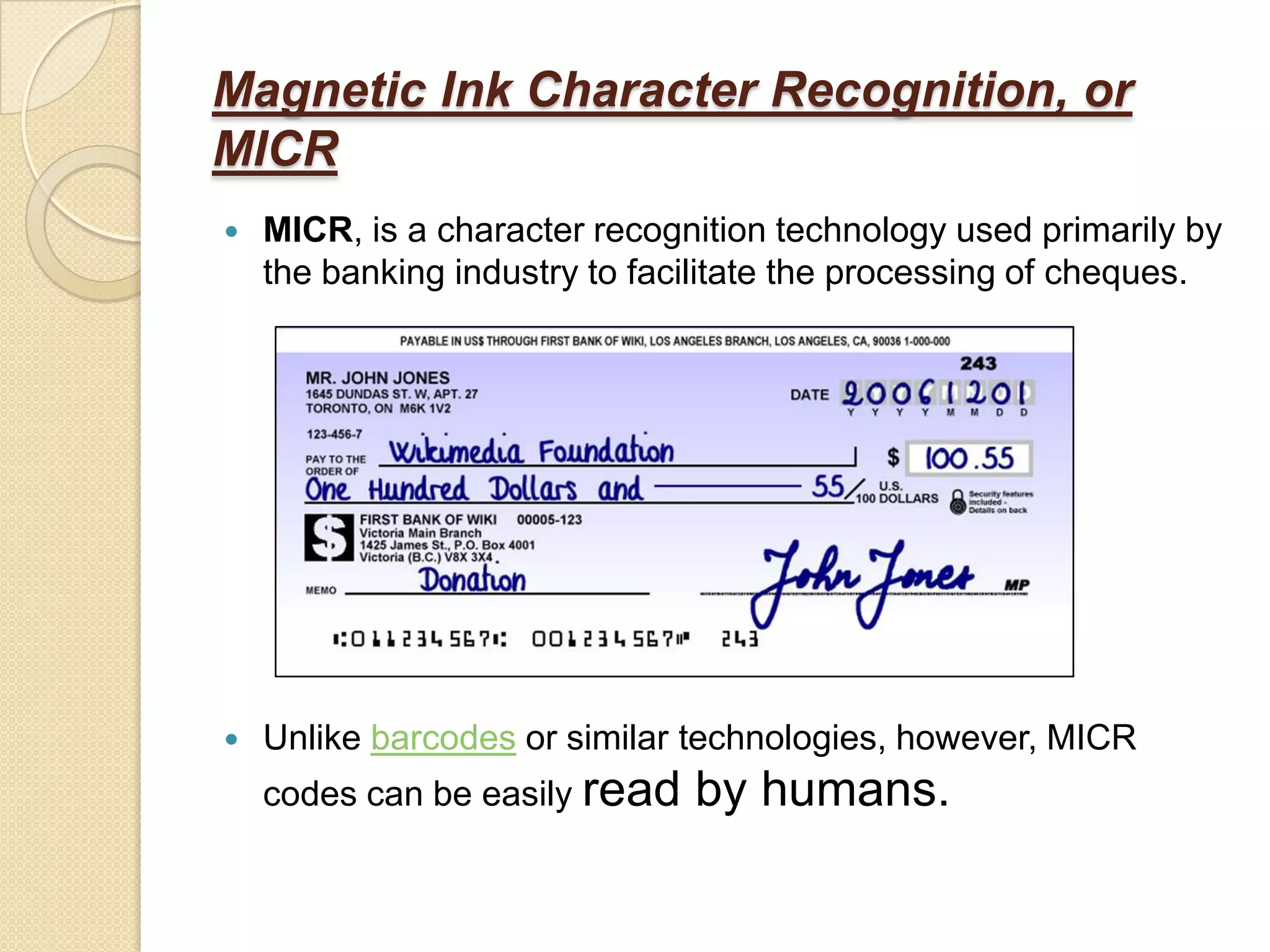
Magnetic Ink Character Recognition, or
MICR
   MICR, is a character recognition technology used primarily by
    the banking industry to facilitate the processing of cheques.


   Unlike barcodes or similar technologies, however, MICR
    codes can be easily read   by humans.
Why this change??
 Online banking was already popular in the
  developed countries.
 After liberalization modern banking methods had
  to be implemented in India.
 Since a number of foreign players started coming
  to India online or internet banking had to be
  introduced in Indian system of banking.
Flexible banking
  Online banking offers the flexibility of banking from
  anywhere.
 It is attracting more and more people.
 Gone are days of standing in long queues for
  getting a cheque book or depositing cash.
 Internet Banking is actually fast and hassle free, no
  wastage of time and no paperwork.
 With the help of internet banking most of the banks
  in India have also tuned into a 24/7 service
  provider.
Online banking does not only benefit the
        user but the bank as well
   Banks can increase their base of high networking
    clients.

   Online banking also gives banks an edge in the
    global banking scenario and gives them the
    opportunity to stand alongside the best banks in
    the world.

   Many banks in the country today have numerous
    overseas clients and it is only because of online
    banking that these banks can take care of the
    needs of their currents.
References
   http://www.rbi.org.in/scripts/PublicationsVie
    w.aspx?id=162.
   http://www.preparegk.com.
Saraf Commitee Report

Saraf Commitee Report

  • 1.
    Saraf committee onTechnological Issue Group members : Rahul Kumar (11020241094) Sanjay Kumar (11020241127) Ankit chawla (11020241037)
  • 2.
    Introductiom  The concept of online banking in India was introduced by the Saraf Committee which was appointed by the then Governor of the Reserve Bank of India.  Realizing the important of modern technology the Governor of the Reserve Bank formed a Committee under the leadership of Shri W.S.Saraf.  The committee was appointed with the aim of finding out the latest issues relating to the use of modern technology in the Indian banking industry.  A Saraf Committee was constituted by RBI in 1994 that recommended the use of:- Electronic Fund Transfer System (EFT), Introduction of electronic clearing services and extension of Magnetic Ink Character Recognition (MICR) beyond metropolitan cities and branches.
  • 3.
    Indian banking system The Indian banking industry was well known for its stability and also extreme stubbornness.  The introduction of online banking took banking services in India to new heights.  The public banks in India were famous for their resistance change in their style of working and maintained a routine work culture.  But after realizing the fact that India was lagging behind in banking technology as compared to foreign countries the government introduced certain latest banking techniques which all the banks had to follow.
  • 4.
    Recommendation of Saraf committee.  Establishment of an Electronic Funds Transfer (EFT) system, with the BANKNET communications network as its carrier.  Enactment of suitable legislation on the lines of the Electronic Funds Transfer Act 1978, USA and Data Protection Act 1984, UK.  MICR clearing be introduced at all centres with more than 100 bank branches.  Priority should be given to centres such as Ahmedabad, Bangalore, Hyderabad, Pune and Surat which have relatively large volumes.
  • 5.
    Recommendation of Saraf committee.  Introduction of a Delivery versus Payment (DvP) system for SGL transactions.  With settlement on gross basis both for securities transactions in PDO and funds transactions in current accounts at DAD.  Introduction of Electronic Clearing Service Credit for low value repetitive transactions such as interest, dividend, salary, pension payments and an Electronic Debit Clearing for payments to utility companies.
  • 6.
    Recommendation of Saraf committee.  A uniform size for MICR instruments.  Geographical expansion of the BANKNET network with nodes in all important branches of banks.  Modifications in COMET software to enable dial-up connectivity, file transfer facility, encryption etc.  Switch over to on-line inter-bank clearing on a gross basis.
  • 7.
    Recommendation of Saraf committee. Introduction of 'Clearing Bank' concept for decentralised cheque processing.  Truncation of cheques up to the value of Rs.5,000/-  Large scale induction of computers and communication technology in service branches.  Optimal usage of SWIFT.
  • 8.
    Electronic Funds Transfer System  Transfer of money from one account to another, either within a single financial institution or across multiple institutions, through computer-based systems.  One of the most widely-used EFT programs is Direct Deposit in which payroll is deposited straight into an employee's bank account.  EFT refers to any transfer of funds initiated through an electronic terminal, including credit card, ATM, Fedwire and point-of-sale (POS) transactions.  It is used for both credit transfers, such as payroll
  • 9.
    Electronic Clearing Service  It is a mode of electronic funds transfer from one bank account to another bank account using the services of a Clearing House. 2 Types of ECS: ECS (Credit) : ECS (Credit) is used for affording credit to a large number of beneficiaries by raising a single debit to an account, such as dividend, interest or salary payment ECS (Debit). ECS (Debit) is used for raising debits to a number of accounts of consumers/ account holders for crediting a particular institution.
  • 10.
    Working of ECSCredit system  The ECS users intending to effect payments have to submit the data in a specified format to one of the approved clearing houses.  The clearing house would debit the account of the ECS user .  credit the accounts of the recipient banks.
  • 11.
    ECS (Debit) scheme  Any ECS user desirous of participating in the scheme has to register with an approved clearing house.  He should also collect the mandate forms from the participating destination account holders, with bank's acknowledgement.  A copy of the mandate should be available with the drawee bank.  The ECS user has to submit the data in specified form through the sponsor bank to the clearing house.  The clearing house would pass on the debit to the destination account holder through the clearing system and credit the sponsor bank's account for onward crediting the ECS user.  All the unprocessed debits have to be returned to the sponsor bank within the time frame specified.  Banks will treat the electronic instructions received through the clearing system on par with the physical cheques.
  • 12.
    The advantages tothe banks  Banks handling ECS get freed of paper handling.  Paper handling also creates lot of pressure on banks as they have to encode the instruments, present them in clearing, monitor their return and follow up with the concerned bank and customers.  In ECS banks simply get the mandate particulars relating to their customers. All they need to do is to match the account particulars like name, a/c number and debit the accounts.  Wherever the details do not match, they have to return it back, as per the procedure.
  • 13.
    Magnetic Ink CharacterRecognition, or MICR  MICR, is a character recognition technology used primarily by the banking industry to facilitate the processing of cheques.  Unlike barcodes or similar technologies, however, MICR codes can be easily read by humans.
  • 14.
    Why this change?? Online banking was already popular in the developed countries.  After liberalization modern banking methods had to be implemented in India.  Since a number of foreign players started coming to India online or internet banking had to be introduced in Indian system of banking.
  • 15.
    Flexible banking  Online banking offers the flexibility of banking from anywhere.  It is attracting more and more people.  Gone are days of standing in long queues for getting a cheque book or depositing cash.  Internet Banking is actually fast and hassle free, no wastage of time and no paperwork.  With the help of internet banking most of the banks in India have also tuned into a 24/7 service provider.
  • 16.
    Online banking doesnot only benefit the user but the bank as well  Banks can increase their base of high networking clients.  Online banking also gives banks an edge in the global banking scenario and gives them the opportunity to stand alongside the best banks in the world.  Many banks in the country today have numerous overseas clients and it is only because of online banking that these banks can take care of the needs of their currents.
  • 17.
    References  http://www.rbi.org.in/scripts/PublicationsVie w.aspx?id=162.  http://www.preparegk.com.