Download to read offline
![IOSR Journal of VLSI and Signal Processing (IOSR-JVSP)
e-ISSN: 2319 – 4200, p-ISSN No. : 2319 – 4197 Volume 1, Issue 6 (Mar. – Apr. 2013), PP 19-26
www.iosrjournals.org
www.iosrjournals.org 19 | Page
An Efficient Two’s Complement Multiplier With FPGA
Implementation
Kolathur Lakshmipathy 1
, , Voruganti Santhosh Kumar 2,
Dr Vangala padmaja3
1(Department of ECE, VNR VJIET, Hyderabad, India)
2 (Department of ECE, AEC, Kodad, A.P, India)
3 (Department of ECE, VNR VJIET, Hyderabad, India)
Abstract: The performance of multiplication is crucial for multimedia applications such as 3D graphics and
signal processing systems which depend on extensive numbers of multiplications. Previously reported
multiplication algorithms mainly focus on rapidly reducing the partial products rows down to final sums and
carries used for the final accumulation. These techniques mostly rely on circuit optimization and minimization
of the critical paths.
In this paper, an algorithm to achieve fast multiplication in two’s complement representation is
presented. Indeed, our approach focuses on reducing the number of partial product rows. In turn, this directly
influences the speed of the multiplication, even before applying partial products reduction techniques. Fewer
partial products rows are produced, thereby lowering the overall operation time. This results in a true diamond-
shape for the partial product tree which is more efficient in terms of implementation.
Keywords:— MBE, PPR, PPRG, FPGA.
I. INTRODUCTION
The performance of 3D graphics and signal processing systems strongly depends on the performance of
multiplications because these applications need to support highly multiplication intensive operations. Therefore,
there has been much work on advanced multiplication algorithms and designs [1, 22, 3, 23, 18, 14, 13, 6, 7, 16,
20, 24, 12].
There are three major steps to any multiplication. In the first step, the partial products are generated. In
the second step, the partial products are reduced to one row of final sums and one row of carries. In the third
step, the final sums and carries are added to generate the result. Most of the above mentioned approaches
employ the Modified Booth Encoding (MBE) approach [6, 7, 13, 24, 4] for the first step because of its ability to
cut the number of partial products rows in half. They then select some variation of any one of partial products
reduction schemes such as the Wallace trees [22, 6] or the compressor trees [16, 13, 18, 14] in the second step to
steeply reduce the number of partial product rows to the final two (sums and carries). In the third step, they use
some kind of advanced adder approach such as carry-lookahead or carry-select adders [5, 17, 11] to add the final
two rows, resulting in the final product. The main focus of recent multiplier papers [7, 16, 20, 24,4, 12] has been
on rapidly reducing the partial product rows by using some kind of circuit optimization and identifying the
critical paths and signal races. In other words, the goals have been to optimize the second step of the
multiplication described above.
However, in this paper, we will focus on the first step which consists in forming the partial product
array and we will strive to design a multiplication algorithm which will produce fewer partial product rows. By
having fewer partial product rows, the reduction tree can be smaller in size and faster in speed. It should also be
noted that 8 or16-bit words are the most commonly used word sizes in the kernels of most multimedia
applications [19] and that the implementation of our overall algorithm is particularly well suited to such word
sizes. In the next section, the conventional multiplication method is described in detail with an emphasis on its
weaknesses. In section iii, a step-by-step procedure to prevent the adverse effects of some conventional
multiplication algorithms is presented. In section iv, the effectiveness and usage of our method is presented by
showing a detailed evaluation.
II. Multiplication Algorithms
There is no doubt that MBE is efficient when it comes to reducing the partial products. However, it is
important to note that there are two unavoidable consequences when using MBE: sign extension prevention and
negative encoding. The combination of these two unavoidable consequences results in the formation of one
additional partial product row and of course, this additional partial product row requires more hardware but
more importantly time](https://image.slidesharecdn.com/d0161926-140516043109-phpapp02/85/D0161926-1-320.jpg)
![IOSR Journal of VLSI and Signal Processing (IOSR-JVSP)
e-ISSN: 2319 – 4200, p-ISSN No. : 2319 – 4197 Volume 1, Issue 6 (Mar. – Apr. 2013), PP 19-26
www.iosrjournals.org
www.iosrjournals.org 19 | Page
An Efficient Two’s Complement Multiplier With FPGA
Implementation
Kolathur Lakshmipathy 1
, , Voruganti Santhosh Kumar 2,
Dr Vangala padmaja3
1(Department of ECE, VNR VJIET, Hyderabad, India)
2 (Department of ECE, AEC, Kodad, A.P, India)
3 (Department of ECE, VNR VJIET, Hyderabad, India)
Abstract: The performance of multiplication is crucial for multimedia applications such as 3D graphics and
signal processing systems which depend on extensive numbers of multiplications. Previously reported
multiplication algorithms mainly focus on rapidly reducing the partial products rows down to final sums and
carries used for the final accumulation. These techniques mostly rely on circuit optimization and minimization
of the critical paths.
In this paper, an algorithm to achieve fast multiplication in two’s complement representation is
presented. Indeed, our approach focuses on reducing the number of partial product rows. In turn, this directly
influences the speed of the multiplication, even before applying partial products reduction techniques. Fewer
partial products rows are produced, thereby lowering the overall operation time. This results in a true diamond-
shape for the partial product tree which is more efficient in terms of implementation.
Keywords:— MBE, PPR, PPRG, FPGA.
I. INTRODUCTION
The performance of 3D graphics and signal processing systems strongly depends on the performance of
multiplications because these applications need to support highly multiplication intensive operations. Therefore,
there has been much work on advanced multiplication algorithms and designs [1, 22, 3, 23, 18, 14, 13, 6, 7, 16,
20, 24, 12].
There are three major steps to any multiplication. In the first step, the partial products are generated. In
the second step, the partial products are reduced to one row of final sums and one row of carries. In the third
step, the final sums and carries are added to generate the result. Most of the above mentioned approaches
employ the Modified Booth Encoding (MBE) approach [6, 7, 13, 24, 4] for the first step because of its ability to
cut the number of partial products rows in half. They then select some variation of any one of partial products
reduction schemes such as the Wallace trees [22, 6] or the compressor trees [16, 13, 18, 14] in the second step to
steeply reduce the number of partial product rows to the final two (sums and carries). In the third step, they use
some kind of advanced adder approach such as carry-lookahead or carry-select adders [5, 17, 11] to add the final
two rows, resulting in the final product. The main focus of recent multiplier papers [7, 16, 20, 24,4, 12] has been
on rapidly reducing the partial product rows by using some kind of circuit optimization and identifying the
critical paths and signal races. In other words, the goals have been to optimize the second step of the
multiplication described above.
However, in this paper, we will focus on the first step which consists in forming the partial product
array and we will strive to design a multiplication algorithm which will produce fewer partial product rows. By
having fewer partial product rows, the reduction tree can be smaller in size and faster in speed. It should also be
noted that 8 or16-bit words are the most commonly used word sizes in the kernels of most multimedia
applications [19] and that the implementation of our overall algorithm is particularly well suited to such word
sizes. In the next section, the conventional multiplication method is described in detail with an emphasis on its
weaknesses. In section iii, a step-by-step procedure to prevent the adverse effects of some conventional
multiplication algorithms is presented. In section iv, the effectiveness and usage of our method is presented by
showing a detailed evaluation.
II. Multiplication Algorithms
There is no doubt that MBE is efficient when it comes to reducing the partial products. However, it is
important to note that there are two unavoidable consequences when using MBE: sign extension prevention and
negative encoding. The combination of these two unavoidable consequences results in the formation of one
additional partial product row and of course, this additional partial product row requires more hardware but
more importantly time](https://image.slidesharecdn.com/d0161926-140516043109-phpapp02/75/D0161926-1-2048.jpg)
![An Efficient Two’s Complement Multiplier With FPGA Implementation
www.iosrjournals.org 20 | Page
A. Modified Booth Encoding and the Overhead of Negative Encodings
This grouping of the multiplier bits of MBE is shown in Figure 1 and it is based on a window size of 3
bits and astride of 2. The multiplier (Y) is segmented into groups of three bits (y2i+1, y2i, y2i−1) and each such
group of bits is associated with its own partial product row by using Table 1 [15]. In this grouping, y−1 = 0.By
applying this encoding, the number of partial product rows to be accumulated is reduced from n to n/2. For
example, for an 8 × 8 multiplication, a multiplier without MBE will generate eight partial product rows
(because there is one partial product row for each bit of the multiplier).However, with MBE, only n/2 (= 4)
partial products rows are generated as shown in the example of Figure 2.However, there are actually n/2 + 1
partial product rows anther than n/2, because of the last neg signal (neg3 in Figure2).
The neg signals (neg0, neg1, neg2, and neg3) are needed because MBE may generate a negative
encoding ((-1) times the multiplicand or (-2) times the multiplicand).Consequently, one additional carry save
adding stage is needed to perform the reduction. This is the overhead of implementing the negative encodings of
MBE.
Figure 1: Multiplier bits grouping according to modified booth encoding for 8-bit input
Table 1: Modified Booth Encoding (radix-4)
Y2i+1 Y2i Y2i-1 Generated partial
products
0 0 0 0×X
0 0 1 1×X
0 1 0 1×X
0 1 1 2×X
1 0 0 (-2)×X
1 0 1 (-1)×X
1 1 0 (-1)×X
1 1 1 0×X
B. Sign Extension and its Prevention
In signed multiplication, the sign bit of a partial product row would have to be extended all the way to
the MSB position which would require the sign bit to drive that many output loads (each bit position until the
MSB should have the same value as the sign). This makes the partial product rows unequal in length as shown
in Figure : the first row spans 16 bits (pp00 to the leftmost pp80), the second row 14 bits (pp01 to the leftmost
pp81), the third row 12bits (pp02 to the leftmost pp82), and the fourth row 10 bits(pp03 to the leftmost pp83).
The sign extension prevention method shown in figure3.and arrives a newly formed partial product rows as in
figure4[10]where the sign extension has been removed. We use this structure as the basis structure for our
multiplier architecture.
Figure 2. The Array of Partial Products for Signed Multiplication with MBE
Figure. 3: Application of sign extension prevention measure on the partial product array of 8×8
multiplier](https://image.slidesharecdn.com/d0161926-140516043109-phpapp02/85/D0161926-2-320.jpg)
![An Efficient Two’s Complement Multiplier With FPGA Implementation
www.iosrjournals.org 21 | Page
C. One Additional Partial Product Row
However, there is still the problem of having the last neg forming one additional partial product row
(neg3 in Figure3) and this causes another carry save adder delay in order to generate the sums and carries before
the final accumulation. This is because in any case, one more partial product means one additional 3-2
reduction. For example, Figure 4(a)[10] shows a 8-input reduction (16 bit × 16 bit multiplication for our
architecture) using 4-2 compressors. If we have to reduce 9 inputs (16 bit × 16 bit multiplication for the
conventional architecture), one additional carry save adder is required as in Figure 4(b)[10].
.
III . Stopping the Extra Partial Product Row
Therefore, our aim is to remove the last neg signal. This would prevent the extra partial product row,
and thus save the time of one additional carry save adding stage and the hardware required for the additional
carry save adding. We noticed that if we could somehow produce the two’s complement of the multiplicand
while the other partial products were produced, there would be no need for the last neg because this neg signal
would have already been applied when generating the two’s complement of the multiplicand.
Therefore, we “only” need to find a faster method to calculate the two’s complement of a binary number.
A . A Quick Method to Find Two’s Complements
Our method is an extension of well-known algorithm that two’s complementation complements all the
bits after the rightmost “1” in the word but keeps the other bits as they are. The two’s complement of a binary
number 0010102(1010) is 1101102 (−1010). For this number, the right most “1” happens in bit position 1 (the
check mark position in Figure 4 ).
Figure 4:Two Complement Conversion Example
Therefore, values in bit positions 2 to5 can simply be complemented while values in bit positions0 and 1 are
kept as they were. Therefore, two’s complementation now comes down to finding the conversion signals that are
used for selectively complementing some of the input bits. If the conversion signal at any position is “0” (the
crosses in Figure 4), then the value is kept as it is and if the conversion signal is “1”(the checks in Figure 4),
then the value is complemented. The conversion signals after the rightmost “1” are always1. They are 0
otherwise. Once a lower order bit has been detected to be a “1,” the conversion signals for the higher order bits
to the left of that bit position should all be “1.”However, this searching for the rightmost “1” could as time
consuming as rippling a carry through to the MSB since the previous bits information must be transferred to the
MSB. Therefore, we must find a method to expedite this detection of the rightmost “1.”As we will see, this
search for the rightmost “1” can be achieved in logarithmic time using a binary search tree-like structure. We
first find the conversion signals for a 2-bitgroup by grouping two consecutive bits (the grouping always starts
from the LSB) from the input and finds the conversion signals in each group as shown in Figure 6(a)[10]. Then
we find the conversion signals for a 4-bit group (formed by two consecutive 2-bit groups). Then we find the
conversion
Signals for a 8-bit group (formed by two consecutive 4-bitgroup). This divide-and-conquer approach is
pursued until the whole input has been covered. When grouping two 2n-bits groups, the leftmost conversion
signals from the right group contain the accumulative information of its group about whether a “1” ever
appeared in any bit position of its group, so that a conversion signal should force all the conversion signals from
the left group all the way to the “1” if it is itself is a “1.” For instance, as shown in Figure 6(b)[10], if CS1 (the
leftmost conversion signal from the right group) = “1,” the conversion signals from the left group (CS2 and
CS3) should be forced to a“1,” regardless of their previous values. If CS1 = “0,” nothing happens to the
conversion signals from the left group. This variable control is shown with a dashed arrow. Likewise,CS5 may
affect conversion signals CS6 and CS7.The same goes for CS3’ which may affect the conversion signals (CS7’,
CS6’, CS5’, and CS4’).The inputs to the 2-bit group are bits from the original binary number. However, the
inputs to the next level groups are conversion signals from the previous level. For instance, the inputs to the 4-
bit group are the conversion signals generated from two 2-bit groups. Therefore, from the second level (4-bit
grouping) on, the conversion signals are scanned in order to find the rightmost “1.” One possible](https://image.slidesharecdn.com/d0161926-140516043109-phpapp02/85/D0161926-3-320.jpg)
![An Efficient Two’s Complement Multiplier With FPGA Implementation
www.iosrjournals.org 22 | Page
implementation of our algorithm is shown in Figure7 (a). Figure 7(b)[10] shows another version of the design
using NAND, NOR, and inverter. Once we have the complete conversion signals, these signals are shifted left 1
bit and EXOR-ed with the input to create the two’s complement of the input. One complete example of two’s
complementation of “001010002”is shown in Figure 8[10]. Our approach is more general and shows better
adaptability to any word size.
Figure 5: Two’s complement computation
A. Putting it all together
By applying the method we just described for two’s complementation, the last partial product row (in
Figure 3) is correctly generated without the last neg(neg3 in Figure 3).Now, the multiplication can have a
smaller critical path. This avoids having to include one extra carry saving adding stage. It also reduces the time
to find the product and saves the hardware corresponding to the carry saving adding stage. Forming a truly
parallelogram-shaped partial product array after removing the last neg requires undergoing the following
steps:
Step a: Replace the last partial product row and neg3 in Figure 3 with signals s9 ∼s0 as shown in Figure 6.
Step b: Replace the second to the last partial product row as in Figure 6.
Figure 6: Replacing the last row and the Last neg with signals s9 -s0
Step c: Finally, the MSB of the last row can be complemented
(s9) and the “1” directly above it can be removed as shown in Figure 7.
Figure 7: Partial Products After Removing the last neg
As can be seen, the critical path column with n /2 +1 elements (6th bit position of Figure 3 (n−2)) now
have only n/2 elements as shown in Figure 7(the neg3 is no longer there). This directly improves the speed of
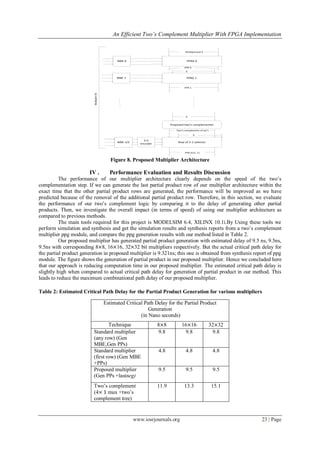
the multiplication. The multiplier architecture to generate the partial products is shown in Figure. The only
Difference between our architecture and the conventional multiplier architectures is that for the last partial
product row, our architecture has no partial product generation but partial product selection with a two’s
complement unit. The 3-5 decoder select the correct value from 5 possible inputs (2×X, 1×X, 0, -1×X,-2×X)
which are either coming from the two’s complement logic or the multiplicand itself and input into the row of 5-
1selectors. Unlike the other rows which use PPRG (Partial Product Row Generator), the two’s complement logic
does not have to wait for MBE to finish. Two’s complementation is performed in parallel with MBE and the 3-5
decoders.](https://image.slidesharecdn.com/d0161926-140516043109-phpapp02/85/D0161926-4-320.jpg)
![An Efficient Two’s Complement Multiplier With FPGA Implementation
www.iosrjournals.org 25 | Page
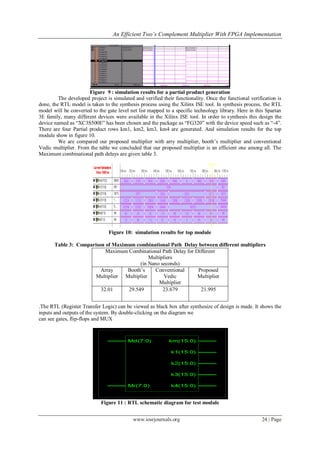
The figure shows the technical schematic of top module,
Figure 12 : technology schematic diagram for ppg module
which consists of iob’s, lookup tables, functional blocks and flip-flops.
Figure 13 : Hardware implementation
The above FPGA implementation shows the multiplication operation, i.e. the multiplier value is 1 &
the multiplicand value is 127. Hence the output lights glow from 1 to 7 continuously, which indicates the output
value is 127
V . Conclusions
In this project an algorithm is presented to reduce from [n/2] +1 to [n /2] the number of partial product
rows generated during the first step of a multiplication algorithm. By doing so, the structure of the partial
product array becomes more regular and easier to implement. Even more importantly, the product is found faster.
This can be achieved using less hardware. A detailed and step-by-step approach to prevent the occurrence of the
additional row is shown. The proposed multiplication method is particularly efficient when executing the
multiplications of the kernels of most common multimedia applications which are based on 8 to 16-bit operands
& implemented by using Spartan 3(XC3S400) FPGA.
Compared our approach with a recent proposal with the same aim, considering results using a widely
used industrial synthesis tool and concluded that our approach may improve both the performance and area
requirements of square multiplier designs. The proposed approach also applies with small modifications to
rectangular and to general radix-B Modified Booth Encoding multipliers.
References
[1] M.D. Ercegovac and T. Lang, Digital Arithmetic. Morgan Kaufmann Publishers, 2003.
[2] S.K. Hsu, S.K. Mathew, M.A. Anders, B.R. Zeydel, V.G.Oklobdzija, R.K. Krishnamurthy, and S.Y. Borkar, “A 110GOPS/W 16-
Bit Multiplier and Reconfigurable PLA Loop in 90-nm CMOS,” IEEE J. Solid State Circuits, vol. 41, no. 1, pp. 256-264, Jan.2006.
[3] H. Kaul, M.A. Anders, S.K. Mathew, S.K. Hsu, A. Agarwal, R.K.Krishnamurthy, and S. Borkar, “A 300 mV 494GOPS/W
Reconfigurable Dual-Supply 4-Way SIMD Vector Processing Accelerator in 45 nm CMOS,” IEEE J. Solid State Circuits, vol. 45,
no. 1, pp. 95-101, Jan. 2010
[4] M.S. Schmookler, M. Putrino, A. Mather, J. Tyler, H.V. Nguyen, C.Roth, M. Sharma, M.N. Pham, and J. Lent, “A Low-Power,
High-Speed Implementation of a PowerPC Microprocessor Vector Extension,” Proc. 14th IEEE Symp. Computer Arithmetic, pp.
12-19,1999.
[5] O.L. MacSorley, “High Speed Arithmetic in Binary Computers,” Proc. IRE, vol. 49, pp. 67-91, Jan. 1961.
[6] L. Dadda, “Some Schemes for Parallel Multipliers,” Alta Frequenza, vol. 34, pp. 349-356, May 1965.
[7] C.S. Wallace, “A Suggestion for a Fast Multiplier,” IEEE Trans.Electronic Computers, vol. EC-13, no. 1, pp. 14-17, Feb. 1964.
[8] D.E. Shaw, “Anton: A Specialized Machine for Millisecond-Scale Molecular Dynamics Simulations of Proteins,” Proc. 19th IEEE
Symp. Computer Arithmetic, p. 3, 2009.
[9] J.-Y. Kang and J.-L. Gaudiot, “A Simple High-Speed Multiplier Design,” IEEE Trans. Computers, vol. 55, no. 10, pp. 1253-1258,
Oct.2006.](https://image.slidesharecdn.com/d0161926-140516043109-phpapp02/85/D0161926-7-320.jpg)
![An Efficient Two’s Complement Multiplier With FPGA Implementation
www.iosrjournals.org 26 | Page
[10] J.-Y. Kang and J.-L. Gaudiot, “A Fast and Well-Structured Multiplier,” Proc. Euromicro Symp. Digital System Design, pp. 508-515,
Sept. 2004.
[11] F. Lamberti, N. Andrikos, E. Antelo, and P. Montuschi,“Speeding-Up Booth Encoded Multipliers by Reducing the Size of Partial
Product Array,” internal report, http://arith.polito.it/ir_mbe.pdf, pp. 1-14, 2009.
[12] E.M. Schwarz, R.M. Averill III, and L.J. Sigal, “A Radix-8 CMOSS/390 Multiplier,” Proc. 13th IEEE Symp. Computer
Arithmetic,pp. 2-9, 1997.
[13] W.-C. Yeh and C.-W. Jen, “High-Speed Booth Encoded Parallel Multiplier Design,” IEEE Trans. Computers, vol. 49, no. 7, pp.
692-701, July 2000.
[14] Z. Huang and M.D. Ercegovac, “High-Performance Low-Power Left-to-Right Array Multiplier Design,” IEEE Trans.
Computers,vol. 54, no. 3, pp. 272-283, Mar. 2005.
[15] R. Zimmermann and D.Q. Tran, “Optimized Synthesis of Sum-of-Products,” Proc. Conf. Record of the 37th Asilomar Conf.
Signals,Systems and Computers, vol. 1, pp. 867-872, 2003.
[16] V.G. Oklobdzija, D. Villeger, and S.S. Liu, “A Method for Speed Optimized Partial Product Reduction and Generation of Fast
Parallel Multipliers Using an Algorithmic Approach,” IEEE Trans.Computers, vol. 45, no. 3, pp. 294-306, Mar. 1996.
[17] P.F. Stelling, C.U. Martel, V.G. Oklobdzija, and R. Ravi, “Optimal Circuits for Parallel Multipliers,” IEEE Trans. Computers, vol.
47, no. 3, pp. 273-285, Mar. 1998.
[18] J.-Y. Kang and J.-L. Gaudiot, “A Logarithmic Time Method for Two’s Complementation,” Proc. Int’l Conf. Computational Science,
pp. 212-219, 2005.
[19] K. Hwang, Computer Arithmetic Principles, Architectures, and Design.Wiley, 1979.
[20] R. Hashemian and C.P. Chen, “A New Parallel Technique for Design of Decrement/Increment and Two’s Complement
Circuits,”Proc. 34th Midwest Symp. Circuits and Systems, vol. 2,pp. 887-890, 1991.
[21] D. Gajski, Principles of Digital Design. Prentice-Hall, 1997.
[22] STMicroelectronics, “130nm HCMOS9 Cell Library,” http://www.st.com/stonline/products/technologies/soc/evol.htm, 2010.
Kolathur Lakshmipathy received the B.Tech. Degree in electronics and Communication
engineering from SANA Engineering College, affiliated to Jawaharlal Nehru
Technological University Hyderabad , AP, India, in 2007. He received M.Tech Degree in
VLSI system design From VNR Vignana Jyothi Institute of Engineering & technology,
Bachpally, Hyderabad, India,in 2012. His research interests include Digital design with
FPGA and Low Power vlsi.
Voruganti Santhosh Kumar received the B.Tech. Degree in electronics and Communication
engineering from SANA Engineering College, affiliated to Jawaharlal Nehru Technological
University Hyderabad, AP, India, in 2007.he received M.Tech Degree in VLSI system
design From Anurag Engineering college, kodad, AP, India. He is an assistant professor in
Dept of ECE in Anurag College of engineering. His research interests include Digital design
with FPGA.
Dr. V. Padmaja born in 1968. She received B.E Degree in Electronics and
Communications Engineering, M.E Degree in Digital Systems Engineering from O.U in
1991 and 1999 respectively. She received Ph.D from J.N.T.U in 2009. She is an Professor
in Dept. of ECE in VNRVJIET, her research of interest includes image processing and
Embedded Systems. She has authored more than 5 Research papers in National and
International Conferences and Journals](https://image.slidesharecdn.com/d0161926-140516043109-phpapp02/85/D0161926-8-320.jpg)

This document describes an efficient algorithm for two's complement multiplication. The algorithm focuses on reducing the number of partial product rows generated in the first step of multiplication. It presents a method called "sign extension prevention" that removes unequal row lengths from the partial product array. However, there is still one additional partial product row generated from the last "neg" signal of the modified Booth encoding. The algorithm then describes a quick method to calculate the two's complement of a number by selectively complementing bits based on "conversion signals". This allows generating the two's complement while also producing the other partial products, removing the need for the extra row from the last "neg" signal.


