This paper proposes a low-complexity postprocessing algorithm to remove blocking artifacts and ringing noise in low bit rate video coding. The algorithm combines deblocking and deringing operations to reduce computational complexity compared to existing algorithms like MPEG-4 postprocessing. It analyzes blocks using DCT coefficients and motion vectors to classify them as smooth or complex. Smooth blocks undergo only deblocking while complex blocks undergo deringing, which also removes blocking artifacts. Processing is done selectively using pixel values across block boundaries to improve quality while maintaining low complexity. Simulation results show the proposed algorithm achieves comparable quality to MPEG-4 postprocessing but with only 15% of the computational complexity.
![A LOW-COMPLEXITY POSTPROCESSING ALGORITHM FOR BLOCK BASED VIDEO
CODING
Ravikanth Maddikonda and Tushar K. Adhikary
Emuzed India Pvt. Ltd.
ABSTRACT
This paper presents a low-complexity algorithm to remove
quantization effects in low bit rate video coding, such as
blocking artifacts and ringing noise. The postprocessing
algorithms presented in literature and MPEG-4 standard
are of high computational complexity and apply low pass
filtering twice to remove the two quantization effects
mentioned above. The proposed algorithm uses the
information contained in the compressed bit stream for
processing. In this method, the deblocking and deringing
operations are combined effectively and filtering is done
only once to remove both the noises. This results in
reduction of computational complexity. The efficiency of
the proposed algorithm is compared with MPEG-4
postprocessing algorithm in terms of computational
complexity and peak signal to noise ratio for several video
sequences.
1. INTRODUCTION
The high volume audio-visual data associated with typical
multimedia services call for efficient data compression
schemes to facilitate transmission and storage applications.
Most video coding standards like MPEG-4 [1] and H.263
[2] use block based Discrete Cosine Transform (DCT). An
8x8 block DCT packs the information into few coefficients
by utilizing the spatial correlation of images. This block
based coding introduces blocking artifacts at block
boundaries as the blocks are coded independently. The
blocking artifacts are mainly resulted from the
quantization of DC and low frequency AC coefficients.
The other artifacts that are introduced due to quantization
of high frequency coefficients are ringing effect around the
object edges (Gibbs’s phenomenon) and corner outliers.
Many postprocessing algorithms like two
dimensional signal adaptive filtering [3], iterative image
recovery using theory of projection onto convex sets [4],
spatio-temporal adaptive theory [5], Markov random fields
[6], algorithm using spatial frequency and temporal
information [7], etc. are proposed in literature. The
MPEG-4 standard also suggests a postprocessing
algorithm. The main draw back of these algorithms is high
computational complexity. With increasing attraction on
applications like video streaming and video on mobile
handsets, where computational capacity and available
power are limited, there is high demand for low
complexity algorithms.
In this paper, a low-complexity video
postprocessing algorithm is proposed which uses the
spatial frequency and temporal information present in the
coded bit stream. This algorithm removes the blocking
artifacts at block boundaries and ringing noise at the
object edges, which are usually more annoying among all
the quantization effects in low bit rate video applications.
The deblocking and deringing operations are combined
effectively to decrease the computational complexity. The
proposed algorithm needs approximately 15% of the
computational complexity of MPEG-4 postprocessing
algorithm.
This paper is organized in the following manner.
Section 2 describes the proposed algorithm. Section 3
presents the simulation results and comparison of the
proposed algorithm with MPEG-4 postprocessing
algorithm in terms of computational complexity and peak
signal to noise ratio (PSNR). Conclusions are given in
section 4.
2. PROPOSED ALGORITHM
In MPEG-4 algorithm, pixel wise filtering decision is a
computationally intensive step. In the proposed algorithm,
the filtering decision is partially made on a 8x8 block basis
using the DCT coefficients and motion vectors available
from the bit stream.
2.1. Characterization of blocks
Each 8x8 block in a frame is divided into one of the two
categories, based on the intensity changes. Blocks with
low intensity variation are called smooth blocks and those
with high intensity variation are called as complex blocks.
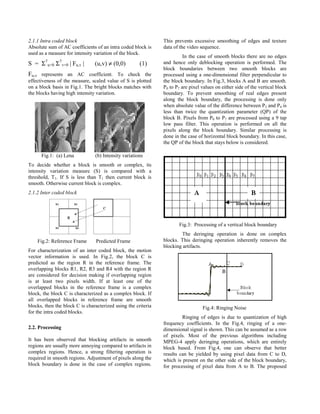
Intensity variation is measured as explained below.](https://image.slidesharecdn.com/b09ad686-ec08-43b2-af11-bf7a716b24d4-160809174400/85/paper573-1-320.jpg)
![A LOW-COMPLEXITY POSTPROCESSING ALGORITHM FOR BLOCK BASED VIDEO
CODING
Ravikanth Maddikonda and Tushar K. Adhikary
Emuzed India Pvt. Ltd.
ABSTRACT
This paper presents a low-complexity algorithm to remove
quantization effects in low bit rate video coding, such as
blocking artifacts and ringing noise. The postprocessing
algorithms presented in literature and MPEG-4 standard
are of high computational complexity and apply low pass
filtering twice to remove the two quantization effects
mentioned above. The proposed algorithm uses the
information contained in the compressed bit stream for
processing. In this method, the deblocking and deringing
operations are combined effectively and filtering is done
only once to remove both the noises. This results in
reduction of computational complexity. The efficiency of
the proposed algorithm is compared with MPEG-4
postprocessing algorithm in terms of computational
complexity and peak signal to noise ratio for several video
sequences.
1. INTRODUCTION
The high volume audio-visual data associated with typical
multimedia services call for efficient data compression
schemes to facilitate transmission and storage applications.
Most video coding standards like MPEG-4 [1] and H.263
[2] use block based Discrete Cosine Transform (DCT). An
8x8 block DCT packs the information into few coefficients
by utilizing the spatial correlation of images. This block
based coding introduces blocking artifacts at block
boundaries as the blocks are coded independently. The
blocking artifacts are mainly resulted from the
quantization of DC and low frequency AC coefficients.
The other artifacts that are introduced due to quantization
of high frequency coefficients are ringing effect around the
object edges (Gibbs’s phenomenon) and corner outliers.
Many postprocessing algorithms like two
dimensional signal adaptive filtering [3], iterative image
recovery using theory of projection onto convex sets [4],
spatio-temporal adaptive theory [5], Markov random fields
[6], algorithm using spatial frequency and temporal
information [7], etc. are proposed in literature. The
MPEG-4 standard also suggests a postprocessing
algorithm. The main draw back of these algorithms is high
computational complexity. With increasing attraction on
applications like video streaming and video on mobile
handsets, where computational capacity and available
power are limited, there is high demand for low
complexity algorithms.
In this paper, a low-complexity video
postprocessing algorithm is proposed which uses the
spatial frequency and temporal information present in the
coded bit stream. This algorithm removes the blocking
artifacts at block boundaries and ringing noise at the
object edges, which are usually more annoying among all
the quantization effects in low bit rate video applications.
The deblocking and deringing operations are combined
effectively to decrease the computational complexity. The
proposed algorithm needs approximately 15% of the
computational complexity of MPEG-4 postprocessing
algorithm.
This paper is organized in the following manner.
Section 2 describes the proposed algorithm. Section 3
presents the simulation results and comparison of the
proposed algorithm with MPEG-4 postprocessing
algorithm in terms of computational complexity and peak
signal to noise ratio (PSNR). Conclusions are given in
section 4.
2. PROPOSED ALGORITHM
In MPEG-4 algorithm, pixel wise filtering decision is a
computationally intensive step. In the proposed algorithm,
the filtering decision is partially made on a 8x8 block basis
using the DCT coefficients and motion vectors available
from the bit stream.
2.1. Characterization of blocks
Each 8x8 block in a frame is divided into one of the two
categories, based on the intensity changes. Blocks with
low intensity variation are called smooth blocks and those
with high intensity variation are called as complex blocks.
Intensity variation is measured as explained below.](https://image.slidesharecdn.com/b09ad686-ec08-43b2-af11-bf7a716b24d4-160809174400/75/paper573-1-2048.jpg)
![algorithm makes use of this observation and uses data
outside the block boundary, whenever desired.
A row of pixels is shown in Fig.5. One-
dimensional horizontal gradient operator is applied on the
row of pixels from P2 to P9 in order to find the edge pixels.
If the absolute value of the difference between two
consecutive pixels is greater than or equal to QP, then both
the pixels are marked as edge pixels.
Fig.5: Array of pixels
For example, in Fig.5, pixels P5 and P6 are edge
pixels. Now 1-D processing is done on pixels (excluding
the edge pixels) as follows.
Step1: For processing the pixels P2 to P4, pixels outside
the block boundary (P0 & P1) are used if the following
constraints are satisfied.
(a) | P1 – P2 | < (0.5QP)
(b) P1 lies in a smooth block.
Step 2: If the above conditions are satisfied, first the pixels
P2 to P4 are to be processed. Processing is done on pixels
starting from block boundary to the edge pixel. P2 is
processed using the pixels on the left side of it.
P2
'
= ( P0 + P1 + 2P2 ) / 4.
Similarly,
P3
'
= ( P1 + P2
'
+ 2P3 ) / 4,
P4
'
= ( P2
'
+ P3'
+ 2P4 ) / 4.
Step 3: If the constraints (a) and (b) are not satisfied,
filtering is done using the pixels within the block boundary
only. Three tap filter with coefficients (1/4)[1 2 1] is used
in processing. In the above example P3 and P4 are
processed as follows:
P3
'
= ( P2 + 2P3 + P4 ) / 4,
P4
'
= ( P3
'
+ 2P4 + P5 ) / 4.
Step 4: When the pixels between two edges in a row are to
be processed, processing is done as explained in step 3.
Step 5: When no edge is found in the row of pixels,
boundary pixels P1 and P2 are processed as following.
d = ( P1 – P2 )
if ( | d | < 2QP ) {
P1
'
= P1 – d/4
P2
'
= P2 + d/4 }.
Processing of pixels P7, P8 & P9 is done in similar
manner as explained above. Here, processing is done from
block boundary to the edge i.e., P9 to P7 using the pixels
on the right side of the pixel being processed.
Each block characterized as a complex block is
processed in the above manner. First each row and then
each column of the block is processed. Both the luminance
and chrominance data of the frame are processed using the
above procedure.
3. SIMULATION RESULTS
Simulations are performed using MPEG-4 simple profile
video codec with fixed QP. Motion vector search range is
[-16, 15.5] with four motion vectors per macroblock.
Various QCIF test sequences with 15Hz frame rate coded
at bit rates approximately 10, 24 and 48 Kbps are used.
Each sequence is of 300 frames.
Simulations are carried out using the thresholds
T1 = 10 and T2 = 5. Nine tap filter (1/16)[1 1 2 2 4 2 2 1 1]
is used for filtering of block boundaries between smooth
blocks. For subjective measure of quality, postprocessed
frames using proposed algorithm and MPEG-4 algorithm
are presented in Fig.6. Proposed algorithm reduces
blocking artifacts and ringing noise substantially and the
result of proposed algorithm is comparable with that of
MPEG-4 algorithm.
Fig.6: Postprocessing results of Hall Monitor (QCIF,
15Hz, QP = 25) 45th
frame (a) Original frame (b) Without
postprocessing (c) Proposed filtering (d) MPEG-4 filtering](https://image.slidesharecdn.com/b09ad686-ec08-43b2-af11-bf7a716b24d4-160809174400/85/paper573-3-320.jpg)
![Table I: PSNR comparison for various sequences
Table II: Comparison of computational complexity
Fig.7: Comparison of total number of instructions per
frame for MPEG-4 and the proposed algorithms
Peak signal to noise ratio (PSNR) is used as an
objective measurement for comparing the results. Table I
gives the PSNR measurements of luminance for several
sequences at various bit rates. Table II gives the
computation complexity statistics of the proposed
algorithm and compares with MPEG-4 postprocessing
algorithm. Computational complexity is measured in terms
of number of additions, multiplications and control
instructions required per frame averaged over 300 frames.
On average the proposed algorithm requires only 15% of
the computational complexity of the MPEG-4
postprocessing algorithm. Fig.7 presents the bar graph of
computational complexity.
4. CONCLUSIONS
The proposed postprocessing algorithm effectively
combines the deblocking and deringing operations and
uses the information contained in the coded bit stream to
reduce complexity. The proposed algorithm requires very
low computational complexity and gives comparable
performance to MPEG-4 postprocessing algorithm.
5. REFERENCES
[1]. “Information Technology – Generic Coding of Audio-
Visual Objects – Part 2:Visual,” MPEG-4 standard,
ISO/IEC/ JTC 1/SC29/WG 11 N 2688, March 1999.
[2]. “Video Coding for Low Bit Rate Communication,”
H.263 Standard, ITU-T Recommendation H.263,
February 1998.
[3]. Y. L. Lee, H. C. Kim, and H. W. Park, “Blocking
Effect Reduction of JPEG Images by Signal Adaptive
Filtering,” IEEE Trans. on Image Processing, Vol. 7,
pp. 229-234, Feb. 1998.
[4]. Y. Yang, N. Galatsanos, and A. Katsaggelos,
“Projection-based Spatially Adaptive Reconstruction
of Block Transform Compressed Images,” IEEE
Trans on Image Processing, Vol. 4, pp. 896-908, July
1995.
[5]. T. S. Liu and N. S. Jayant, “Adaptive Postprocessing
Algorithm for Low Bit-Rate Video Signals,” IEEE
Trans. on Image Processing, Vol. 4, pp. 1032-1035,
July 1995.
[6]. Thomas Meier, King N. Ngan, and Gregory Crebbin,
“Reduction of Blocking Artifacts in Image and Video
Coding,” IEEE Trans. on Circuits and Systems for
Video Technology, Vol. 9, No. 3, pp. 490-500, April
1999
[7]. H Hyun Wook Park and Yung Lyul Lee, “A
Postprocessing Method for Reducing Quantization
Effects in Low Bit-Rate Moving Picture Coding,”
IEEE Trans. on Circuits and Systems for Video
Technology, Vol. 9, pp. 161-171, Feb. 1999.](https://image.slidesharecdn.com/b09ad686-ec08-43b2-af11-bf7a716b24d4-160809174400/85/paper573-4-320.jpg)


