International Research Journal of Engineering and Technology (IRJET) e-ISSN: 2395 -0056
Volume: 04 Issue: 03 | Mar -2017 www.irjet.net p-ISSN: 2395-0072
© 2017, IRJET | Impact Factor value: 5.181 | ISO 9001:2008 Certified Journal | Page 1611
AC to AC STEP DOWN CYCLOCONVERTER
Viren Patel1, Dipak Makawana2, Vishal Rangpara3, Jaydipsinh Zala4
1.2.3 B.E. in Electrical Engineering, DSTC, Junagadh, Gujarat, India
4 Assistant Professor, Department of Electrical Engineering, DSTC, Junagadh, Gujarat, India
---------------------------------------------------------------------***---------------------------------------------------------------------
Abstract - To control the speed of a single phase induction
motor in three steps using SCR based single phase
cycloconverter technique. A.C. motors have great advantages
of being relatively inexpensive and veryreliable. Theinduction
motors in particular are very robust. Therefore they are used
in many domestic appliances such as washing machines,
vacuum cleaners, water pumps, and in industries as well.
Induction motor is known as constant speed machine. The
difficulty of varying its speed by a cost effective device isoneof
its main disadvantage. As AC supply frequency cannot be
changed, so this uses a thyristor controlled cycloconverter
which enables control of speed in steps for aninductionmotor.
The microcontroller used in this is arduino. A pair of slide
switches are provided to select desired speed range F, F/2 and
F/3 of operation of induction motor. These switches are
interfaced to the microcontroller. The status of switches
enables the microcontroller to deliver pulses that trigger aset
of SCRs in dual bridge. Thus, the speed control of induction
motor can be achieved in three steps i.e. (F, F/2 and F/3).
Key Words: SCRs, Tap Changing Transformer, Opto
Coupler, AC Fan.
1. INTRODUCTION
A Cycloconverter refers to a frequency changer that can to
change AC power from one frequency to AC power at
another frequency. It converts the frequency withouthelpof
any intermediate DC link. The output voltage and frequency
of a cycloconverter can be varied continuously and
independently usinga control circuit.Therefore,unlikeother
converters, it is a single stage frequency converter.
Fig 1: Cycloconverter
Single phase cycloconverter has two full wave converters
connected back to back. If one converter is operating the
other one is disabled, no current passes through it.
In step down cycloconverterforcedcommutationandresults
in an output with a frequency lower than that of the input Fo
(Output Frequency) < Fs (SupplyFrequency). Thestepdown
cycloconverter is physically commutated and the output
frequency is limited to a value that is a fraction.
1.1 Block Diagram of AC to AC Step down
Cycloconverter
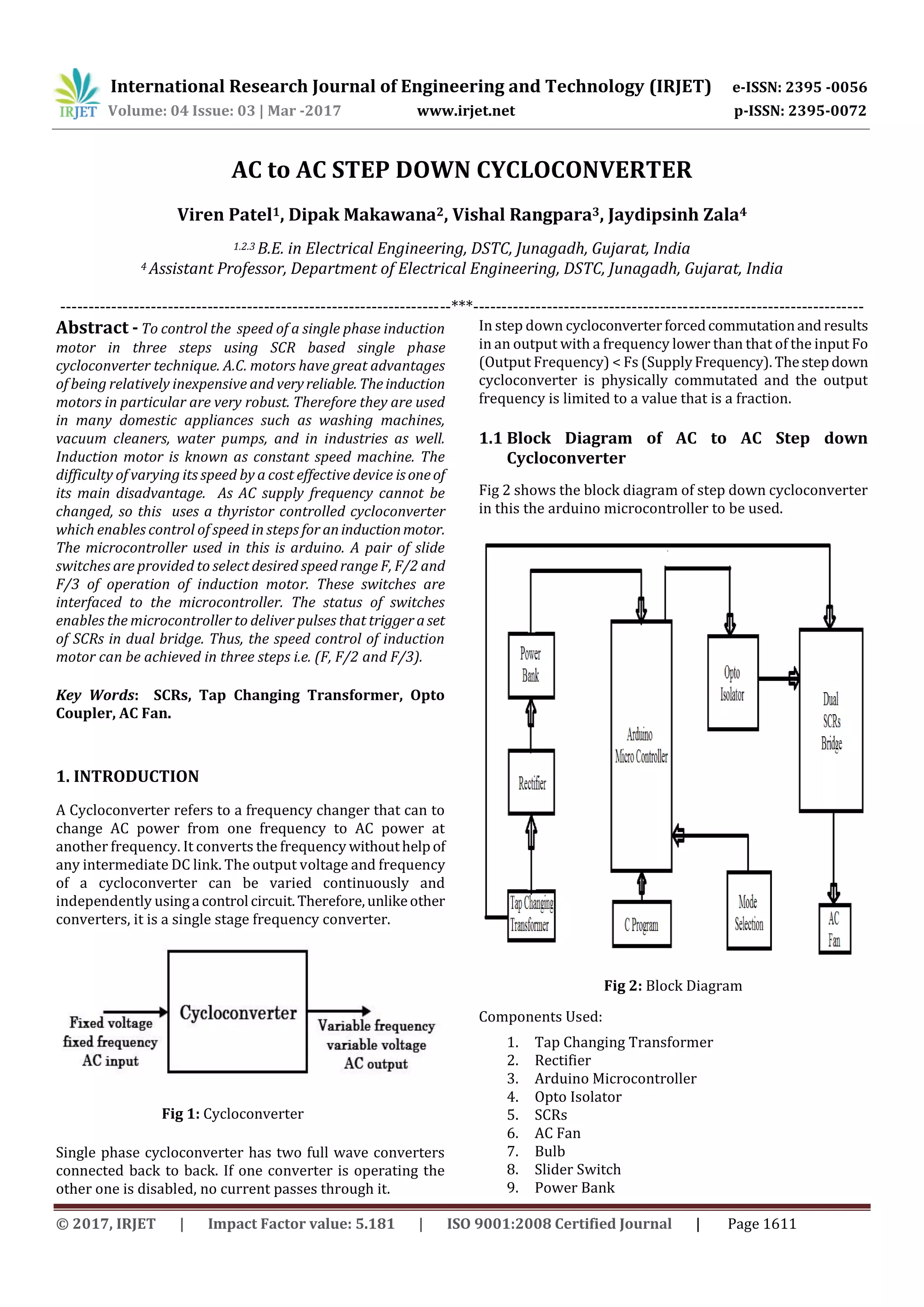
Fig 2 shows the block diagram of step down cycloconverter
in this the arduino microcontroller to be used.
Fig 2: Block Diagram
Components Used:
1. Tap Changing Transformer
2. Rectifier
3. Arduino Microcontroller
4. Opto Isolator
5. SCRs
6. AC Fan
7. Bulb
8. Slider Switch
9. Power Bank
International Research Journal of Engineering and Technology (IRJET) e-ISSN: 2395 -0056
Volume: 04 Issue: 03 | Mar -2017 www.irjet.net p-ISSN: 2395-0072
© 2017, IRJET | Impact Factor value: 5.181 | ISO 9001:2008 Certified Journal | Page 1612
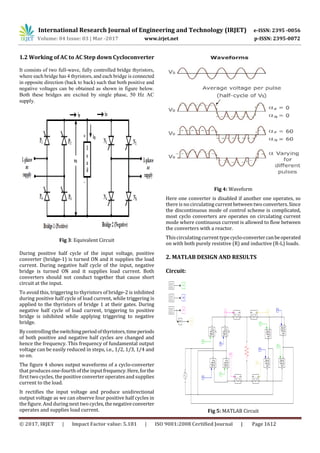
1.2 Working of AC to AC Step down Cycloconverter
It consists of two full-wave, fully controlled bridge thyristors,
where each bridge has 4 thyristors, and each bridge is connected
in opposite direction (back to back) such that both positive and
negative voltages can be obtained as shown in figure below.
Both these bridges are excited by single phase, 50 Hz AC
supply.
Fig 3: Equivalent Circuit
During positive half cycle of the input voltage, positive
converter (bridge-1) is turned ON and it supplies the load
current. During negative half cycle of the input, negative
bridge is turned ON and it supplies load current. Both
converters should not conduct together that cause short
circuit at the input.
To avoid this, triggering to thyristors of bridge-2 is inhibited
during positive half cycle of load current, while triggering is
applied to the thyristors of bridge 1 at their gates. During
negative half cycle of load current, triggering to positive
bridge is inhibited while applying triggering to negative
bridge.
By controllingtheswitchingperiodofthyristors,timeperiods
of both positive and negative half cycles are changed and
hence the frequency. This frequency of fundamental output
voltage can be easily reduced in steps, i.e., 1/2, 1/3, 1/4 and
so on.
The figure 4 shows output waveforms of a cyclo-converter
that produces one-fourth of the inputfrequency.Here,forthe
first two cycles, the positive converter operates and supplies
current to the load.
It rectifies the input voltage and produce unidirectional
output voltage as we can observe four positive half cycles in
the figure. And during next two cycles,thenegativeconverter
operates and supplies load current.
Fig 4: Waveform
Here one converter is disabled if another one operates, so
there is no circulating current between two converters.Since
the discontinuous mode of control scheme is complicated,
most cyclo converters are operates on circulating current
mode where continuous current is allowed to flow between
the converters with a reactor.
Thiscirculating current typecyclo-convertercanbeoperated
on with both purely resistive (R) and inductive (R-L) loads.
2. MATLAB DESIGN AND RESULTS
Circuit:
Fig 5: MATLAB Circuit
International Research Journal of Engineering and Technology (IRJET) e-ISSN: 2395 -0056
Volume: 04 Issue: 03 | Mar -2017 www.irjet.net p-ISSN: 2395-0072
© 2017, IRJET | Impact Factor value: 5.181 | ISO 9001:2008 Certified Journal | Page 1613
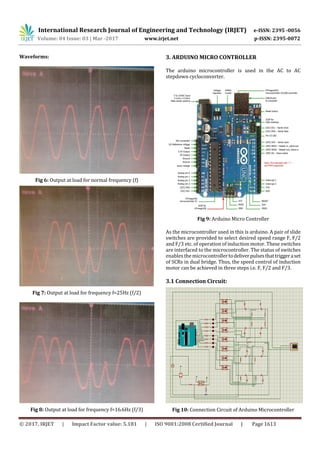
Waveforms:
Fig 6: Output at load for normal frequency (f)
Fig 7: Output at load for frequency f=25Hz (f/2)
Fig 8: Output at load for frequency f=16.6Hz (f/3)
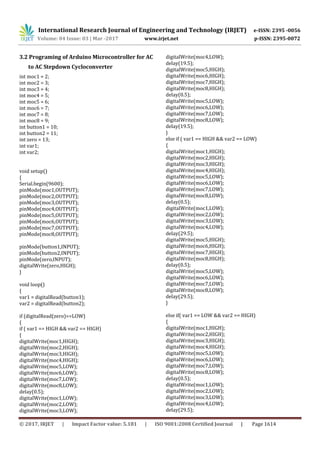
3. ARDUINO MICRO CONTROLLER
The arduino microcontroller is used in the AC to AC
stepdown cycloconverter.
Fig 9: Arduino Micro Controller
As the microcontroller used in this is arduino. A pair of slide
switches are provided to select desired speed range F, F/2
and F/3 etc. of operation of induction motor. These switches
are interfaced to the microcontroller. The status of switches
enables the microcontrollertodeliverpulsesthattriggeraset
of SCRs in dual bridge. Thus, the speed control of induction
motor can be achieved in three steps i.e. F, F/2 and F/3.
3.1 Connection Circuit:
Fig 10: Connection Circuit of Arduino Microcontroller
International Research Journal of Engineering and Technology (IRJET) e-ISSN: 2395 -0056
Volume: 04 Issue: 03 | Mar -2017 www.irjet.net p-ISSN: 2395-0072
© 2017, IRJET | Impact Factor value: 5.181 | ISO 9001:2008 Certified Journal | Page 1614
3.2 Programing of Arduino Microcontroller for AC
to AC Stepdown Cycloconverter
int moc1 = 2;
int moc2 = 3;
int moc3 = 4;
int moc4 = 5;
int moc5 = 6;
int moc6 = 7;
int moc7 = 8;
int moc8 = 9;
int button1 = 10;
int button2 = 11;
int zero = 13;
int var1;
int var2;
void setup()
{
Serial.begin(9600);
pinMode(moc1,OUTPUT);
pinMode(moc2,OUTPUT);
pinMode(moc3,OUTPUT);
pinMode(moc4,OUTPUT);
pinMode(moc5,OUTPUT);
pinMode(moc6,OUTPUT);
pinMode(moc7,OUTPUT);
pinMode(moc8,OUTPUT);
pinMode(button1,INPUT);
pinMode(button2,INPUT);
pinMode(zero,INPUT);
digitalWrite(zero,HIGH);
}
void loop()
{
var1 = digitalRead(button1);
var2 = digitalRead(button2);
if (digitalRead(zero)==LOW)
{
if ( var1 == HIGH && var2 == HIGH)
{
digitalWrite(moc1,HIGH);
digitalWrite(moc2,HIGH);
digitalWrite(moc3,HIGH);
digitalWrite(moc4,HIGH);
digitalWrite(moc5,LOW);
digitalWrite(moc6,LOW);
digitalWrite(moc7,LOW);
digitalWrite(moc8,LOW);
delay(0.5);
digitalWrite(moc1,LOW);
digitalWrite(moc2,LOW);
digitalWrite(moc3,LOW);
digitalWrite(moc4,LOW);
delay(19.5);
digitalWrite(moc5,HIGH);
digitalWrite(moc6,HIGH);
digitalWrite(moc7,HIGH);
digitalWrite(moc8,HIGH);
delay(0.5);
digitalWrite(moc5,LOW);
digitalWrite(moc6,LOW);
digitalWrite(moc7,LOW);
digitalWrite(moc8,LOW);
delay(19.5);
}
else if ( var1 == HIGH && var2 == LOW)
{
digitalWrite(moc1,HIGH);
digitalWrite(moc2,HIGH);
digitalWrite(moc3,HIGH);
digitalWrite(moc4,HIGH);
digitalWrite(moc5,LOW);
digitalWrite(moc6,LOW);
digitalWrite(moc7,LOW);
digitalWrite(moc8,LOW);
delay(0.5);
digitalWrite(moc1,LOW);
digitalWrite(moc2,LOW);
digitalWrite(moc3,LOW);
digitalWrite(moc4,LOW);
delay(29.5);
digitalWrite(moc5,HIGH);
digitalWrite(moc6,HIGH);
digitalWrite(moc7,HIGH);
digitalWrite(moc8,HIGH);
delay(0.5);
digitalWrite(moc5,LOW);
digitalWrite(moc6,LOW);
digitalWrite(moc7,LOW);
digitalWrite(moc8,LOW);
delay(29.5);
}
else if( var1 == LOW && var2 == HIGH)
{
digitalWrite(moc1,HIGH);
digitalWrite(moc2,HIGH);
digitalWrite(moc3,HIGH);
digitalWrite(moc4,HIGH);
digitalWrite(moc5,LOW);
digitalWrite(moc6,LOW);
digitalWrite(moc7,LOW);
digitalWrite(moc8,LOW);
delay(0.5);
digitalWrite(moc1,LOW);
digitalWrite(moc2,LOW);
digitalWrite(moc3,LOW);
digitalWrite(moc4,LOW);
delay(29.5);
International Research Journal of Engineering and Technology (IRJET) e-ISSN: 2395 -0056
Volume: 04 Issue: 03 | Mar -2017 www.irjet.net p-ISSN: 2395-0072
© 2017, IRJET | Impact Factor value: 5.181 | ISO 9001:2008 Certified Journal | Page 1615
digitalWrite(moc5,HIGH);
digitalWrite(moc6,HIGH);
digitalWrite(moc7,HIGH);
digitalWrite(moc8,HIGH);
delay(0.5);
digitalWrite(moc5,LOW);
digitalWrite(moc6,LOW);
digitalWrite(moc7,LOW);
digitalWrite(moc8,LOW);
delay(29.5);
}
else
{
digitalWrite(moc1,LOW);
digitalWrite(moc2,LOW);
digitalWrite(moc3,LOW);
digitalWrite(moc4,LOW);
digitalWrite(moc5,LOW);
digitalWrite(moc6,LOW);
digitalWrite(moc7,LOW);
digitalWrite(moc8,LOW);
}
}
}
3.3 Technical Specifications of Arduino Micro -
Controller
Table of Technical Specifications:
Microcontroller ATmega328P
Operating Voltage 5V
Input Voltage (recommended) 7-12 V
Input Voltage (limit) 6-20 V
Digital I/O Pins 14
Clock Speed 16MHz
PWM Digital I/O Pins 6
Analog Input Pins 6
DC Current per I/O Pins 20mA
DC Current for 3.3V Pin 50mA
SRAM 2KB
EPROM 1KB
Flash Memory 32KB
LED BUILTIN 13
4. CONCLUSIONS
From this work it is observed that speed of an induction
motor can be efficiently controlled by using Cycloconverter.
The role of Cycloconverter is in speed control of induction
motor is to vary the supply frequency which inturn, changes
the speed of motor. The speed control of induction motor
can be achieved in three steps i.e. (F, F/2 and F/3).
REFERENCES
[1] Vinamra Kumar Govil, Yogesh Chaurasia “Modeling &
Simulation of PWM Controlled Cycloconverter FED Split
Phase Induction Motor” International Journal of Advanced
Research in Electrical, Electronics and Instrumentation
Engineering, Vol. 1, Issue 3, September 2012.
[2] E A Lewis “Cycloconverter Drive Systems” Power
Electronics and Variable Speed Drives, Conference
Publication No. 429, IEEE, 1996.
[3] C. Lander, Power Electronics, Second Edition, McGraw
Hill, England, 1987
[4] BurakOzpineci, Leon M. Tolbert, “Cycloconverters”,
University of Tennessee-Knoxville, Knoxville, USA.
[5] J. Zhang, “Single phase input cycloconverters driving an
induction motor” Ph.D. thesis, University of Technology,
Sydney.
International Research Journal of Engineering and Technology (IRJET) e-ISSN: 2395 -0056
Volume: 04 Issue: 03 | Mar -2017 www.irjet.net p-ISSN: 2395-0072
© 2017, IRJET | Impact Factor value: 5.181 | ISO 9001:2008 Certified Journal | Page 1616
BIOGRAPHIES
Viren J. Patel
B.E. in Electrical Engineering at Dr.
Subhash Technical campus - Junagadh,
Gujarat, India
Dipak K. Makawana
B.E. in Electrical Engineering at Dr.
Subhash Technical campus - Junagadh,
Gujarat, India
Vishal M. Rangpara
B.E. in Electrical Engineering at Dr.
Subhash Technical campus - Junagadh,
Gujarat, India
Jaydipsinh B. Zala
Assistant Professor in Electrical
Engineering Department at Dr. Subhash
Technical Campus - Junagadh, Gujarat,
India

AC to AC Step Down Cycloconverter

  • 1.
    International Research Journalof Engineering and Technology (IRJET) e-ISSN: 2395 -0056 Volume: 04 Issue: 03 | Mar -2017 www.irjet.net p-ISSN: 2395-0072 © 2017, IRJET | Impact Factor value: 5.181 | ISO 9001:2008 Certified Journal | Page 1611 AC to AC STEP DOWN CYCLOCONVERTER Viren Patel1, Dipak Makawana2, Vishal Rangpara3, Jaydipsinh Zala4 1.2.3 B.E. in Electrical Engineering, DSTC, Junagadh, Gujarat, India 4 Assistant Professor, Department of Electrical Engineering, DSTC, Junagadh, Gujarat, India ---------------------------------------------------------------------***--------------------------------------------------------------------- Abstract - To control the speed of a single phase induction motor in three steps using SCR based single phase cycloconverter technique. A.C. motors have great advantages of being relatively inexpensive and veryreliable. Theinduction motors in particular are very robust. Therefore they are used in many domestic appliances such as washing machines, vacuum cleaners, water pumps, and in industries as well. Induction motor is known as constant speed machine. The difficulty of varying its speed by a cost effective device isoneof its main disadvantage. As AC supply frequency cannot be changed, so this uses a thyristor controlled cycloconverter which enables control of speed in steps for aninductionmotor. The microcontroller used in this is arduino. A pair of slide switches are provided to select desired speed range F, F/2 and F/3 of operation of induction motor. These switches are interfaced to the microcontroller. The status of switches enables the microcontroller to deliver pulses that trigger aset of SCRs in dual bridge. Thus, the speed control of induction motor can be achieved in three steps i.e. (F, F/2 and F/3). Key Words: SCRs, Tap Changing Transformer, Opto Coupler, AC Fan. 1. INTRODUCTION A Cycloconverter refers to a frequency changer that can to change AC power from one frequency to AC power at another frequency. It converts the frequency withouthelpof any intermediate DC link. The output voltage and frequency of a cycloconverter can be varied continuously and independently usinga control circuit.Therefore,unlikeother converters, it is a single stage frequency converter. Fig 1: Cycloconverter Single phase cycloconverter has two full wave converters connected back to back. If one converter is operating the other one is disabled, no current passes through it. In step down cycloconverterforcedcommutationandresults in an output with a frequency lower than that of the input Fo (Output Frequency) < Fs (SupplyFrequency). Thestepdown cycloconverter is physically commutated and the output frequency is limited to a value that is a fraction. 1.1 Block Diagram of AC to AC Step down Cycloconverter Fig 2 shows the block diagram of step down cycloconverter in this the arduino microcontroller to be used. Fig 2: Block Diagram Components Used: 1. Tap Changing Transformer 2. Rectifier 3. Arduino Microcontroller 4. Opto Isolator 5. SCRs 6. AC Fan 7. Bulb 8. Slider Switch 9. Power Bank
  • 2.
    International Research Journalof Engineering and Technology (IRJET) e-ISSN: 2395 -0056 Volume: 04 Issue: 03 | Mar -2017 www.irjet.net p-ISSN: 2395-0072 © 2017, IRJET | Impact Factor value: 5.181 | ISO 9001:2008 Certified Journal | Page 1612 1.2 Working of AC to AC Step down Cycloconverter It consists of two full-wave, fully controlled bridge thyristors, where each bridge has 4 thyristors, and each bridge is connected in opposite direction (back to back) such that both positive and negative voltages can be obtained as shown in figure below. Both these bridges are excited by single phase, 50 Hz AC supply. Fig 3: Equivalent Circuit During positive half cycle of the input voltage, positive converter (bridge-1) is turned ON and it supplies the load current. During negative half cycle of the input, negative bridge is turned ON and it supplies load current. Both converters should not conduct together that cause short circuit at the input. To avoid this, triggering to thyristors of bridge-2 is inhibited during positive half cycle of load current, while triggering is applied to the thyristors of bridge 1 at their gates. During negative half cycle of load current, triggering to positive bridge is inhibited while applying triggering to negative bridge. By controllingtheswitchingperiodofthyristors,timeperiods of both positive and negative half cycles are changed and hence the frequency. This frequency of fundamental output voltage can be easily reduced in steps, i.e., 1/2, 1/3, 1/4 and so on. The figure 4 shows output waveforms of a cyclo-converter that produces one-fourth of the inputfrequency.Here,forthe first two cycles, the positive converter operates and supplies current to the load. It rectifies the input voltage and produce unidirectional output voltage as we can observe four positive half cycles in the figure. And during next two cycles,thenegativeconverter operates and supplies load current. Fig 4: Waveform Here one converter is disabled if another one operates, so there is no circulating current between two converters.Since the discontinuous mode of control scheme is complicated, most cyclo converters are operates on circulating current mode where continuous current is allowed to flow between the converters with a reactor. Thiscirculating current typecyclo-convertercanbeoperated on with both purely resistive (R) and inductive (R-L) loads. 2. MATLAB DESIGN AND RESULTS Circuit: Fig 5: MATLAB Circuit
  • 3.
    International Research Journalof Engineering and Technology (IRJET) e-ISSN: 2395 -0056 Volume: 04 Issue: 03 | Mar -2017 www.irjet.net p-ISSN: 2395-0072 © 2017, IRJET | Impact Factor value: 5.181 | ISO 9001:2008 Certified Journal | Page 1613 Waveforms: Fig 6: Output at load for normal frequency (f) Fig 7: Output at load for frequency f=25Hz (f/2) Fig 8: Output at load for frequency f=16.6Hz (f/3) 3. ARDUINO MICRO CONTROLLER The arduino microcontroller is used in the AC to AC stepdown cycloconverter. Fig 9: Arduino Micro Controller As the microcontroller used in this is arduino. A pair of slide switches are provided to select desired speed range F, F/2 and F/3 etc. of operation of induction motor. These switches are interfaced to the microcontroller. The status of switches enables the microcontrollertodeliverpulsesthattriggeraset of SCRs in dual bridge. Thus, the speed control of induction motor can be achieved in three steps i.e. F, F/2 and F/3. 3.1 Connection Circuit: Fig 10: Connection Circuit of Arduino Microcontroller
  • 4.
    International Research Journalof Engineering and Technology (IRJET) e-ISSN: 2395 -0056 Volume: 04 Issue: 03 | Mar -2017 www.irjet.net p-ISSN: 2395-0072 © 2017, IRJET | Impact Factor value: 5.181 | ISO 9001:2008 Certified Journal | Page 1614 3.2 Programing of Arduino Microcontroller for AC to AC Stepdown Cycloconverter int moc1 = 2; int moc2 = 3; int moc3 = 4; int moc4 = 5; int moc5 = 6; int moc6 = 7; int moc7 = 8; int moc8 = 9; int button1 = 10; int button2 = 11; int zero = 13; int var1; int var2; void setup() { Serial.begin(9600); pinMode(moc1,OUTPUT); pinMode(moc2,OUTPUT); pinMode(moc3,OUTPUT); pinMode(moc4,OUTPUT); pinMode(moc5,OUTPUT); pinMode(moc6,OUTPUT); pinMode(moc7,OUTPUT); pinMode(moc8,OUTPUT); pinMode(button1,INPUT); pinMode(button2,INPUT); pinMode(zero,INPUT); digitalWrite(zero,HIGH); } void loop() { var1 = digitalRead(button1); var2 = digitalRead(button2); if (digitalRead(zero)==LOW) { if ( var1 == HIGH && var2 == HIGH) { digitalWrite(moc1,HIGH); digitalWrite(moc2,HIGH); digitalWrite(moc3,HIGH); digitalWrite(moc4,HIGH); digitalWrite(moc5,LOW); digitalWrite(moc6,LOW); digitalWrite(moc7,LOW); digitalWrite(moc8,LOW); delay(0.5); digitalWrite(moc1,LOW); digitalWrite(moc2,LOW); digitalWrite(moc3,LOW); digitalWrite(moc4,LOW); delay(19.5); digitalWrite(moc5,HIGH); digitalWrite(moc6,HIGH); digitalWrite(moc7,HIGH); digitalWrite(moc8,HIGH); delay(0.5); digitalWrite(moc5,LOW); digitalWrite(moc6,LOW); digitalWrite(moc7,LOW); digitalWrite(moc8,LOW); delay(19.5); } else if ( var1 == HIGH && var2 == LOW) { digitalWrite(moc1,HIGH); digitalWrite(moc2,HIGH); digitalWrite(moc3,HIGH); digitalWrite(moc4,HIGH); digitalWrite(moc5,LOW); digitalWrite(moc6,LOW); digitalWrite(moc7,LOW); digitalWrite(moc8,LOW); delay(0.5); digitalWrite(moc1,LOW); digitalWrite(moc2,LOW); digitalWrite(moc3,LOW); digitalWrite(moc4,LOW); delay(29.5); digitalWrite(moc5,HIGH); digitalWrite(moc6,HIGH); digitalWrite(moc7,HIGH); digitalWrite(moc8,HIGH); delay(0.5); digitalWrite(moc5,LOW); digitalWrite(moc6,LOW); digitalWrite(moc7,LOW); digitalWrite(moc8,LOW); delay(29.5); } else if( var1 == LOW && var2 == HIGH) { digitalWrite(moc1,HIGH); digitalWrite(moc2,HIGH); digitalWrite(moc3,HIGH); digitalWrite(moc4,HIGH); digitalWrite(moc5,LOW); digitalWrite(moc6,LOW); digitalWrite(moc7,LOW); digitalWrite(moc8,LOW); delay(0.5); digitalWrite(moc1,LOW); digitalWrite(moc2,LOW); digitalWrite(moc3,LOW); digitalWrite(moc4,LOW); delay(29.5);
  • 5.
    International Research Journalof Engineering and Technology (IRJET) e-ISSN: 2395 -0056 Volume: 04 Issue: 03 | Mar -2017 www.irjet.net p-ISSN: 2395-0072 © 2017, IRJET | Impact Factor value: 5.181 | ISO 9001:2008 Certified Journal | Page 1615 digitalWrite(moc5,HIGH); digitalWrite(moc6,HIGH); digitalWrite(moc7,HIGH); digitalWrite(moc8,HIGH); delay(0.5); digitalWrite(moc5,LOW); digitalWrite(moc6,LOW); digitalWrite(moc7,LOW); digitalWrite(moc8,LOW); delay(29.5); } else { digitalWrite(moc1,LOW); digitalWrite(moc2,LOW); digitalWrite(moc3,LOW); digitalWrite(moc4,LOW); digitalWrite(moc5,LOW); digitalWrite(moc6,LOW); digitalWrite(moc7,LOW); digitalWrite(moc8,LOW); } } } 3.3 Technical Specifications of Arduino Micro - Controller Table of Technical Specifications: Microcontroller ATmega328P Operating Voltage 5V Input Voltage (recommended) 7-12 V Input Voltage (limit) 6-20 V Digital I/O Pins 14 Clock Speed 16MHz PWM Digital I/O Pins 6 Analog Input Pins 6 DC Current per I/O Pins 20mA DC Current for 3.3V Pin 50mA SRAM 2KB EPROM 1KB Flash Memory 32KB LED BUILTIN 13 4. CONCLUSIONS From this work it is observed that speed of an induction motor can be efficiently controlled by using Cycloconverter. The role of Cycloconverter is in speed control of induction motor is to vary the supply frequency which inturn, changes the speed of motor. The speed control of induction motor can be achieved in three steps i.e. (F, F/2 and F/3). REFERENCES [1] Vinamra Kumar Govil, Yogesh Chaurasia “Modeling & Simulation of PWM Controlled Cycloconverter FED Split Phase Induction Motor” International Journal of Advanced Research in Electrical, Electronics and Instrumentation Engineering, Vol. 1, Issue 3, September 2012. [2] E A Lewis “Cycloconverter Drive Systems” Power Electronics and Variable Speed Drives, Conference Publication No. 429, IEEE, 1996. [3] C. Lander, Power Electronics, Second Edition, McGraw Hill, England, 1987 [4] BurakOzpineci, Leon M. Tolbert, “Cycloconverters”, University of Tennessee-Knoxville, Knoxville, USA. [5] J. Zhang, “Single phase input cycloconverters driving an induction motor” Ph.D. thesis, University of Technology, Sydney.
  • 6.
    International Research Journalof Engineering and Technology (IRJET) e-ISSN: 2395 -0056 Volume: 04 Issue: 03 | Mar -2017 www.irjet.net p-ISSN: 2395-0072 © 2017, IRJET | Impact Factor value: 5.181 | ISO 9001:2008 Certified Journal | Page 1616 BIOGRAPHIES Viren J. Patel B.E. in Electrical Engineering at Dr. Subhash Technical campus - Junagadh, Gujarat, India Dipak K. Makawana B.E. in Electrical Engineering at Dr. Subhash Technical campus - Junagadh, Gujarat, India Vishal M. Rangpara B.E. in Electrical Engineering at Dr. Subhash Technical campus - Junagadh, Gujarat, India Jaydipsinh B. Zala Assistant Professor in Electrical Engineering Department at Dr. Subhash Technical Campus - Junagadh, Gujarat, India