Intel & McAfee Confidential 
Strategic Leadership for Managing Evolving Cybersecurity Risks 
NSF Cybersecurity Summit 2014 
August 28th2014, Arlington Virginia 
Matthew RosenquistCybersecurity Strategist, Intel Corp
Opportunity and Challenges 
Working together to address 
•Burning challenges of today 
•Opportunities for a better tomorrow 
•Many roles and uncertainty 
•Embracing the best practices across the industry 
•What does success look like?
Technology connects and enriches the lives of every person on earth 
Security is critical to protect computing technology from threats which undermine the health of the industry
ā€œ...If security breaks down, technology breaks downā€ 
Brian Krebs 
Noted Cybersecurity Reporter
We manage security through either leadership or crisis. In the absence of leadership, we are left with crisis. 
crisis In the absence of leadership, we are left with crisis
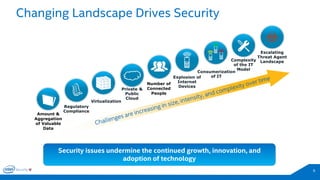
Changing Landscape Drives Security 
6 
Security issues undermine the continued growth, innovation, and adoption of technology 
Amount & Aggregation of Valuable Data 
Number of Connected People
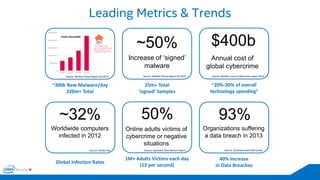
Leading Metrics & Trends 
~300k New Malware/day 220m+ Total 
25m+ Totalā€˜signed’ Samples 
Increase of ā€˜signed’ malware 
~50% 
40% Increasein Data Breaches 
Organizations suffering a data breach in 2013 
93% 
1M+ Adults Victims each day (12 per second) 
Online adults victims of cybercrime or negative situations 
50% 
~20%-30% of overall technology spending1 
Source: McAfee Cost of Cybercrime report 2014 
Source: McAfee Threat Report Q1 2014 
Source: McAfee Threat Report Q3 2013 
Global Infection Rates 
Worldwide computers infected in 2012 
~32% 
Source: Panda Labs 
Source: UK Government BIS Survey 
Source: Symantec 2013 Norton Report 
$400b 
Annual cost ofglobal cybercrime 
TOTAL MALWARE
8 
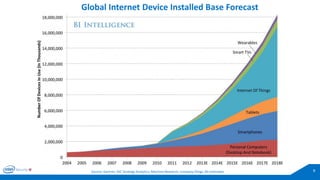
Source: Gartner, IDC Strategy Analytics, MachinaResearch, company filings, BII estimates 
Global Internet Device Installed Base Forecast
9 
~$3 Trillion 
Aggregate economic impact of cybersecurity on technology trends, through 20201 
1Risk and Responsibility in a HyperconnectedWorld -2014 World Economic Forum, http://www.mckinsey.com/insights/business_technology/risk_and_responsibility_in_a_hyperconnected_world_implications_for_enterprises
We manage security through either leadership or crisis. In the absence of leadership, we are left with crisis. 
Leadership is key in organizing resources to achieve and maintain an optimal level of security value
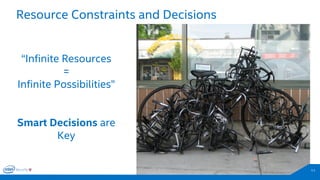
Resource Constraints and Decisions 
11 
ā€œInfinite Resources 
= 
Infinite Possibilitiesā€ 
Smart Decisions are Key
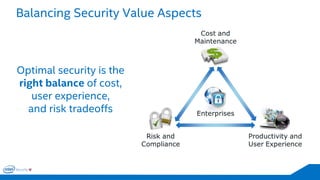
Balancing Security Value Aspects 
Optimal security is the right balance of cost, user experience, and risk tradeoffs
13 
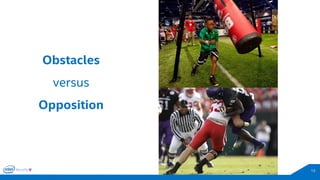
Obstacles 
versus 
Opposition
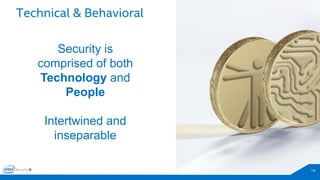
Technical & Behavioral 
14 
Security is comprised of both Technologyand People 
Intertwined and inseparable
15 
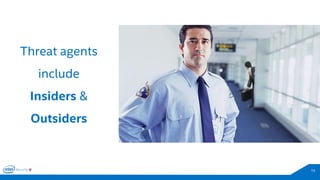
Threat agents include 
Insiders& Outsiders
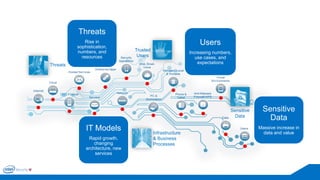
Users 
Increasing numbers, use cases, and expectations 
Sensitive Data 
Massive increase in data and value 
IT Models 
Rapid growth, changing architecture, new services 
Threats 
Infrastructure& Business Processes 
Trusted 
Users 
SensitiveData 
Threats 
Rise in sophistication, numbers, and resources
We manage security through either leadership or crisis. In the absence of leadership, we are left with crisis. 
An effective strategy enables operational flexibility, while driving cost efficiency, and risk manageability
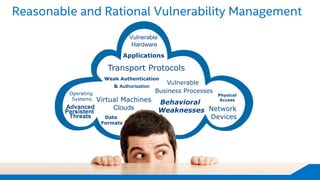
Reasonable and Rational Vulnerability Management 
Operating Systems 
Applications 
Virtual MachinesClouds 
Data Formats 
PhysicalAccess 
Behavioral Weaknesses 
Network Devices 
Transport Protocols 
Vulnerable 
Business Processes 
Weak Authentication 
& Authorization 
Vulnerable Hardware 
AdvancedPersistent Threats
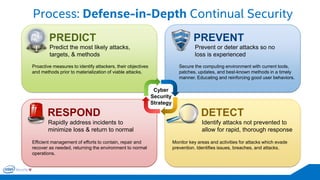
Process: Defense-in-DepthContinual Security 
DETECT 
Identify attacks not prevented to allow for rapid, thorough response 
Monitor key areas and activities for attacks which evade prevention. Identifies issues, breaches, and attacks. 
RESPOND 
Rapidly address incidents to minimize loss & return to normal 
Efficient management of efforts to contain, repair and recover as needed, returning the environment to normal operations. 
PREDICT 
Predict the most likely attacks, targets, & methods 
Proactive measures to identify attackers, their objectives and methods prior to materialization of viable attacks. 
PREVENT 
Prevent or deter attacks so no loss is experienced 
Secure the computing environment with current tools, patches, updates, and best-known methods in a timely manner. Educating and reinforcing good user behaviors. 
Cyber 
Security 
Strategy
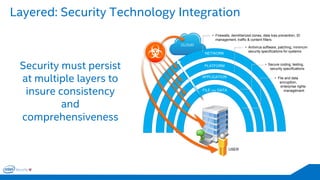
Layered: Security Technology Integration 
Security must persist at multiple layers to insure consistency and comprehensiveness 
NETWORK 
•Firewalls, demilitarized zones, data loss prevention, ID management, traffic & content filters 
PLATFORM 
•Antivirus software, patching, minimum security specifications for systems 
APPLICATION 
•Secure coding, testing, security specifications 
FILE ANDDATA 
•File and data encryption, 
enterprise rights management 
CLOUD 
USER
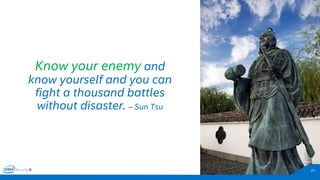
Know your enemyand know yourself and you can fight a thousand battles without disaster. –Sun Tsu 
21
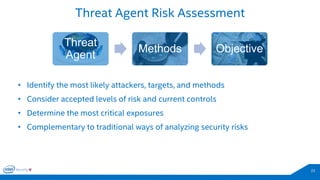
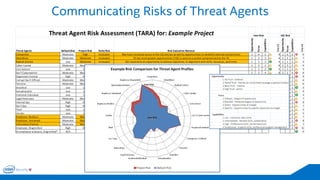
Threat Agent Risk Assessment 
22 
Threat Agent 
Methods 
Objective 
•Identify the most likely attackers, targets, and methods 
•Consider accepted levels of risk and current controls 
•Determine the most critical exposures 
•Complementary to traditional ways of analyzing security risks
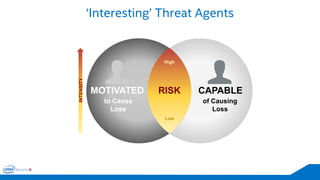
ā€˜Interesting’ Threat Agents 
RISK 
High 
Low 
MOTIVATED 
CAPABLE 
to Cause 
Loss 
of Causing 
Loss 
INTENSITY
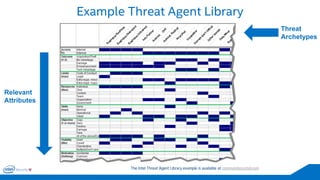
Example Threat Agent Library 
The Intel Threat Agent Library example is availableat communities.intel.com 
ThreatArchetypes 
RelevantAttributes
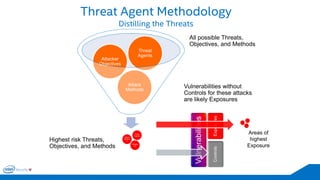
Threat Agent MethodologyDistilling the Threats 
Attack Methods 
Attacker Objectives 
Threat Agents 
Vulnerabilities without Controls for these attacks are likely Exposures 
Areas of highest Exposure 
All possible Threats, Objectives, and Methods 
Highest risk Threats, Objectives, and Methods 
Objectives 
Threat Agents 
Attack Methods
Communicating Risks of Threat Agents
We manage security through either leadership or crisis. In the absence of leadership, we are left with crisis. 
Two types of victims exist: those with something of value and those who are easy targetsTherefore: Don’t be an easy target, and protect your valuables
28 
Bad Assumptions: 
ļ‚§I am not a target for attack -> 
ļ‚§Security is an IT/user/security/product/other-guy problem -> 
ļ‚§Closed environments -> 
ļ‚§Insiders aren’t a major problem -> 
Where there is value, there is risk. …(the Willie Sutton principle) 
It is everyone’s problem and requires everyone to contribute. 
…aren’t really as closed as you think. 
Insiders are a significant risk, but largely hidden until something big goes wrong! 
Bad Assumptions & Good Practices
Bad Assumptions & Good Practices 
29 
Good Practices: 
ļ‚§Understand primary threats (most relevant agents, their objectives, & likely methods) 
ļ‚§Value and grow security savvy users/employees 
ļ‚§Plan across the Defense-in-Depth (predict, prevent, detect, respond) 
ļ‚§Disrupt the attack cycle (threat agent -> methods -> objectives) 
ļ‚§Think ahead, but never forsake security fundamentals 
ļ‚§Gauge investments with Security Aspects (innovative, hardened, trusted, ubiquitous)
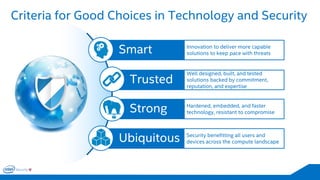
Smart 
Innovation to deliver more capable solutions to keep pace with threats 
Ubiquitous 
Security benefitting all users and devices across the compute landscape 
Trusted 
Well designed, built, and tested solutions backed by commitment, reputation, and expertise 
Strong 
Hardened, embedded, and faster technology, resistant to compromise 
Criteria for Good Choices in Technology and Security
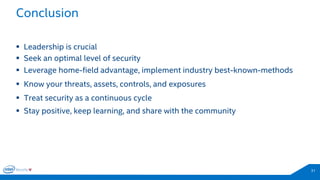
Conclusion 
31 
ļ‚§Leadership is crucial 
ļ‚§Leverage home-field advantage, implement industry best-known-methods 
ļ‚§Know your threats, assets, controls, and exposures 
ļ‚§Treat security as a continuous cycle 
ļ‚§Seek an optimal level of security 
ļ‚§Stay positive, keep learning, and share with the community
32

Strategic Leadership for Managing Evolving Cybersecurity Risks

  • 1.
    Intel & McAfeeConfidential Strategic Leadership for Managing Evolving Cybersecurity Risks NSF Cybersecurity Summit 2014 August 28th2014, Arlington Virginia Matthew RosenquistCybersecurity Strategist, Intel Corp
  • 2.
    Opportunity and Challenges Working together to address •Burning challenges of today •Opportunities for a better tomorrow •Many roles and uncertainty •Embracing the best practices across the industry •What does success look like?
  • 3.
    Technology connects andenriches the lives of every person on earth Security is critical to protect computing technology from threats which undermine the health of the industry
  • 4.
    ā€œ...If security breaksdown, technology breaks downā€ Brian Krebs Noted Cybersecurity Reporter
  • 5.
    We manage securitythrough either leadership or crisis. In the absence of leadership, we are left with crisis. crisis In the absence of leadership, we are left with crisis
  • 6.
    Changing Landscape DrivesSecurity 6 Security issues undermine the continued growth, innovation, and adoption of technology Amount & Aggregation of Valuable Data Number of Connected People
  • 7.
    Leading Metrics &Trends ~300k New Malware/day 220m+ Total 25m+ Totalā€˜signed’ Samples Increase of ā€˜signed’ malware ~50% 40% Increasein Data Breaches Organizations suffering a data breach in 2013 93% 1M+ Adults Victims each day (12 per second) Online adults victims of cybercrime or negative situations 50% ~20%-30% of overall technology spending1 Source: McAfee Cost of Cybercrime report 2014 Source: McAfee Threat Report Q1 2014 Source: McAfee Threat Report Q3 2013 Global Infection Rates Worldwide computers infected in 2012 ~32% Source: Panda Labs Source: UK Government BIS Survey Source: Symantec 2013 Norton Report $400b Annual cost ofglobal cybercrime TOTAL MALWARE
  • 8.
    8 Source: Gartner,IDC Strategy Analytics, MachinaResearch, company filings, BII estimates Global Internet Device Installed Base Forecast
  • 9.
    9 ~$3 Trillion Aggregate economic impact of cybersecurity on technology trends, through 20201 1Risk and Responsibility in a HyperconnectedWorld -2014 World Economic Forum, http://www.mckinsey.com/insights/business_technology/risk_and_responsibility_in_a_hyperconnected_world_implications_for_enterprises
  • 10.
    We manage securitythrough either leadership or crisis. In the absence of leadership, we are left with crisis. Leadership is key in organizing resources to achieve and maintain an optimal level of security value
  • 11.
    Resource Constraints andDecisions 11 ā€œInfinite Resources = Infinite Possibilitiesā€ Smart Decisions are Key
  • 12.
    Balancing Security ValueAspects Optimal security is the right balance of cost, user experience, and risk tradeoffs
  • 13.
  • 14.
    Technical & Behavioral 14 Security is comprised of both Technologyand People Intertwined and inseparable
  • 15.
    15 Threat agentsinclude Insiders& Outsiders
  • 16.
    Users Increasing numbers,use cases, and expectations Sensitive Data Massive increase in data and value IT Models Rapid growth, changing architecture, new services Threats Infrastructure& Business Processes Trusted Users SensitiveData Threats Rise in sophistication, numbers, and resources
  • 17.
    We manage securitythrough either leadership or crisis. In the absence of leadership, we are left with crisis. An effective strategy enables operational flexibility, while driving cost efficiency, and risk manageability
  • 18.
    Reasonable and RationalVulnerability Management Operating Systems Applications Virtual MachinesClouds Data Formats PhysicalAccess Behavioral Weaknesses Network Devices Transport Protocols Vulnerable Business Processes Weak Authentication & Authorization Vulnerable Hardware AdvancedPersistent Threats
  • 19.
    Process: Defense-in-DepthContinual Security DETECT Identify attacks not prevented to allow for rapid, thorough response Monitor key areas and activities for attacks which evade prevention. Identifies issues, breaches, and attacks. RESPOND Rapidly address incidents to minimize loss & return to normal Efficient management of efforts to contain, repair and recover as needed, returning the environment to normal operations. PREDICT Predict the most likely attacks, targets, & methods Proactive measures to identify attackers, their objectives and methods prior to materialization of viable attacks. PREVENT Prevent or deter attacks so no loss is experienced Secure the computing environment with current tools, patches, updates, and best-known methods in a timely manner. Educating and reinforcing good user behaviors. Cyber Security Strategy
  • 20.
    Layered: Security TechnologyIntegration Security must persist at multiple layers to insure consistency and comprehensiveness NETWORK •Firewalls, demilitarized zones, data loss prevention, ID management, traffic & content filters PLATFORM •Antivirus software, patching, minimum security specifications for systems APPLICATION •Secure coding, testing, security specifications FILE ANDDATA •File and data encryption, enterprise rights management CLOUD USER
  • 21.
    Know your enemyandknow yourself and you can fight a thousand battles without disaster. –Sun Tsu 21
  • 22.
    Threat Agent RiskAssessment 22 Threat Agent Methods Objective •Identify the most likely attackers, targets, and methods •Consider accepted levels of risk and current controls •Determine the most critical exposures •Complementary to traditional ways of analyzing security risks
  • 23.
    ā€˜Interesting’ Threat Agents RISK High Low MOTIVATED CAPABLE to Cause Loss of Causing Loss INTENSITY
  • 24.
    Example Threat AgentLibrary The Intel Threat Agent Library example is availableat communities.intel.com ThreatArchetypes RelevantAttributes
  • 25.
    Threat Agent MethodologyDistillingthe Threats Attack Methods Attacker Objectives Threat Agents Vulnerabilities without Controls for these attacks are likely Exposures Areas of highest Exposure All possible Threats, Objectives, and Methods Highest risk Threats, Objectives, and Methods Objectives Threat Agents Attack Methods
  • 26.
  • 27.
    We manage securitythrough either leadership or crisis. In the absence of leadership, we are left with crisis. Two types of victims exist: those with something of value and those who are easy targetsTherefore: Don’t be an easy target, and protect your valuables
  • 28.
    28 Bad Assumptions: ļ‚§I am not a target for attack -> ļ‚§Security is an IT/user/security/product/other-guy problem -> ļ‚§Closed environments -> ļ‚§Insiders aren’t a major problem -> Where there is value, there is risk. …(the Willie Sutton principle) It is everyone’s problem and requires everyone to contribute. …aren’t really as closed as you think. Insiders are a significant risk, but largely hidden until something big goes wrong! Bad Assumptions & Good Practices
  • 29.
    Bad Assumptions &Good Practices 29 Good Practices: ļ‚§Understand primary threats (most relevant agents, their objectives, & likely methods) ļ‚§Value and grow security savvy users/employees ļ‚§Plan across the Defense-in-Depth (predict, prevent, detect, respond) ļ‚§Disrupt the attack cycle (threat agent -> methods -> objectives) ļ‚§Think ahead, but never forsake security fundamentals ļ‚§Gauge investments with Security Aspects (innovative, hardened, trusted, ubiquitous)
  • 30.
    Smart Innovation todeliver more capable solutions to keep pace with threats Ubiquitous Security benefitting all users and devices across the compute landscape Trusted Well designed, built, and tested solutions backed by commitment, reputation, and expertise Strong Hardened, embedded, and faster technology, resistant to compromise Criteria for Good Choices in Technology and Security
  • 31.
    Conclusion 31 ļ‚§Leadershipis crucial ļ‚§Leverage home-field advantage, implement industry best-known-methods ļ‚§Know your threats, assets, controls, and exposures ļ‚§Treat security as a continuous cycle ļ‚§Seek an optimal level of security ļ‚§Stay positive, keep learning, and share with the community
  • 32.