Evolutionarypredictionsforcybersecurity
2016andbeyond
Matthew Rosenquist
Cybersecurity Strategist,
Intel Corp
January 2016
Biography
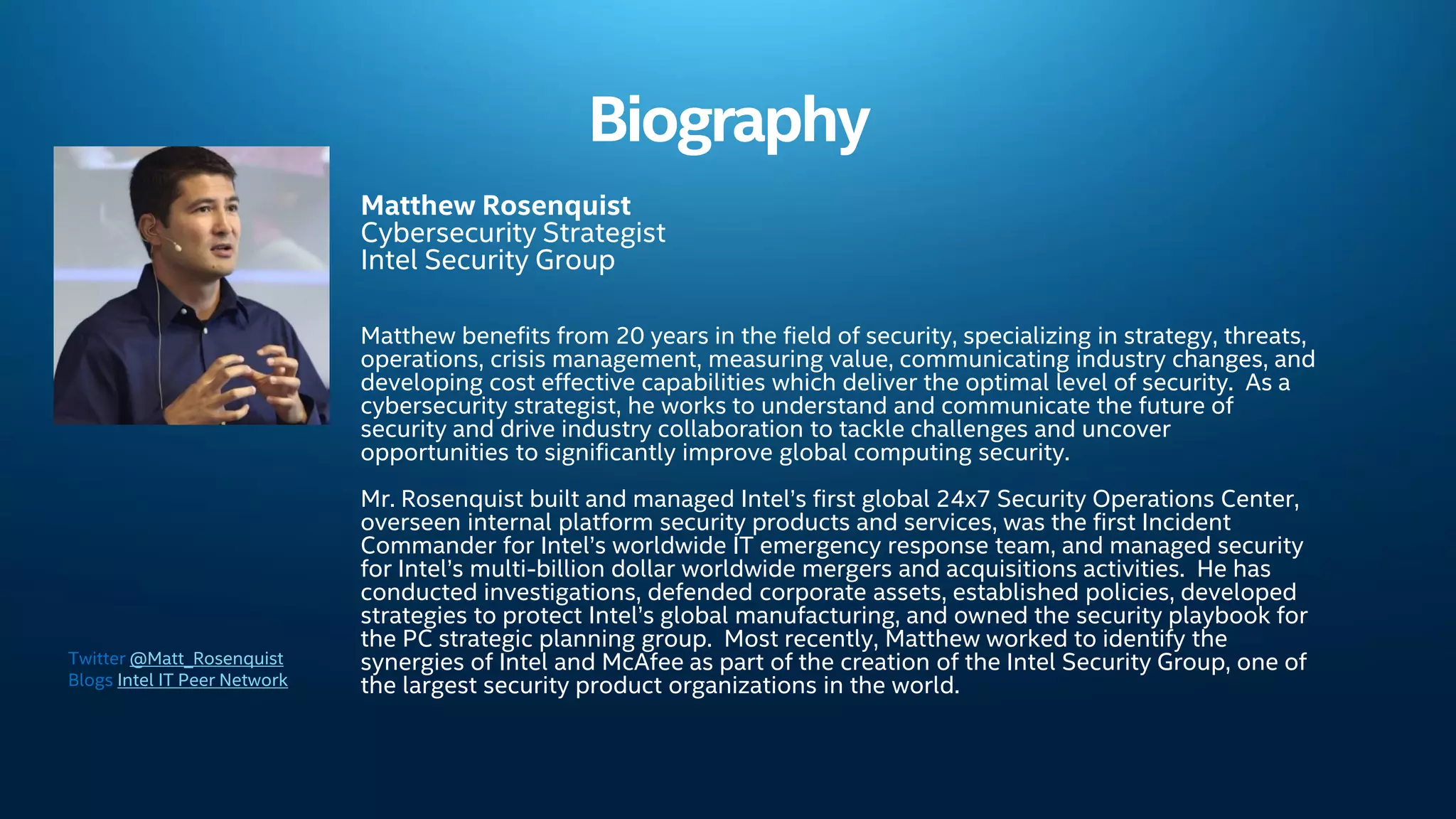
Matthew Rosenquist
Cybersecurity Strategist
Intel Security Group
Matthew benefits from 20 years in the field of security, specializing in strategy, threats,
operations, crisis management, measuring value, communicating industry changes, and
developing cost effective capabilities which deliver the optimal level of security. As a
cybersecurity strategist, he works to understand and communicate the future of
security and drive industry collaboration to tackle challenges and uncover
opportunities to significantly improve global computing security.
Mr. Rosenquist built and managed Intel’s first global 24x7 Security Operations Center,
overseen internal platform security products and services, was the first Incident
Commander for Intel’s worldwide IT emergency response team, and managed security
for Intel’s multi-billion dollar worldwide mergers and acquisitions activities. He has
conducted investigations, defended corporate assets, established policies, developed
strategies to protect Intel’s global manufacturing, and owned the security playbook for
the PC strategic planning group. Most recently, Matthew worked to identify the
synergies of Intel and McAfee as part of the creation of the Intel Security Group, one of
the largest security product organizations in the world.
Twitter @Matt_Rosenquist
Blogs Intel IT Peer Network
ChainReactionsDriveCybersecurityEvolution…
1. Government’s roles expand
2. Advances in nation-state cyber-
offense affects everyone
3. Life safety and cybersecurity
intersect in products
4. The rise of cyber litigation
5. Realistic costs of cybersecurity are
better understood and shocking!
6. Cybersecurity expectations increase
across enterprises and consumers
7. Attackers evolve, adapt, and accelerate
8. Trust and Integrity are targeted and
undermined
9. Security technologies improve but
remain outpaced and outmaneuvered
10. Lack of security talent hinders the
industry
The Top 10Cybersecurity Predictions for 2016
Government’s roles expand
1.
Government’s roles expand
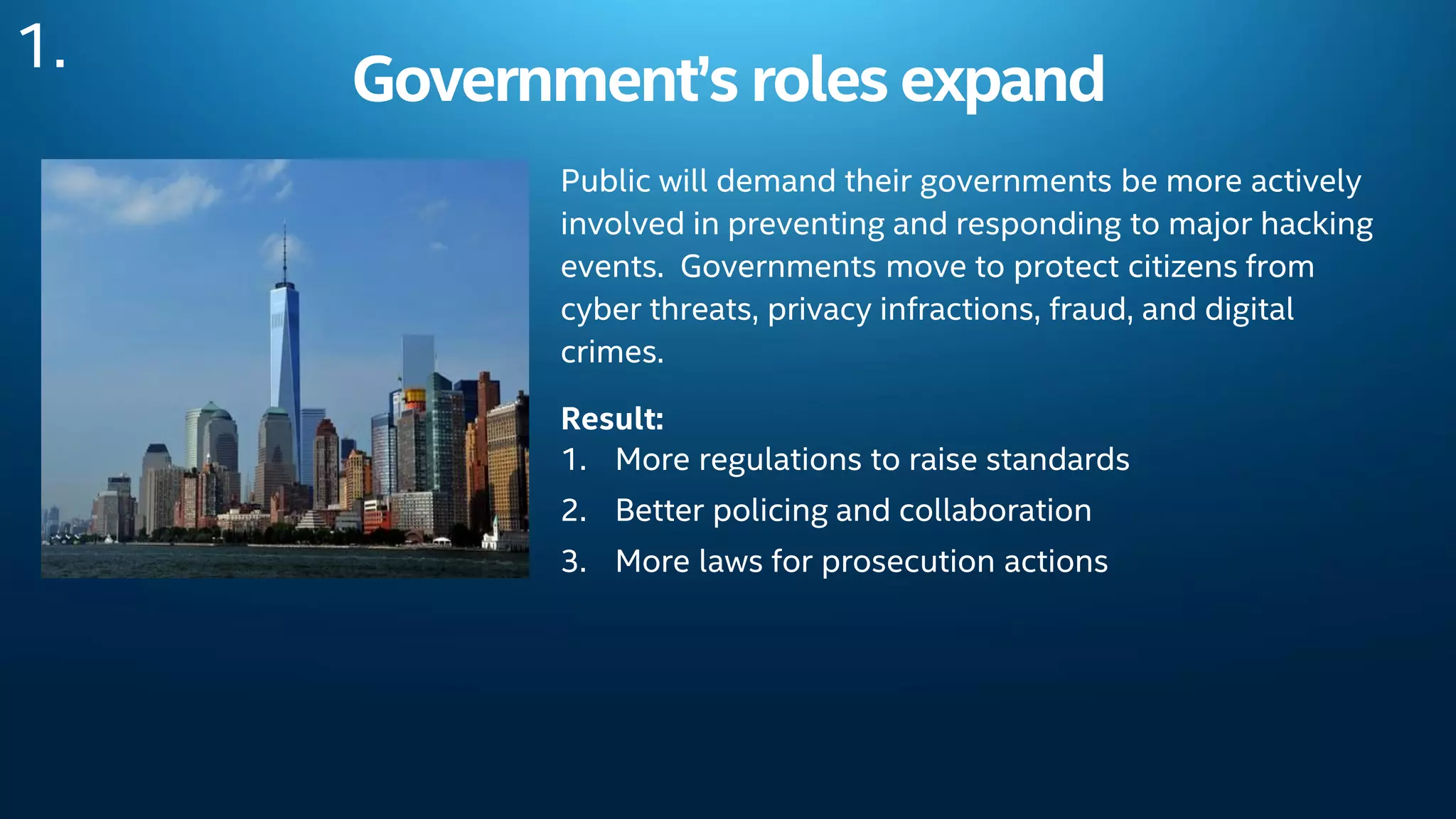
Public will demand their governments be more actively
involved in preventing and responding to major hacking
events. Governments move to protect citizens from
cyber threats, privacy infractions, fraud, and digital
crimes.
Result:
1. More regulations to raise standards
2. Better policing and collaboration
3. More laws for prosecution actions
1.
Advances innation-state cyber-offense
affects everyone
2.
Advances innation-state cyber-offense
affects everyone
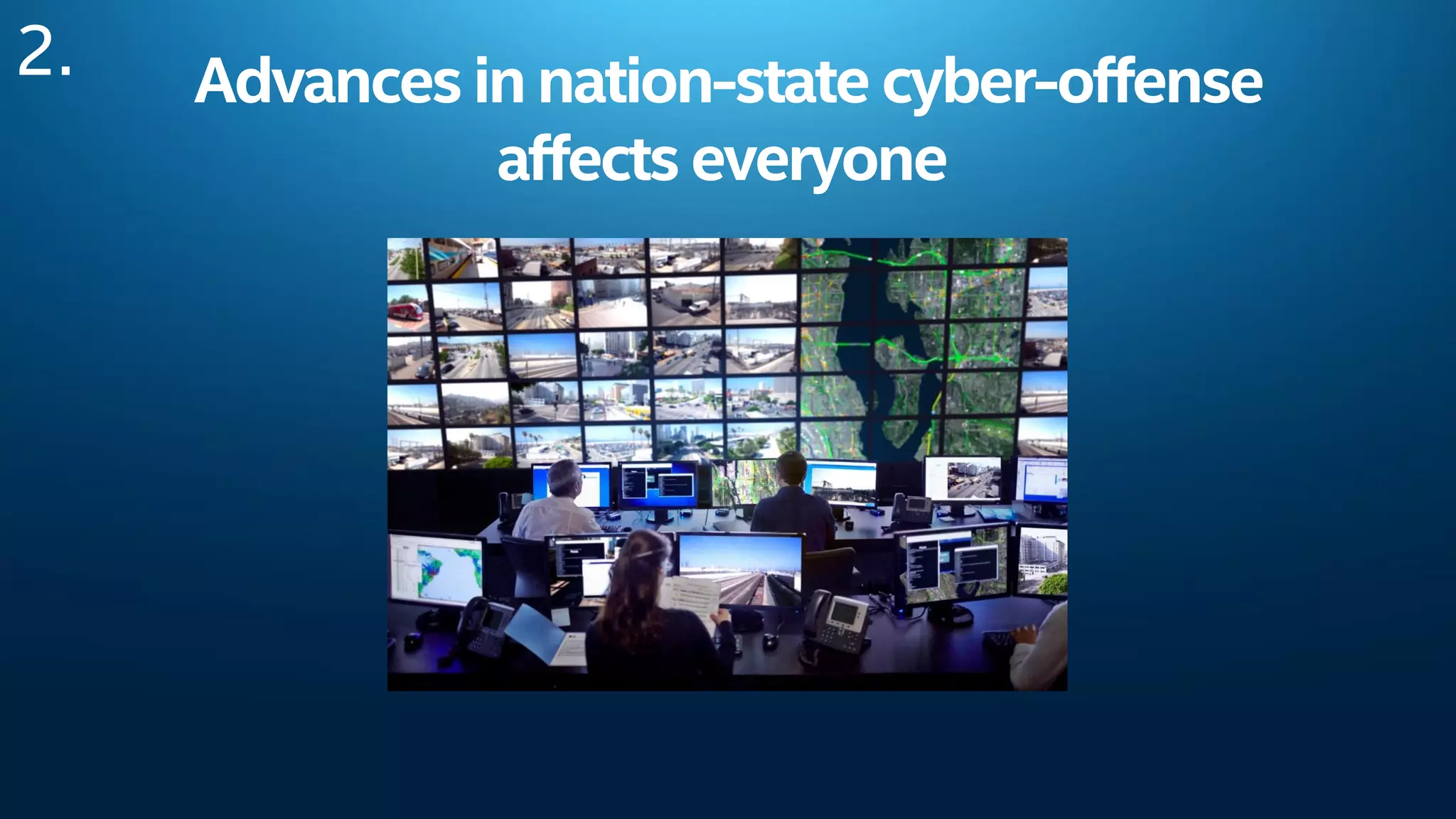
Broad adoption by many nation states for cyber-
offense capabilities. Large governments incorporate
cyber roles into all 4 defense domains (land, sea, air,
space) with clear objectives and deployable systems.
Result:
1. Trickle down effect gives some tech to cyber
criminals and attackers
2. Reverse engineered code is reused by other threats
3. Attackers don’t have to invest in developing high-
end exploits, instead they can just harvest what
governments create
2.
Life safety andcybersecurity intersect in
products
3.
Life safety andcybersecurity intersect in
products
Industrial and consumer products are being connected
to the internet and to each other. Appliances, cars,
power stations, medical devices, wearables, and others
are both gathering data and exerting control over our
activities. Such data and control can have catastrophic
impacts as our reliance and trust increase.
Result:
1. A slow burn wake-up call for the transportation
(auto, air, trains) industry as risks emerge
2. IoT devices will explode in number and function, but
so will the vulnerabilities and potential misuse
3. Drones are of interesting concern to safety and
privacy. Expect more regulations
3.
Therise ofcyber litigation
4.
Therise ofcyber litigation
Lack of best security practices will create liability. The
barrier to sue is contested in the digital world and
decreases for data breaches and device/service security.
The litigation field is preparing to pounce on emerging
opportunities.
Result:
1. Overall legal costs increase and the limits for
compensatory and punitive damage are challenged
2. Firms begin to specialize (ex. breach defense and
breach class-action, privacy, product security)
3. Companies will have to contend with litigation as
well as regulatory actions
4.
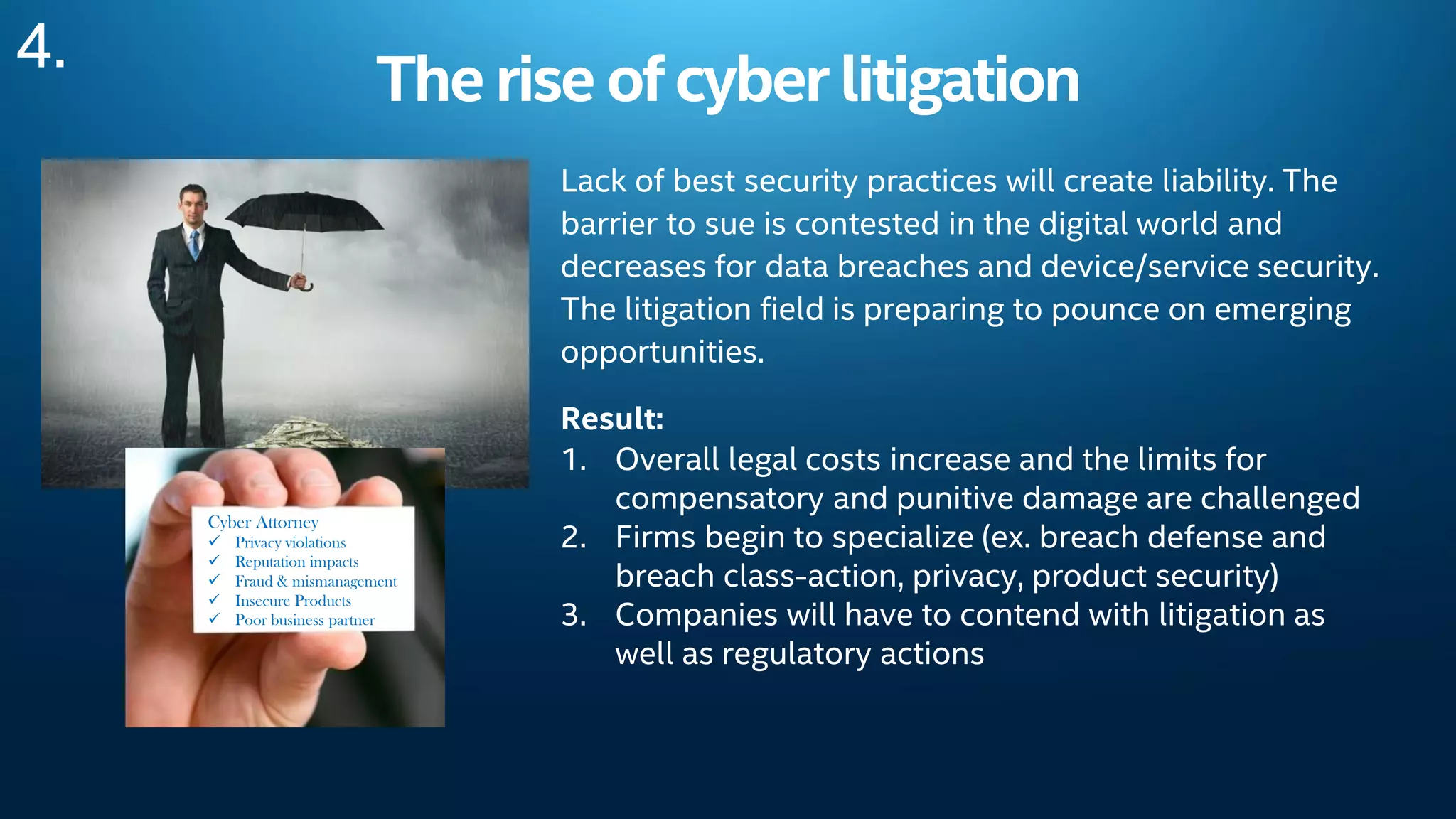
Cyber Attorney
 Privacy violations
 Reputation impacts
 Fraud & mismanagement
 Insecure Products
 Poor business partner
Realistic costs ofcybersecurity arebetter
understood and shocking!
5.
Realistic costs ofcybersecurity arebetter
understood and shocking!
Industry currently fails to see the overall impact and long
term trends. How do we prioritize investments if we don’t
know the costs?
New emphasis will emerge to understand the systemic
costs of cybersecurity risks to include:
 Products & services spending, staffing, audit, compliance, and insurance
 Incident response, regulatory, and recovery costs
 Opportunity costs, product dev/test, release delays, hindrance to
innovation and investment
Result:
1. Overall costs may exceed $100 trillion by 2030
2. The industry shift-of-perspective begins. From tactical
treatment of recurring symptoms to the strategic
interdiction of the systemic condition
5.
Cybersecurity expectations increase across
enterprises andconsumers
6.
Cybersecurity expectations increase across
enterprises andconsumers
Enterprise perspectives shift to accept the reputation and
market impacts of digital security.
Consumers expect security “their way” with access
anywhere to anything, while keeping them safe.
Market demands for more connectivity, devices,
architectures, and applications.
Result:
1. Expectations will rise, but the resources and
capabilities will not keep pace, causing friction.
2. Leadership will be key. Organizations and market
players will strategic insight will stand out and seize
opportunities.
6.
Attackers evolve, adapt, andaccelerate
7.
Attackers evolve, adapt, andaccelerate
Attackers are nimble, opportunistic, cooperative, and
skilled. Their motivation, resiliency and creativity drives
great adaptability. We will see acceleration in their
methods, tools, and targets.
Result:
1. Ransomware rises to become a serious problem
2. Dark and grey markets grow and services mature
3. New data breach targets are added to the mix
4. Personal, health, biometric and ID data is explored
by attackers
5. Integrity attacks expand by professionals
6. Reconnaissance and research follows quickly into
new technology growth areas
7.
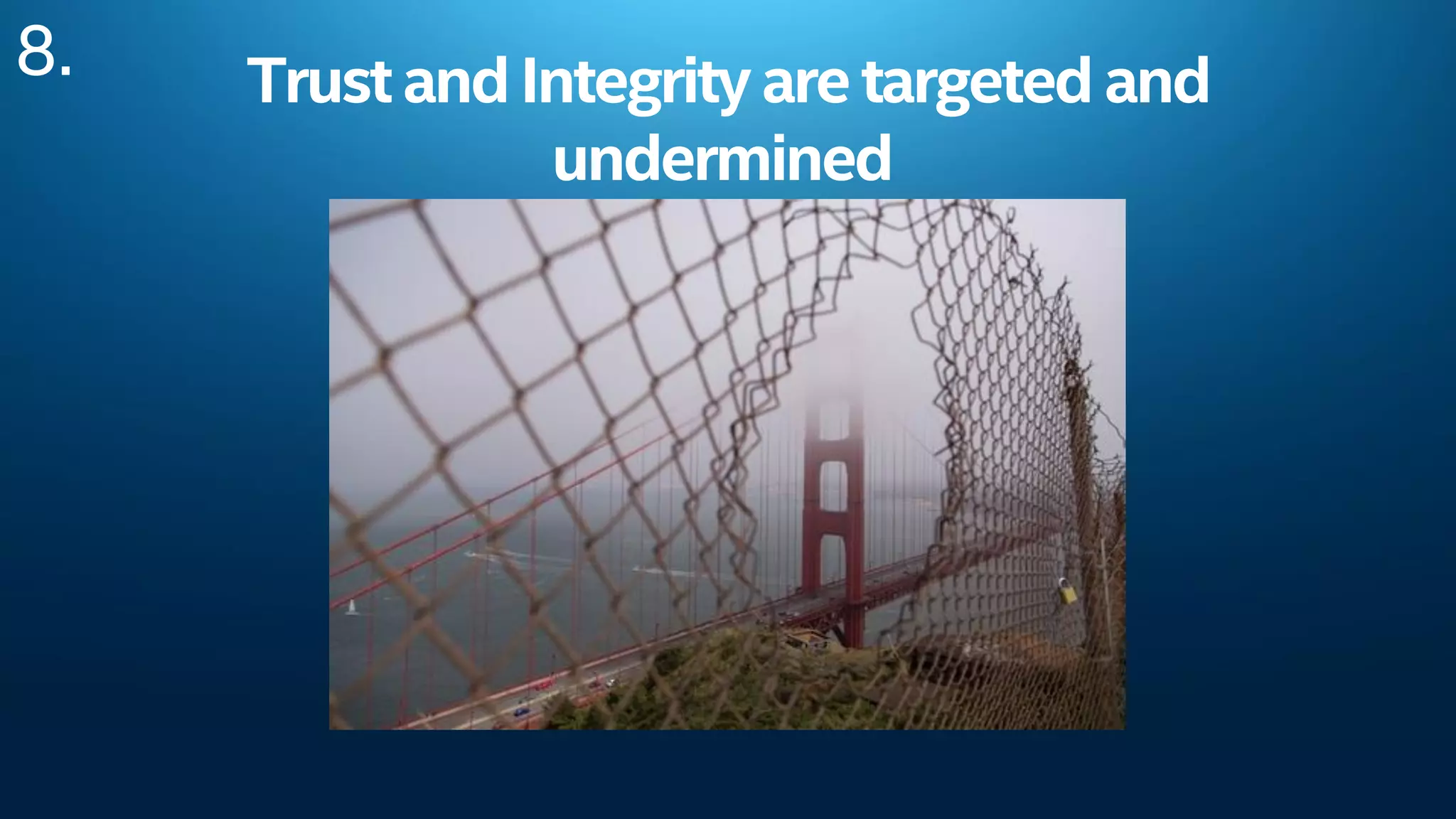
Trust andIntegrity aretargeted and
undermined
8.
Trust andIntegrity aretargeted and
undermined
Attackers leverage trust mechanisms for their goals:
Digital certs, Identity and Authentication, Encryption
standards and implementation, HW/FW/code
vulnerabilities.
Integrity attacks continue to escalate, altering data
instead of stealing it. This begins a whole new game.
Result:
1. Digital certs misuse allows access and malicious
sites/software to proliferate
2. Vulnerabilities in devices, encryption, and code force
changes in product design
3. Integrity attacks emerge as a devastating new
strategy. Financial, communications, and
authentication transactions will be targeted first
8.
Security technologies improve butremain
outpaced andoutmaneuvered
9.
Security technologies improve butremain
outpaced andoutmaneuvered
Holistic and strategic views take hold. Executives get
serious on managing cyber risks
Cloud gets more secure
Malware detection and forensics improves
Attack Attribution proficiency increases
Incident Response capabilities and services achieves
professional standing
Result:
1. Availability/Denial of Service protection (GREAT)
2. Confidentiality/Data Breach protection (GOOD)
3. Integrity and trust protection (LACKING)
9.
Lack ofsecurity talent hinders the industry
10.
Lack ofsecurity talent hinders theindustry
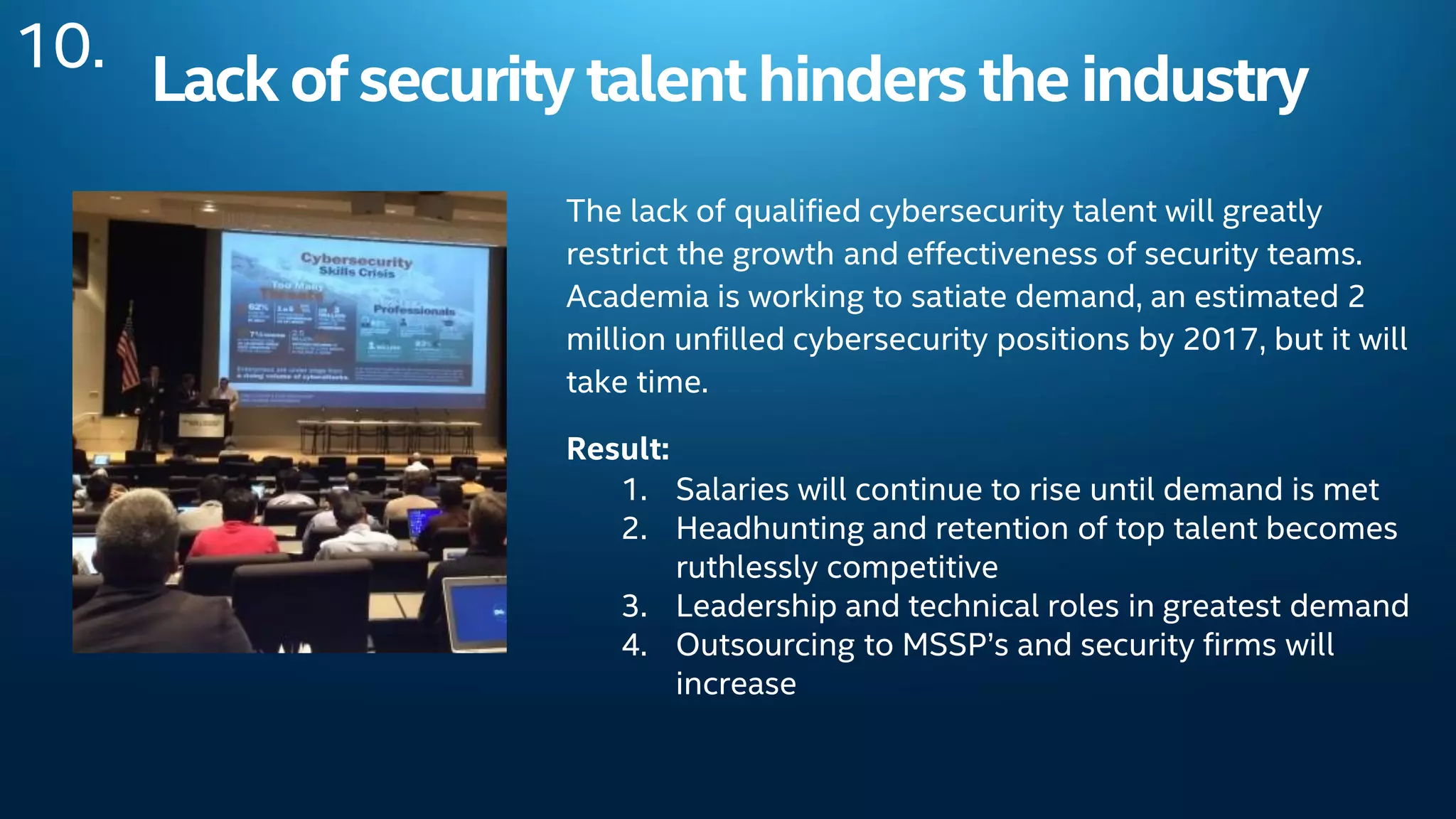
The lack of qualified cybersecurity talent will greatly
restrict the growth and effectiveness of security teams.
Academia is working to satiate demand, an estimated 2
million unfilled cybersecurity positions by 2017, but it will
take time.
Result:
1. Salaries will continue to rise until demand is met
2. Headhunting and retention of top talent becomes
ruthlessly competitive
3. Leadership and technical roles in greatest demand
4. Outsourcing to MSSP’s and security firms will
increase
10.
Conclusion
As always, cybersecurity represents risks
and opportunities
Much of what was seen in 2015 will
continue, but new vectors will emerge and
supplant legacy tactics
The fundamentals remain but the details
and specifics remain chaotic and
unpredictable
Those with insights to the future have the
best opportunity to be prepared
Intel, the Intel logo, and McAfee are trademarks of Intel Corporation in the United States and other countries.
*Other names and brands may be claimed as the property of others.
Copyright © 2015 Intel Corporation. All Rights Reserved

Future of Cybersecurity 2016 - M.Rosenquist

  • 1.
  • 2.
    Biography Matthew Rosenquist Cybersecurity Strategist IntelSecurity Group Matthew benefits from 20 years in the field of security, specializing in strategy, threats, operations, crisis management, measuring value, communicating industry changes, and developing cost effective capabilities which deliver the optimal level of security. As a cybersecurity strategist, he works to understand and communicate the future of security and drive industry collaboration to tackle challenges and uncover opportunities to significantly improve global computing security. Mr. Rosenquist built and managed Intel’s first global 24x7 Security Operations Center, overseen internal platform security products and services, was the first Incident Commander for Intel’s worldwide IT emergency response team, and managed security for Intel’s multi-billion dollar worldwide mergers and acquisitions activities. He has conducted investigations, defended corporate assets, established policies, developed strategies to protect Intel’s global manufacturing, and owned the security playbook for the PC strategic planning group. Most recently, Matthew worked to identify the synergies of Intel and McAfee as part of the creation of the Intel Security Group, one of the largest security product organizations in the world. Twitter @Matt_Rosenquist Blogs Intel IT Peer Network
  • 3.
  • 4.
    1. Government’s rolesexpand 2. Advances in nation-state cyber- offense affects everyone 3. Life safety and cybersecurity intersect in products 4. The rise of cyber litigation 5. Realistic costs of cybersecurity are better understood and shocking! 6. Cybersecurity expectations increase across enterprises and consumers 7. Attackers evolve, adapt, and accelerate 8. Trust and Integrity are targeted and undermined 9. Security technologies improve but remain outpaced and outmaneuvered 10. Lack of security talent hinders the industry The Top 10Cybersecurity Predictions for 2016
  • 5.
  • 6.
    Government’s roles expand Publicwill demand their governments be more actively involved in preventing and responding to major hacking events. Governments move to protect citizens from cyber threats, privacy infractions, fraud, and digital crimes. Result: 1. More regulations to raise standards 2. Better policing and collaboration 3. More laws for prosecution actions 1.
  • 7.
  • 8.
    Advances innation-state cyber-offense affectseveryone Broad adoption by many nation states for cyber- offense capabilities. Large governments incorporate cyber roles into all 4 defense domains (land, sea, air, space) with clear objectives and deployable systems. Result: 1. Trickle down effect gives some tech to cyber criminals and attackers 2. Reverse engineered code is reused by other threats 3. Attackers don’t have to invest in developing high- end exploits, instead they can just harvest what governments create 2.
  • 9.
    Life safety andcybersecurityintersect in products 3.
  • 10.
    Life safety andcybersecurityintersect in products Industrial and consumer products are being connected to the internet and to each other. Appliances, cars, power stations, medical devices, wearables, and others are both gathering data and exerting control over our activities. Such data and control can have catastrophic impacts as our reliance and trust increase. Result: 1. A slow burn wake-up call for the transportation (auto, air, trains) industry as risks emerge 2. IoT devices will explode in number and function, but so will the vulnerabilities and potential misuse 3. Drones are of interesting concern to safety and privacy. Expect more regulations 3.
  • 11.
  • 12.
    Therise ofcyber litigation Lackof best security practices will create liability. The barrier to sue is contested in the digital world and decreases for data breaches and device/service security. The litigation field is preparing to pounce on emerging opportunities. Result: 1. Overall legal costs increase and the limits for compensatory and punitive damage are challenged 2. Firms begin to specialize (ex. breach defense and breach class-action, privacy, product security) 3. Companies will have to contend with litigation as well as regulatory actions 4. Cyber Attorney  Privacy violations  Reputation impacts  Fraud & mismanagement  Insecure Products  Poor business partner
  • 13.
    Realistic costs ofcybersecurityarebetter understood and shocking! 5.
  • 14.
    Realistic costs ofcybersecurityarebetter understood and shocking! Industry currently fails to see the overall impact and long term trends. How do we prioritize investments if we don’t know the costs? New emphasis will emerge to understand the systemic costs of cybersecurity risks to include:  Products & services spending, staffing, audit, compliance, and insurance  Incident response, regulatory, and recovery costs  Opportunity costs, product dev/test, release delays, hindrance to innovation and investment Result: 1. Overall costs may exceed $100 trillion by 2030 2. The industry shift-of-perspective begins. From tactical treatment of recurring symptoms to the strategic interdiction of the systemic condition 5.
  • 15.
    Cybersecurity expectations increaseacross enterprises andconsumers 6.
  • 16.
    Cybersecurity expectations increaseacross enterprises andconsumers Enterprise perspectives shift to accept the reputation and market impacts of digital security. Consumers expect security “their way” with access anywhere to anything, while keeping them safe. Market demands for more connectivity, devices, architectures, and applications. Result: 1. Expectations will rise, but the resources and capabilities will not keep pace, causing friction. 2. Leadership will be key. Organizations and market players will strategic insight will stand out and seize opportunities. 6.
  • 17.
    Attackers evolve, adapt,andaccelerate 7.
  • 18.
    Attackers evolve, adapt,andaccelerate Attackers are nimble, opportunistic, cooperative, and skilled. Their motivation, resiliency and creativity drives great adaptability. We will see acceleration in their methods, tools, and targets. Result: 1. Ransomware rises to become a serious problem 2. Dark and grey markets grow and services mature 3. New data breach targets are added to the mix 4. Personal, health, biometric and ID data is explored by attackers 5. Integrity attacks expand by professionals 6. Reconnaissance and research follows quickly into new technology growth areas 7.
  • 19.
  • 20.
    Trust andIntegrity aretargetedand undermined Attackers leverage trust mechanisms for their goals: Digital certs, Identity and Authentication, Encryption standards and implementation, HW/FW/code vulnerabilities. Integrity attacks continue to escalate, altering data instead of stealing it. This begins a whole new game. Result: 1. Digital certs misuse allows access and malicious sites/software to proliferate 2. Vulnerabilities in devices, encryption, and code force changes in product design 3. Integrity attacks emerge as a devastating new strategy. Financial, communications, and authentication transactions will be targeted first 8.
  • 21.
    Security technologies improvebutremain outpaced andoutmaneuvered 9.
  • 22.
    Security technologies improvebutremain outpaced andoutmaneuvered Holistic and strategic views take hold. Executives get serious on managing cyber risks Cloud gets more secure Malware detection and forensics improves Attack Attribution proficiency increases Incident Response capabilities and services achieves professional standing Result: 1. Availability/Denial of Service protection (GREAT) 2. Confidentiality/Data Breach protection (GOOD) 3. Integrity and trust protection (LACKING) 9.
  • 23.
    Lack ofsecurity talenthinders the industry 10.
  • 24.
    Lack ofsecurity talenthinders theindustry The lack of qualified cybersecurity talent will greatly restrict the growth and effectiveness of security teams. Academia is working to satiate demand, an estimated 2 million unfilled cybersecurity positions by 2017, but it will take time. Result: 1. Salaries will continue to rise until demand is met 2. Headhunting and retention of top talent becomes ruthlessly competitive 3. Leadership and technical roles in greatest demand 4. Outsourcing to MSSP’s and security firms will increase 10.
  • 25.
    Conclusion As always, cybersecurityrepresents risks and opportunities Much of what was seen in 2015 will continue, but new vectors will emerge and supplant legacy tactics The fundamentals remain but the details and specifics remain chaotic and unpredictable Those with insights to the future have the best opportunity to be prepared
  • 26.
    Intel, the Intellogo, and McAfee are trademarks of Intel Corporation in the United States and other countries. *Other names and brands may be claimed as the property of others. Copyright © 2015 Intel Corporation. All Rights Reserved