We’re all going to have to change how we think about data
protection.
--- Elizabeth Denham
-By PARAB MISHRA
0133CS191120
2 2
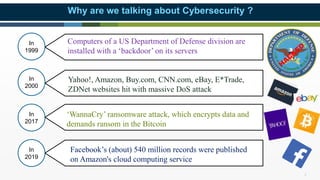
Why are we talking about Cybersecurity ?
In
1999
In
2000
In
2017
In
2019
Computers of a US Department of Defense division are
installed with a ‘backdoor’ on its servers
Yahoo!, Amazon, Buy.com, CNN.com, eBay, E*Trade,
ZDNet websites hit with massive DoS attack
‘WannaCry’ ransomware attack, which encrypts data and
demands ransom in the Bitcoin
Facebook’s (about) 540 million records were published
on Amazon's cloud computing service
3 3
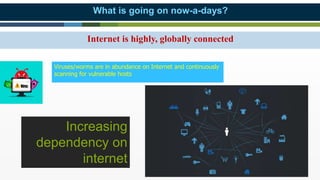
What is going on now-a-days?
Internet is highly, globally connected
Viruses/worms are in abundance on Internet and continuously
scanning for vulnerable hosts
Increasing
dependency on
internet
4 4
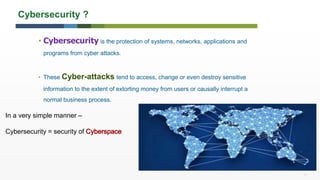
Cybersecurity ?
• Cybersecurity is the protection of systems, networks, applications and
programs from cyber attacks.
• These Cyber-attacks tend to access, change or even destroy sensitive
information to the extent of extorting money from users or causally interrupt a
normal business process.
In a very simple manner –
Cybersecurity = security of
5 5
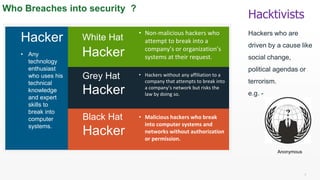
Who Breaches into security ?
• Non-malicious hackers who
attempt to break into a
company’s or organization’s
systems at their request.
• Hackers without any affiliation to a
company that attempts to break into
a company’s network but risks the
law by doing so.
• Malicious hackers who break
into computer systems and
networks without authorization
or permission.
Hacker
• Any
technology
enthusiast
who uses his
technical
knowledge
and expert
skills to
break into
computer
systems.
White Hat
Hacker
Grey Hat
Hacker
Black Hat
Hacker
Hacktivists
Hackers who are
driven by a cause like
social change,
political agendas or
terrorism.
e.g. -
Anonymous
6 6
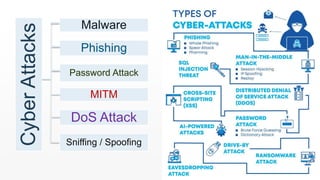
CyberAttacks
MITM
DoS Attack
Sniffing / Spoofing
Malware
Phishing
Password Attack
7 7
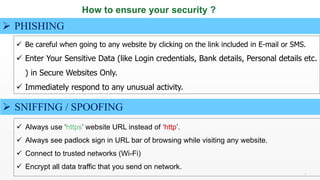
How to ensure your security ?
 PHISHING
 Be careful when going to any website by clicking on the link included in E-mail or SMS.
 Enter Your Sensitive Data (like Login credentials, Bank details, Personal details etc.
) in Secure Websites Only.
 Immediately respond to any unusual activity.
 SNIFFING / SPOOFING
 Always use ‘https’ website URL instead of ‘http’.
 Always see padlock sign in URL bar of browsing while visiting any website.
 Connect to trusted networks (Wi-Fi)
 Encrypt all data traffic that you send on network.
8 8
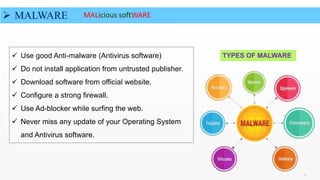
 MALWARE
 Use good Anti-malware (Antivirus software)
 Do not install application from untrusted publisher.
 Download software from official website.
 Configure a strong firewall.
 Use Ad-blocker while surfing the web.
 Never miss any update of your Operating System
and Antivirus software.
TYPES OF MALWARE
MALicious softWARE
9 9
 PASSWORD ATTACK
 Make alpha-numeric-symbolic password phrase.
 Do not keep same passwords.
 8-character string password can be hacked in less than 2.5 hours.
 It is impossible to crack 25-character string password.
 Man In The Middle & Denial Of Service ATTACK
 This can be prevented by using a strong firewall.
 By using IPS & IDS.
 By increasing your bandwidth size.
10 10
_ _ _ _ _ _ _ _ _ _ _
/  /  /  /  /  /  /  /  /  /  / 
( P | A | R | A | B ) ( M | I | S | H | R | A )
_/ _/ _/ _/ _/ _/ _/ _/ _/ _/ _/

Cyber security presentation

  • 1.
    We’re all goingto have to change how we think about data protection. --- Elizabeth Denham -By PARAB MISHRA 0133CS191120
  • 2.
    2 2 Why arewe talking about Cybersecurity ? In 1999 In 2000 In 2017 In 2019 Computers of a US Department of Defense division are installed with a ‘backdoor’ on its servers Yahoo!, Amazon, Buy.com, CNN.com, eBay, E*Trade, ZDNet websites hit with massive DoS attack ‘WannaCry’ ransomware attack, which encrypts data and demands ransom in the Bitcoin Facebook’s (about) 540 million records were published on Amazon's cloud computing service
  • 3.
    3 3 What isgoing on now-a-days? Internet is highly, globally connected Viruses/worms are in abundance on Internet and continuously scanning for vulnerable hosts Increasing dependency on internet
  • 4.
    4 4 Cybersecurity ? •Cybersecurity is the protection of systems, networks, applications and programs from cyber attacks. • These Cyber-attacks tend to access, change or even destroy sensitive information to the extent of extorting money from users or causally interrupt a normal business process. In a very simple manner – Cybersecurity = security of
  • 5.
    5 5 Who Breachesinto security ? • Non-malicious hackers who attempt to break into a company’s or organization’s systems at their request. • Hackers without any affiliation to a company that attempts to break into a company’s network but risks the law by doing so. • Malicious hackers who break into computer systems and networks without authorization or permission. Hacker • Any technology enthusiast who uses his technical knowledge and expert skills to break into computer systems. White Hat Hacker Grey Hat Hacker Black Hat Hacker Hacktivists Hackers who are driven by a cause like social change, political agendas or terrorism. e.g. - Anonymous
  • 6.
    6 6 CyberAttacks MITM DoS Attack Sniffing/ Spoofing Malware Phishing Password Attack
  • 7.
    7 7 How toensure your security ?  PHISHING  Be careful when going to any website by clicking on the link included in E-mail or SMS.  Enter Your Sensitive Data (like Login credentials, Bank details, Personal details etc. ) in Secure Websites Only.  Immediately respond to any unusual activity.  SNIFFING / SPOOFING  Always use ‘https’ website URL instead of ‘http’.  Always see padlock sign in URL bar of browsing while visiting any website.  Connect to trusted networks (Wi-Fi)  Encrypt all data traffic that you send on network.
  • 8.
    8 8  MALWARE Use good Anti-malware (Antivirus software)  Do not install application from untrusted publisher.  Download software from official website.  Configure a strong firewall.  Use Ad-blocker while surfing the web.  Never miss any update of your Operating System and Antivirus software. TYPES OF MALWARE MALicious softWARE
  • 9.
    9 9  PASSWORDATTACK  Make alpha-numeric-symbolic password phrase.  Do not keep same passwords.  8-character string password can be hacked in less than 2.5 hours.  It is impossible to crack 25-character string password.  Man In The Middle & Denial Of Service ATTACK  This can be prevented by using a strong firewall.  By using IPS & IDS.  By increasing your bandwidth size.
  • 10.
    10 10 _ __ _ _ _ _ _ _ _ _ / / / / / / / / / / / ( P | A | R | A | B ) ( M | I | S | H | R | A ) _/ _/ _/ _/ _/ _/ _/ _/ _/ _/ _/