Muhammad Adnan
PGR Paeds ATH
Abbottabad
Cyanosis
 Cyanosis specifically refers to a bluish tone visible in

the mucous membranes and skin when desaturated or
abnormal hemoglobin is present in the peripheral
circulation
 Central cyanosis occurs when poorly oxygenated
blood enters the systemic circulation
 right-to-left” shunt and may occur within the heart or
in the pulmonary circulation itself.
 When there is primary parenchymal lung disease or
neurologic disease causing alveolar
hypoventilation, an “intrapulmonary” right-to-left
shunt can occur.
Causes of cyanosis
 Abnormal hemoglobins may be fully saturated with oxygen, yet

unable to release it to the tissues like Methemoglobinemia
 Anemia at hb= 3-5gm/dl cyanosis will be visible
 Typical cyanotic lesions are the “five Ts” of congenital heart disease (
 tetralogy of Fallot,
 transposition of the great vessels,
 total anomalous pulmonary venous return,
 tricuspid atresia, and
 truncus arteriosus), but others may also be present.
 Pulmonary diseases like
 upper airway obstructive problems (croup, epiglottitis)
 lower airway diseases (bronchiolitis, asthma, cystic
fibrosis, pneumonia with lobar consolidation).
 Foreign body
Differentiating cardiac from pulmonary causes
 Differentiating cardiac from pulmonary etiologies is critical
 breath sounds are usually normal in cardiac disease
 while wheezes, rhonchi, and chest wall abnormalities usually

accompany a pulmonary process.

 hyperoxia test
 cyanotic cardiac disease

oxygen,
 pulmonary disease
with Oxygen.

little response to increased ambient
the saturation increase may be dramatic

 ABG may also be useful, since an elevated pCO2 indicating

impaired ventilatory status, usually not seen with cyanotic congenital
heart disease unless there is associated pulmonary congestion.












The chest X-ray may reveal
cardiomegaly,
an abnormal pulmonary circulatory pattern, or
overt pulmonary parenchymal abnormalities such as atelectasis
or pneumothorax.
Heart murmer
The absence of a heart murmur does not rule out cyanotic
cardiac disease; in most conditions with right-to-left shunting
there is no murmur.
Tachypnea may be present with most pulmonary diseases
Hyperpnea, or deep breathing with only a mild increase in
rate, is more characteristic of a primary cardiac disorder where
alveolar ventilation is maximized but pulmonary blood flow is
reduced.
Hyperpnea can also reflect metabolic acidosis or elevated
intracranial pressure
Cyanotic (Tet) spells
 Acute hypoxemic attacks represent a true emergency and initial

treatment is crucial to long term outcome.
 Usually, the underlying diagnosis is tetralogy of Fallot.
 In a Tet spell,
 an acute increase in obstruction to pulmonary blood flow (either in heart or
in pulmonary circulation) results in increase in right-to-left shunting through
an intracardiac septal defect.
 Alternatively, if systemic perfusion is reduced, as with hypovolemia or the
development of a tachyarrhythmia, right-to-left shunting will also increase

and a cyanotic spell develop.
Clinical presentation and diagnosis
 They are characterised by:
Period of uncontrollable crying / panic,
Rapid and deep breathing (hyperpnoea),
Deepening of cyanosis,
Decreased intensity of heart murmur,
Limpness, convulsions and rarely, death.

 common in the early morning, shortly after the patient awakens,.
 Prolonged agitation and crying are also cited as precipitants,
 Also, noxious stimuli, such as phlebotomy or a bee sting, or any circumstance which
leads to enhanced catecholamine output can precipitate a spell in a susceptible child.
 A decrease in systemic vascular resistance (SVR) during exercise, bathing, or fever
potentiates a right-to-left shunt and precipitates hypoxemia

 In such cases(tet spells), the absence of a heart murmur is a worrisome
indicator that pulmonary blood flow is severely compromised.
Differential Diagnoses











Aortic stenosis
Acute Respiratory Distress Syndrome
Apnea
Bronchiolitis
Foreign Body Ingestion
Pediatric Patent Ductus Arteriosus Surgery
Pneumonia
Pneumothorax
Pulmonic Valvular Stenosis
Sickle Cell Anemia
Workup
 Hemoglobin and hematocrit values are usually elevated in proportion to

the degree of cyanosis. Prolonged cyanosis causes reactive polycythemia
that increases the oxygen-carrying capacity. While in cyanosis due to
Anemia hb is 3-5g/dl
 ABG

 results show varying oxygen saturation, but pH and partial pressure of

carbon dioxide (pCO2) are normal, unless the patient is in extremis, such
as during a tet spell.
 Oximetry is particularly useful in a dark-skinned patient or an anemic

patient whose level of cyanosis is not apparent. Generally, cyanosis is not
evident until 3-5 g/dL of reduced hemoglobin is present.
 Echocardiography
 Echocardiograms will usually reveal a large VSD with an overriding aorta and
variable degrees of right ventricular (RV) outflow tract obstruction (RVOTO)
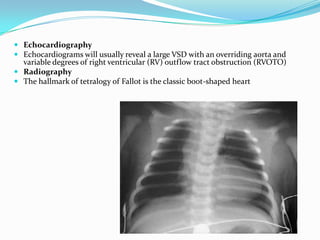
 Radiography
 The hallmark of tetralogy of Fallot is the classic boot-shaped heart
Emergency management
 Management is directed at manipulating the relative resistances of the systemic and
pulmonary
 vascular beds, as well as maintenance of appropriate circulating volume and heart rate
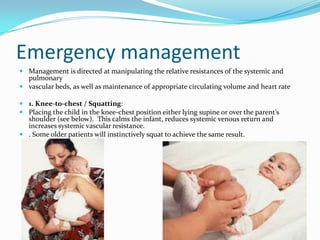
 1. Knee-to-chest / Squatting:
 Placing the child in the knee-chest position either lying supine or over the parent’s
shoulder (see below). This calms the infant, reduces systemic venous return and
increases systemic vascular resistance.
 . Some older patients will instinctively squat to achieve the same result.
 2. Oxygen (100%) can be administered which also increasessystemic
resistance and may help enhance oxygen delivery
 but usually has minimal effect.
 3. Morphine: 0.1-0.2 mg/kg IM. (Caution in infants under 3 months).
 morphine may cause pulmonary vasodilatation and also provide a beneficial

sedative effect, with consequent reduction of catecholamine secretion.
 If the above procedures are ineffective or have suboptimal effect, the following

treatments may need to be given.
 Establish IV access and discuss with a senior colleague.

 4. Crystalloid or colloid fluid bolus: 10-20ml/kg by rapid IV push.
 give an IV fluid bolus of 20 mL/kg normal saline
 Obtain an ABG.
 Treat metabolic acidosis with sodium bicarbonate, 1–2 mEq/kg slowly IV, only if
ventilation is adequate
 (low or normal pCO2)
 5. . phenylephrine
 If cyanosis persists, give phenylephrine (10 mcg/kg by slow IV push)
 to pharmacologically increase the systemic vascular resistance
 5. beta blocker (e.g. propranolol or esmolol)
 In severe episodes, IV propranolol (Inderal) may be administered, which
relaxes the infundibular muscle spasm causing right ventricular (RV) outflow
tract obstruction (RVOTO)
 Esmolol (BREVIBLOC®) 500 mcg/kg over one minute IV, then maintenance of
50 mcg/kg/min can be increased in steps of 50mcg/kg/min to maximum dose
of 300mcg/kg/min
 ultra-short acting cardioselective beta blocker, reducing dynamic muscular

stenosis of the right ventricular outflow tract and increasing pulmonary blood
flow
 The availability of these medications may be limited in some centres.

 . Progressive hypoxemia and the occurrence of cyanotic spells are
indications for early surgery.
For chronic cyanotic
congenital heart conditions
 supportive treatment is all that can be done until a surgical





or catheter-directed intervention can be accomplished.
Give supplemental oxygen, even though dramatic changes
in saturation will not occur with oxygen alone.
Secure IV access and give fluid to maintain an adequate
circulating volume.
Treat systemic acidosis once adequate ventilation is
ensured.
Most of all, immediately consult with a cardiologist to
arrange for more definitive treatment and to prevent
unnecessary interventions.
Cyanotic spells/ TET Spells

Cyanotic spells/ TET Spells

  • 1.
  • 2.
    Cyanosis  Cyanosis specificallyrefers to a bluish tone visible in the mucous membranes and skin when desaturated or abnormal hemoglobin is present in the peripheral circulation  Central cyanosis occurs when poorly oxygenated blood enters the systemic circulation  right-to-left” shunt and may occur within the heart or in the pulmonary circulation itself.  When there is primary parenchymal lung disease or neurologic disease causing alveolar hypoventilation, an “intrapulmonary” right-to-left shunt can occur.
  • 3.
    Causes of cyanosis Abnormal hemoglobins may be fully saturated with oxygen, yet unable to release it to the tissues like Methemoglobinemia  Anemia at hb= 3-5gm/dl cyanosis will be visible  Typical cyanotic lesions are the “five Ts” of congenital heart disease (  tetralogy of Fallot,  transposition of the great vessels,  total anomalous pulmonary venous return,  tricuspid atresia, and  truncus arteriosus), but others may also be present.  Pulmonary diseases like  upper airway obstructive problems (croup, epiglottitis)  lower airway diseases (bronchiolitis, asthma, cystic fibrosis, pneumonia with lobar consolidation).  Foreign body
  • 4.
    Differentiating cardiac frompulmonary causes  Differentiating cardiac from pulmonary etiologies is critical  breath sounds are usually normal in cardiac disease  while wheezes, rhonchi, and chest wall abnormalities usually accompany a pulmonary process.  hyperoxia test  cyanotic cardiac disease oxygen,  pulmonary disease with Oxygen. little response to increased ambient the saturation increase may be dramatic  ABG may also be useful, since an elevated pCO2 indicating impaired ventilatory status, usually not seen with cyanotic congenital heart disease unless there is associated pulmonary congestion.
  • 5.
             The chest X-raymay reveal cardiomegaly, an abnormal pulmonary circulatory pattern, or overt pulmonary parenchymal abnormalities such as atelectasis or pneumothorax. Heart murmer The absence of a heart murmur does not rule out cyanotic cardiac disease; in most conditions with right-to-left shunting there is no murmur. Tachypnea may be present with most pulmonary diseases Hyperpnea, or deep breathing with only a mild increase in rate, is more characteristic of a primary cardiac disorder where alveolar ventilation is maximized but pulmonary blood flow is reduced. Hyperpnea can also reflect metabolic acidosis or elevated intracranial pressure
  • 6.
    Cyanotic (Tet) spells Acute hypoxemic attacks represent a true emergency and initial treatment is crucial to long term outcome.  Usually, the underlying diagnosis is tetralogy of Fallot.  In a Tet spell,  an acute increase in obstruction to pulmonary blood flow (either in heart or in pulmonary circulation) results in increase in right-to-left shunting through an intracardiac septal defect.  Alternatively, if systemic perfusion is reduced, as with hypovolemia or the development of a tachyarrhythmia, right-to-left shunting will also increase and a cyanotic spell develop.
  • 7.
    Clinical presentation anddiagnosis  They are characterised by: Period of uncontrollable crying / panic, Rapid and deep breathing (hyperpnoea), Deepening of cyanosis, Decreased intensity of heart murmur, Limpness, convulsions and rarely, death.  common in the early morning, shortly after the patient awakens,.  Prolonged agitation and crying are also cited as precipitants,  Also, noxious stimuli, such as phlebotomy or a bee sting, or any circumstance which leads to enhanced catecholamine output can precipitate a spell in a susceptible child.  A decrease in systemic vascular resistance (SVR) during exercise, bathing, or fever potentiates a right-to-left shunt and precipitates hypoxemia  In such cases(tet spells), the absence of a heart murmur is a worrisome indicator that pulmonary blood flow is severely compromised.
  • 8.
    Differential Diagnoses           Aortic stenosis AcuteRespiratory Distress Syndrome Apnea Bronchiolitis Foreign Body Ingestion Pediatric Patent Ductus Arteriosus Surgery Pneumonia Pneumothorax Pulmonic Valvular Stenosis Sickle Cell Anemia
  • 9.
    Workup  Hemoglobin andhematocrit values are usually elevated in proportion to the degree of cyanosis. Prolonged cyanosis causes reactive polycythemia that increases the oxygen-carrying capacity. While in cyanosis due to Anemia hb is 3-5g/dl  ABG  results show varying oxygen saturation, but pH and partial pressure of carbon dioxide (pCO2) are normal, unless the patient is in extremis, such as during a tet spell.  Oximetry is particularly useful in a dark-skinned patient or an anemic patient whose level of cyanosis is not apparent. Generally, cyanosis is not evident until 3-5 g/dL of reduced hemoglobin is present.
  • 10.
     Echocardiography  Echocardiogramswill usually reveal a large VSD with an overriding aorta and variable degrees of right ventricular (RV) outflow tract obstruction (RVOTO)  Radiography  The hallmark of tetralogy of Fallot is the classic boot-shaped heart
  • 11.
    Emergency management  Managementis directed at manipulating the relative resistances of the systemic and pulmonary  vascular beds, as well as maintenance of appropriate circulating volume and heart rate  1. Knee-to-chest / Squatting:  Placing the child in the knee-chest position either lying supine or over the parent’s shoulder (see below). This calms the infant, reduces systemic venous return and increases systemic vascular resistance.  . Some older patients will instinctively squat to achieve the same result.
  • 12.
     2. Oxygen(100%) can be administered which also increasessystemic resistance and may help enhance oxygen delivery  but usually has minimal effect.  3. Morphine: 0.1-0.2 mg/kg IM. (Caution in infants under 3 months).  morphine may cause pulmonary vasodilatation and also provide a beneficial sedative effect, with consequent reduction of catecholamine secretion.
  • 13.
     If theabove procedures are ineffective or have suboptimal effect, the following treatments may need to be given.  Establish IV access and discuss with a senior colleague.   4. Crystalloid or colloid fluid bolus: 10-20ml/kg by rapid IV push.  give an IV fluid bolus of 20 mL/kg normal saline  Obtain an ABG.  Treat metabolic acidosis with sodium bicarbonate, 1–2 mEq/kg slowly IV, only if ventilation is adequate  (low or normal pCO2)  5. . phenylephrine  If cyanosis persists, give phenylephrine (10 mcg/kg by slow IV push)  to pharmacologically increase the systemic vascular resistance
  • 14.
     5. betablocker (e.g. propranolol or esmolol)  In severe episodes, IV propranolol (Inderal) may be administered, which relaxes the infundibular muscle spasm causing right ventricular (RV) outflow tract obstruction (RVOTO)  Esmolol (BREVIBLOC®) 500 mcg/kg over one minute IV, then maintenance of 50 mcg/kg/min can be increased in steps of 50mcg/kg/min to maximum dose of 300mcg/kg/min  ultra-short acting cardioselective beta blocker, reducing dynamic muscular stenosis of the right ventricular outflow tract and increasing pulmonary blood flow  The availability of these medications may be limited in some centres.  . Progressive hypoxemia and the occurrence of cyanotic spells are indications for early surgery.
  • 15.
    For chronic cyanotic congenitalheart conditions  supportive treatment is all that can be done until a surgical     or catheter-directed intervention can be accomplished. Give supplemental oxygen, even though dramatic changes in saturation will not occur with oxygen alone. Secure IV access and give fluid to maintain an adequate circulating volume. Treat systemic acidosis once adequate ventilation is ensured. Most of all, immediately consult with a cardiologist to arrange for more definitive treatment and to prevent unnecessary interventions.