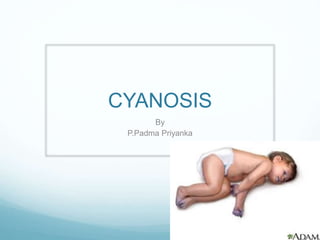
CYANOSIS
By
P.Padma Priyanka
Contents
 Introduction
 Factors affecting detection of cyanosis
 Etiology
 Types
 Cardiac vs pulmonary
 Approach
 Conclusion
Introduction
 Cyanosis is the bluish discoloration of the skin and
mucous membranes due to increased concentration of
reduced hemoglobin to about >5g/100 mL in the
cutaneous veins
 Desaturation of arterial blood
 Increased extraction of oxygen by peripheral tissue in
the presence of normal arterial saturation
 Detected –lips,fingernails,oral mucous
membranes,conjuctiva and tip of tongue
Factors affecting detection of
cyanosis in newborn
 Hemoglobin concentration
 Fetal hemoglobin
 Skin pigmentation
Hemoglobin
concentration
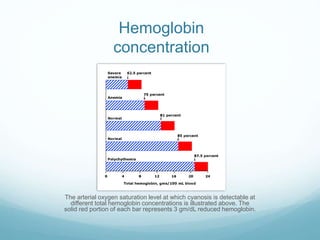
The arterial oxygen saturation level at which cyanosis is detectable at
different total hemoglobin concentrations is illustrated above. The
solid red portion of each bar represents 3 gm/dL reduced hemoglobin.
Fetal hemoglobin
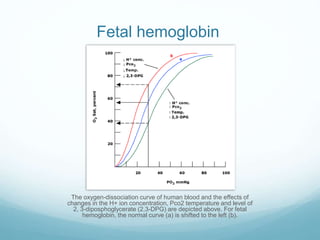
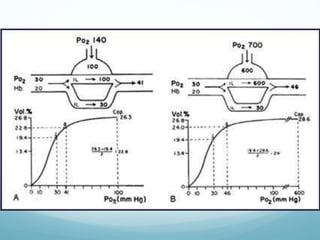
The oxygen-dissociation curve of human blood and the effects of
changes in the H+ ion concentration, Pco2 temperature and level of
2, 3-diposphoglycerate (2,3-DPG) are depicted above. For fetal
hemoglobin, the normal curve (a) is shifted to the left (b).
Skin pigmentation
 Less apparent in the skin of babies with darker
pigmentation.
 Examination should include the nail beds, tongue,
and mucous membranes, which are less affected by
pigmentation.
Cyanosis
Pulmonary
Central CNS
depression
Local
Ventilation-
perfusion
mismatch
Alveolar
hypoventilation
Diffuse
impairment
Cardiac
Increased
pulmonary
vascularity
Decreased
pulmonary
vascularity
Hemoglobi-
nopathies
Ventilation/perfusion mismatch
 Airway disease: transient tachypnea of the newborn
(TTN), respiratory distress syndrome (RDS),
pneumonia, aspiration (meconium, blood, amniotic
fluid), atelectasis, diaphragmatic hernia, pulmonary
hypoplasia, pulmonary hemorrhage, CCAM
 Extrinsic compression of the lungs: pneumothorax,
pleural effusion, hemothorax,
Alveolar hypoventilation
 CNS depression: asphyxia, maternal sedation,
intraventricular hemorrhage, seizure, meningitis,
encephalitis
 Airway obstruction: choanal atresia, laryngomalacia,
Pierre Robin syndrome
 Neuromuscular disease: phrenic nerve inury, neonatal
myasthenia gravis
Diffusion impairment
 Pulmonary edema: left-sided obstructive cardiac
disease, cardiomyopathy
 Pulmonary fibrosis
 Congenital lymphangiectasia
Cardiac causes
 Decreased pulmonary blood flow-
 Tetralogy of Fallot
 Tricuspid valve anomaly
 Pulmonary valve atresia
 Critical valvular pulmonary steanosis
 Increased pulmonary blood flow-
 Transposition of great arteries
 Truncus arteriosus
 Total anomalous pulmonary venous connection
 Cardiac causes- "five Ts" of cyanotic CHD:
 Transposition of the great arteries
 Tetralogy of Fallot
 Truncus arteriosus
 Total anomalous pulmonary venous connection
 Tricuspid valve abnormalities.
 A sixth "T" is often added for "tons" of other diseases,
such as double outlet right ventricle, pulmonary atresia,
multiple variations of single ventricle, hypoplastic left
heart syndrome, or anomalous systemic venous
connection (left superior vena cava connected to the
left atrium).
Hemoglobinopathies
 Hereditary < exposure to toxic substances
 >15%- cyanosis
 >70% -lethal
 Remain chocolate brown-even with full oxygenation or
long exposure to room air
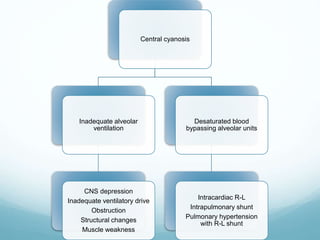
Central cyanosis
Inadequate alveolar
ventilation
CNS depression
Inadequate ventilatory drive
Obstruction
Structural changes
Muscle weakness
Desaturated blood
bypassing alveolar units
Intracardiac R-L
Intrapulmonary shunt
Pulmonary hypertension
with R-L shunt
Peripheral cyanosis
 Peripheral cyanosis, involves a bluish discoloration of the
skin but sparing of the mucus membranes & tongue. In this
type, a normal PaO2 value is detected
 Increased oxygen extraction due to sluggish movement
through the capillaries leads to increased deoxygenated
blood on the venous side
 Vasomotor instability,vasoconstriction caused by cold, low
cardiac output, venous obstruction, elevated venous
pressure and polycythemia
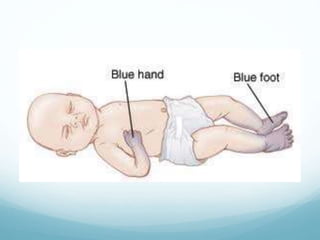
Acrocyanosis
 Bluish discoloration of fingers seen in neonates and infants
due to vasoconstriction as a result of transient hypothermia
 No clinical significance unless associated with circulatory
shock
Circum-oral cyanosis
 Healthy child with fair skin due to sluggish blood flow
with vasoconstriction
 No clinical significance unless associated with low
cardiac output
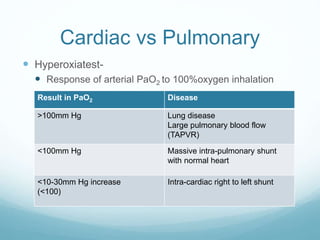
Cardiac vs Pulmonary
 Hyperoxiatest-
 Response of arterial PaO2 to 100%oxygen inhalation
Result in PaO2 Disease
>100mm Hg Lung disease
Large pulmonary blood flow
(TAPVR)
<100mm Hg Massive intra-pulmonary shunt
with normal heart
<10-30mm Hg increase
(<100)
Intra-cardiac right to left shunt
Approach to cyanotic neonate
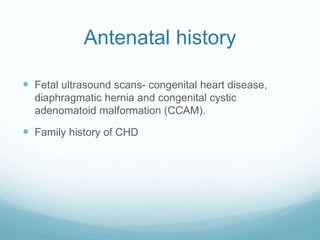
Antenatal history
 Fetal ultrasound scans- congenital heart disease,
diaphragmatic hernia and congenital cystic
adenomatoid malformation (CCAM).
 Family history of CHD
Physical examination
 Vitals
 R/o choanal atresia
 Respiratory system
 Cardiovascular system
 Abdomen
 Neurological disorders
Vitals
 Vital signs-
 signs of respiratory distress such as tachypnea,
retractions, nasal flaring & grunting usually indicate a
respiratory problem
 congenital heart disease is often accompanied by absent
or effortless tachypnea.
 Sepsis often has the following findings: peripheral
cyanosis, HR, RR, BP, / temp
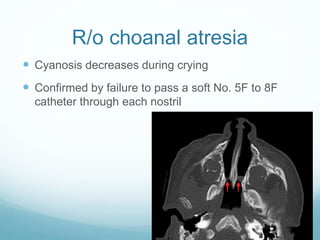
R/o choanal atresia
 Cyanosis decreases during crying
 Confirmed by failure to pass a soft No. 5F to 8F
catheter through each nostril
Respiratory system
 Inspiratory stridor-
 upper airway obstruction
 Chest-
 Asymmetric chest movement combined with severe
distress-
 alarming sign for tension pneumothorax, diaphragmatic
hernia
 Transillumination of the chest-
 Pneumothorax
Cardiovascular system
 A systolic murmur audible in most forms of cyanotic
CHD (exception: d-TGA with intact ventricular septum &
no pulmonary stenosis).
 Respirations often are unlabored unless there is
pulmonary congestion or complicated by the
development of heart failure or acidosis, which will
affect the respiratory pattern
Per abdomen
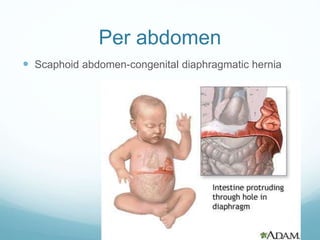
 Scaphoid abdomen-congenital diaphragmatic hernia
Neurological disorders
 Observe for apnea and periodic breathing, which may
be related to immaturity of the nervous system.
 Seizures can cause cyanosis if the infant fails to
breathe during the episodes.
Investigations
• CBC
• Serum glucose
• ABG
 Chest X-ray films,ECG
 Arterial PaO2 in preductal and postductal arteries
 Hyperoxitest
 CBC & diff :
 or WBC  sepsis
 hematocrit > 65%  polycythemia
 Serum glucose: to detect hypoglycemia
 Arterial Blood Gases (ABGs):
 Arterial PO2: to confirm central cyanosis SaO2 not as good an indicator
due to fetal Hb affinity for O2 (left-shift)
 PaCO2: may indicate pulmonary or CNS disorders, heart failure
 pH: sepsis, circulatory shock, severe hypoxemia
 Methemoglobinemia: SaO2, normal PaO2, chocolate-brown blood
X-ray -Increased pulmonary
vascularity
 RVH on ECG
 D-TGA
 TAPVR with obstruction
 DORV with subpulmonary VSD
 PPHN
 LVH/BVH on ECG
 Persistent truncus arteriosus
 Single ventricle
 TGA and VSD
 Polysplenia syndrome
X-ray -Decreased pulmonary
vascularity
 RVH on ECG
 TOF
 DORV with PS
 Asplenia syndrome
 RBBB on ECG
 Ebstein’s anomaly
 LVH on ECG
 Pulmonary atresia
 Tricuspid atresia
 BVH on ECG
 TGA and PS
 Persistent truncus arteriosus
 Single ventricle and PS
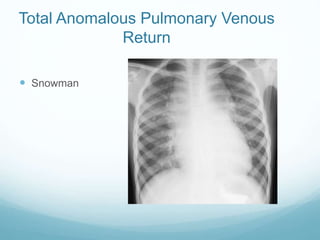
Total Anomalous Pulmonary Venous
Return
 Snowman
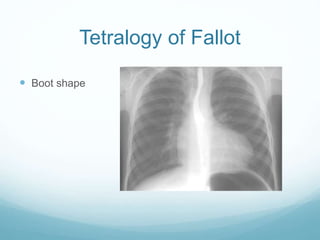
Tetralogy of Fallot
 Boot shape
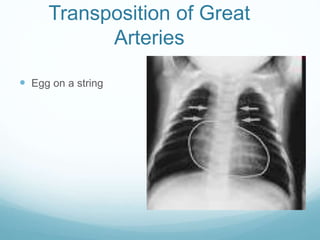
Transposition of Great
Arteries
 Egg on a string
Arterial PaO2 in preductal and
postductal arteries
 Right upper body-radial,brachial,temporal
 Umbilical artery line
 PaO2 should be compared
 Right radial-umbilical artery=>10-15 mm Hg
Differential cyanosis
 In severe R-L ductal shunt
 Pink-upper and cyanosed-lower
 Causes
 PPHN
 Severe AS
 Interrupted aortic arch
 Coarctation of aorta
Initial management
 Monitor Airway, breathing, circulation (ABCs)
 with respiratory compromise, establish an airway &
provide supportive therapy (e.g., oxygen, mechanical
ventilation)
 Monitor Vital signs
 Establish vascular access for sampling blood &
administering medicatons(if needed)
 umbilical vessels convenient for placement of intravenous
& intra-arterial catheters
 If sepsis is suspected or another specific cause is not
identified, start on broad spectrum antibiotics (e.g.,
ampicillin and gentamycin) after obtaining a CBC,
urinalysis, blood & urine cultures (if possible). Left
untreated, sepsis may lead to pulmonary disease & left
ventricular dysfunction.
 Secure a separate intravenous catheter to provide
fluids for resuscitation and ensure accessibility of
intubation equipment should they be required.
Prostaglandin E1 infusion
 Prostaglandin E1
 For cyanotic CHD/duct dependent cardiac defect
 Infusion of prostaglandin E1 at a dose of 0.05-
0.1mcg/kg/min intravenously
 Increase PaO2,increase systemic blood
pressure,improved pH-tapered 0.01mcg/kg/min
 No effect-increased upto 0.4mcg/kg/min
 Side effects-apnea(12%),fever(14%),flushing(10%)
 Less common side effects-
tachy/bradycardia,hypotension,cardiac arrest
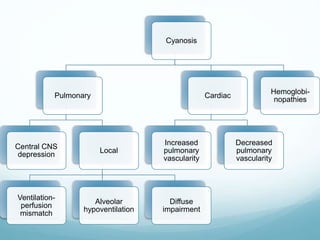
Cyanosis
Pulmonary
Central CNS
depression
Local
Ventilation-
perfusion
mismatch
Alveolar
hypoventilation
Diffuse
impairment
Cardiac
Increased
pulmonary
vascularity
Decreased
pulmonary
vascularity
Hemoglobi-
nopathies
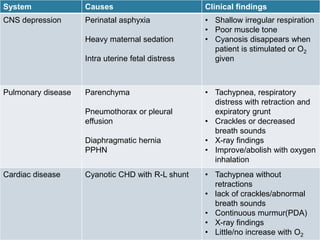
System Causes Clinical findings
CNS depression Perinatal asphyxia
Heavy maternal sedation
Intra uterine fetal distress
• Shallow irregular respiration
• Poor muscle tone
• Cyanosis disappears when
patient is stimulated or O2
given
Pulmonary disease Parenchyma
Pneumothorax or pleural
effusion
Diaphragmatic hernia
PPHN
• Tachypnea, respiratory
distress with retraction and
expiratory grunt
• Crackles or decreased
breath sounds
• X-ray findings
• Improve/abolish with oxygen
inhalation
Cardiac disease Cyanotic CHD with R-L shunt • Tachypnea without
retractions
• lack of crackles/abnormal
breath sounds
• Continuous murmur(PDA)
• X-ray findings
• Little/no increase with O2
Conclusion
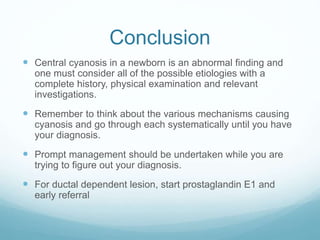
 Central cyanosis in a newborn is an abnormal finding and
one must consider all of the possible etiologies with a
complete history, physical examination and relevant
investigations.
 Remember to think about the various mechanisms causing
cyanosis and go through each systematically until you have
your diagnosis.
 Prompt management should be undertaken while you are
trying to figure out your diagnosis.
 For ductal dependent lesion, start prostaglandin E1 and
early referral
Thank You

Cyanosis in newborn

  • 1.
  • 2.
    Contents  Introduction  Factorsaffecting detection of cyanosis  Etiology  Types  Cardiac vs pulmonary  Approach  Conclusion
  • 3.
    Introduction  Cyanosis isthe bluish discoloration of the skin and mucous membranes due to increased concentration of reduced hemoglobin to about >5g/100 mL in the cutaneous veins  Desaturation of arterial blood  Increased extraction of oxygen by peripheral tissue in the presence of normal arterial saturation  Detected –lips,fingernails,oral mucous membranes,conjuctiva and tip of tongue
  • 4.
    Factors affecting detectionof cyanosis in newborn  Hemoglobin concentration  Fetal hemoglobin  Skin pigmentation
  • 5.
    Hemoglobin concentration The arterial oxygensaturation level at which cyanosis is detectable at different total hemoglobin concentrations is illustrated above. The solid red portion of each bar represents 3 gm/dL reduced hemoglobin.
  • 6.
    Fetal hemoglobin The oxygen-dissociationcurve of human blood and the effects of changes in the H+ ion concentration, Pco2 temperature and level of 2, 3-diposphoglycerate (2,3-DPG) are depicted above. For fetal hemoglobin, the normal curve (a) is shifted to the left (b).
  • 7.
    Skin pigmentation  Lessapparent in the skin of babies with darker pigmentation.  Examination should include the nail beds, tongue, and mucous membranes, which are less affected by pigmentation.
  • 8.
  • 9.
    Ventilation/perfusion mismatch  Airwaydisease: transient tachypnea of the newborn (TTN), respiratory distress syndrome (RDS), pneumonia, aspiration (meconium, blood, amniotic fluid), atelectasis, diaphragmatic hernia, pulmonary hypoplasia, pulmonary hemorrhage, CCAM  Extrinsic compression of the lungs: pneumothorax, pleural effusion, hemothorax,
  • 10.
    Alveolar hypoventilation  CNSdepression: asphyxia, maternal sedation, intraventricular hemorrhage, seizure, meningitis, encephalitis  Airway obstruction: choanal atresia, laryngomalacia, Pierre Robin syndrome  Neuromuscular disease: phrenic nerve inury, neonatal myasthenia gravis
  • 11.
    Diffusion impairment  Pulmonaryedema: left-sided obstructive cardiac disease, cardiomyopathy  Pulmonary fibrosis  Congenital lymphangiectasia
  • 12.
    Cardiac causes  Decreasedpulmonary blood flow-  Tetralogy of Fallot  Tricuspid valve anomaly  Pulmonary valve atresia  Critical valvular pulmonary steanosis  Increased pulmonary blood flow-  Transposition of great arteries  Truncus arteriosus  Total anomalous pulmonary venous connection
  • 13.
     Cardiac causes-"five Ts" of cyanotic CHD:  Transposition of the great arteries  Tetralogy of Fallot  Truncus arteriosus  Total anomalous pulmonary venous connection  Tricuspid valve abnormalities.  A sixth "T" is often added for "tons" of other diseases, such as double outlet right ventricle, pulmonary atresia, multiple variations of single ventricle, hypoplastic left heart syndrome, or anomalous systemic venous connection (left superior vena cava connected to the left atrium).
  • 14.
    Hemoglobinopathies  Hereditary <exposure to toxic substances  >15%- cyanosis  >70% -lethal  Remain chocolate brown-even with full oxygenation or long exposure to room air
  • 15.
    Central cyanosis Inadequate alveolar ventilation CNSdepression Inadequate ventilatory drive Obstruction Structural changes Muscle weakness Desaturated blood bypassing alveolar units Intracardiac R-L Intrapulmonary shunt Pulmonary hypertension with R-L shunt
  • 16.
    Peripheral cyanosis  Peripheralcyanosis, involves a bluish discoloration of the skin but sparing of the mucus membranes & tongue. In this type, a normal PaO2 value is detected  Increased oxygen extraction due to sluggish movement through the capillaries leads to increased deoxygenated blood on the venous side  Vasomotor instability,vasoconstriction caused by cold, low cardiac output, venous obstruction, elevated venous pressure and polycythemia
  • 18.
    Acrocyanosis  Bluish discolorationof fingers seen in neonates and infants due to vasoconstriction as a result of transient hypothermia  No clinical significance unless associated with circulatory shock Circum-oral cyanosis  Healthy child with fair skin due to sluggish blood flow with vasoconstriction  No clinical significance unless associated with low cardiac output
  • 19.
    Cardiac vs Pulmonary Hyperoxiatest-  Response of arterial PaO2 to 100%oxygen inhalation Result in PaO2 Disease >100mm Hg Lung disease Large pulmonary blood flow (TAPVR) <100mm Hg Massive intra-pulmonary shunt with normal heart <10-30mm Hg increase (<100) Intra-cardiac right to left shunt
  • 21.
  • 22.
    Antenatal history  Fetalultrasound scans- congenital heart disease, diaphragmatic hernia and congenital cystic adenomatoid malformation (CCAM).  Family history of CHD
  • 24.
    Physical examination  Vitals R/o choanal atresia  Respiratory system  Cardiovascular system  Abdomen  Neurological disorders
  • 25.
    Vitals  Vital signs- signs of respiratory distress such as tachypnea, retractions, nasal flaring & grunting usually indicate a respiratory problem  congenital heart disease is often accompanied by absent or effortless tachypnea.  Sepsis often has the following findings: peripheral cyanosis, HR, RR, BP, / temp
  • 26.
    R/o choanal atresia Cyanosis decreases during crying  Confirmed by failure to pass a soft No. 5F to 8F catheter through each nostril
  • 27.
    Respiratory system  Inspiratorystridor-  upper airway obstruction  Chest-  Asymmetric chest movement combined with severe distress-  alarming sign for tension pneumothorax, diaphragmatic hernia  Transillumination of the chest-  Pneumothorax
  • 28.
    Cardiovascular system  Asystolic murmur audible in most forms of cyanotic CHD (exception: d-TGA with intact ventricular septum & no pulmonary stenosis).  Respirations often are unlabored unless there is pulmonary congestion or complicated by the development of heart failure or acidosis, which will affect the respiratory pattern
  • 29.
    Per abdomen  Scaphoidabdomen-congenital diaphragmatic hernia
  • 30.
    Neurological disorders  Observefor apnea and periodic breathing, which may be related to immaturity of the nervous system.  Seizures can cause cyanosis if the infant fails to breathe during the episodes.
  • 31.
    Investigations • CBC • Serumglucose • ABG  Chest X-ray films,ECG  Arterial PaO2 in preductal and postductal arteries  Hyperoxitest
  • 32.
     CBC &diff :  or WBC  sepsis  hematocrit > 65%  polycythemia  Serum glucose: to detect hypoglycemia  Arterial Blood Gases (ABGs):  Arterial PO2: to confirm central cyanosis SaO2 not as good an indicator due to fetal Hb affinity for O2 (left-shift)  PaCO2: may indicate pulmonary or CNS disorders, heart failure  pH: sepsis, circulatory shock, severe hypoxemia  Methemoglobinemia: SaO2, normal PaO2, chocolate-brown blood
  • 33.
    X-ray -Increased pulmonary vascularity RVH on ECG  D-TGA  TAPVR with obstruction  DORV with subpulmonary VSD  PPHN  LVH/BVH on ECG  Persistent truncus arteriosus  Single ventricle  TGA and VSD  Polysplenia syndrome
  • 34.
    X-ray -Decreased pulmonary vascularity RVH on ECG  TOF  DORV with PS  Asplenia syndrome  RBBB on ECG  Ebstein’s anomaly  LVH on ECG  Pulmonary atresia  Tricuspid atresia  BVH on ECG  TGA and PS  Persistent truncus arteriosus  Single ventricle and PS
  • 35.
    Total Anomalous PulmonaryVenous Return  Snowman
  • 36.
  • 37.
  • 38.
    Arterial PaO2 inpreductal and postductal arteries  Right upper body-radial,brachial,temporal  Umbilical artery line  PaO2 should be compared  Right radial-umbilical artery=>10-15 mm Hg
  • 39.
    Differential cyanosis  Insevere R-L ductal shunt  Pink-upper and cyanosed-lower  Causes  PPHN  Severe AS  Interrupted aortic arch  Coarctation of aorta
  • 40.
    Initial management  MonitorAirway, breathing, circulation (ABCs)  with respiratory compromise, establish an airway & provide supportive therapy (e.g., oxygen, mechanical ventilation)  Monitor Vital signs  Establish vascular access for sampling blood & administering medicatons(if needed)  umbilical vessels convenient for placement of intravenous & intra-arterial catheters
  • 41.
     If sepsisis suspected or another specific cause is not identified, start on broad spectrum antibiotics (e.g., ampicillin and gentamycin) after obtaining a CBC, urinalysis, blood & urine cultures (if possible). Left untreated, sepsis may lead to pulmonary disease & left ventricular dysfunction.  Secure a separate intravenous catheter to provide fluids for resuscitation and ensure accessibility of intubation equipment should they be required.
  • 42.
    Prostaglandin E1 infusion Prostaglandin E1  For cyanotic CHD/duct dependent cardiac defect  Infusion of prostaglandin E1 at a dose of 0.05- 0.1mcg/kg/min intravenously  Increase PaO2,increase systemic blood pressure,improved pH-tapered 0.01mcg/kg/min  No effect-increased upto 0.4mcg/kg/min  Side effects-apnea(12%),fever(14%),flushing(10%)  Less common side effects- tachy/bradycardia,hypotension,cardiac arrest
  • 43.
  • 44.
    System Causes Clinicalfindings CNS depression Perinatal asphyxia Heavy maternal sedation Intra uterine fetal distress • Shallow irregular respiration • Poor muscle tone • Cyanosis disappears when patient is stimulated or O2 given Pulmonary disease Parenchyma Pneumothorax or pleural effusion Diaphragmatic hernia PPHN • Tachypnea, respiratory distress with retraction and expiratory grunt • Crackles or decreased breath sounds • X-ray findings • Improve/abolish with oxygen inhalation Cardiac disease Cyanotic CHD with R-L shunt • Tachypnea without retractions • lack of crackles/abnormal breath sounds • Continuous murmur(PDA) • X-ray findings • Little/no increase with O2
  • 45.
    Conclusion  Central cyanosisin a newborn is an abnormal finding and one must consider all of the possible etiologies with a complete history, physical examination and relevant investigations.  Remember to think about the various mechanisms causing cyanosis and go through each systematically until you have your diagnosis.  Prompt management should be undertaken while you are trying to figure out your diagnosis.  For ductal dependent lesion, start prostaglandin E1 and early referral
  • 46.