

Unit 14 Customer Relationship Management
Contents
•   Introduction
•   Relationship marketing vs. relationship management
•   Definitions of customer relationship management
•   Forms of relationship management
•   Managing customer loyalty and development
•   Reasons behind losing customers by organizations
•   Significance of customer relationship management
•   Social actions affecting buyer-seller relationships
Introduction
•   In marketing, it is often said that ‘retaining customer is more important than
    acquiring one’.
•   Organizations use communication tools to make the consumer aware about their
    products and brands.
•   It uses supply chain and human resources to sell its products.
•   All these have a cost to the company and in this competitive world organizations
    want to reduce cost.
•   For this organizations develop a database which helps in creating loyalty
    programs.
•   Many Indian companies like Infosys, Wipro and others started offering CRM
    software to companies.
•   The benefits of CRM software are quicker, better quality, and timely services to
    the customers.
•   This increases the word of mouth communications and reduces the cost of mass
    media.
Learning Objectives
After studying this unit, you will be able to
• Explain the meaning, need and relevance of customer relationship
   management.
• Mention the forms of relationship management.
• Cite the reasons for losing customers by organizations.
• Bring out the significance of customer relationship management.
Relationship Marketing Vs. Relationship Management
•   The relationship marketing approach considers customers as part of the business
    and aims at building a long term and never-ending relationship with them.
•   The focus of relationship marketing approach is on developing ‘hard core loyal’
    customers and retaining them forever.
•   The relationship marketing approach has slowly taken the form of customer
    relationship management.
•   Relationship marketing focuses only on the marketing function of the organization.
•   Customer relationship management focuses on customers and the entire
    functions connected with value creation and delivery chain of the organization.
Definitions of Customer Relationship Management
•   Berry defines CRM as “attracting, maintaining and in multi-service organizations
    enhancing customer relationships.”
•   Berry and Parasuraman define CRM as “attracting, developing and retaining
    customer relationships.”
•   In industrial marketing, Jackson defines CRM as “marketing oriented toward
    strong, lasting relationships with individual accounts.”
•   From the above definitions, it is concluded that Customer Relationship
    Management refers to all marketing activities directed towards establishing,
    developing, and sustaining long lasting, trusting, win-win, beneficial and
    successful relational exchanges between the organization and its stakeholders .
•   CRM is not a new concept but
    a very old practice, which has
    grown because of the benefits
    it offers in the present
    marketing scenario.
•   CRM today is a discipline and
    also a set of software and
    technology which automates
    and improves the business
    process     associated     with
    managing              customer
    relationships in the area of
    sales, marketing, customer
    service and support.
•   CRM       helps      companies
    understand, start and develop
    long-term relationships with
    clients as well as help in
    retaining current customers.
Forms of Relationship Management
The 10 different forms of relationship marketing are:
1. The partnership involved in relational exchanges between manufacturers
   and their external goods suppliers.
2. Relational exchanges between service providers, as between advertising
   or marketing research agencies and their clients.
3. Strategic alliances between firms and their competitors, as in technology
   alliances; co-marketing alliances and global strategic alliance.
4. Alliances between a firm and non-profit organizations, as in public-
   purpose partnerships.
5. Partnerships for joint research and development, as between firms and
   local, state, or national governments.
6.  Long-term exchanges between firms and customers, particularly in the services
    marketing area.
7. Relational exchanges of working partnerships as in channels of distribution.
8. Exchanges involving functional departments within a firm.
9. Exchanges between a firm and its employees, as in internal marketing.
10. Within firm relational exchanges involving such business units as subsidiaries,
    divisions or strategic business units.
Managing Customer Loyalty and Development

•   Managing customer development is
    one of the important aspects of
    relationship marketing.
•   The focus is on two things – customer
    catching and customer keeping.

•   ‘Customer catching’ is the process of
    attracting new customers (inviting new
    blood), while customer keeping is the
    process of retaining the existing ones
    (encouraging old blood).
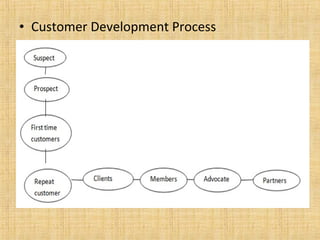
• Customer Development Process
1.   Suspect: Suspect is everyone who might conceivably buy the product or service.
2.   Prospects: Prospects are those people who have a strong potential interest in the
     product and the ability to pay for it. The company rejects the disqualified
     prospects because they have poor credit or would be unprofitable.
3.   First time customers: The company wants to convert the qualified prospects into
     first time customers.
4.   Repeat customers: The company wants to convert satisfied first time customers
     into repeat customers. First time and repeat customers may also buy from the
     competitors.
5.   Clients: The company then tries to convert repeat customers into clients. Clients
     are those people who buy only from the company.
6.   Advocates: The next step is to convert the
     clients into advocates. Advocates are those
     people who speak good about the company
     and encourage others to buy from it.
7.   Partners: The ultimate goal of the company
     is to convert advocates into partners. After
     reaching this stage, the customer and the
     company work actively together.

Some customers may become inactive or may
   drop out due to many reasons leading to end
   of the relationship. The challenge is to re-
   activate dissatisfied customers through
   customer win back strategies
Reasons Behind Losing Customers by Organizations
•   The cost of attracting a new customer is five times the cost of keeping a current
    customer happy.
•   But most marketing theories and practices focus on attracting new customers
    rather than retaining existing ones.
•   Today, however, more companies are recognizing the importance of satisfying and
    retaining the current customers.
•   Today’s companies must focus on their defection rate and take steps to reduce it.
    The possible reasons for customer defection include:
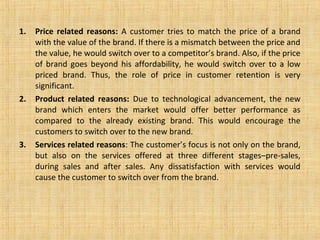
1.   Price related reasons: A customer tries to match the price of a brand
     with the value of the brand. If there is a mismatch between the price and
     the value, he would switch over to a competitor’s brand. Also, if the price
     of brand goes beyond his affordability, he would switch over to a low
     priced brand. Thus, the role of price in customer retention is very
     significant.
2.   Product related reasons: Due to technological advancement, the new
     brand which enters the market would offer better performance as
     compared to the already existing brand. This would encourage the
     customers to switch over to the new brand.
3.   Services related reasons: The customer’s focus is not only on the brand,
     but also on the services offered at three different stages–pre-sales,
     during sales and after sales. Any dissatisfaction with services would
     cause the customer to switch over from the brand.
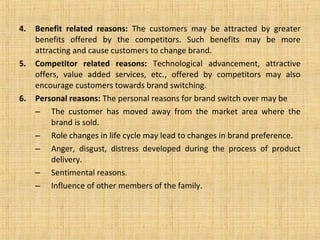
4.   Benefit related reasons: The customers may be attracted by greater
     benefits offered by the competitors. Such benefits may be more
     attracting and cause customers to change brand.
5.   Competitor related reasons: Technological advancement, attractive
     offers, value added services, etc., offered by competitors may also
     encourage customers towards brand switching.
6.   Personal reasons: The personal reasons for brand switch over may be
     – The customer has moved away from the market area where the
          brand is sold.
     – Role changes in life cycle may lead to changes in brand preference.
     – Anger, disgust, distress developed during the process of product
          delivery.
     – Sentimental reasons.
     – Influence of other members of the family.
Significance of Customer Relationship Management
•    Reduction in customer recruitment cost.
•    Generation of more and more loyal customers.
•    Expansion of customer base.
•    Reduction in advertisement and other sales promotion expenses.
•    Increase in the number of profitable customers.
•    Easy introduction of new products.
•    Easy business expansion possibilities.
•    Increase in customer partnering.
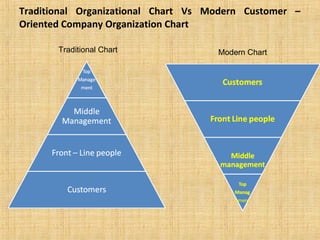
Traditional Organizational Chart Vs Modern Customer –
Oriented Company Organization Chart

       Traditional Chart             Modern Chart
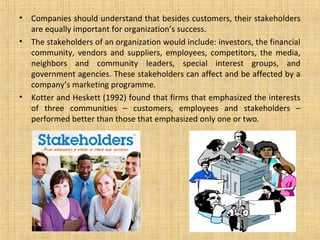
•   Companies should understand that besides customers, their stakeholders
    are equally important for organization’s success.
•   The stakeholders of an organization would include: investors, the financial
    community, vendors and suppliers, employees, competitors, the media,
    neighbors and community leaders, special interest groups, and
    government agencies. These stakeholders can affect and be affected by a
    company’s marketing programme.
•   Kotter and Heskett (1992) found that firms that emphasized the interests
    of three communities – customers, employees and stakeholders –
    performed better than those that emphasized only one or two.
Soft and Hard Versions of Relationship Marketing
• Soft version of relationship marketing suggests ‘humanistic
  relationship development’, whereas the hard version reflects
  a ‘utilitarian instrumentalism’.
• The soft version focuses on the term ‘relationship’, thus laying
  importance on relationship management. It strongly
  advocates that all management is basically relationship
  management and all managers are relationship managers. It
  focuses on ‘developmental humanism’ as a foundation to
  build and develop long lasting relationships in marketing
  exchanges.
• On the other hand, the hard version stresses on the idea of
  ‘marketing’, that is something to be used unemotionally and
  in a formally sensible manner.
Social Actions Affecting Buyer-Seller Relationships

Good things                       Bad things
• Initiate positive phone calls   • Make only callbacks
• Make recommendations            • Make justifications
• Candor (frankness) in           • Accommodative language
  language                        • Use legal language
• Use “we” problem solving        • Only respond to problems
  language                        • Use long-winded
• Get to problems                   communications
• Use jargon or shorthand         • Shift blame
• Accept responsibility           • Rehash (repeat) the past
• Plan the future
Customer relationship management

Customer relationship management

  • 1.
    Unit 14 CustomerRelationship Management
  • 2.
    Contents • Introduction • Relationship marketing vs. relationship management • Definitions of customer relationship management • Forms of relationship management • Managing customer loyalty and development • Reasons behind losing customers by organizations • Significance of customer relationship management • Social actions affecting buyer-seller relationships
  • 3.
    Introduction • In marketing, it is often said that ‘retaining customer is more important than acquiring one’. • Organizations use communication tools to make the consumer aware about their products and brands. • It uses supply chain and human resources to sell its products. • All these have a cost to the company and in this competitive world organizations want to reduce cost. • For this organizations develop a database which helps in creating loyalty programs. • Many Indian companies like Infosys, Wipro and others started offering CRM software to companies. • The benefits of CRM software are quicker, better quality, and timely services to the customers. • This increases the word of mouth communications and reduces the cost of mass media.
  • 4.
    Learning Objectives After studyingthis unit, you will be able to • Explain the meaning, need and relevance of customer relationship management. • Mention the forms of relationship management. • Cite the reasons for losing customers by organizations. • Bring out the significance of customer relationship management.
  • 5.
    Relationship Marketing Vs.Relationship Management • The relationship marketing approach considers customers as part of the business and aims at building a long term and never-ending relationship with them. • The focus of relationship marketing approach is on developing ‘hard core loyal’ customers and retaining them forever. • The relationship marketing approach has slowly taken the form of customer relationship management. • Relationship marketing focuses only on the marketing function of the organization. • Customer relationship management focuses on customers and the entire functions connected with value creation and delivery chain of the organization.
  • 6.
    Definitions of CustomerRelationship Management • Berry defines CRM as “attracting, maintaining and in multi-service organizations enhancing customer relationships.” • Berry and Parasuraman define CRM as “attracting, developing and retaining customer relationships.” • In industrial marketing, Jackson defines CRM as “marketing oriented toward strong, lasting relationships with individual accounts.” • From the above definitions, it is concluded that Customer Relationship Management refers to all marketing activities directed towards establishing, developing, and sustaining long lasting, trusting, win-win, beneficial and successful relational exchanges between the organization and its stakeholders .
  • 7.
    CRM is not a new concept but a very old practice, which has grown because of the benefits it offers in the present marketing scenario. • CRM today is a discipline and also a set of software and technology which automates and improves the business process associated with managing customer relationships in the area of sales, marketing, customer service and support. • CRM helps companies understand, start and develop long-term relationships with clients as well as help in retaining current customers.
  • 8.
    Forms of RelationshipManagement The 10 different forms of relationship marketing are: 1. The partnership involved in relational exchanges between manufacturers and their external goods suppliers. 2. Relational exchanges between service providers, as between advertising or marketing research agencies and their clients. 3. Strategic alliances between firms and their competitors, as in technology alliances; co-marketing alliances and global strategic alliance. 4. Alliances between a firm and non-profit organizations, as in public- purpose partnerships. 5. Partnerships for joint research and development, as between firms and local, state, or national governments.
  • 9.
    6. Long-termexchanges between firms and customers, particularly in the services marketing area. 7. Relational exchanges of working partnerships as in channels of distribution. 8. Exchanges involving functional departments within a firm. 9. Exchanges between a firm and its employees, as in internal marketing. 10. Within firm relational exchanges involving such business units as subsidiaries, divisions or strategic business units.
  • 10.
    Managing Customer Loyaltyand Development • Managing customer development is one of the important aspects of relationship marketing. • The focus is on two things – customer catching and customer keeping. • ‘Customer catching’ is the process of attracting new customers (inviting new blood), while customer keeping is the process of retaining the existing ones (encouraging old blood).
  • 11.
  • 12.
    1. Suspect: Suspect is everyone who might conceivably buy the product or service. 2. Prospects: Prospects are those people who have a strong potential interest in the product and the ability to pay for it. The company rejects the disqualified prospects because they have poor credit or would be unprofitable. 3. First time customers: The company wants to convert the qualified prospects into first time customers. 4. Repeat customers: The company wants to convert satisfied first time customers into repeat customers. First time and repeat customers may also buy from the competitors. 5. Clients: The company then tries to convert repeat customers into clients. Clients are those people who buy only from the company.
  • 13.
    6. Advocates: The next step is to convert the clients into advocates. Advocates are those people who speak good about the company and encourage others to buy from it. 7. Partners: The ultimate goal of the company is to convert advocates into partners. After reaching this stage, the customer and the company work actively together. Some customers may become inactive or may drop out due to many reasons leading to end of the relationship. The challenge is to re- activate dissatisfied customers through customer win back strategies
  • 14.
    Reasons Behind LosingCustomers by Organizations • The cost of attracting a new customer is five times the cost of keeping a current customer happy. • But most marketing theories and practices focus on attracting new customers rather than retaining existing ones. • Today, however, more companies are recognizing the importance of satisfying and retaining the current customers. • Today’s companies must focus on their defection rate and take steps to reduce it. The possible reasons for customer defection include:
  • 15.
    1. Price related reasons: A customer tries to match the price of a brand with the value of the brand. If there is a mismatch between the price and the value, he would switch over to a competitor’s brand. Also, if the price of brand goes beyond his affordability, he would switch over to a low priced brand. Thus, the role of price in customer retention is very significant. 2. Product related reasons: Due to technological advancement, the new brand which enters the market would offer better performance as compared to the already existing brand. This would encourage the customers to switch over to the new brand. 3. Services related reasons: The customer’s focus is not only on the brand, but also on the services offered at three different stages–pre-sales, during sales and after sales. Any dissatisfaction with services would cause the customer to switch over from the brand.
  • 16.
    4. Benefit related reasons: The customers may be attracted by greater benefits offered by the competitors. Such benefits may be more attracting and cause customers to change brand. 5. Competitor related reasons: Technological advancement, attractive offers, value added services, etc., offered by competitors may also encourage customers towards brand switching. 6. Personal reasons: The personal reasons for brand switch over may be – The customer has moved away from the market area where the brand is sold. – Role changes in life cycle may lead to changes in brand preference. – Anger, disgust, distress developed during the process of product delivery. – Sentimental reasons. – Influence of other members of the family.
  • 17.
    Significance of CustomerRelationship Management • Reduction in customer recruitment cost. • Generation of more and more loyal customers. • Expansion of customer base. • Reduction in advertisement and other sales promotion expenses. • Increase in the number of profitable customers. • Easy introduction of new products. • Easy business expansion possibilities. • Increase in customer partnering.
  • 18.
    Traditional Organizational ChartVs Modern Customer – Oriented Company Organization Chart Traditional Chart Modern Chart
  • 19.
    Companies should understand that besides customers, their stakeholders are equally important for organization’s success. • The stakeholders of an organization would include: investors, the financial community, vendors and suppliers, employees, competitors, the media, neighbors and community leaders, special interest groups, and government agencies. These stakeholders can affect and be affected by a company’s marketing programme. • Kotter and Heskett (1992) found that firms that emphasized the interests of three communities – customers, employees and stakeholders – performed better than those that emphasized only one or two.
  • 20.
    Soft and HardVersions of Relationship Marketing • Soft version of relationship marketing suggests ‘humanistic relationship development’, whereas the hard version reflects a ‘utilitarian instrumentalism’. • The soft version focuses on the term ‘relationship’, thus laying importance on relationship management. It strongly advocates that all management is basically relationship management and all managers are relationship managers. It focuses on ‘developmental humanism’ as a foundation to build and develop long lasting relationships in marketing exchanges. • On the other hand, the hard version stresses on the idea of ‘marketing’, that is something to be used unemotionally and in a formally sensible manner.
  • 21.
    Social Actions AffectingBuyer-Seller Relationships Good things Bad things • Initiate positive phone calls • Make only callbacks • Make recommendations • Make justifications • Candor (frankness) in • Accommodative language language • Use legal language • Use “we” problem solving • Only respond to problems language • Use long-winded • Get to problems communications • Use jargon or shorthand • Shift blame • Accept responsibility • Rehash (repeat) the past • Plan the future