CURRENT AND FUTURE USE OF CUSTOM
IMPLANTS IN ORTHOPAEDIC SURGERY
OMTEC 2016 CHICAGO
P James Burn FRACS
Consultant Orthopaedic Surgeon
Canterbury District Health Board
Christchurch
New Zealand
pjamesburn@xtra.co.nz
DISCLOSURES:
• Founding shareholder of Ossis Ltd (NZ)
• Founding shareholder of Enztec Ltd (NZ)
• Receive royalties from the Enztec Stardrill
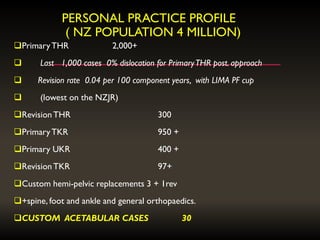
PERSONAL PRACTICE PROFILE
( NZ POPULATION 4 MILLION)
PrimaryTHR 2,000+
 Last 1,000 cases 0% dislocation for PrimaryTHR post. approach
 Revision rate 0.04 per 100 component years, with LIMA PF cup
 (lowest on the NZJR)
RevisionTHR 300
PrimaryTKR 950 +
Primary UKR 400 +
RevisionTKR 97+
Custom hemi-pelvic replacements 3 + 1rev
+spine, foot and ankle and general orthopaedics.
CUSTOM ACETABULAR CASES 30
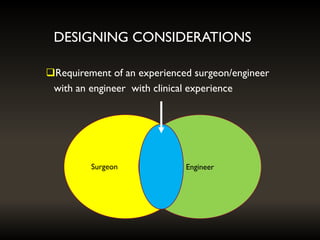
DESIGNING CONSIDERATIONS
Requirement of an experienced surgeon/engineer
with an engineer with clinical experience
EngineerSurgeon
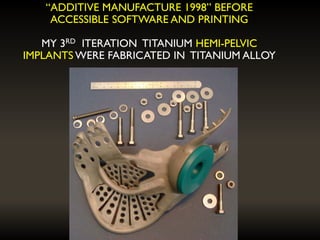
“ADDITIVE MANUFACTURE 1998” BEFORE
ACCESSIBLE SOFTWARE AND PRINTING
MY 3RD ITERATION TITANIUM HEMI-PELVIC
IMPLANTS WERE FABRICATED IN TITANIUM ALLOY
CUSTOM ACETABULAR CASES:
N=102
IMPLANTED IN:
NEW ZEALAND AND AUSTRALIA
MANUFACTURED BY:
OSSIS LTD, NZ
In conjunction with
MED. MODELLING/3D SYSTEMS, USA
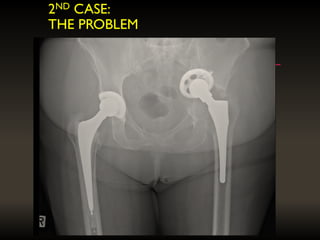
2ND CASE:
THE PROBLEM
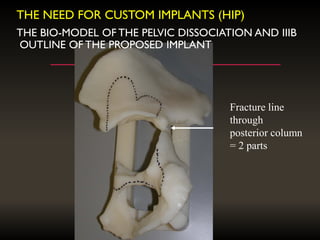
THE BIO-MODEL OF THE PELVIC DISSOCIATION AND IIIB
OUTLINE OF THE PROPOSED IMPLANT
Fracture line
through
posterior column
= 2 parts
THE NEED FOR CUSTOM IMPLANTS (HIP)
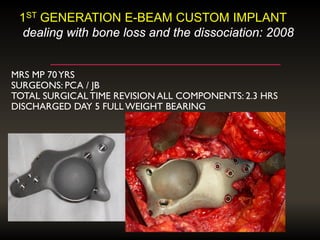
MRS MP 70YRS
SURGEONS: PCA / JB
TOTAL SURGICAL TIME REVISION ALL COMPONENTS: 2.3 HRS
DISCHARGED DAY 5 FULL WEIGHT BEARING
1ST GENERATION E-BEAM CUSTOM IMPLANT
dealing with bone loss and the dissociation: 2008
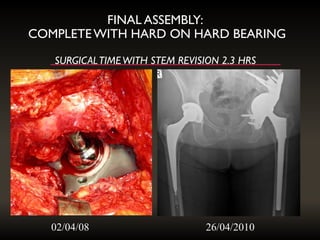
FINAL ASSEMBLY:
COMPLETEWITH HARD ON HARD BEARING
SURGICALTIMEWITH STEM REVISION 2.3 HRS
02/04/08 26/04/2010
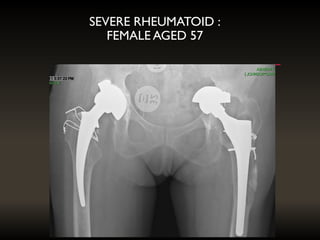
SEVERE RHEUMATOID :
FEMALE AGED 57
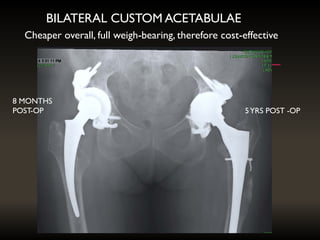
BILATERAL CUSTOM ACETABULAE
5YRS POST -OP
8 MONTHS
POST-OP
Cheaper overall, full weigh-bearing, therefore cost-effective
TOTAL NUMBER OF CASES USING EBM
ACETABULAR IMPLANTS = 102
Ossis Ltd, NZ and Med. Modelling / 3D Systems USA
NZ AND AUSTRALIAN MARKETS OF 24 MILLION
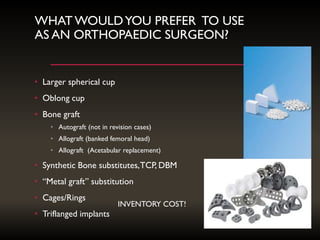
WHAT WOULDYOU PREFER TO USE
AS AN ORTHOPAEDIC SURGEON?
• Larger spherical cup
• Oblong cup
• Bone graft
• Autograft (not in revision cases)
• Allograft (banked femoral head)
• Allograft (Acetabular replacement)
• Synthetic Bone substitutes,TCP, DBM
• “Metal graft” substitution
• Cages/Rings
• Triflanged implants
INVENTORY COST!
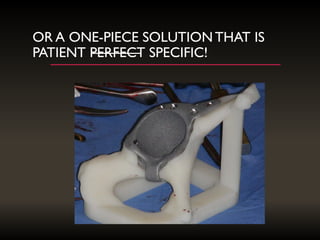
OR A ONE-PIECE SOLUTIONTHAT IS
PATIENT PERFECT SPECIFIC!
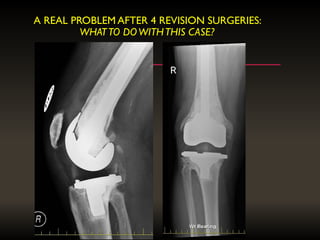
A REAL PROBLEM AFTER 4 REVISION SURGERIES:
WHATTO DOWITHTHIS CASE?
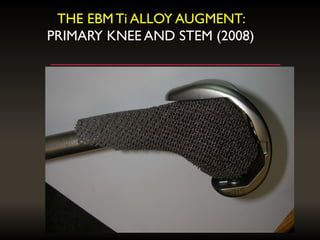
THE EBMTi ALLOY AUGMENT:
PRIMARY KNEE AND STEM (2008)
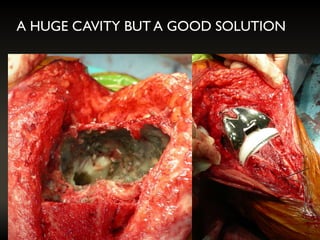
A HUGE CAVITY BUT A GOOD SOLUTION
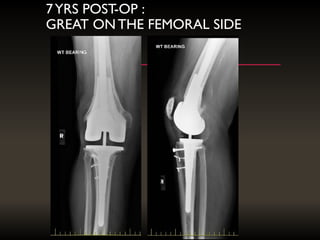
7YRS POST-OP :
GREAT ONTHE FEMORAL SIDE
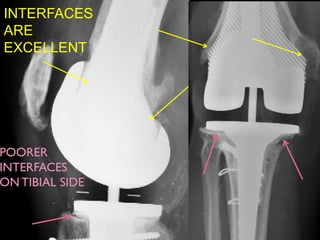
INTERFACES
ARE
EXCELLENT
POORER
INTERFACES
ON TIBIAL SIDE
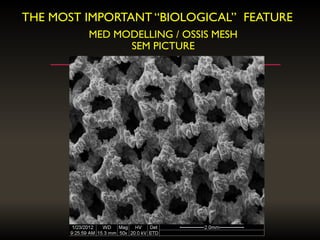
MED MODELLING / OSSIS MESH
SEM PICTURE
THE MOST IMPORTANT “BIOLOGICAL” FEATURE
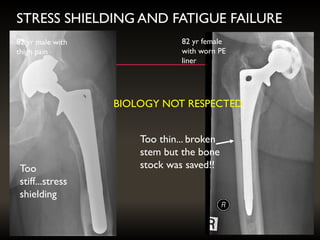
STRESS SHIELDING AND FATIGUE FAILURE
Too
stiff...stress
shielding
Too thin... broken
stem but the bone
stock was saved!!
82 yr female
with worn PE
liner
82 yr male with
thigh pain
BIOLOGY NOT RESPECTED
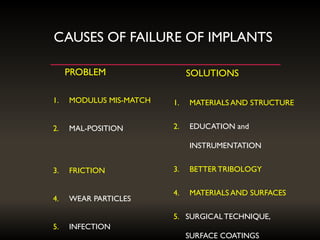
CAUSES OF FAILURE OF IMPLANTS
PROBLEM
1. MODULUS MIS-MATCH
2. MAL-POSITION
3. FRICTION
4. WEAR PARTICLES
5. INFECTION
SOLUTIONS
1. MATERIALS AND STRUCTURE
2. EDUCATION and
INSTRUMENTATION
3. BETTERTRIBOLOGY
4. MATERIALS AND SURFACES
5. SURGICAL TECHNIQUE,
SURFACE COATINGS
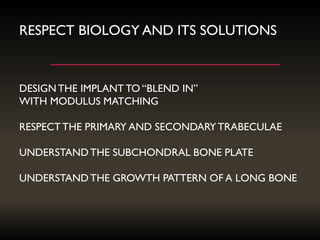
RESPECT BIOLOGY AND ITS SOLUTIONS
DESIGNTHE IMPLANT TO “BLEND IN”
WITH MODULUS MATCHING
RESPECTTHE PRIMARY AND SECONDARY TRABECULAE
UNDERSTANDTHE SUBCHONDRAL BONE PLATE
UNDERSTANDTHE GROWTH PATTERN OF A LONG BONE
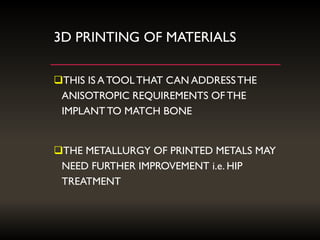
3D PRINTING OF MATERIALS
THIS IS A TOOLTHAT CAN ADDRESSTHE
ANISOTROPIC REQUIREMENTS OF THE
IMPLANT TO MATCH BONE
THE METALLURGY OF PRINTED METALS MAY
NEED FURTHER IMPROVEMENT i.e. HIP
TREATMENT
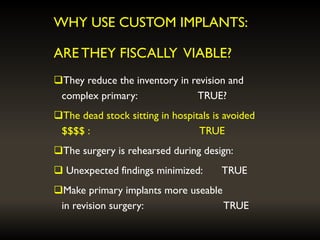
WHY USE CUSTOM IMPLANTS:
ARE THEY FISCALLY VIABLE?
They reduce the inventory in revision and
complex primary: TRUE?
The dead stock sitting in hospitals is avoided
$$$$ : TRUE
The surgery is rehearsed during design:
 Unexpected findings minimized: TRUE
Make primary implants more useable
in revision surgery: TRUE
CUSTOM
DOES NOT EQUAL
CUSTOMIZABLE
(Descriptive and Legal
Regulatory processes, N.Z.)
WHO PAYS CURRENTLY IN N.Z.
PUBLIC HOSPITALS WITH PRIOR APPROVAL OF
SERVICE MANAGERS
PRIVATE INSURANCE COMPANIES,AGAIN PRIOR
APPROVAL AND EXPLANATION
DO THE OUTCOMES OF CUSTOMISED
IMPLANTS EXTRAPOLATE TO
STANDARD PROVEN IMPLANTS?
The “IdentiFit Hip” experience (milled stem)
?20% per annum failure, Dr J Hart,Australia
OPEN QUESTION
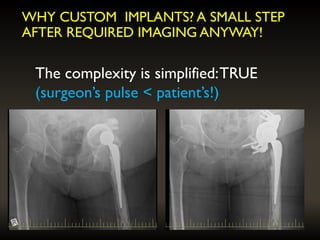
WHY CUSTOM IMPLANTS? A SMALL STEP
AFTER REQUIRED IMAGING ANYWAY!
The complexity is simplified:TRUE
(surgeon’s pulse < patient’s!)
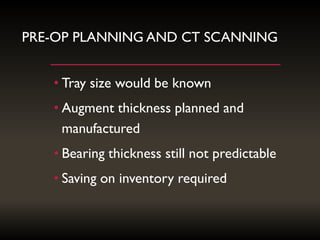
PRE-OP PLANNING AND CT SCANNING
• Tray size would be known
• Augment thickness planned and
manufactured
• Bearing thickness still not predictable
• Saving on inventory required
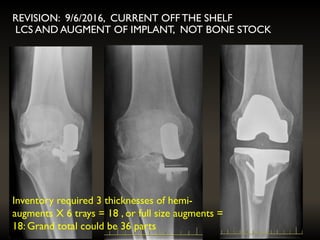
Inventory required 3 thicknesses of hemi-
augments X 6 trays = 18 , or full size augments =
18: Grand total could be 36 parts
REVISION: 9/6/2016, CURRENT OFF THE SHELF
LCS AND AUGMENT OF IMPLANT, NOT BONE STOCK
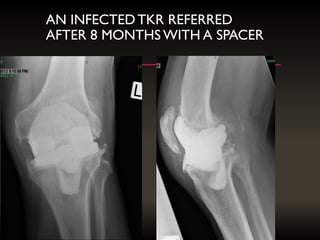
AN INFECTEDTKR REFERRED
AFTER 8 MONTHS WITH A SPACER
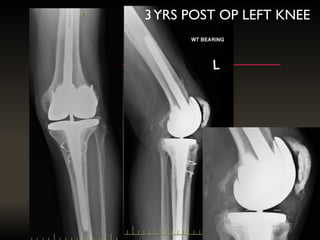
3YRS POST OP LEFT KNEE
OTHER USES
CUSTOMISED PRIMARY IMPLANTS RATHER
THAN CUSTOM AUGMENTS
InTHR: easily “do-able” due to spherical bearings
(adjustable neck lengths etc.)
InTKR: Surface geometry critical for outcomes to be
predictable (PE does not adapt as menisci!)
In knees the soft tissue elasticity and balance is
variable, needing a range of sizes
InTrauma: specialised fixation plates
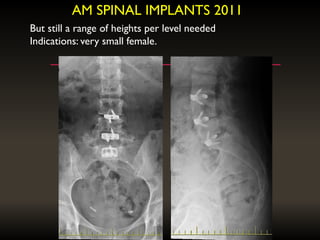
AM SPINAL IMPLANTS 2011
But still a range of heights per level needed
Indications: very small female.
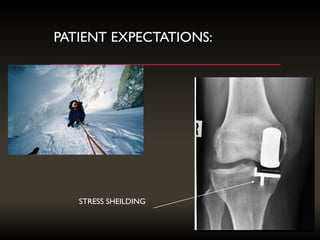
PATIENT EXPECTATIONS:
STRESS SHEILDING
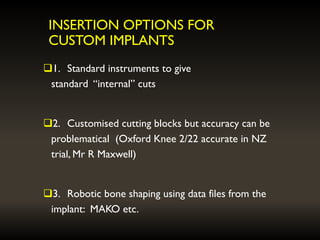
INSERTION OPTIONS FOR
CUSTOM IMPLANTS
1. Standard instruments to give
standard “internal” cuts
2. Customised cutting blocks but accuracy can be
problematical (Oxford Knee 2/22 accurate in NZ
trial, Mr R Maxwell)
3. Robotic bone shaping using data files from the
implant: MAKO etc.
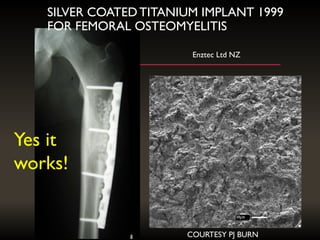
SILVER COATEDTITANIUM IMPLANT 1999
FOR FEMORAL OSTEOMYELITIS
COURTESY PJ BURN
Enztec Ltd NZ
Yes it
works!
THE FUTURE
New biocompatible materials (polyimide
etc.)
“Plastic” knees
Custom implants incorporating
active surfaces
 (antimicrobial and osteo-inductive)
Composite structures ( AM parts
and standard parts)
DESIGNS ARE INFINITE BUT A
CAUTIONARY NOTE…
RULES OF BIOLOGY CANNOT BE BROKEN…
Particulates, surface finishes, corrosion
THE REACTION OF LIVINGTISSUES
NEEDSTO CONSIDERED…
Osteolysis, ALVAL, toxicity of ion release,
impurities in and on implants
THE MATERIAL’S SPECIFIC ENGINEERING
PARAMETERS HAVETO BE ALLOWED FOR...
Fatigue resistance, loadings,
corrosion and valency, scratches
THANKYOU FROM NEW ZEALAND
Custom Implants

Custom Implants

  • 2.
    CURRENT AND FUTUREUSE OF CUSTOM IMPLANTS IN ORTHOPAEDIC SURGERY OMTEC 2016 CHICAGO P James Burn FRACS Consultant Orthopaedic Surgeon Canterbury District Health Board Christchurch New Zealand pjamesburn@xtra.co.nz
  • 3.
    DISCLOSURES: • Founding shareholderof Ossis Ltd (NZ) • Founding shareholder of Enztec Ltd (NZ) • Receive royalties from the Enztec Stardrill
  • 4.
    PERSONAL PRACTICE PROFILE (NZ POPULATION 4 MILLION) PrimaryTHR 2,000+  Last 1,000 cases 0% dislocation for PrimaryTHR post. approach  Revision rate 0.04 per 100 component years, with LIMA PF cup  (lowest on the NZJR) RevisionTHR 300 PrimaryTKR 950 + Primary UKR 400 + RevisionTKR 97+ Custom hemi-pelvic replacements 3 + 1rev +spine, foot and ankle and general orthopaedics. CUSTOM ACETABULAR CASES 30
  • 5.
    DESIGNING CONSIDERATIONS Requirement ofan experienced surgeon/engineer with an engineer with clinical experience EngineerSurgeon
  • 6.
    “ADDITIVE MANUFACTURE 1998”BEFORE ACCESSIBLE SOFTWARE AND PRINTING MY 3RD ITERATION TITANIUM HEMI-PELVIC IMPLANTS WERE FABRICATED IN TITANIUM ALLOY
  • 7.
    CUSTOM ACETABULAR CASES: N=102 IMPLANTEDIN: NEW ZEALAND AND AUSTRALIA MANUFACTURED BY: OSSIS LTD, NZ In conjunction with MED. MODELLING/3D SYSTEMS, USA
  • 8.
  • 9.
    THE BIO-MODEL OFTHE PELVIC DISSOCIATION AND IIIB OUTLINE OF THE PROPOSED IMPLANT Fracture line through posterior column = 2 parts THE NEED FOR CUSTOM IMPLANTS (HIP)
  • 10.
    MRS MP 70YRS SURGEONS:PCA / JB TOTAL SURGICAL TIME REVISION ALL COMPONENTS: 2.3 HRS DISCHARGED DAY 5 FULL WEIGHT BEARING 1ST GENERATION E-BEAM CUSTOM IMPLANT dealing with bone loss and the dissociation: 2008
  • 11.
    FINAL ASSEMBLY: COMPLETEWITH HARDON HARD BEARING SURGICALTIMEWITH STEM REVISION 2.3 HRS 02/04/08 26/04/2010
  • 12.
  • 13.
    BILATERAL CUSTOM ACETABULAE 5YRSPOST -OP 8 MONTHS POST-OP Cheaper overall, full weigh-bearing, therefore cost-effective
  • 14.
    TOTAL NUMBER OFCASES USING EBM ACETABULAR IMPLANTS = 102 Ossis Ltd, NZ and Med. Modelling / 3D Systems USA NZ AND AUSTRALIAN MARKETS OF 24 MILLION
  • 15.
    WHAT WOULDYOU PREFERTO USE AS AN ORTHOPAEDIC SURGEON? • Larger spherical cup • Oblong cup • Bone graft • Autograft (not in revision cases) • Allograft (banked femoral head) • Allograft (Acetabular replacement) • Synthetic Bone substitutes,TCP, DBM • “Metal graft” substitution • Cages/Rings • Triflanged implants INVENTORY COST!
  • 16.
    OR A ONE-PIECESOLUTIONTHAT IS PATIENT PERFECT SPECIFIC!
  • 17.
    A REAL PROBLEMAFTER 4 REVISION SURGERIES: WHATTO DOWITHTHIS CASE?
  • 18.
    THE EBMTi ALLOYAUGMENT: PRIMARY KNEE AND STEM (2008)
  • 19.
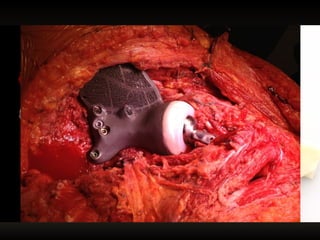
    A HUGE CAVITYBUT A GOOD SOLUTION
  • 20.
    7YRS POST-OP : GREATONTHE FEMORAL SIDE
  • 21.
  • 22.
    MED MODELLING /OSSIS MESH SEM PICTURE THE MOST IMPORTANT “BIOLOGICAL” FEATURE
  • 23.
    STRESS SHIELDING ANDFATIGUE FAILURE Too stiff...stress shielding Too thin... broken stem but the bone stock was saved!! 82 yr female with worn PE liner 82 yr male with thigh pain BIOLOGY NOT RESPECTED
  • 24.
    CAUSES OF FAILUREOF IMPLANTS PROBLEM 1. MODULUS MIS-MATCH 2. MAL-POSITION 3. FRICTION 4. WEAR PARTICLES 5. INFECTION SOLUTIONS 1. MATERIALS AND STRUCTURE 2. EDUCATION and INSTRUMENTATION 3. BETTERTRIBOLOGY 4. MATERIALS AND SURFACES 5. SURGICAL TECHNIQUE, SURFACE COATINGS
  • 25.
    RESPECT BIOLOGY ANDITS SOLUTIONS DESIGNTHE IMPLANT TO “BLEND IN” WITH MODULUS MATCHING RESPECTTHE PRIMARY AND SECONDARY TRABECULAE UNDERSTANDTHE SUBCHONDRAL BONE PLATE UNDERSTANDTHE GROWTH PATTERN OF A LONG BONE
  • 26.
    3D PRINTING OFMATERIALS THIS IS A TOOLTHAT CAN ADDRESSTHE ANISOTROPIC REQUIREMENTS OF THE IMPLANT TO MATCH BONE THE METALLURGY OF PRINTED METALS MAY NEED FURTHER IMPROVEMENT i.e. HIP TREATMENT
  • 27.
    WHY USE CUSTOMIMPLANTS: ARE THEY FISCALLY VIABLE? They reduce the inventory in revision and complex primary: TRUE? The dead stock sitting in hospitals is avoided $$$$ : TRUE The surgery is rehearsed during design:  Unexpected findings minimized: TRUE Make primary implants more useable in revision surgery: TRUE
  • 28.
    CUSTOM DOES NOT EQUAL CUSTOMIZABLE (Descriptiveand Legal Regulatory processes, N.Z.)
  • 29.
    WHO PAYS CURRENTLYIN N.Z. PUBLIC HOSPITALS WITH PRIOR APPROVAL OF SERVICE MANAGERS PRIVATE INSURANCE COMPANIES,AGAIN PRIOR APPROVAL AND EXPLANATION
  • 30.
    DO THE OUTCOMESOF CUSTOMISED IMPLANTS EXTRAPOLATE TO STANDARD PROVEN IMPLANTS? The “IdentiFit Hip” experience (milled stem) ?20% per annum failure, Dr J Hart,Australia OPEN QUESTION
  • 31.
    WHY CUSTOM IMPLANTS?A SMALL STEP AFTER REQUIRED IMAGING ANYWAY! The complexity is simplified:TRUE (surgeon’s pulse < patient’s!)
  • 32.
    PRE-OP PLANNING ANDCT SCANNING • Tray size would be known • Augment thickness planned and manufactured • Bearing thickness still not predictable • Saving on inventory required
  • 33.
    Inventory required 3thicknesses of hemi- augments X 6 trays = 18 , or full size augments = 18: Grand total could be 36 parts REVISION: 9/6/2016, CURRENT OFF THE SHELF LCS AND AUGMENT OF IMPLANT, NOT BONE STOCK
  • 34.
    AN INFECTEDTKR REFERRED AFTER8 MONTHS WITH A SPACER
  • 35.
    3YRS POST OPLEFT KNEE
  • 36.
  • 37.
    CUSTOMISED PRIMARY IMPLANTSRATHER THAN CUSTOM AUGMENTS InTHR: easily “do-able” due to spherical bearings (adjustable neck lengths etc.) InTKR: Surface geometry critical for outcomes to be predictable (PE does not adapt as menisci!) In knees the soft tissue elasticity and balance is variable, needing a range of sizes InTrauma: specialised fixation plates
  • 38.
    AM SPINAL IMPLANTS2011 But still a range of heights per level needed Indications: very small female.
  • 39.
  • 40.
    INSERTION OPTIONS FOR CUSTOMIMPLANTS 1. Standard instruments to give standard “internal” cuts 2. Customised cutting blocks but accuracy can be problematical (Oxford Knee 2/22 accurate in NZ trial, Mr R Maxwell) 3. Robotic bone shaping using data files from the implant: MAKO etc.
  • 41.
    SILVER COATEDTITANIUM IMPLANT1999 FOR FEMORAL OSTEOMYELITIS COURTESY PJ BURN Enztec Ltd NZ Yes it works!
  • 42.
    THE FUTURE New biocompatiblematerials (polyimide etc.) “Plastic” knees Custom implants incorporating active surfaces  (antimicrobial and osteo-inductive) Composite structures ( AM parts and standard parts)
  • 43.
    DESIGNS ARE INFINITEBUT A CAUTIONARY NOTE… RULES OF BIOLOGY CANNOT BE BROKEN… Particulates, surface finishes, corrosion THE REACTION OF LIVINGTISSUES NEEDSTO CONSIDERED… Osteolysis, ALVAL, toxicity of ion release, impurities in and on implants THE MATERIAL’S SPECIFIC ENGINEERING PARAMETERS HAVETO BE ALLOWED FOR... Fatigue resistance, loadings, corrosion and valency, scratches
  • 44.