Additive Manufacturing - Mechanical Test Methods - OMTEC 2018
The document outlines mechanical testing methods for additive manufactured medical devices, focusing on the evaluation of materials, processes, and standards necessary for compliance with regulatory requirements. It highlights common pitfalls in protocol development, including issues with specimen preparation and acceptance criteria, while providing specific guidance on tests such as tensile, fatigue, and abrasion. Recommendations emphasize the importance of thorough testing and adherence to established standards to ensure the performance and safety of medical devices made through additive manufacturing.
Overview
• Company Introductionand Background
• Areas of Additive Manufacturing Evaluation
• Mechanical Testing Methods
• General
• Medical-specific
• Strategies for Protocol Development
• Common Pitfalls to Avoid
4.
Company Introduction andBackground
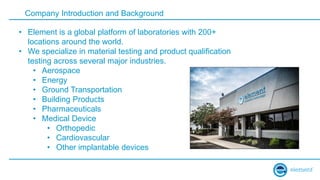
• Element is a global platform of laboratories with 200+
locations around the world.
• We specialize in material testing and product qualification
testing across several major industries.
• Aerospace
• Energy
• Ground Transportation
• Building Products
• Pharmaceuticals
• Medical Device
• Orthopedic
• Cardiovascular
• Other implantable devices
5.
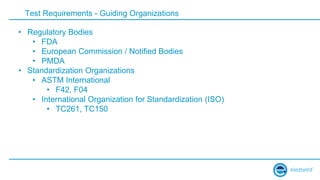
Test Requirements -Guiding Organizations
• Regulatory Bodies
• FDA
• European Commission / Notified Bodies
• PMDA
• Standardization Organizations
• ASTM International
• F42, F04
• International Organization for Standardization (ISO)
• TC261, TC150
6.
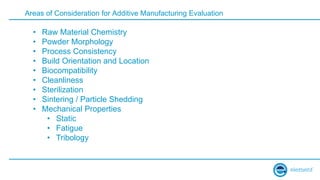
Areas of Considerationfor Additive Manufacturing Evaluation
• Raw Material Chemistry
• Powder Morphology
• Process Consistency
• Build Orientation and Location
• Biocompatibility
• Cleanliness
• Sterilization
• Sintering / Particle Shedding
• Mechanical Properties
• Static
• Fatigue
• Tribology
Medical-Specific Test Methods
•Modified Surfaces / Porous Structures
• Component level static and fatigue testing
• Coupon and component level wear testing
• FDA Guidance Document
• Technical Considerations for Additive Manufactured Medical Devices
9.
Component Fatigue Testing
•The scopes of existing test standards encompass implants
made using a variety of manufacturing processes.
• As such, AM implants are covered and should be
tested under current standards.
• AM devices are not exempt from minimum performance requirements.
• AM devices may be subject to additional test requirements if designs
are deemed sensitive to other failure modes.
• Additional fatigue testing on components such as:
• Acetabular Shells
• Femoral Components
10.
Modified Surfaces /Porous Structures
• Several published test methods and standards:
• ASTM F1044, F1147, F1160 Tensile and Shear
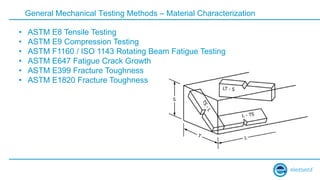
• ASTM F1160 / ISO 1143 Rotating Beam and Bending Fatigue
• ASTM F1978 Taber Abrasion
• ASTM F1854 Stereoscopic Examination
• ASTM F2077 Compression Testing
• In general, reference FDA guidance documents:
• Guidance for Industry on the Testing of Metallic Plasma Sprayed Coatings on Orthopedic
Implants to Support Reconsideration of Postmarket Surveillance Requirements
• Guidance Document for Testing Orthopedic Implants With Modified
Metallic Surfaces Apposing Bone Or Bone Cement
11.
ASTM F1044, F1147,F1160 Tensile and Shear
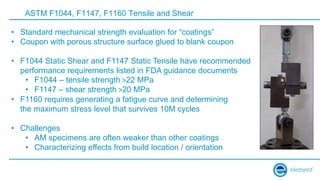
• Standard mechanical strength evaluation for “coatings”
• Coupon with porous structure surface glued to blank coupon
• F1044 Static Shear and F1147 Static Tensile have recommended
performance requirements listed in FDA guidance documents
• F1044 – tensile strength >22 MPa
• F1147 – shear strength >20 MPa
• F1160 requires generating a fatigue curve and determining
the maximum stress level that survives 10M cycles
• Challenges
• AM specimens are often weaker than other coatings
• Characterizing effects from build location / orientation
12.
ASTM F1044, F1147,F1160 Tensile and Shear
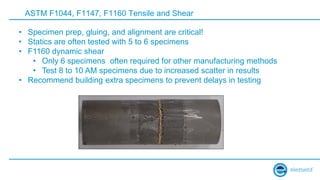
• Specimen prep, gluing, and alignment are critical!
• Statics are often tested with 5 to 6 specimens
• F1160 dynamic shear
• Only 6 specimens often required for other manufacturing methods
• Test 8 to 10 AM specimens due to increased scatter in results
• Recommend building extra specimens to prevent delays in testing
13.
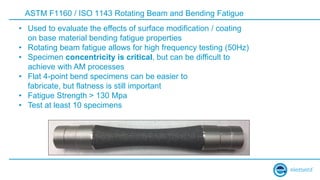
ASTM F1160 /ISO 1143 Rotating Beam and Bending Fatigue
• Used to evaluate the effects of surface modification / coating
on base material bending fatigue properties
• Rotating beam fatigue allows for high frequency testing (50Hz)
• Specimen concentricity is critical, but can be difficult to
achieve with AM processes
• Flat 4-point bend specimens can be easier to
fabricate, but flatness is still important
• Fatigue Strength > 130 Mpa
• Test at least 10 specimens
14.
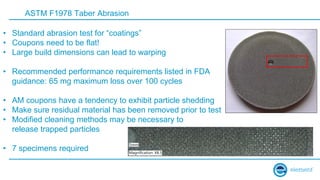
ASTM F1978 TaberAbrasion
• Standard abrasion test for “coatings”
• Coupons need to be flat!
• Large build dimensions can lead to warping
• Recommended performance requirements listed in FDA
guidance: 65 mg maximum loss over 100 cycles
• AM coupons have a tendency to exhibit particle shedding
• Make sure residual material has been removed prior to test
• Modified cleaning methods may be necessary to
release trapped particles
• 7 specimens required
15.
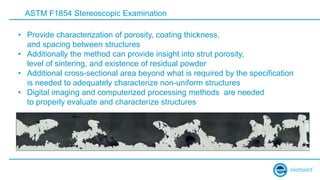
ASTM F1854 StereoscopicExamination
• Provide characterization of porosity, coating thickness,
and spacing between structures
• Additionally the method can provide insight into strut porosity,
level of sintering, and existence of residual powder
• Additional cross-sectional area beyond what is required by the specification
is needed to adequately characterize non-uniform structures
• Digital imaging and computerized processing methods are needed
to properly evaluate and characterize structures
16.
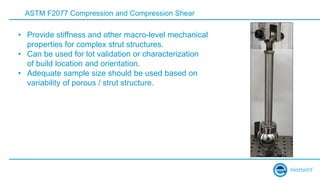
ASTM F2077 Compressionand Compression Shear
• Provide stiffness and other macro-level mechanical
properties for complex strut structures.
• Can be used for lot validation or characterization
of build location and orientation.
• Adequate sample size should be used based on
variability of porous / strut structure.
17.
Tribology
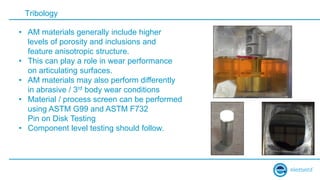
• AM materialsgenerally include higher
levels of porosity and inclusions and
feature anisotropic structure.
• This can play a role in wear performance
on articulating surfaces.
• AM materials may also perform differently
in abrasive / 3rd body wear conditions
• Material / process screen can be performed
using ASTM G99 and ASTM F732
Pin on Disk Testing
• Component level testing should follow.
18.
Protocol Development Strategies
•Consider the purpose of the testing and review applicable requirements
• Consult guidance documents and test standards
• Check for draft standards and work items as these may include more
up-to-date information
• Resolve conflicting requirements
• Detail test method and specimen preparation as much as possible
• Set acceptance criteria including acceptable and unacceptable results
and behaviors
• Consider statistical requirements to determine appropriate sample size
and how you will analyze the numerical data
• Review protocol with suppliers and testing partners prior to approval
19.
Common Mistakes toAvoid
• Not addressing particle shedding / residual material
• Creating too few test specimens
• Fabrication of test coupons that are out of concentricity, or
that warp during post-processing
• Setting acceptance criteria that are too high (e.g. comparing
fatigue strength to conventional materials)
• Failing to set any acceptance criteria prior to start of testing
• Not accounting for build orientation
• Inconsistent test sample preparation / gluing / alignment