Millstone
Packaging Solutions: Increase speed to market and lower costs
Kelly Lucenti, President
Common Problems
Getting your product to
market faster
Common Problems
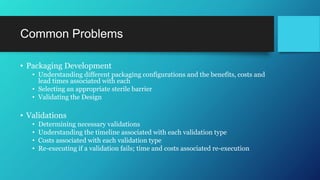
• Packaging Development
• Understanding different packaging configurations and the benefits, costs and
lead times associated with each
• Selecting an appropriate sterile barrier
• Validating the Design
• Validations
• Determining necessary validations
• Understanding the timeline associated with each validation type
• Costs associated with each validation type
• Re-executing if a validation fails; time and costs associated re-execution
Common Problems
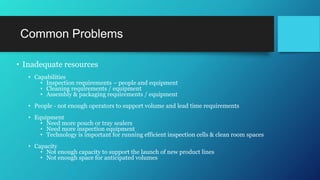
• Inadequate resources
• Capabilities
• Inspection requirements – people and equipment
• Cleaning requirements / equipment
• Assembly & packaging requirements / equipment
• People - not enough operators to support volume and lead time requirements
• Equipment
• Need more pouch or tray sealers
• Need more inspection equipment
• Technology is important for running efficient inspection cells & clean room spaces
• Capacity
• Not enough capacity to support the launch of new product lines
• Not enough space for anticipated volumes
Common Problems
• Staying on top of industry standards
• Quality
• Mixed product
• Inadequate seals
• Lead Times
• Launch deadlines
• Validation lead times
Solutions
Prepare for successful &
timely validations
Preparing for successful & timely validations
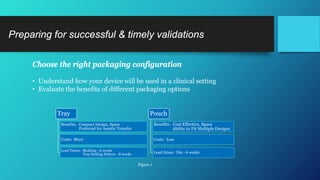
Choose the right packaging configuration
• Understand how your device will be used in a clinical setting
• Evaluate the benefits of different packaging options
Tray
Benefits: Compact Design, Space
Preferred for Aseptic Transfer
Costs: More
Lead Times: Molding - 6 weeks
Tray Sealing Fixture - 8 weeks
Pouch
Benefits: Cost Effective, Space
Ability to Fit Multiple Designs
Costs: Less
Lead times: Die - 6 weeks
Figure 1
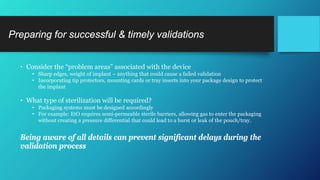
• Consider the “problem areas” associated with the device
• Sharp edges, weight of implant – anything that could cause a failed validation
• Incorporating tip protectors, mounting cards or tray inserts into your package design to protect
the implant
• What type of sterilization will be required?
• Packaging systems must be designed accordingly
• For example: EtO requires semi-permeable sterile barriers, allowing gas to enter the packaging
without creating a pressure differential that could lead to a burst or leak of the pouch/tray.
Being aware of all details can prevent significant delays during the
validation process
Preparing for successful & timely validations
Determine what validations are required
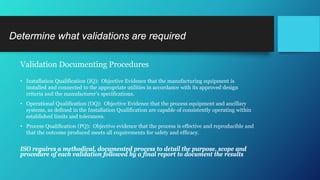
Validation Documenting Procedures
• Installation Qualification (IQ): Objective Evidence that the manufacturing equipment is
installed and connected to the appropriate utilities in accordance with its approved design
criteria and the manufacturer’s specifications.
• Operational Qualification (OQ): Objective Evidence that the process equipment and ancillary
systems, as defined in the Installation Qualification are capable of consistently operating within
established limits and tolerances.
• Process Qualification (PQ): Objective evidence that the process is effective and reproducible and
that the outcome produced meets all requirements for safety and efficacy.
ISO requires a methodical, documented process to detail the purpose, scope and
procedure of each validation followed by a final report to document the results
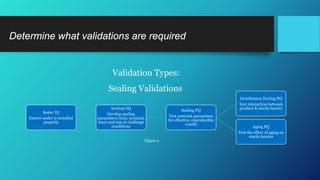
Validation Types:
Sealer IQ
Ensure sealer is installed
properly
Sealing OQ
Develop sealing
parameters (min, nominal,
max) and test at challenge
conditions
Sealing PQ
Test nominal parameters
for effective, reproducible
results
Distribution Testing PQ
Test interaction between
product & sterile barrier
Aging PQ
Test the effect of aging on
sterile barrier
Sealing Validations
Determine what validations are required
Figure 2
Sealing Validations
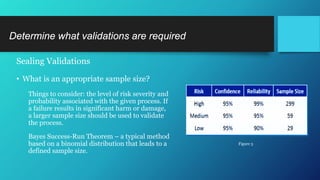
• What is an appropriate sample size?
Things to consider: the level of risk severity and
probability associated with the given process. If
a failure results in significant harm or damage,
a larger sample size should be used to validate
the process.
Bayes Success-Run Theorem – a typical method
based on a binomial distribution that leads to a
defined sample size.
Determine what validations are required
Figure 3
Sealing Validations
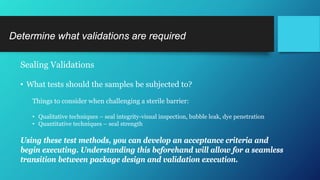
• What tests should the samples be subjected to?
Things to consider when challenging a sterile barrier:
• Qualitative techniques – seal integrity-visual inspection, bubble leak, dye penetration
• Quantitative techniques – seal strength
Using these test methods, you can develop an acceptance criteria and
begin executing. Understanding this beforehand will allow for a seamless
transition between package design and validation execution.
Determine what validations are required
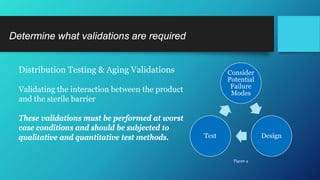
Distribution Testing & Aging Validations
Validating the interaction between the product
and the sterile barrier
These validations must be performed at worst
case conditions and should be subjected to
qualitative and quantitative test methods.
Determine what validations are required
Consider
Potential
Failure
Modes
DesignTest
Figure 4
Determine what validations are required
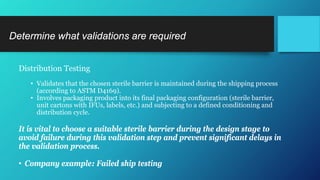
Distribution Testing
• Validates that the chosen sterile barrier is maintained during the shipping process
(according to ASTM D4169).
• Involves packaging product into its final packaging configuration (sterile barrier,
unit cartons with IFUs, labels, etc.) and subjecting to a defined conditioning and
distribution cycle.
It is vital to choose a suitable sterile barrier during the design stage to
avoid failure during this validation step and prevent significant delays in
the validation process.
• Company example: Failed ship testing
Determine what validations are required
Aging Validations / Shelf Life Testing
• Validates that the sterile barrier can be maintained through a given period of time which
provides an expiration date for the medical device (ASTM F1980).
• Accelerated Aging manipulates humidity and temperature levels to hasten the testing
process and reach market faster. It is important to note that the ISO standard indicates
that Real Time Aging is required to substantiate this data.
• To avoid potential issues with Accelerated Aging, be sure to check the pouch/tray supplier’s
suggested humidity and temperature levels. Exceeding these can yield negative results due
to the extreme conditions.
• When testing, it is important to choose the part that has the greatest failure potential to the
sterile barrier, thus ensuring that the integrity of the sterile barrier is maintained when the
product reaches market.
Key Takeaways
A failure during these validations can create significant delays in
reaching market; failure in the field leads to a recall, liability, and
harm to the end-user. Re-execution of validations is costly.
Reviewing potential failure modes as well as the intricacies of these
validations will provide a proper transition from the process
validation stage to getting your product to market in a safe,
effective manner.
Preparing for successful and timely validations
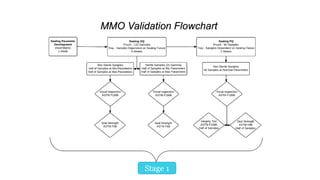
Stage 1
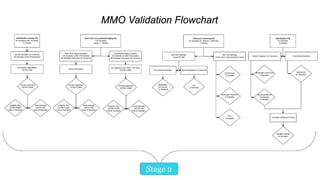
MMO Validation Flowchart
Stage 2
Solutions
Pre-validated packaging
configurations
Pre-validated Packaging
One of the quickest, easiest, most cost-effective ways to get your
medical device to market.
• Eliminates tooling & design costs
• Packaging available in both tray and pouch configurations
• Pre-validated to meet industry recognized standards
• Compatible with various methods of sterilization
• Reduces resource needs & costs
• Increases speed to market (see validation timeline)
Solutions
Universal Packaging
Universal Packaging
One of the quickest, easiest, most cost-effective ways to get more
of your products to market
• Single packaging configuration that accommodates hundreds
to thousands of various sized implants
• Reduces validation costs and protocol development
• Allows packaging across multiple product lines
• Reduces “footprint” of packaging companies
Universal Packaging
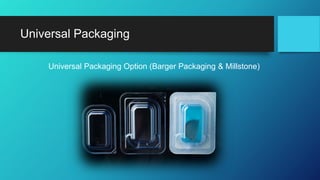
Universal Packaging Option (Barger Packaging & Millstone)
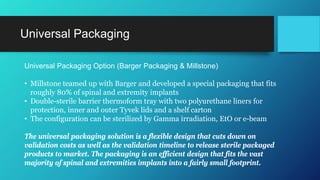
• Millstone teamed up with Barger and developed a special packaging that fits
roughly 80% of spinal and extremity implants
• Double-sterile barrier thermoform tray with two polyurethane liners for
protection, inner and outer Tyvek lids and a shelf carton
• The configuration can be sterilized by Gamma irradiation, EtO or e-beam
The universal packaging solution is a flexible design that cuts down on
validation costs as well as the validation timeline to release sterile packaged
products to market. The packaging is an efficient design that fits the vast
majority of spinal and extremities implants into a fairly small footprint.
Universal Packaging
Universal Packaging Option (Barger Packaging & Millstone)
Solutions
Outsource
When to Outsource vs. Package In-house
• Limited internal resources
• People
• Capacity
• Equipment
• Tight deadlines
• Aggressive launch dates
• Quality
• Specialized services catered to specific program and customer needs
• Cost Savings
• Experts that can do it better, quicker and for less overall cost
Evaluating a Packaging Partner
Four important considerations when evaluating a packaging partner:
• Quality (Leadership)
• Speed
• Cost
• Expertise
Evaluating a Packaging Partner
Quality:
• Perform a quality audit of the packaging facility
• Evaluate company registrations & certifications
• Class 10,000/ISO7-rated clean rooms
• State of the art equipment and experienced operators
• Evaluate company quality metrics; What are the company’s quality
standards and objectives? DPMO, 6 Sigma, FDA & BSI audit history, etc.
• The best packaging facilities are run by experienced leaders, have skilled
operators and state-of-the-art facilities and equipment.
• Core competency - Expertise
Evaluating a Packaging Partner
Speed:
• Evaluating average lead time for the production of finished goods
(from vendor receipt to final sterilized shipment)
• Utilizing industry “best practices” to be more efficient.
• Increasing through-put and speed to market as well as the ability to
effectively manage vendors are advantages.
Evaluating a Packaging Partner
Cost:
• Quality, speed, and cost are all interrelated.
• Cost of internal clean room is related to expense of labor and
equipment as well as speed to market.

• Reducing labor overhead, developing turn-key processes, validation
services
• Outsourcing packaging requires giving up some control but can be
a cost-effective alternative that, with the right partner, can
enhance quality.
How to Maximize Outsourcing Relationship
• The relationship needs to be a partnership where both companies
mutually benefit
• Understand the company’s core competencies
• Select a partner that can scale with the growth of your company and be able to
support future projects
• Set up open communication between the two companies
• Leverage partner’s experience and knowledge of best practices in the industry
• Benefits include: Speed to market, access to expertise, enhanced quality,
reallocation of internal resources, and reduced costs
Q & A
Kelly Lucenti
klucenti@millstonemedical.com
508.679.8384
Millstone
Packaging Solutions that Improve Time to Market

Packaging Solutions that Improve Time to Market

  • 2.
    Millstone Packaging Solutions: Increasespeed to market and lower costs Kelly Lucenti, President
  • 3.
    Common Problems Getting yourproduct to market faster
  • 4.
    Common Problems • PackagingDevelopment • Understanding different packaging configurations and the benefits, costs and lead times associated with each • Selecting an appropriate sterile barrier • Validating the Design • Validations • Determining necessary validations • Understanding the timeline associated with each validation type • Costs associated with each validation type • Re-executing if a validation fails; time and costs associated re-execution
  • 5.
    Common Problems • Inadequateresources • Capabilities • Inspection requirements – people and equipment • Cleaning requirements / equipment • Assembly & packaging requirements / equipment • People - not enough operators to support volume and lead time requirements • Equipment • Need more pouch or tray sealers • Need more inspection equipment • Technology is important for running efficient inspection cells & clean room spaces • Capacity • Not enough capacity to support the launch of new product lines • Not enough space for anticipated volumes
  • 6.
    Common Problems • Stayingon top of industry standards • Quality • Mixed product • Inadequate seals • Lead Times • Launch deadlines • Validation lead times
  • 7.
  • 8.
    Preparing for successful& timely validations Choose the right packaging configuration • Understand how your device will be used in a clinical setting • Evaluate the benefits of different packaging options Tray Benefits: Compact Design, Space Preferred for Aseptic Transfer Costs: More Lead Times: Molding - 6 weeks Tray Sealing Fixture - 8 weeks Pouch Benefits: Cost Effective, Space Ability to Fit Multiple Designs Costs: Less Lead times: Die - 6 weeks Figure 1
  • 9.
    • Consider the“problem areas” associated with the device • Sharp edges, weight of implant – anything that could cause a failed validation • Incorporating tip protectors, mounting cards or tray inserts into your package design to protect the implant • What type of sterilization will be required? • Packaging systems must be designed accordingly • For example: EtO requires semi-permeable sterile barriers, allowing gas to enter the packaging without creating a pressure differential that could lead to a burst or leak of the pouch/tray. Being aware of all details can prevent significant delays during the validation process Preparing for successful & timely validations
  • 10.
    Determine what validationsare required Validation Documenting Procedures • Installation Qualification (IQ): Objective Evidence that the manufacturing equipment is installed and connected to the appropriate utilities in accordance with its approved design criteria and the manufacturer’s specifications. • Operational Qualification (OQ): Objective Evidence that the process equipment and ancillary systems, as defined in the Installation Qualification are capable of consistently operating within established limits and tolerances. • Process Qualification (PQ): Objective evidence that the process is effective and reproducible and that the outcome produced meets all requirements for safety and efficacy. ISO requires a methodical, documented process to detail the purpose, scope and procedure of each validation followed by a final report to document the results
  • 11.
    Validation Types: Sealer IQ Ensuresealer is installed properly Sealing OQ Develop sealing parameters (min, nominal, max) and test at challenge conditions Sealing PQ Test nominal parameters for effective, reproducible results Distribution Testing PQ Test interaction between product & sterile barrier Aging PQ Test the effect of aging on sterile barrier Sealing Validations Determine what validations are required Figure 2
  • 12.
    Sealing Validations • Whatis an appropriate sample size? Things to consider: the level of risk severity and probability associated with the given process. If a failure results in significant harm or damage, a larger sample size should be used to validate the process. Bayes Success-Run Theorem – a typical method based on a binomial distribution that leads to a defined sample size. Determine what validations are required Figure 3
  • 13.
    Sealing Validations • Whattests should the samples be subjected to? Things to consider when challenging a sterile barrier: • Qualitative techniques – seal integrity-visual inspection, bubble leak, dye penetration • Quantitative techniques – seal strength Using these test methods, you can develop an acceptance criteria and begin executing. Understanding this beforehand will allow for a seamless transition between package design and validation execution. Determine what validations are required
  • 14.
    Distribution Testing &Aging Validations Validating the interaction between the product and the sterile barrier These validations must be performed at worst case conditions and should be subjected to qualitative and quantitative test methods. Determine what validations are required Consider Potential Failure Modes DesignTest Figure 4
  • 15.
    Determine what validationsare required Distribution Testing • Validates that the chosen sterile barrier is maintained during the shipping process (according to ASTM D4169). • Involves packaging product into its final packaging configuration (sterile barrier, unit cartons with IFUs, labels, etc.) and subjecting to a defined conditioning and distribution cycle. It is vital to choose a suitable sterile barrier during the design stage to avoid failure during this validation step and prevent significant delays in the validation process. • Company example: Failed ship testing
  • 16.
    Determine what validationsare required Aging Validations / Shelf Life Testing • Validates that the sterile barrier can be maintained through a given period of time which provides an expiration date for the medical device (ASTM F1980). • Accelerated Aging manipulates humidity and temperature levels to hasten the testing process and reach market faster. It is important to note that the ISO standard indicates that Real Time Aging is required to substantiate this data. • To avoid potential issues with Accelerated Aging, be sure to check the pouch/tray supplier’s suggested humidity and temperature levels. Exceeding these can yield negative results due to the extreme conditions. • When testing, it is important to choose the part that has the greatest failure potential to the sterile barrier, thus ensuring that the integrity of the sterile barrier is maintained when the product reaches market.
  • 17.
    Key Takeaways A failureduring these validations can create significant delays in reaching market; failure in the field leads to a recall, liability, and harm to the end-user. Re-execution of validations is costly. Reviewing potential failure modes as well as the intricacies of these validations will provide a proper transition from the process validation stage to getting your product to market in a safe, effective manner. Preparing for successful and timely validations
  • 18.
  • 19.
  • 20.
  • 21.
    Pre-validated Packaging One ofthe quickest, easiest, most cost-effective ways to get your medical device to market. • Eliminates tooling & design costs • Packaging available in both tray and pouch configurations • Pre-validated to meet industry recognized standards • Compatible with various methods of sterilization • Reduces resource needs & costs • Increases speed to market (see validation timeline)
  • 22.
  • 23.
    Universal Packaging One ofthe quickest, easiest, most cost-effective ways to get more of your products to market • Single packaging configuration that accommodates hundreds to thousands of various sized implants • Reduces validation costs and protocol development • Allows packaging across multiple product lines • Reduces “footprint” of packaging companies
  • 24.
    Universal Packaging Universal PackagingOption (Barger Packaging & Millstone) • Millstone teamed up with Barger and developed a special packaging that fits roughly 80% of spinal and extremity implants • Double-sterile barrier thermoform tray with two polyurethane liners for protection, inner and outer Tyvek lids and a shelf carton • The configuration can be sterilized by Gamma irradiation, EtO or e-beam The universal packaging solution is a flexible design that cuts down on validation costs as well as the validation timeline to release sterile packaged products to market. The packaging is an efficient design that fits the vast majority of spinal and extremities implants into a fairly small footprint.
  • 25.
    Universal Packaging Universal PackagingOption (Barger Packaging & Millstone)
  • 26.
  • 27.
    When to Outsourcevs. Package In-house • Limited internal resources • People • Capacity • Equipment • Tight deadlines • Aggressive launch dates • Quality • Specialized services catered to specific program and customer needs • Cost Savings • Experts that can do it better, quicker and for less overall cost
  • 28.
    Evaluating a PackagingPartner Four important considerations when evaluating a packaging partner: • Quality (Leadership) • Speed • Cost • Expertise
  • 29.
    Evaluating a PackagingPartner Quality: • Perform a quality audit of the packaging facility • Evaluate company registrations & certifications • Class 10,000/ISO7-rated clean rooms • State of the art equipment and experienced operators • Evaluate company quality metrics; What are the company’s quality standards and objectives? DPMO, 6 Sigma, FDA & BSI audit history, etc. • The best packaging facilities are run by experienced leaders, have skilled operators and state-of-the-art facilities and equipment. • Core competency - Expertise
  • 30.
    Evaluating a PackagingPartner Speed: • Evaluating average lead time for the production of finished goods (from vendor receipt to final sterilized shipment) • Utilizing industry “best practices” to be more efficient. • Increasing through-put and speed to market as well as the ability to effectively manage vendors are advantages.
  • 31.
    Evaluating a PackagingPartner Cost: • Quality, speed, and cost are all interrelated. • Cost of internal clean room is related to expense of labor and equipment as well as speed to market. • Reducing labor overhead, developing turn-key processes, validation services • Outsourcing packaging requires giving up some control but can be a cost-effective alternative that, with the right partner, can enhance quality.
  • 32.
    How to MaximizeOutsourcing Relationship • The relationship needs to be a partnership where both companies mutually benefit • Understand the company’s core competencies • Select a partner that can scale with the growth of your company and be able to support future projects • Set up open communication between the two companies • Leverage partner’s experience and knowledge of best practices in the industry • Benefits include: Speed to market, access to expertise, enhanced quality, reallocation of internal resources, and reduced costs
  • 33.
  • 34.