Disease/Syndrome
Ratheesh.R
SLMGNC
Cushing's Disease/ Cushing's Syndrome:
Cushing's is a hormonal disorder caused by prolonged
exposure of the body's tissues to high levels of the
hormone cortisol. Your adrenal glands, which are right
above your kidneys, release cortisol when they receive a
chemical message from your pituitary gland. The message
comes in the form of adrenocorticotrophic hormone
(ACTH), which travels through the bloodstream.
The pituitary gland is known as the “Master gland of the
body”.
Introduction
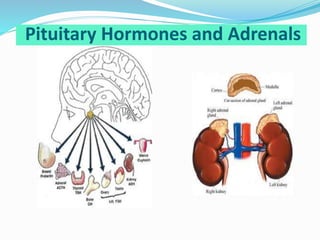
Pituitary Hormones and Adrenals
Definition
It is a condition in which the plasma cortisol
level is elevated, causing signs and symptoms
of Hypercortisolism.
Causes of Cushing’s
 A benign tumor of the adrenal gland
 A benign tumor of the pituitary gland
 A benign tumor of the lung or other organ
 Extensive use of cortisone medication
 Administration of ACTH or Corticosteroids.
 Primary hyperplasia of both adrenal gland.
 Excessive secretion of adrenal androgen.
 Exogenous Glucocorticoid administration.
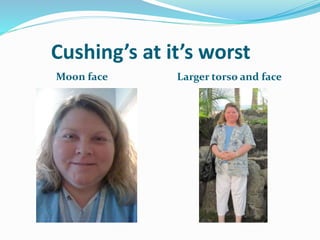
Cushing’s at it’s worst
Moon face Larger torso and face
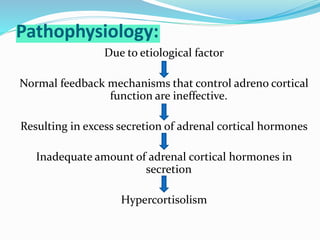
Pathophysiology:
Due to etiological factor
Normal feedback mechanisms that control adreno cortical
function are ineffective.
Resulting in excess secretion of adrenal cortical hormones
Inadequate amount of adrenal cortical hormones in
secretion
Hypercortisolism
Symptoms of Cushing’s Disease
Excess Glucocorticoids:
 Weight gain/obesity
 Heavy trunk and thin extremities
 Buffalo hump in neck
 Thin skin
 Rounded face/moon face
 Muscles wasted
 Osteoporosis
 Mental Disturbance
 Increased susceptibility to infection.
Excess Mineralo-corticoids:
 Hypertension
 Hypernatremia
 Hypokalemia
 Weight gain
 Expanded blood volume
 Edema
Excess Antrogen:
 Women- Hirsutism
- Breast atropy
- Clitoris enlargement
- Voice masculine
• Men- Loss of Libido
Gastro Intestinal:
 Peptic Ulcer
 Pancreatitis
 Gastritis and Duodenitis
Ophthlmic:
 Cataracts
 Glaucoma
Others
 Tachycardia
 Fatty Liver
 Mild slowing on EEG
 Pituitary Adenoma
 Migraines
 Syncope
 Memory and cognitive skills diminished
 Superficial skin infections


Diagnostic Evaluation
 History Collection
 Physical Examination
 CT Scan and USG
 Radio-Immuno Assay of plasma ACTH
 Corticotropin releasing factor (CRF) Stimulation Test.
 Dexamethasone suppression Test
 Blood samples
 X-rays of the skull
 Reduced eosinophils level
 Excessive Plasma cortisol level
Medical Management
 Mitotane = An agent toxic to the adrenal cortex.
 Metropine = To control (steroid hyper secretion) who
do not respond to mitotane therapy.
 Amino-glutethimide = Effectively Blocking cortisol
production
 Protein anabollic steroids may be given to facilitate is
required (protein and potassium replacement)
Surgical Mgt:
i) Trans sphenoidal adenomectomy or Hypophysectomy:
= Removal of pituitary gland
ii) Transfrontal Carinotomy:
= It is necessary when pituitary tumor is enlarge.
iii) Bilateral Adrenalectomy:
= Hyperplasia of adrenals
Complication:
 Adrenal Carcinoma
 Addisonian crisis
 Adverse effects of Adreno – cortical activity.
Nursing Diagnosis
 Impaired skin integrity r/t altered healing and edema.
 Self care deficit r/t muscle wasting and fatigue.
 Anxiety r/t surgery
 Risk for Injury to surgical procedure.
 Self – Esteem disturbance related to altered physical
appearance.
The End

cushingssyndrome-180217104318.pdf

  • 1.
  • 2.
    Cushing's Disease/ Cushing'sSyndrome: Cushing's is a hormonal disorder caused by prolonged exposure of the body's tissues to high levels of the hormone cortisol. Your adrenal glands, which are right above your kidneys, release cortisol when they receive a chemical message from your pituitary gland. The message comes in the form of adrenocorticotrophic hormone (ACTH), which travels through the bloodstream. The pituitary gland is known as the “Master gland of the body”. Introduction
  • 3.
  • 4.
    Definition It is acondition in which the plasma cortisol level is elevated, causing signs and symptoms of Hypercortisolism.
  • 5.
    Causes of Cushing’s A benign tumor of the adrenal gland  A benign tumor of the pituitary gland  A benign tumor of the lung or other organ  Extensive use of cortisone medication  Administration of ACTH or Corticosteroids.  Primary hyperplasia of both adrenal gland.  Excessive secretion of adrenal androgen.  Exogenous Glucocorticoid administration.
  • 6.
    Cushing’s at it’sworst Moon face Larger torso and face
  • 7.
    Pathophysiology: Due to etiologicalfactor Normal feedback mechanisms that control adreno cortical function are ineffective. Resulting in excess secretion of adrenal cortical hormones Inadequate amount of adrenal cortical hormones in secretion Hypercortisolism
  • 8.
    Symptoms of Cushing’sDisease Excess Glucocorticoids:  Weight gain/obesity  Heavy trunk and thin extremities  Buffalo hump in neck  Thin skin  Rounded face/moon face  Muscles wasted  Osteoporosis  Mental Disturbance  Increased susceptibility to infection. Excess Mineralo-corticoids:  Hypertension  Hypernatremia  Hypokalemia  Weight gain  Expanded blood volume  Edema Excess Antrogen:  Women- Hirsutism - Breast atropy - Clitoris enlargement - Voice masculine • Men- Loss of Libido Gastro Intestinal:  Peptic Ulcer  Pancreatitis  Gastritis and Duodenitis Ophthlmic:  Cataracts  Glaucoma Others  Tachycardia  Fatty Liver  Mild slowing on EEG  Pituitary Adenoma  Migraines  Syncope  Memory and cognitive skills diminished  Superficial skin infections  
  • 9.
    Diagnostic Evaluation  HistoryCollection  Physical Examination  CT Scan and USG  Radio-Immuno Assay of plasma ACTH  Corticotropin releasing factor (CRF) Stimulation Test.  Dexamethasone suppression Test  Blood samples  X-rays of the skull  Reduced eosinophils level  Excessive Plasma cortisol level
  • 10.
    Medical Management  Mitotane= An agent toxic to the adrenal cortex.  Metropine = To control (steroid hyper secretion) who do not respond to mitotane therapy.  Amino-glutethimide = Effectively Blocking cortisol production  Protein anabollic steroids may be given to facilitate is required (protein and potassium replacement)
  • 11.
    Surgical Mgt: i) Transsphenoidal adenomectomy or Hypophysectomy: = Removal of pituitary gland ii) Transfrontal Carinotomy: = It is necessary when pituitary tumor is enlarge. iii) Bilateral Adrenalectomy: = Hyperplasia of adrenals
  • 12.
    Complication:  Adrenal Carcinoma Addisonian crisis  Adverse effects of Adreno – cortical activity.
  • 13.
    Nursing Diagnosis  Impairedskin integrity r/t altered healing and edema.  Self care deficit r/t muscle wasting and fatigue.  Anxiety r/t surgery  Risk for Injury to surgical procedure.  Self – Esteem disturbance related to altered physical appearance.
  • 14.