
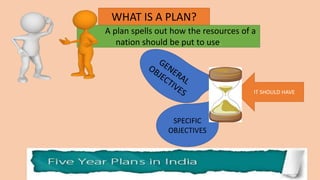
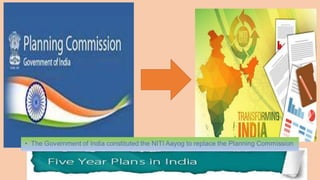


WHAT IS A PLAN?
A plan spells out how the resources of a
nation should be put to use.
IT SHOULD HAVE
SPECIFIC
OBJECTIVES
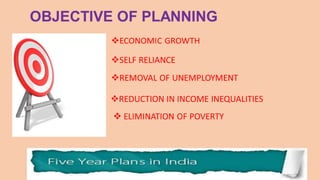
REDUCTION IN INCOME INEQUALITIES
THE PLANNING COMMISSION IS AN INSTITUTION IN THE GOVERNMENT OF INDIA
WHICH FORMULATES INDIA’S FIVE YEAR PLANS
SET UP ON 15TH MARCH 1950, WITH PRIME MINISTER JAWAHARLAL NEHRU AS
THE CHAIRMAN
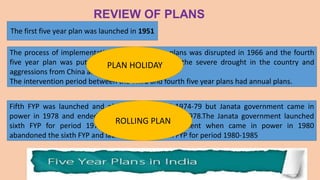
The first five year plan was launched in 1951
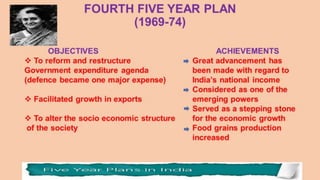
The process of implementation of the five year plans was disrupted in 1966 and the fourth
five year plan was put off by three years due to the severe drought in the country and
aggressions from China and Pakistan.
The intervention period between the Third and fourth five year plans had annual plans.
PLAN HOLIDAY
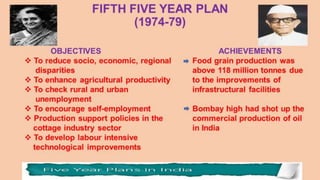
Fifth FYP was launched and planned for period 1974-79 but Janata government came in
power in 1978 and ended the plan prematurely in 1978.The Janata government launched
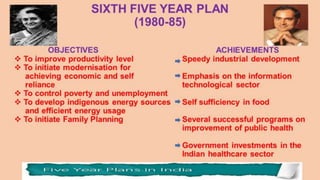
sixth FYP for period 1978-1983. Congress government when came in power in 1980
abandoned the sixth FYP and launched a new sixth FYP for period 1980-1985
ROLLING PLAN
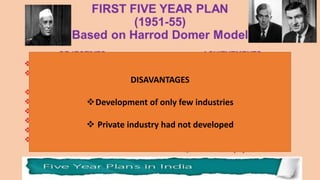
DISAVANTAGES
Development of only few industries
 Private industry had not developed
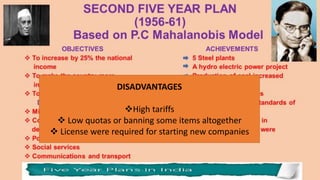
DISADVANTAGES
High tariffs
 Low quotas or banning some items altogether
 License were required for starting new companies
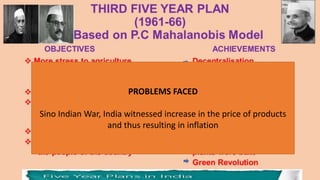
PROBLEMS FACED
Sino Indian War, India witnessed increase in the price of products
and thus resulting in inflation
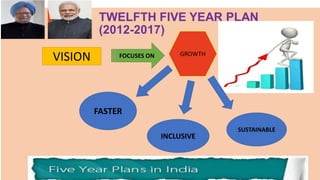
VISION FOCUSES ON GROWTH
FASTER
INCLUSIVE
SUSTAINABLE
ECONOMICGROWTH
• Real GDP growth at 8%.
• Agriculture growth at
4%.
• Manufacturing growth at
10%.
• Every state must attain
higher growth rate than
the rate achieved during
11th plan
POVERTY&EMPLOYMENT
• Poverty rate to be reduced
by 10% than the rate at the
end of 11th plan.
• 5 Crore new work
opportunities and skill
certifications in non-farm
sector.
EDUCATION
• Mean years of
schooling to increase to
7 years.
• 20 lakh seats for each
age bracket in higher
education.
• End gender gap and
social gap in school
enrollment.
HEALTH
• Reduce : IMR to 25;
MMR to 1. Increase Child
Sex Ratio to 950.
• Reduce Total Fertility
Rate to 2.1
• Reduce under nutrition
of children in age group
0-3 to half of NFHS-3
levels.
INFRASTRUCTURE
• Investment in Infrastructure
at 9% of GDP
• Gross Irrigated Area 103
million hectare (from
90 million hectare)
• Electricity to all villages;
Reduce AT&C losses by 20%.
• Connect Villages with All
Weather Roads
• National and State high
ways to a minimum of 2
lane standard.
INFRASTRUCTURE
• Complete Eastern and Western
Dedicated Freight Corridors.
• Rural Tele-Density to 70%.
• 40 Litres Per Capita Per Day
Drinking Water to 50% of rural
population; Nirmal Gram Status
to 50% of all Gram Panchayats.
ENVIRONMENT&
STABILITY
• Increase green cover by 1
million hectare every year.
• 30,000 MW renewable
energy during Five Year
Period.
• Emission intensity of GDP to
be reduced to 20-25% of
2005 levels by 2020.
SERVICEDELIVERY
• Banking Services to 90% of
Indian Households.
• Subsidies and Welfare
related payment to be
routed through Aadhar
based Direct Cash Transfer
Scheme.
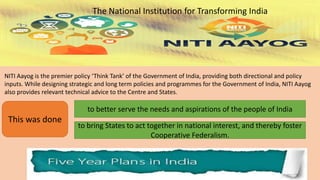
The National Institution for Transforming India
NITI Aayog is the premier policy ‘Think Tank’ of the Government of India, providing both directional and policy
inputs. While designing strategic and long term policies and programmes for the Government of India, NITI Aayog
also provides relevant technical advice to the Centre and States.
This was done
to better serve the needs and aspirations of the people of India
to bring States to act together in national interest, and thereby foster
Cooperative Federalism.
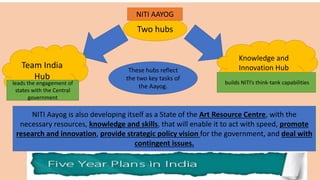
Two hubs
NITI AAYOG
Team India
Hub
Knowledge and
Innovation Hub
leads the engagement of
states with the Central
government
builds NITI’s think-tank capabilities
These hubs reflect
the two key tasks of
the Aayog.
NITI Aayog is also developing itself as a State of the Art Resource Centre, with the
necessary resources, knowledge and skills, that will enable it to act with speed, promote
research and innovation, provide strategic policy vision for the government, and deal with
contingent issues.
Five year plan and NITI AAYOG

Five year plan and NITI AAYOG

  • 2.
    WHAT IS APLAN? A plan spells out how the resources of a nation should be put to use. IT SHOULD HAVE SPECIFIC OBJECTIVES
  • 3.
  • 4.
    THE PLANNING COMMISSIONIS AN INSTITUTION IN THE GOVERNMENT OF INDIA WHICH FORMULATES INDIA’S FIVE YEAR PLANS SET UP ON 15TH MARCH 1950, WITH PRIME MINISTER JAWAHARLAL NEHRU AS THE CHAIRMAN
  • 5.
    The first fiveyear plan was launched in 1951 The process of implementation of the five year plans was disrupted in 1966 and the fourth five year plan was put off by three years due to the severe drought in the country and aggressions from China and Pakistan. The intervention period between the Third and fourth five year plans had annual plans. PLAN HOLIDAY Fifth FYP was launched and planned for period 1974-79 but Janata government came in power in 1978 and ended the plan prematurely in 1978.The Janata government launched sixth FYP for period 1978-1983. Congress government when came in power in 1980 abandoned the sixth FYP and launched a new sixth FYP for period 1980-1985 ROLLING PLAN
  • 6.
    DISAVANTAGES Development of onlyfew industries  Private industry had not developed
  • 7.
    DISADVANTAGES High tariffs  Lowquotas or banning some items altogether  License were required for starting new companies
  • 8.
    PROBLEMS FACED Sino IndianWar, India witnessed increase in the price of products and thus resulting in inflation
  • 17.
    VISION FOCUSES ONGROWTH FASTER INCLUSIVE SUSTAINABLE
  • 19.
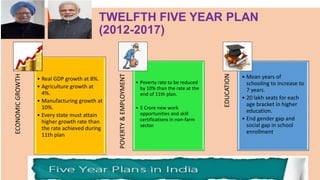
    ECONOMICGROWTH • Real GDPgrowth at 8%. • Agriculture growth at 4%. • Manufacturing growth at 10%. • Every state must attain higher growth rate than the rate achieved during 11th plan POVERTY&EMPLOYMENT • Poverty rate to be reduced by 10% than the rate at the end of 11th plan. • 5 Crore new work opportunities and skill certifications in non-farm sector. EDUCATION • Mean years of schooling to increase to 7 years. • 20 lakh seats for each age bracket in higher education. • End gender gap and social gap in school enrollment.
  • 20.
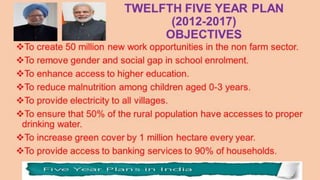
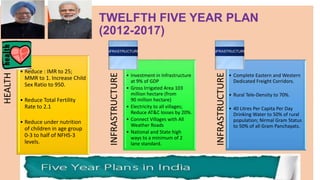
    HEALTH • Reduce :IMR to 25; MMR to 1. Increase Child Sex Ratio to 950. • Reduce Total Fertility Rate to 2.1 • Reduce under nutrition of children in age group 0-3 to half of NFHS-3 levels. INFRASTRUCTURE • Investment in Infrastructure at 9% of GDP • Gross Irrigated Area 103 million hectare (from 90 million hectare) • Electricity to all villages; Reduce AT&C losses by 20%. • Connect Villages with All Weather Roads • National and State high ways to a minimum of 2 lane standard. INFRASTRUCTURE • Complete Eastern and Western Dedicated Freight Corridors. • Rural Tele-Density to 70%. • 40 Litres Per Capita Per Day Drinking Water to 50% of rural population; Nirmal Gram Status to 50% of all Gram Panchayats.
  • 21.
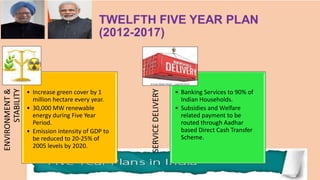
    ENVIRONMENT& STABILITY • Increase greencover by 1 million hectare every year. • 30,000 MW renewable energy during Five Year Period. • Emission intensity of GDP to be reduced to 20-25% of 2005 levels by 2020. SERVICEDELIVERY • Banking Services to 90% of Indian Households. • Subsidies and Welfare related payment to be routed through Aadhar based Direct Cash Transfer Scheme.
  • 23.
    The National Institutionfor Transforming India NITI Aayog is the premier policy ‘Think Tank’ of the Government of India, providing both directional and policy inputs. While designing strategic and long term policies and programmes for the Government of India, NITI Aayog also provides relevant technical advice to the Centre and States. This was done to better serve the needs and aspirations of the people of India to bring States to act together in national interest, and thereby foster Cooperative Federalism.
  • 24.
    Two hubs NITI AAYOG TeamIndia Hub Knowledge and Innovation Hub leads the engagement of states with the Central government builds NITI’s think-tank capabilities These hubs reflect the two key tasks of the Aayog. NITI Aayog is also developing itself as a State of the Art Resource Centre, with the necessary resources, knowledge and skills, that will enable it to act with speed, promote research and innovation, provide strategic policy vision for the government, and deal with contingent issues.