Reporter:
Princess Marynee V. Morga
PRIMARY EDUCATION IN JAPAN
▪ 6 years compulsory education
▪ 243 school days (Saturday class)
▪ School system generally called “6-3-
3-4 year system”
▪1st graders, 1st of April, immediately
following their 6th birthday.
▪ Kindergarten do not form a part in
compulsory education
▪ Academic calendar starts in April
ends in March
▪ Pupil’s performance on subjects and
record of day to day life are kept in the
teaching record. Schools compile it and
send it to the guardians of the pupils once
every term.
▪ The pupils undergo extended learning
activities outside the school.
▪ Most primary schools provide school
lunch.
▪ Textbooks for all the subjects are
provided free of charge.
▪ School trips almost always take place in
the final year of the school.
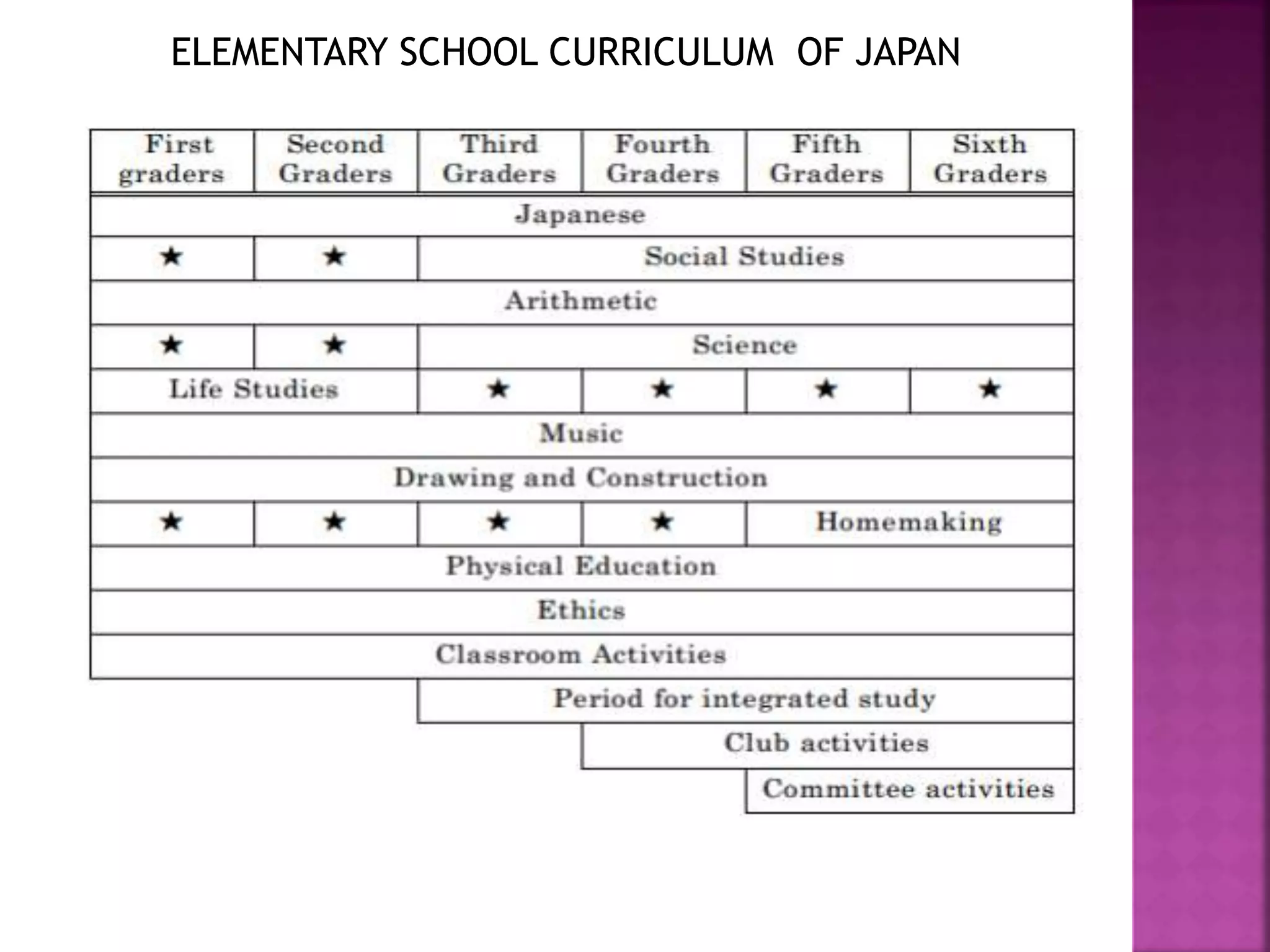
ELEMENTARY SCHOOL CURRICULUM OF JAPAN
PRIMARY EDUCATION OF PHILIPPINES
▪ 200 school days
▪ 6 years of compulsory education
▪ Academic calendar starts in June ends in
April
▪ Learning Resources are provided for all
learning areas.
▪ K-12 curriculum holistically develop Filipino
with 21st century skills.
SECONDARY EDUCATION IN JAPAN
- Lower Secondary Education (Junior High School)
- Secondary Stage of Compulsory Education
- 3 years in the age of 12-15
- No tuition fee at any National and Public
Secondary Schools.
- Public Lower Secondary Schools are managed by
Municipalities.
- National Secondary Schools are attached to
faculties of education at National Universities.
▪ Subject based-teacher assignment
▪ School lunch is served, if not
parents must apply homemade
lunches.
▪ Cleaning is done by students
themselves.
▪ Cultural festivals and
commencement ceremonies are
common.
▪ Club activities (athletic and
cultural)
JUNIOR HIGH SCHOOL CURRICULUM OF JAPAN
SECONDARY EDUCATION IN THE
PHILIPPINES
- The Department of Education
(DepEd) has formed a Technical
Vocational unit in the Bureau of
Secondary Education. That will
prepare high school graduates by
arming them with skills for
employment.
Each TLE subject in Grades 7 and 8 is exploratory. This means each student
has the chance to explore the following four main courses of TLE.
1) Agri-Fishery Arts 2) Home Economics
3) Information and Communications Technology (ICT)
4) Industrial Arts
K12Philippines (n.d). Retrieved from
http://k12philippines.com/what-is-k-12s-
technical-vocational-livelihood-track/
NATIONAL INSTITUTE FOR EDUCATIONAL POLICY
RESEARCH (NIER), (n.d) Retrieved from
http://www.nier.go.jp/English/educationjapan/pd
f/201109BE.pdf
Ocampo, D. (2014). The K to 12 Curriculum.
Retrieved from http://industry.gov.ph/wp-
content/uploads/2015/05/6th-TID-Usec.-Ocampos-
Presentation-on-K-to-12.pdf

Comparative Education (Japan and Philippines)

  • 1.
  • 2.
    PRIMARY EDUCATION INJAPAN ▪ 6 years compulsory education ▪ 243 school days (Saturday class) ▪ School system generally called “6-3- 3-4 year system” ▪1st graders, 1st of April, immediately following their 6th birthday. ▪ Kindergarten do not form a part in compulsory education ▪ Academic calendar starts in April ends in March
  • 3.
    ▪ Pupil’s performanceon subjects and record of day to day life are kept in the teaching record. Schools compile it and send it to the guardians of the pupils once every term. ▪ The pupils undergo extended learning activities outside the school. ▪ Most primary schools provide school lunch. ▪ Textbooks for all the subjects are provided free of charge. ▪ School trips almost always take place in the final year of the school.
  • 4.
  • 5.
    PRIMARY EDUCATION OFPHILIPPINES ▪ 200 school days ▪ 6 years of compulsory education ▪ Academic calendar starts in June ends in April ▪ Learning Resources are provided for all learning areas. ▪ K-12 curriculum holistically develop Filipino with 21st century skills.
  • 7.
    SECONDARY EDUCATION INJAPAN - Lower Secondary Education (Junior High School) - Secondary Stage of Compulsory Education - 3 years in the age of 12-15 - No tuition fee at any National and Public Secondary Schools. - Public Lower Secondary Schools are managed by Municipalities. - National Secondary Schools are attached to faculties of education at National Universities.
  • 8.
    ▪ Subject based-teacherassignment ▪ School lunch is served, if not parents must apply homemade lunches. ▪ Cleaning is done by students themselves. ▪ Cultural festivals and commencement ceremonies are common. ▪ Club activities (athletic and cultural)
  • 9.
    JUNIOR HIGH SCHOOLCURRICULUM OF JAPAN
  • 10.
    SECONDARY EDUCATION INTHE PHILIPPINES - The Department of Education (DepEd) has formed a Technical Vocational unit in the Bureau of Secondary Education. That will prepare high school graduates by arming them with skills for employment.
  • 11.
    Each TLE subjectin Grades 7 and 8 is exploratory. This means each student has the chance to explore the following four main courses of TLE. 1) Agri-Fishery Arts 2) Home Economics 3) Information and Communications Technology (ICT) 4) Industrial Arts
  • 12.
    K12Philippines (n.d). Retrievedfrom http://k12philippines.com/what-is-k-12s- technical-vocational-livelihood-track/ NATIONAL INSTITUTE FOR EDUCATIONAL POLICY RESEARCH (NIER), (n.d) Retrieved from http://www.nier.go.jp/English/educationjapan/pd f/201109BE.pdf Ocampo, D. (2014). The K to 12 Curriculum. Retrieved from http://industry.gov.ph/wp- content/uploads/2015/05/6th-TID-Usec.-Ocampos- Presentation-on-K-to-12.pdf