Dementia vs. Delirium
Prepared by:
Sehrish Naz
Assistant Professor
INS-KMU
Objectives
 At the end of session students will be able to
Identify the elements of comprehensive
psychiatric assessment of elderly client with
compromised cognition
• Discuss dementia & delirium in relation to
mental health.
• Analyze nursing care needs for elderly clients
with mental health problems..
Delirium
Disturbance of consciousness that is
accompanied by variations in cognition
within few hours or days, reduced clarity of
awareness of the environment with
reduced ability to focus, sustain, or shift
attention.
It is also referred to acute brain syndrome,
acute toxic psychosis.
Yaghmou ,Y & Gholizadeh ,L 2016
• Infections (encephalitis, pneumonia)
• Withdrawal (alchol, benzodiazepine, sedatives)
Acute Metabolic (Electrolyte imbalances, dehydration)
– ) Toxic drugs(opiates, anti cholinergic)
CNS Pathalogy (stroke, tumour, hemorrrhage,
– Hypoxia (anemia ,cardiac failure low B
– Deficiencies (thiamine)
• Endocrine(thyroid,hypo/hyperglycemia)
• Acute Vascular(shock, hypertensive,)
• Tr Trauma(head injury)
• Heavy Metals (lead, mercury) (Johnstone,R
2005)
I WATCH DEATH
I
W
A
T
C
H
D
E
A
T
H
Etiology
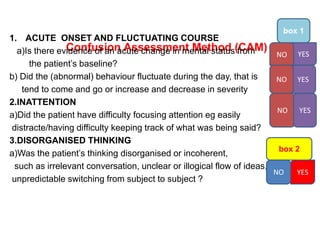
Confusion Assessment Method (CAM)
1. ACUTE ONSET AND FLUCTUATING COURSE
a)Is there evidence of an acute change in mental status from
the patient’s baseline?
b) Did the (abnormal) behaviour fluctuate during the day, that is
tend to come and go or increase and decrease in severity
2.INATTENTION
a)Did the patient have difficulty focusing attention eg easily
distracte/having difficulty keeping track of what was being said?
3.DISORGANISED THINKING
a)Was the patient’s thinking disorganised or incoherent,
such as irrelevant conversation, unclear or illogical flow of ideas, or
unpredictable switching from subject to subject ?
YES
YES
box 1
box 2
NO
NO
YES
NO
NO YES
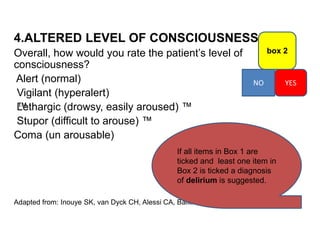
4.ALTERED LEVEL OF CONSCIOUSNESS
Overall, how would you rate the patient’s level of
consciousness?
Alert (normal)
Vigilant (hyperalert)
™
Lethargic (drowsy, easily aroused) ™
Stupor (difficult to arouse) ™
Coma (un arousable)
Adapted from: Inouye SK, van Dyck CH, Alessi CA, Balkin S, Siegal AP, Horwitz RI.
NO
box 2
YES
If all items in Box 1 are
ticked and least one item in
Box 2 is ticked a diagnosis
of delirium is suggested.
Scenario
Jeffries, age 78 , is admitted to the hospital for an
arthroplasty of the left hip. he lives with his wife
and son in a two-story home. He has a history of
arthritis and type 2 diabetes, which has been
controlled with tolazamide 100 mg daily. On the
second post-op day, his nurse, Jessica, notes that he
slept most of the morning and fell asleep after
physical therapy in the afternoon.
When his wife visits at lunch time, she tells Jessica
her husband is picking at the bedding and
complaining of feeling cold. Jessica give him a warm
blanket. Later in the afternoon, Mr. Jeffries puts on
• He states he didn’t have trouble until he came to
the hospital. He complains of pain in his left hip
and says he doesn’t think he has had any pain
medication today. However, you know he
received morphine 4 hours ago. He asks again
about getting his TV working.
• When Mr. Jeffries’ son visits later, you question
him about his father’s memory. He confirms his
father had no trouble with his memory before.
(Bull,M 2015)
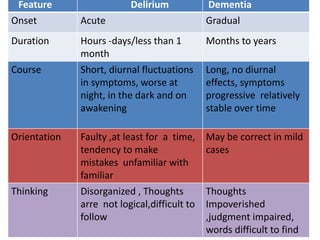
Feature Delirium Dementia
Onset Acute Gradual
Duration Hours -days/less than 1
month
Months to years
Course Short, diurnal fluctuations
in symptoms, worse at
night, in the dark and on
awakening
Long, no diurnal
effects, symptoms
progressive relatively
stable over time
Orientation Faulty ,at least for a time,
tendency to make
mistakes unfamiliar with
familiar
May be correct in mild
cases
Thinking Disorganized , Thoughts
arre not logical,difficult to
follow
Thoughts
Impoverished
,judgment impaired,
words difficult to find
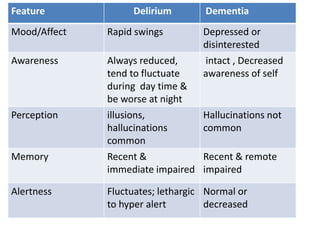
Feature Delirium Dementia
Mood/Affect Rapid swings Depressed or
disinterested
Awareness Always reduced,
tend to fluctuate
during day time &
be worse at night
intact , Decreased
awareness of self
Perception illusions,
hallucinations
common
Hallucinations not
common
Memory Recent &
immediate impaired
Recent & remote
impaired
Alertness Fluctuates; lethargic
to hyper alert
Normal or
decreased
Feature Delirium Dementia
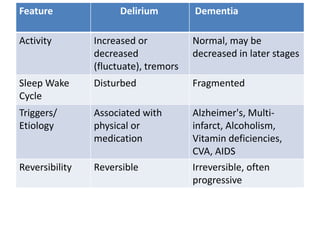
Activity Increased or
decreased
(fluctuate), tremors
Normal, may be
decreased in later stages
Sleep Wake
Cycle
Disturbed Fragmented
Triggers/
Etiology
Associated with
physical or
medication
Alzheimer's, Multi-
infarct, Alcoholism,
Vitamin deficiencies,
CVA, AIDS
Reversibility Reversible Irreversible, often
progressive
Bull, M 2015
• Reviewing medication for adverse effects
• Check labs
• Providing a therapeutic environment
– minimizing noise ,ensure appropriate lighting ,
minimize room changes to reduce
environmental stimuli, and promote rest.
• Assessing for pain &. provide analgesia
• Use Orientation clues(clock and calendar)
• Ensuring that hearing aids and eyeglasses
are available for patients who use them
GERIATRIC
EMERGENCY
Nursing Interventions
Conti..
• Encourage mobility to the extent allowed
• Ensure adequate food and fluid intake to prevent
dehydration
• Use clear, concise communication
• Educating family members about delirium
symptom causes, and suggest ways for
them to promote comfort.
• Family members should involve patients
for diversional activities such as
newspapers, magazines, or puzzles.
(Johnstone,R
A neurodegenerative syndrome of progressive;
decline in multiple areas of cognitive functions
eventually leading to a significant inability to
maintain occupational & social behavior.
(Johnstone,R 2005)
Dementia
• Advanced age
• Genetics
• Female
• Head injury
Risk factors
Types Of Dementia
• Alzheimer’s disease
• „
Vascular dementia
• „
Dementia with Lewy Bodies „
„
• Fronto temporal dementia
• Reversible dementia
Yaghmou ,Y & Gholizadeh ,L 2016
Assessment
• History from caregiver
• Functional assessment
• Cognitive assessment
• Physical Examination
• Labs
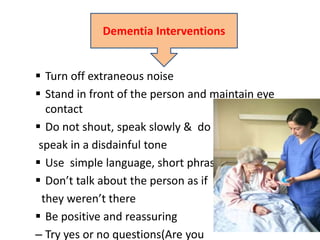
 Turn off extraneous noise
 Stand in front of the person and maintain eye
contact
 Do not shout, speak slowly & do not
speak in a disdainful tone
 Use simple language, short phrases
 Don’t talk about the person as if
they weren’t there
 Be positive and reassuring
– Try yes or no questions(Are you
Dementia Interventions
Conti…
– Learn to be a good listener & do not interrupt
– Be aware of signs of frustration fatigue or overload that
might lead to disruptive behavior
– Use touch that maintain attention during
conversation & give sense of reassuring
• Optimize for physical ,mental activity & social interaction
– Orient and reorient frequently
– Make sure they have hearing aids or glasses if
they need them
• Educating family members about dementia symptoms
suggest ways for effective care
Conti..
• Repeat rephrase and repair
– Do not trying to be disagreeable they are usually
unaware that they are making mistakes
– Don’t argue you will only cause frustration, fear
and anger.
• High intake of fish, fruit & vegetable intake
– Vitamin E
References
 Yaghmou,Y & Gholizadeh2,S (2016) Review of
Nurses’ Knowledge of Delirium, Dementia and
Depressions (3Ds): Systematic Literature Review
Scientific Research Publishing
• Bull,M (2015) Managing delirium in hospitalized
older adults Vol. 10
• Johnstone, R (2005) Recognition & Screening of
Delirium, Dementia and Depressions A Self Learning
Guide
• Bell, L. (November, 2011). AACN practice alert:
Delirium assessment and management. American
Association of Critical Care Nurses.
 Cason-McNeeley, D. (2004). Delirium the Mistaken
Confusion. PESI Healthcare, Eau Claire, Wisconsin

unit 7.ppt

  • 1.
    Dementia vs. Delirium Preparedby: Sehrish Naz Assistant Professor INS-KMU
  • 2.
    Objectives  At theend of session students will be able to Identify the elements of comprehensive psychiatric assessment of elderly client with compromised cognition • Discuss dementia & delirium in relation to mental health. • Analyze nursing care needs for elderly clients with mental health problems..
  • 3.
    Delirium Disturbance of consciousnessthat is accompanied by variations in cognition within few hours or days, reduced clarity of awareness of the environment with reduced ability to focus, sustain, or shift attention. It is also referred to acute brain syndrome, acute toxic psychosis. Yaghmou ,Y & Gholizadeh ,L 2016
  • 4.
    • Infections (encephalitis,pneumonia) • Withdrawal (alchol, benzodiazepine, sedatives) Acute Metabolic (Electrolyte imbalances, dehydration) – ) Toxic drugs(opiates, anti cholinergic) CNS Pathalogy (stroke, tumour, hemorrrhage, – Hypoxia (anemia ,cardiac failure low B – Deficiencies (thiamine) • Endocrine(thyroid,hypo/hyperglycemia) • Acute Vascular(shock, hypertensive,) • Tr Trauma(head injury) • Heavy Metals (lead, mercury) (Johnstone,R 2005) I WATCH DEATH I W A T C H D E A T H Etiology
  • 5.
    Confusion Assessment Method(CAM) 1. ACUTE ONSET AND FLUCTUATING COURSE a)Is there evidence of an acute change in mental status from the patient’s baseline? b) Did the (abnormal) behaviour fluctuate during the day, that is tend to come and go or increase and decrease in severity 2.INATTENTION a)Did the patient have difficulty focusing attention eg easily distracte/having difficulty keeping track of what was being said? 3.DISORGANISED THINKING a)Was the patient’s thinking disorganised or incoherent, such as irrelevant conversation, unclear or illogical flow of ideas, or unpredictable switching from subject to subject ? YES YES box 1 box 2 NO NO YES NO NO YES
  • 6.
    4.ALTERED LEVEL OFCONSCIOUSNESS Overall, how would you rate the patient’s level of consciousness? Alert (normal) Vigilant (hyperalert) ™ Lethargic (drowsy, easily aroused) ™ Stupor (difficult to arouse) ™ Coma (un arousable) Adapted from: Inouye SK, van Dyck CH, Alessi CA, Balkin S, Siegal AP, Horwitz RI. NO box 2 YES If all items in Box 1 are ticked and least one item in Box 2 is ticked a diagnosis of delirium is suggested.
  • 7.
    Scenario Jeffries, age 78, is admitted to the hospital for an arthroplasty of the left hip. he lives with his wife and son in a two-story home. He has a history of arthritis and type 2 diabetes, which has been controlled with tolazamide 100 mg daily. On the second post-op day, his nurse, Jessica, notes that he slept most of the morning and fell asleep after physical therapy in the afternoon. When his wife visits at lunch time, she tells Jessica her husband is picking at the bedding and complaining of feeling cold. Jessica give him a warm blanket. Later in the afternoon, Mr. Jeffries puts on
  • 8.
    • He stateshe didn’t have trouble until he came to the hospital. He complains of pain in his left hip and says he doesn’t think he has had any pain medication today. However, you know he received morphine 4 hours ago. He asks again about getting his TV working. • When Mr. Jeffries’ son visits later, you question him about his father’s memory. He confirms his father had no trouble with his memory before. (Bull,M 2015)
  • 9.
    Feature Delirium Dementia OnsetAcute Gradual Duration Hours -days/less than 1 month Months to years Course Short, diurnal fluctuations in symptoms, worse at night, in the dark and on awakening Long, no diurnal effects, symptoms progressive relatively stable over time Orientation Faulty ,at least for a time, tendency to make mistakes unfamiliar with familiar May be correct in mild cases Thinking Disorganized , Thoughts arre not logical,difficult to follow Thoughts Impoverished ,judgment impaired, words difficult to find
  • 10.
    Feature Delirium Dementia Mood/AffectRapid swings Depressed or disinterested Awareness Always reduced, tend to fluctuate during day time & be worse at night intact , Decreased awareness of self Perception illusions, hallucinations common Hallucinations not common Memory Recent & immediate impaired Recent & remote impaired Alertness Fluctuates; lethargic to hyper alert Normal or decreased
  • 11.
    Feature Delirium Dementia ActivityIncreased or decreased (fluctuate), tremors Normal, may be decreased in later stages Sleep Wake Cycle Disturbed Fragmented Triggers/ Etiology Associated with physical or medication Alzheimer's, Multi- infarct, Alcoholism, Vitamin deficiencies, CVA, AIDS Reversibility Reversible Irreversible, often progressive
  • 12.
  • 13.
    • Reviewing medicationfor adverse effects • Check labs • Providing a therapeutic environment – minimizing noise ,ensure appropriate lighting , minimize room changes to reduce environmental stimuli, and promote rest. • Assessing for pain &. provide analgesia • Use Orientation clues(clock and calendar) • Ensuring that hearing aids and eyeglasses are available for patients who use them GERIATRIC EMERGENCY Nursing Interventions
  • 14.
    Conti.. • Encourage mobilityto the extent allowed • Ensure adequate food and fluid intake to prevent dehydration • Use clear, concise communication • Educating family members about delirium symptom causes, and suggest ways for them to promote comfort. • Family members should involve patients for diversional activities such as newspapers, magazines, or puzzles. (Johnstone,R
  • 15.
    A neurodegenerative syndromeof progressive; decline in multiple areas of cognitive functions eventually leading to a significant inability to maintain occupational & social behavior. (Johnstone,R 2005) Dementia
  • 16.
    • Advanced age •Genetics • Female • Head injury Risk factors
  • 17.
    Types Of Dementia •Alzheimer’s disease • „ Vascular dementia • „ Dementia with Lewy Bodies „ „ • Fronto temporal dementia • Reversible dementia Yaghmou ,Y & Gholizadeh ,L 2016
  • 18.
    Assessment • History fromcaregiver • Functional assessment • Cognitive assessment • Physical Examination • Labs
  • 19.
     Turn offextraneous noise  Stand in front of the person and maintain eye contact  Do not shout, speak slowly & do not speak in a disdainful tone  Use simple language, short phrases  Don’t talk about the person as if they weren’t there  Be positive and reassuring – Try yes or no questions(Are you Dementia Interventions
  • 20.
    Conti… – Learn tobe a good listener & do not interrupt – Be aware of signs of frustration fatigue or overload that might lead to disruptive behavior – Use touch that maintain attention during conversation & give sense of reassuring • Optimize for physical ,mental activity & social interaction – Orient and reorient frequently – Make sure they have hearing aids or glasses if they need them • Educating family members about dementia symptoms suggest ways for effective care
  • 21.
    Conti.. • Repeat rephraseand repair – Do not trying to be disagreeable they are usually unaware that they are making mistakes – Don’t argue you will only cause frustration, fear and anger. • High intake of fish, fruit & vegetable intake – Vitamin E
  • 22.
    References  Yaghmou,Y &Gholizadeh2,S (2016) Review of Nurses’ Knowledge of Delirium, Dementia and Depressions (3Ds): Systematic Literature Review Scientific Research Publishing • Bull,M (2015) Managing delirium in hospitalized older adults Vol. 10 • Johnstone, R (2005) Recognition & Screening of Delirium, Dementia and Depressions A Self Learning Guide • Bell, L. (November, 2011). AACN practice alert: Delirium assessment and management. American Association of Critical Care Nurses.  Cason-McNeeley, D. (2004). Delirium the Mistaken Confusion. PESI Healthcare, Eau Claire, Wisconsin

Editor's Notes

  • #4 a(WHO), 15% of the elderly population, aged 60 years and above, suffer from mental disorders Changes in cognition; Memory impairment, disorientation, and perceptual or linguistic deficit. Disturbance in the sleep-wake cycle, emotional status, and hyperactivity or hypo-activity. Occurs over a short time period and fluctuates during the day. Delirium is marked by sudden onset of confusion (over a few hours or days), inattention, illogical thinking or incoherent speech, altered sleep-wake cycle, and changes in psychomotor behaviors. S/s fluctuate over time, with the patient seeming to float in and out of confusion. Consequences of delirium for older adults include increased mortality, functional decline, nursing home placement, and dec quality of life
  • #5 acute metabolic, dehydration, the serum sodium level may rise, causing increased blood pressure.
  • #9 After learning of Mr. Jeffries’ positive delirium screen, the attending physician replaces morphine with tramadol 50 mg P.O. every 4 to 6 hours. Jessica explains to the patient’s family that delirium symptoms can reflect an adverse drug reaction and the physician thought morphine might have caused Mr. Jeffries’ symptoms. She encourages them to alert her if they notice that he seems confused. She also teaches them that tramadol shouldn’t be stopped abruptly and that Mr. Jeffries should avoid alcohol when taking the medication. Two days after discontinuing morphine, Mr. Jeffries’ delirium resolves. On the fifth day after surgery, he’s transferred to inpatient rehabilitation. 
  • #10  flactuate: Memory impaired Aphasia –Inability to speak „Apraxia–Inability to perform known tasks „Agnosia–Inability to recognize objects „Executive function –Judgement/social appropriateness Disorganized :
  • #12 Sudden onset of a change in cognition maybe the only indicator that this is delirium and not dementia Behavior symptoms;iRemoval of IV, Catheter, senstivity to light ,sound, vocal disturbance:screaming. tendency to attack others
  • #13 Different than dementia because of: Fluctuating nature of delirium Inattention Hyperactive ;agitation , reffusal to medication, restless,shouting,spitting Hypoactive; sluggish, difficult to arouse & require strong stimuli (vigrous shaaking) Behavior symptoms; „Emotional disturbances „Fear „Depression „irritabiliity. Functional symptoms; incontinence, falls, dependence for self care ,physical symptoms; hypertension ,tachycardia
  • #14 To provide a therapeutic environment, orient the patient to time, place, and self.. Monitor vital signs to help identify complications, such as infection and dehydration. Eg low blood pressure may suggest dehydration, irregular breathing may indicate hypoxia, and an elevated temperature might reflect dehydration or infection.
  • #15 speaking in short sentences because the patient might have a short attention span. delirium signs and symptoms can elicit fear and anxiety in family members, who typically lack knowledge about the disorder, its causes, and how to help their loved one. To reduce their anxiety, educate them about delirium, potential causes, and manifestations. Enlist the family’s help to promote early recognition of the disorder. Encourage them to visit the patient and bring Urge them to provide reassurance to their loved one and engage the patient in conversation about current events.
  • #16 ’ Short term memory loss ,personality changes, language disturbance ,and problems caring for themselves ,Often overlooked & attributed to old age
  • #17 (tend to live longer)
  • #18 Alzheimer amyloid protein causes „Neuritic amyloidplaques, language disturbance „impaired ability to carry out motor tasks „failure to identify familiar objects „disturbed executive”functioning((Ability to initiate action or cease action , Ability to judge whether acts might be safe or unsafe) memory „Vascular gait impairment, „same language & motor problems ,CVA,infarct. Degenerative changes occur in the brain which are not reversible „Atrophy or shrinking of brain tissue. , Lewy Bodies the most obvious are shaking, rigidity, slowness of movement, and difficulty with walking, parkinisoms The motor symptoms of the disease result from the death of cells in the substantia nigra, a region of the midbrain.[1] This results in not enough dopamine in these areas.[1] The reason for this cell death is poorly understood, but involves the build-up of proteins into Lewy bodies in the neurons. Fronto temporal :Focal atrophy of the frontal & temporal lobes . „Reversible Medication-induced –analgesics, anticholinergics, psychotropics, sedative hypnotics, steroids „Alcohol-related „Metabolic disorders „Depression (pseudodementia)
  • #19 Physical Examination Metabolic (Electrolyte imbalances, dehydration) Toxic drugS Functional assessment :ADL
  • #20 Our communication strategies can help an older adult with advancing dementia feel safe, less anxious, and less likely to become upset or aggressive
  • #21 It’s 12 noon would you like lunch.Calendars and message boards Keep them up to date, make sure they are easy to locate Are you looking forward to thanksgiving, I’m so happy it’s November. Listen and watch/ wait for the response Be willing to talk about old times then redirect
  • #22 This is a difficult strategy but is helpful to maintain conversation and helps fill in the missing information the person with dementia may omit 1:helps fill in speech Ex: I want a cup of…. If you repeat this the elder may add the word coffee, water or juice 2:helps the person hear the corrected response if they say juice you might point to a juice container and say I want a glass of juice 3uses both tactics to fix or fill in missing information for example a person points at a pantry cabinet and says, “look there.”, you might say, “your Hungry?” If the person is in immediate danger then correcting the thought or behavior might be appropriate. If not Don’t argue