ETHICAL PRINCIPALS AND THEORIES
UNIT III
By
Sehrish Naz
Lecturer INS-KMU
OBJECTIVES
At the end of this session learners will be able
to:
• Define ethical principles and theories in health
care.
• Discuss the ethical dilemmas face by nurses
and clients.
• Discuss the strategies to resolve ethical
dilemma in daily nursing practice.
• List steps of ethical decision making.
Ethical principles
1. Autonomy: Refers to the right to make one’s own
decisions and choices free of harm to others.
Synonyms
• Self-government
• Independence
• Self-rule
• Home rule
• Sovereignty
• Self-determination
• Freedom
INFORMED CONSENT
Definition
• It is an agreement by a client to accept a
course of a treatment, procedure or research
after being provided complete information
including benefits and risks.
• Obtaining informed consent is the
responsibility of the person performing the
procedure or research.
TYPES OF CONSENT
Types of consent
1- Expressed Consent 2- Implied Consent
• Expressed Consent may either be oral or
written.
Written consent is preferred if there are greater
risks of a procedure.
• Implied consent
Exists when the client’s nonverbal behavior
indicates agreement.
ELEMENTS OF CONSENT
Four Basic Elements
1. The consent must be given voluntarily.
2. The consent must be given by a
client/participant with the Capacity and
competence to understand.
3. The consent must be specific to the procedure
& Person.
4. The client/participant must be given enough
information including benefits and possible
risks.
IMPORTANCE OF CONSENT
• The requirement of consent reflects the ethical
principle of patient’s/participant’s autonomy
• It also reflects the principles of beneficence and
non-maleficence.
• It saves both health care member/researcher and
patient/participant legally in exceptional
circumstances, medical treatment must not be
administered without obtaining patient’s valid
consent.
• Treatment/investigations/research performed
without consent constitutes “battery”
PATERNALISM
• Implies well intended actions of kind decision
making, leadership ,protection ,& discipline.
• Decision making on behalf of the patients
without their full consent or knowledge.
• Professionals restricts others autonomy, to
protect that person from perceived & anticipated
harm, but also promoting good in a positive way.
(Burkhardt & Nathaniel,2008)
2. BENEFICENCE
• This principle means do or promote good, prevent
harm, remove evil or harm.
• Nurses need to assist clients in meeting all their needs
– Biological
– Psychological
– Social
ICN says, the nurse takes appropriate action to safe
guard individual ,family ,communities when their care
is endangered by a coworker or any other person
(Burkhardt & Nathaniel,2008)
3. NON-MALEFICENCE
• Non-maleficence literally means to “do no harm.”
• Make sure that the procedure does not harm the
patient.
• Non-maleficence “obligation not to inflict harm on
others.
(Beauchamp and Childress, 2009)
NON –
MALEFICENCE
Non-maleficence
Literally- “Doing no
harm”.
• Make sure that the
procedure does not
harm the patient.
BENEFICENCE
Beneficence Literally –
“Being charitable or
doing good”.
Where a Health care
provider should act in
the “best interests” of
the patient, the
procedure be provided
with the intent of doing
good to the patient.
4. JUSTICE
• According to Salmond, “Justice means provide
everyone his share”
• According to Plato, ‘Justice is a quality. In simple
words the meaning of justice is to discharge one’s
duties honestly and not to interfere in other
actions.
• So justice is concerned with human welfare.
RELATIONSHIP BETWEEN LIBERTY AND
JUSTICE
Liberty is the first need of justice. Every ruler who
attacks the civil liberties is considered unjust
ruler. We can not even think of one without the
other.
• Purpose of both is common.
• Liberty is the first condition of justice But
absolute freedom is against justice.
ETHICAL THEORIES
14
Ethical Theories
• Ethical theory is means by which we
justify a particular ethical decision.
15
ETHICAL SCHOOL OF
THOUGHTS
1- Absolutism
2- Relativism
16
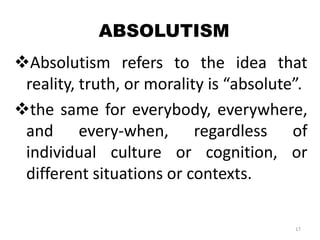
ABSOLUTISM
Absolutism refers to the idea that
reality, truth, or morality is “absolute”.
the same for everybody, everywhere,
and every-when, regardless of
individual culture or cognition, or
different situations or contexts.
17
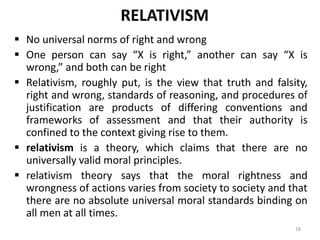
RELATIVISM
 No universal norms of right and wrong
 One person can say “X is right,” another can say “X is
wrong,” and both can be right
 Relativism, roughly put, is the view that truth and falsity,
right and wrong, standards of reasoning, and procedures of
justification are products of differing conventions and
frameworks of assessment and that their authority is
confined to the context giving rise to them.
 relativism is a theory, which claims that there are no
universally valid moral principles.
 relativism theory says that the moral rightness and
wrongness of actions varies from society to society and that
there are no absolute universal moral standards binding on
all men at all times.
18
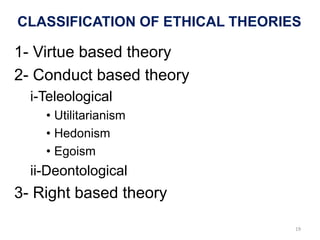
CLASSIFICATION OF ETHICAL THEORIES
1- Virtue based theory
2- Conduct based theory
i-Teleological
• Utilitarianism
• Hedonism
• Egoism
ii-Deontological
3- Right based theory
19
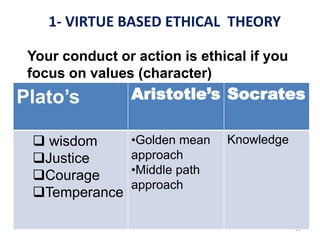
1- VIRTUE BASED ETHICAL THEORY
20
Your conduct or action is ethical if you
focus on values (character)
Plato’s Aristotle’s Socrates
 wisdom
Justice
Courage
Temperance
•Golden mean
approach
•Middle path
approach
Knowledge
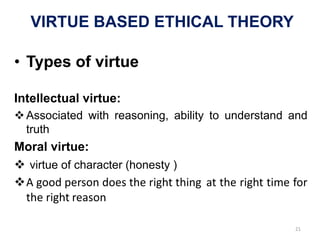
VIRTUE BASED ETHICAL THEORY
• Types of virtue
Intellectual virtue:
Associated with reasoning, ability to understand and
truth
Moral virtue:
 virtue of character (honesty )
A good person does the right thing at the right time for
the right reason
21
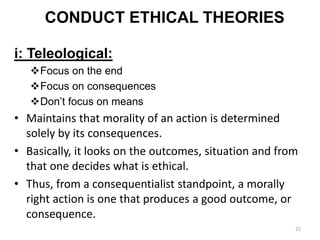
CONDUCT ETHICAL THEORIES
i: Teleological:
Focus on the end
Focus on consequences
Don’t focus on means
• Maintains that morality of an action is determined
solely by its consequences.
• Basically, it looks on the outcomes, situation and from
that one decides what is ethical.
• Thus, from a consequentialist standpoint, a morally
right action is one that produces a good outcome, or
consequence.
22
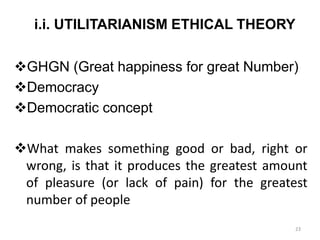
i.i. UTILITARIANISM ETHICAL THEORY
GHGN (Great happiness for great Number)
Democracy
Democratic concept
What makes something good or bad, right or
wrong, is that it produces the greatest amount
of pleasure (or lack of pain) for the greatest
number of people
23
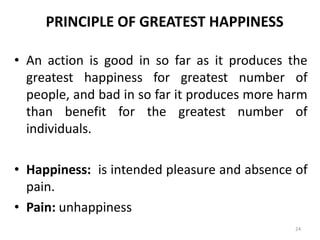
PRINCIPLE OF GREATEST HAPPINESS
• An action is good in so far as it produces the
greatest happiness for greatest number of
people, and bad in so far it produces more harm
than benefit for the greatest number of
individuals.
• Happiness: is intended pleasure and absence of
pain.
• Pain: unhappiness
24
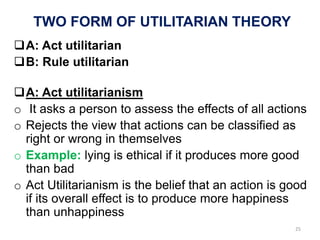
TWO FORM OF UTILITARIAN THEORY
A: Act utilitarian
B: Rule utilitarian
A: Act utilitarianism
o It asks a person to assess the effects of all actions
o Rejects the view that actions can be classified as
right or wrong in themselves
o Example: lying is ethical if it produces more good
than bad
o Act Utilitarianism is the belief that an action is good
if its overall effect is to produce more happiness
than unhappiness
25
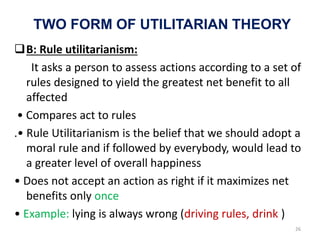
TWO FORM OF UTILITARIAN THEORY
B: Rule utilitarianism:
It asks a person to assess actions according to a set of
rules designed to yield the greatest net benefit to all
affected
• Compares act to rules
.• Rule Utilitarianism is the belief that we should adopt a
moral rule and if followed by everybody, would lead to
a greater level of overall happiness
• Does not accept an action as right if it maximizes net
benefits only once
• Example: lying is always wrong (driving rules, drink )
26
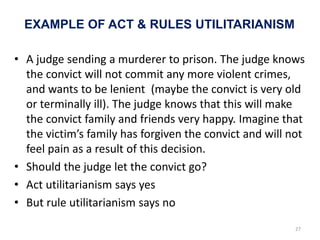
EXAMPLE OF ACT & RULES UTILITARIANISM
• A judge sending a murderer to prison. The judge knows
the convict will not commit any more violent crimes,
and wants to be lenient (maybe the convict is very old
or terminally ill). The judge knows that this will make
the convict family and friends very happy. Imagine that
the victim’s family has forgiven the convict and will not
feel pain as a result of this decision.
• Should the judge let the convict go?
• Act utilitarianism says yes
• But rule utilitarianism says no
27
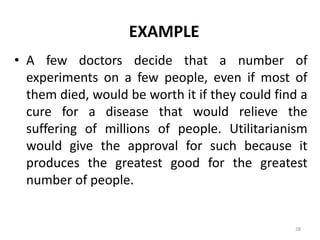
EXAMPLE
• A few doctors decide that a number of
experiments on a few people, even if most of
them died, would be worth it if they could find a
cure for a disease that would relieve the
suffering of millions of people. Utilitarianism
would give the approval for such because it
produces the greatest good for the greatest
number of people.
28
i.ii. HEDONISM ETHICAL THEORY
• Hedonism- is an ethical doctrine which claims
pleasure as norm of morality.
• Pleasurable is good
• Pain is evil is a view that good involves
happiness and pleasure, and evil as unhappiness
and pain.
• Pleasure
• When your conduct/action increases your
happiness or pleasure
29
HEDONISM ETHICAL THEORY
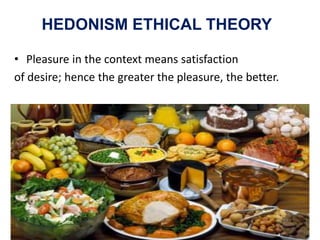
• Pleasure in the context means satisfaction
of desire; hence the greater the pleasure, the better.
30
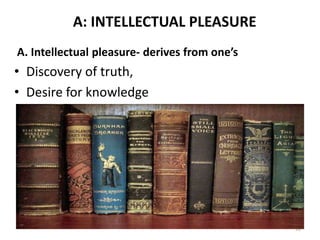
A: INTELLECTUAL PLEASURE
A. Intellectual pleasure- derives from one’s
• Discovery of truth,
• Desire for knowledge
31
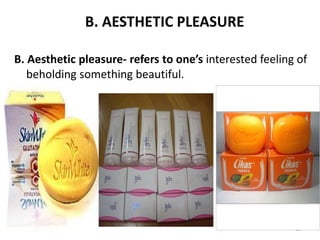
B. AESTHETIC PLEASURE
B. Aesthetic pleasure- refers to one’s interested feeling of
beholding something beautiful.
32
C. PHYSICAL PLEASURE
C. Physical pleasure satisfaction of luxurious or sexual
desire.
What if you attend the office at
11:00am instead of 8am???
33
i.iii. EGOISM ETHICAL THEORY
• Your conduct or action is ethical if it focus on
self-interest
• What makes something good or bad, right or
wrong, is that it satisfies one’s desires, or
meets one’s needs
•Basic Principle:
Self-interest of person doing, considering, or
affected by the action
• One should choose the action which most
realizes or conduces to one’s own self-interest
34
TYPES OF EGOISM
Individual Ethical Egoism
• Judges actions only by their effects on one’s interests
• Usually rejected by moral philosophers as a defensible basis
of ethics
Universal Ethical Egoism
• Can include the interests of others when assessing one’s
actions
• Still self-centered: pursuing pleasure and avoiding pain
• “Enlightened self-interest.” Considers the
interests of others because the person wants others to do
the same toward him or her
35
OBJECTIONS TO EGOISM
Not all human acts are selfish by nature, and some are
truly altruistic.
Egoism is not a moral theory at all: Egoism misses the
whole point of morality, which is to restrain our selfish
desires for the sake of peaceful coexistence with
others.
Does not resolve conflicts in people’s interests
One party would always have the pursuit of his or her
interests blocked
36
ii. DEONTOLOGY ETHICAL THEORY
• Deontologism- Duty Ethics
• Greek: deon-duty
• Deontos: that which is binding, right, proper;
• Emphasis on universal imperatives such is moral laws,
duties, obligations, prohibitions.
• It is sometimes also called imperativism.
• Focus on means
• eg telling truth, Ban on killing, adherence with
religious beliefs
37
DEONTOLOGY ETHICAL THEORY
• It looks on one’s duties and obligations
in determining what is ethical.
• It is also known as Duty Ethics.
• An ethical act is the one that meets
obligations, responsibilities and
duties.
38
KANT’S THEORY
Represent deontological ethics
For him a right action consists solely in an
action that is ruled and justified by a rule
or principle.
It was the rational and autonomous
conformity of one’s will to see right the
universal moral law
39
RIGHTS BASED THEORY
• Does not leads to violate the rights of others
Right: a person’s just claim or entitlement
• Focuses on the person’s actions or the actions of others
toward the person
Types
• Legal rights: defined by a system of laws
• Moral rights: based on ethical standards
• Purpose: let a person freely pursue certain actions without
interference from others
40
RIGHTS BASED THEORY
• Features
 Respect the rights of others
Lets people act as equals
Moral justification of a person’s action
• Examples
• Legal right: right to a fair trial in the Pakistan
• Moral right: right to due process within an organization
41
RIGHTS BASED THEORY
• Rejects view of assessing the results of actions
• Expresses moral rights from individual's view, not
society's. Does not look to the number of people who
benefit from limiting another person's rights
• Example: right to free speech in the Pakistan stands
even if a person expresses a dissenting view
42
TYPES OF RIGHTS
• Negative rights: do not interfere with another
person’s rights
• Positive rights: A person has a duty to help others
pursue their rights
Example
Negative: do not stop a person from whistle-blowing
Positive: coworker helps another person blow the whistle
on unethical actions
43
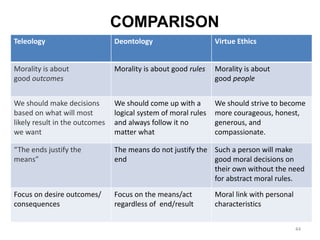
COMPARISON
Teleology Deontology Virtue Ethics
Morality is about
good outcomes
Morality is about good rules Morality is about
good people
We should make decisions
based on what will most
likely result in the outcomes
we want
We should come up with a
logical system of moral rules
and always follow it no
matter what
We should strive to become
more courageous, honest,
generous, and
compassionate.
“The ends justify the
means”
The means do not justify the
end
Such a person will make
good moral decisions on
their own without the need
for abstract moral rules.
Focus on desire outcomes/
consequences
Focus on the means/act
regardless of end/result
Moral link with personal
characteristics
44
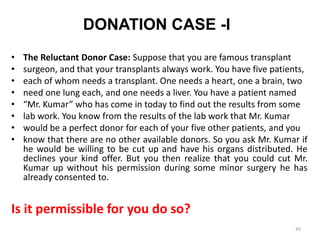
DONATION CASE -I
• The Reluctant Donor Case: Suppose that you are famous transplant
• surgeon, and that your transplants always work. You have five patients,
• each of whom needs a transplant. One needs a heart, one a brain, two
• need one lung each, and one needs a liver. You have a patient named
• “Mr. Kumar” who has come in today to find out the results from some
• lab work. You know from the results of the lab work that Mr. Kumar
• would be a perfect donor for each of your five other patients, and you
• know that there are no other available donors. So you ask Mr. Kumar if
he would be willing to be cut up and have his organs distributed. He
declines your kind offer. But you then realize that you could cut Mr.
Kumar up without his permission during some minor surgery he has
already consented to.
Is it permissible for you do so?
45
• State will create a new stretch
of highway
• New highway segment will circumvent towns
allowing trucks
an alternate route.
• Some wildlife habitat would
be destroyed
• Taxes will be raised
Highway Scenario case-II
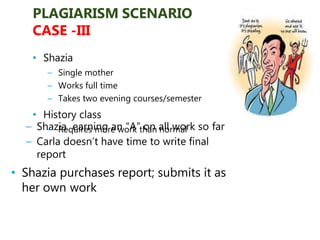
– Shazia earning an “A” on all work so far
– Carla doesn’t have time to write final
report
• Shazia purchases report; submits it as
her own work
PLAGIARISM SCENARIO
CASE -III
• Shazia
– Single mother
– Works full time
– Takes two evening courses/semester
• History class
– Requires more work than normal
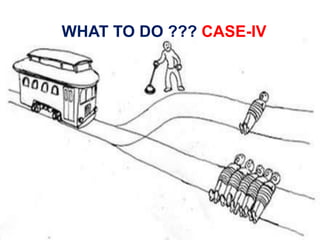
WHAT TO DO ??? CASE-IV
48
ETHICAL DILEMMA, ETHICAL
DECISION MAKING & CODES OF
ETHICS FOR NURSES
ETHICAL DILEMMAS
• Ethical dilemmas, also known as a moral dilemmas, are
situations in which there is a choice to be made
between two options, neither of which resolves the
situation in an ethically acceptable fashion.
• An ethical dilemma or ethical paradox is a decision-
making problem between two possible moral
imperatives, neither of which is unambiguously
acceptable or preferable. The complexity arises out of
the situational conflict in which obeying would result in
transgressing another.
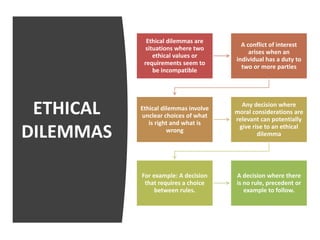
ETHICAL
DILEMMAS
Ethical dilemmas are
situations where two
ethical values or
requirements seem to
be incompatible
A conflict of interest
arises when an
individual has a duty to
two or more parties
Ethical dilemmas involve
unclear choices of what
is right and what is
wrong
Any decision where
moral considerations are
relevant can potentially
give rise to an ethical
dilemma
For example: A decision
that requires a choice
between rules.
A decision where there
is no rule, precedent or
example to follow.
Continue
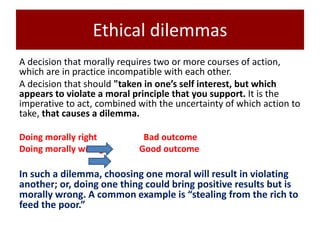
A decision that morally requires two or more courses of action,
which are in practice incompatible with each other.
A decision that should "taken in one’s self interest, but which
appears to violate a moral principle that you support. It is the
imperative to act, combined with the uncertainty of which action to
take, that causes a dilemma.
Doing morally right Bad outcome
Doing morally wrong Good outcome
In such a dilemma, choosing one moral will result in violating
another; or, doing one thing could bring positive results but is
morally wrong. A common example is “stealing from the rich to
feed the poor.”
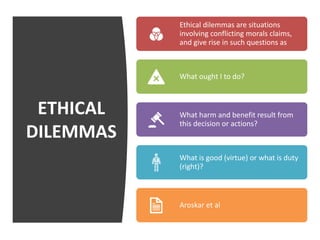
ETHICAL
DILEMMAS
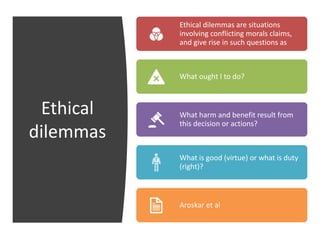
Ethical dilemmas are situations
involving conflicting morals claims,
and give rise in such questions as
What ought I to do?
What harm and benefit result from
this decision or actions?
What is good (virtue) or what is duty
(right)?
Aroskar et al
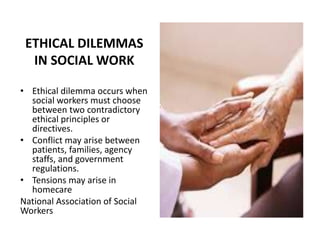
ETHICAL DILEMMAS
IN SOCIAL WORK
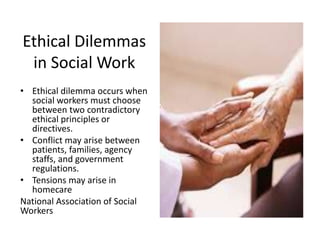
• Ethical dilemma occurs when
social workers must choose
between two contradictory
ethical principles or
directives.
• Conflict may arise between
patients, families, agency
staffs, and government
regulations.
• Tensions may arise in
homecare
National Association of Social
Workers
SOCIAL WORKERS DILEMMA
• Social workers reported that the most common issues
were patient competence and confusion because of
the lack of advance directives
Some examples of ethical dilemmas are:
• A social worker's personal or professional values
conflict with serving their client
• A social worker's values or conduct deviate from the
professional code of ethics that governs social work.
• A social worker must decide whether to break
confidentiality for the good of their client
• An organization or colleague violates a standard of
ethical conduct
SOCIAL WORKERS DILEMMA AND
DECISION MAKING
• The National Association of Social Workers (NASW)
provides the Code of Ethics as a decision-making model
that all social workers use.
Function of the code is to ensure the conditions under which
social workers practice:
– Maintaining appropriate boundaries
– Following privacy rules
– Obtaining proper legal consent from clients
– Protecting confidentiality
• the code reminds social workers of their professional values
and mission. These standards benefit both social worker
and client, and, ideally, create an environment that is
conducive to progress.
ETHICAL DILEMMAS PHYSICIANS FACED
Three possible areas of decision making have
been Identified
1. Using all possible means to keep the patients
alive (ordinary & extraordinary means).
2. Surgeons experience ethical dilemmas in
deciding the right treatment in different
situations.
3. Taking some “positive” steps to hasten
individual’s death.
ETHICAL DILEMMAS IN NURSING
• The challenge of decision making .
• The sanctity of life vs the quality of life.
• Truth-telling
A code of ethics in nursing basically states that
nurses are responsible for respecting human
rights and treating all patients with respect
while promoting health, minimizing suffering,
and preventing sickness.
4 COMMON NURSING ETHICS DILEMMAS
1. Informed consent
Concerns that patients and their families have not been fully informed about their
treatments or clinical prognosis is a common ethical concern of nurses, Ulrich
reported.
2. Disclosing medical conditions
Another example of an ethical dilemma is telling the truth to a patient vs. being
deceptive,
“Sometimes families request that patients not be told about their medical
condition or diagnosis. “The nurse must consider the patient's right to know. How
does the nurse know what the family is saying is true?” (Altman)
The nurse has an obligation to the patient and the ethical principles of
nonmaleficence and fidelity—the obligation to prevent harm and to be faithful to
your colleagues, “The nurse’s own value of truth telling must also be considered.”
4 COMMON NURSING ETHICS DILEMMAS
3. Incompetence among peers
• Another dilemma when a nurse notes incompetence in
a fellow health care team member and struggles with
speaking up or staying silent,
• They may feel the behavior should be reported
because of the threat to patient safety but hesitate to
do so because it would worsen inadequate staffing,
• “Some dilemmas can be framed as competing
obligations, such as protecting the patient on one
hand and protecting the staff on the other. The
principles to consider are nonmaleficence and fidelity.
4 COMMON NURSING ETHICS DILEMMAS
4. Broader ethical issues
• According to Felicia “Liz” Stokes, JD, RN, senior policy advisor at the ANA’s
Center for Ethics and Human Rights, ANA considers the top three
nursing ethics issues as:
• Creating and maintaining an ethical work environment
• Nursing’s role in social justice, such as opposing capital
punishment
• Moral distress and moral resilience.
“The Code of Ethics for Nurses with Interpretive
Statements is clear that nurses are bound in their duty to
protect human health,” (Ruth McBain on behalf of ANA).
ETHICAL DILEMMA VIDEO
• https://www.youtube.com/watch?v=-
GxuvKRL7ks
• https://www.youtube.com/watch?v=oQl6b-
fN1BI
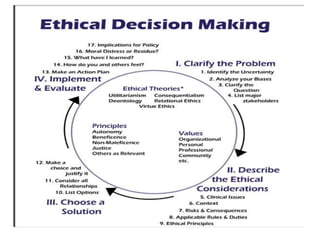
ETHICAL DECISION MAKING
• In the context of decision making, your ethics
are your personal standards of right and
wrong. They are your basis for making
ethically sensitive decisions.
• Ethical decision making is a cognitive process
that considers various ethical principles, rules,
and virtues or the maintenance of
relationships to guide or judge individual or
group decisions orinted actions
ETHICAL DECISION-MAKING MODEL
• Ethical decision-making models provide a
suggested mechanism for critical thinking and
planning for the resolution of ethical dilemmas.
An ethical decision-making model is a tool that
can be used by health care providers to help
develop the ability to think through an ethical
dilemma and arrive at an ethical decision.
• The goal of each model is to provide a framework
for making the best decision in a particular
situation with which the health care provider is
confronted.
References
• Aroskar; M.A., Davis, A., Drought, T.,
Liaschenko, J.(1997). Ethical dilemmas and
nursing practice
• https://www.noodle.com/articles/ethical-
dilemmas-in-social-work-what-to-know-
about-nasw-code-of-ethics Retrieved on 6
April 2020
References
1 Wake E. Commentary on Twycross A, Finley GA (2013) Children’s and parents’
perceptions of postoperative pain management: A mixed methods study. Journal
of Clinical Nursing 22, 3095-3108. Vol. 23, Journal of Clinical Nursing. 2014. p.
3290–1.
2 American Academy of Pediatrics. Committee on Psychosocial Aspects of Child
and Family Health, Task Force on Pain in Infants C and A. The assessment and
management of acute pain in infants, children, and adolescents. Pediatrics.
2001;108(3):793–7.
3 Tein AJ, Roosa MW, Michaels M. Agreement Between Parent and Child Reports
on Parental Behaviors. J Marriage Fam. 2012;56(2):341–55.
4 Cordell WH, Keene KK, Giles BK, Jones JB, Jones JH, Brizendine EJ. The high
prevalence of pain in emergency medical care. Am J Emerg Med. 2002
May;20(3):165–9.
5 Stevens BJ, Abbott LK, Yamada J, Harrison D, Stinson J, Taddio A, et al.
Epidemiology and management of painful procedures in children in Canadian
hospitals. CMAJ. 2011 Apr 19;183(7):E403-10.
6 Online guide to Ethics and Moral Philosophy . (1996). Kant's Ethics.
Recuperado el 22 de Febrero de 2013, de Onlie guide to Ethics and Moral
Philosophy :
http://caae.phil.cmu.edu/Cavalier/80130/part1/sect4/Kant.html
68
References
5 Immanuel Kant Biography –
6 life, family, childhood, children, death, history, school, information,
born, tall, t ime. (n.d.).Encyclopedia of World Biography. Retrieved
February
7 25, 2013, from http://www.notablebiographies.com/Jo-Ki/Kant-
Immanuel.html#b
8 Immanuel Kant Biography - Facts, Birthday, Life Story -
Biography.com . (n.d.). Famous Biographies & TV Shows -
Biography.com . Retrieved February 25, 2013, from
http://www.biography.com/people/immanuel-kant- 9360144 (2011).
Kant's ethical theory. Retrieved February 24th. 2013, de
RSRevision from:
http://www.rsrevision.com/Alevel/ethics/kant/index.htm Fledderman, Ch.
(2014). Engineering Ethics. International Edition, Pearson Prentice Hall.
9 Encyclopedia Britannica, Inc. 2003. www.search.eb.com Online Ethics Center for Engineering and Science. 2004.
http://onlineethics.org
10 Fledderman, Ch. (2014). Engineering Ethics. International Edition, Pearson Prentice Hall. Encyclopedia Britannica, Inc. 2003. www.search.eb.com
11 Online Ethics Center for Engineering and Science. 2004. http://onlineethics.org
Ethical dilemmas
A decision that morally requires two or more courses of action,
which are in practice incompatible with each other.
A decision that should "taken in one’s self interest, but which
appears to violate a moral principle that you support. It is the
imperative to act, combined with the uncertainty of which action to
take, that causes a dilemma.
Doing morally right Bad outcome
Doing morally wrong Good outcome
In such a dilemma, choosing one moral will result in violating
another; or, doing one thing could bring positive results but is
morally wrong. A common example is “stealing from the rich to
feed the poor.”
Ethical
dilemmas
Ethical dilemmas are situations
involving conflicting morals claims,
and give rise in such questions as
What ought I to do?
What harm and benefit result from
this decision or actions?
What is good (virtue) or what is duty
(right)?
Aroskar et al
Ethical Dilemmas
in Social Work
• Ethical dilemma occurs when
social workers must choose
between two contradictory
ethical principles or
directives.
• Conflict may arise between
patients, families, agency
staffs, and government
regulations.
• Tensions may arise in
homecare
National Association of Social
Workers
Social Workers dilemma
• Social workers reported that the most common issues
were patient competence and confusion because of
the lack of advance directives
Some examples of ethical dilemmas are:
• A social worker's personal or professional values
conflict with serving their client
• A social worker's values or conduct deviate from the
professional code of ethics that governs social work.
• A social worker must decide whether to break
confidentiality for the good of their client
• An organization or colleague violates a standard of
ethical conduct
Social Workers dilemma and Decision
making
• The National Association of Social Workers (NASW)
provides the Code of Ethics as a decision-making model
that all social workers use.
Function of the code is to ensure the conditions under which
social workers practice:
– Maintaining appropriate boundaries
– Following privacy rules
– Obtaining proper legal consent from clients
– Protecting confidentiality
• the code reminds social workers of their professional values
and mission. These standards benefit both social worker
and client, and, ideally, create an environment that is
conducive to progress.
Ethical Dilemmas Physicians Faced
Three possible areas of decision making have
been Identified
1. Using all possible means to keep the patients
alive (ordinary & extraordinary means).
2. Surgeons experience ethical dilemmas in
deciding the right treatment in different
situations.
3. Taking some “positive” steps to hasten
individual’s death.
Ethical Dilemmas in Nursing
• The challenge of decision making .
• The sanctity of life vs the quality of life.
• Truth-telling
A code of ethics in nursing basically states that
nurses are responsible for respecting human
rights and treating all patients with respect
while promoting health, minimizing suffering,
and preventing sickness.
4 Common Nursing Ethics
Dilemmas
1. Informed consent
Concerns that patients and their families have not been fully informed about their
treatments or clinical prognosis is a common ethical concern of nurses, Ulrich
reported.
2. Disclosing medical conditions
Another example of an ethical dilemma is telling the truth to a patient vs. being
deceptive,
“Sometimes families request that patients not be told about their medical
condition or diagnosis. “The nurse must consider the patient's right to know. How
does the nurse know what the family is saying is true?” (Altman)
The nurse has an obligation to the patient and the ethical principles of
nonmaleficence and fidelity—the obligation to prevent harm and to be faithful to
your colleagues, “The nurse’s own value of truth telling must also be considered.”
4 Common Nursing Ethics
Dilemmas
3. Incompetence among peers
• Another dilemma when a nurse notes
incompetence in a fellow health care team
member and struggles with speaking up or
staying silent,
• They may feel the behavior should be
reported because of the threat to patient
safety but hesitate to do so because it would
worsen inadequate staffing,
• “Some dilemmas can be framed as competing
4 Common Nursing Ethics
Dilemmas
4. Broader ethical issues
• According to Felicia “Liz” Stokes, JD, RN, senior policy advisor
at the ANA’s Center for Ethics and Human Rights, ANA
considers the top three nursing ethics issues
as:
• Creating and maintaining an ethical work
environment
• Nursing’s role in social justice, such as
opposing capital punishment
• Moral distress and moral resilience.
“The Code of Ethics for Nurses with Interpretive
Ethical Dilemma Video
• https://www.youtube.com/watch?v=-
GxuvKRL7ks
• https://www.youtube.com/watch?v=oQl6b-
fN1BI
Ethical decision making
• In the context of decision making, your ethics
are your personal standards of right and
wrong. They are your basis for making
ethically sensitive decisions.
• Ethical decision making is a cognitive process
that considers various ethical principles, rules,
and virtues or the maintenance of
relationships to guide or judge individual or
group decisions orinted actions
Ethical Decision-making Model
• Ethical decision-making models provide a
suggested mechanism for critical thinking and
planning for the resolution of ethical
dilemmas. An ethical decision-making model
is a tool that can be used by health care
providers to help develop the ability to think
through an ethical dilemma and arrive at an
ethical decision.
• The goal of each model is to provide a
framework for making the best decision in a
ETHICAL DECISION-MAKING
PROCESS
Article Activity
Please read the article carefully, and fill the
questions table with your own nursing practice
issues, how you identified the problem and
what was your decision for resolving that
problems
Note: please answer all the question. This is a
graded activity
References
• Aroskar; M.A., Davis, A., Drought, T.,
Liaschenko, J.(1997). Ethical dilemmas and
nursing practice
• https://www.noodle.com/articles/ethical-
dilemmas-in-social-work-what-to-know-
about-nasw-code-of-ethics Retrieved on 6
April 2020
Case
A 32-year-old pregnant woman, who came for
vaginal delivery. She had two previous babies with
emergency cesarean section. The second baby was
born just a year back. Due to this doctors wanted Mrs.
X to avoid any risk and to get her baby delivered
through c- section. The staff members tried to
convince Mrs. X and her husband, but to no avail.
Finally, the patient was sent home for trail of normal
labor. Two weeks later she came up with strong pains,
but during delivery her uterus got rupture. The baby
was delivered normally, whereas, mother was
transferred to the intensive care unit for close
observation. Unfortunately a few weeks later she
died.
Sayani, A.H (2015)
6 May 2021 87
Question
“Could medical paternalism have saved
patient life?” and if so, how could the
principle of autonomy be justified?”
6 May 2021 88
• In this emblematic ethical dilemma, if
couple autonomy was respected, women
were exposed to complications. While if a
health care professional’s decision was taken
into account, then patients autonomy, was
violated.
• According to Beuchamp and Childress there
is a disparity between the principle of
paternalism and autonomy.
Sayani, A.H (2015)
6 May 2021 89
Medical Paternalism
69 years male diagnosed with metastatic likely terminal
cancer. Based on a long relationship, the man's physician
knows that the patient has a history of psychiatric illness
and is emotionally fragile. When the patient blurts out,
"Am I OK? I don't have cancer, do I?" the physician
answers, "You're as good as you were ten years ago,"
knowing that the response is a paternalistic lie, but also
believing it justified in protecting the health and well-
being of the patient.
6 May 2021 90
Futility
• Medical futility is described as proposed
therapy that should not be performed
because available data have shown that it will
not improve the patient's medical condition.
James L. Bernat, 2005
6 May 2021 91
Cont:
• Futility in medicine is an ancient concept;
Hippocrates clearly stated that physicians
should “refuse to treat those who are
overmastered by their disease, realizing that
in such cases medicine is powerless
Deborah L. Kasman, October 2004
6 May 2021 92
What can physicians do when their professional judgm
differs from preferred patient or family choices?
• First, it is important to determine who has the
moral and legal right to make medical
decisions.
• The patient has the right to make decisions
regarding his own care as long as he is
mentally competent. If a patient is deemed
mentally incompetent to make decisions, a
surrogate must be identified.
(Deborah L. Kasman, 2004)
6 May 2021 93
Cont:
• This surrogate can be legally assigned by the
patient prior to incapacity (a durable power of
attorney), or his next of kin.
• If there is not an identifiable surrogate by
either means, the courts must assign a morally
valid proxy who can act in the patient’s best
interest.
(Deborah L. Kasman, 2004)
6 May 2021 94
Process to consider a treatment futile
•Patient’s Right ( e.g. spirituality)
•Surrogate Involvement (incapable patient)
•Physicians Decision
•Nurse play an important role (as a bridge)
•Court
•Effective communication is mandatory
(Nathaniel A.K Burkhadt M.A 2008)
6 May 2021 95
Futility Differs for Different Age and
Case
A futile care / Procedure for one is not futile for all; it
may be a useful for another…
Child
Young
Old
Acute
Chronic
(Nathaniel A.K Burkhadt M.A 2008)
6 May 2021 96
Session 3 ethical principals and theories

Session 3 ethical principals and theories

  • 1.
    ETHICAL PRINCIPALS ANDTHEORIES UNIT III By Sehrish Naz Lecturer INS-KMU
  • 2.
    OBJECTIVES At the endof this session learners will be able to: • Define ethical principles and theories in health care. • Discuss the ethical dilemmas face by nurses and clients. • Discuss the strategies to resolve ethical dilemma in daily nursing practice. • List steps of ethical decision making.
  • 3.
    Ethical principles 1. Autonomy:Refers to the right to make one’s own decisions and choices free of harm to others. Synonyms • Self-government • Independence • Self-rule • Home rule • Sovereignty • Self-determination • Freedom
  • 4.
    INFORMED CONSENT Definition • Itis an agreement by a client to accept a course of a treatment, procedure or research after being provided complete information including benefits and risks. • Obtaining informed consent is the responsibility of the person performing the procedure or research.
  • 5.
    TYPES OF CONSENT Typesof consent 1- Expressed Consent 2- Implied Consent • Expressed Consent may either be oral or written. Written consent is preferred if there are greater risks of a procedure. • Implied consent Exists when the client’s nonverbal behavior indicates agreement.
  • 6.
    ELEMENTS OF CONSENT FourBasic Elements 1. The consent must be given voluntarily. 2. The consent must be given by a client/participant with the Capacity and competence to understand. 3. The consent must be specific to the procedure & Person. 4. The client/participant must be given enough information including benefits and possible risks.

  • 7.
    IMPORTANCE OF CONSENT •The requirement of consent reflects the ethical principle of patient’s/participant’s autonomy • It also reflects the principles of beneficence and non-maleficence. • It saves both health care member/researcher and patient/participant legally in exceptional circumstances, medical treatment must not be administered without obtaining patient’s valid consent. • Treatment/investigations/research performed without consent constitutes “battery”
  • 8.
    PATERNALISM • Implies wellintended actions of kind decision making, leadership ,protection ,& discipline. • Decision making on behalf of the patients without their full consent or knowledge. • Professionals restricts others autonomy, to protect that person from perceived & anticipated harm, but also promoting good in a positive way. (Burkhardt & Nathaniel,2008)
  • 9.
    2. BENEFICENCE • Thisprinciple means do or promote good, prevent harm, remove evil or harm. • Nurses need to assist clients in meeting all their needs – Biological – Psychological – Social ICN says, the nurse takes appropriate action to safe guard individual ,family ,communities when their care is endangered by a coworker or any other person (Burkhardt & Nathaniel,2008)
  • 10.
    3. NON-MALEFICENCE • Non-maleficenceliterally means to “do no harm.” • Make sure that the procedure does not harm the patient. • Non-maleficence “obligation not to inflict harm on others. (Beauchamp and Childress, 2009)
  • 11.
    NON – MALEFICENCE Non-maleficence Literally- “Doingno harm”. • Make sure that the procedure does not harm the patient. BENEFICENCE Beneficence Literally – “Being charitable or doing good”. Where a Health care provider should act in the “best interests” of the patient, the procedure be provided with the intent of doing good to the patient.
  • 12.
    4. JUSTICE • Accordingto Salmond, “Justice means provide everyone his share” • According to Plato, ‘Justice is a quality. In simple words the meaning of justice is to discharge one’s duties honestly and not to interfere in other actions. • So justice is concerned with human welfare.
  • 13.
    RELATIONSHIP BETWEEN LIBERTYAND JUSTICE Liberty is the first need of justice. Every ruler who attacks the civil liberties is considered unjust ruler. We can not even think of one without the other. • Purpose of both is common. • Liberty is the first condition of justice But absolute freedom is against justice.
  • 14.
  • 15.
    Ethical Theories • Ethicaltheory is means by which we justify a particular ethical decision. 15
  • 16.
    ETHICAL SCHOOL OF THOUGHTS 1-Absolutism 2- Relativism 16
  • 17.
    ABSOLUTISM Absolutism refers tothe idea that reality, truth, or morality is “absolute”. the same for everybody, everywhere, and every-when, regardless of individual culture or cognition, or different situations or contexts. 17
  • 18.
    RELATIVISM  No universalnorms of right and wrong  One person can say “X is right,” another can say “X is wrong,” and both can be right  Relativism, roughly put, is the view that truth and falsity, right and wrong, standards of reasoning, and procedures of justification are products of differing conventions and frameworks of assessment and that their authority is confined to the context giving rise to them.  relativism is a theory, which claims that there are no universally valid moral principles.  relativism theory says that the moral rightness and wrongness of actions varies from society to society and that there are no absolute universal moral standards binding on all men at all times. 18
  • 19.
    CLASSIFICATION OF ETHICALTHEORIES 1- Virtue based theory 2- Conduct based theory i-Teleological • Utilitarianism • Hedonism • Egoism ii-Deontological 3- Right based theory 19
  • 20.
    1- VIRTUE BASEDETHICAL THEORY 20 Your conduct or action is ethical if you focus on values (character) Plato’s Aristotle’s Socrates  wisdom Justice Courage Temperance •Golden mean approach •Middle path approach Knowledge
  • 21.
    VIRTUE BASED ETHICALTHEORY • Types of virtue Intellectual virtue: Associated with reasoning, ability to understand and truth Moral virtue:  virtue of character (honesty ) A good person does the right thing at the right time for the right reason 21
  • 22.
    CONDUCT ETHICAL THEORIES i:Teleological: Focus on the end Focus on consequences Don’t focus on means • Maintains that morality of an action is determined solely by its consequences. • Basically, it looks on the outcomes, situation and from that one decides what is ethical. • Thus, from a consequentialist standpoint, a morally right action is one that produces a good outcome, or consequence. 22
  • 23.
    i.i. UTILITARIANISM ETHICALTHEORY GHGN (Great happiness for great Number) Democracy Democratic concept What makes something good or bad, right or wrong, is that it produces the greatest amount of pleasure (or lack of pain) for the greatest number of people 23
  • 24.
    PRINCIPLE OF GREATESTHAPPINESS • An action is good in so far as it produces the greatest happiness for greatest number of people, and bad in so far it produces more harm than benefit for the greatest number of individuals. • Happiness: is intended pleasure and absence of pain. • Pain: unhappiness 24
  • 25.
    TWO FORM OFUTILITARIAN THEORY A: Act utilitarian B: Rule utilitarian A: Act utilitarianism o It asks a person to assess the effects of all actions o Rejects the view that actions can be classified as right or wrong in themselves o Example: lying is ethical if it produces more good than bad o Act Utilitarianism is the belief that an action is good if its overall effect is to produce more happiness than unhappiness 25
  • 26.
    TWO FORM OFUTILITARIAN THEORY B: Rule utilitarianism: It asks a person to assess actions according to a set of rules designed to yield the greatest net benefit to all affected • Compares act to rules .• Rule Utilitarianism is the belief that we should adopt a moral rule and if followed by everybody, would lead to a greater level of overall happiness • Does not accept an action as right if it maximizes net benefits only once • Example: lying is always wrong (driving rules, drink ) 26
  • 27.
    EXAMPLE OF ACT& RULES UTILITARIANISM • A judge sending a murderer to prison. The judge knows the convict will not commit any more violent crimes, and wants to be lenient (maybe the convict is very old or terminally ill). The judge knows that this will make the convict family and friends very happy. Imagine that the victim’s family has forgiven the convict and will not feel pain as a result of this decision. • Should the judge let the convict go? • Act utilitarianism says yes • But rule utilitarianism says no 27
  • 28.
    EXAMPLE • A fewdoctors decide that a number of experiments on a few people, even if most of them died, would be worth it if they could find a cure for a disease that would relieve the suffering of millions of people. Utilitarianism would give the approval for such because it produces the greatest good for the greatest number of people. 28
  • 29.
    i.ii. HEDONISM ETHICALTHEORY • Hedonism- is an ethical doctrine which claims pleasure as norm of morality. • Pleasurable is good • Pain is evil is a view that good involves happiness and pleasure, and evil as unhappiness and pain. • Pleasure • When your conduct/action increases your happiness or pleasure 29
  • 30.
    HEDONISM ETHICAL THEORY •Pleasure in the context means satisfaction of desire; hence the greater the pleasure, the better. 30
  • 31.
    A: INTELLECTUAL PLEASURE A.Intellectual pleasure- derives from one’s • Discovery of truth, • Desire for knowledge 31
  • 32.
    B. AESTHETIC PLEASURE B.Aesthetic pleasure- refers to one’s interested feeling of beholding something beautiful. 32
  • 33.
    C. PHYSICAL PLEASURE C.Physical pleasure satisfaction of luxurious or sexual desire. What if you attend the office at 11:00am instead of 8am??? 33
  • 34.
    i.iii. EGOISM ETHICALTHEORY • Your conduct or action is ethical if it focus on self-interest • What makes something good or bad, right or wrong, is that it satisfies one’s desires, or meets one’s needs •Basic Principle: Self-interest of person doing, considering, or affected by the action • One should choose the action which most realizes or conduces to one’s own self-interest 34
  • 35.
    TYPES OF EGOISM IndividualEthical Egoism • Judges actions only by their effects on one’s interests • Usually rejected by moral philosophers as a defensible basis of ethics Universal Ethical Egoism • Can include the interests of others when assessing one’s actions • Still self-centered: pursuing pleasure and avoiding pain • “Enlightened self-interest.” Considers the interests of others because the person wants others to do the same toward him or her 35
  • 36.
    OBJECTIONS TO EGOISM Notall human acts are selfish by nature, and some are truly altruistic. Egoism is not a moral theory at all: Egoism misses the whole point of morality, which is to restrain our selfish desires for the sake of peaceful coexistence with others. Does not resolve conflicts in people’s interests One party would always have the pursuit of his or her interests blocked 36
  • 37.
    ii. DEONTOLOGY ETHICALTHEORY • Deontologism- Duty Ethics • Greek: deon-duty • Deontos: that which is binding, right, proper; • Emphasis on universal imperatives such is moral laws, duties, obligations, prohibitions. • It is sometimes also called imperativism. • Focus on means • eg telling truth, Ban on killing, adherence with religious beliefs 37
  • 38.
    DEONTOLOGY ETHICAL THEORY •It looks on one’s duties and obligations in determining what is ethical. • It is also known as Duty Ethics. • An ethical act is the one that meets obligations, responsibilities and duties. 38
  • 39.
    KANT’S THEORY Represent deontologicalethics For him a right action consists solely in an action that is ruled and justified by a rule or principle. It was the rational and autonomous conformity of one’s will to see right the universal moral law 39
  • 40.
    RIGHTS BASED THEORY •Does not leads to violate the rights of others Right: a person’s just claim or entitlement • Focuses on the person’s actions or the actions of others toward the person Types • Legal rights: defined by a system of laws • Moral rights: based on ethical standards • Purpose: let a person freely pursue certain actions without interference from others 40
  • 41.
    RIGHTS BASED THEORY •Features  Respect the rights of others Lets people act as equals Moral justification of a person’s action • Examples • Legal right: right to a fair trial in the Pakistan • Moral right: right to due process within an organization 41
  • 42.
    RIGHTS BASED THEORY •Rejects view of assessing the results of actions • Expresses moral rights from individual's view, not society's. Does not look to the number of people who benefit from limiting another person's rights • Example: right to free speech in the Pakistan stands even if a person expresses a dissenting view 42
  • 43.
    TYPES OF RIGHTS •Negative rights: do not interfere with another person’s rights • Positive rights: A person has a duty to help others pursue their rights Example Negative: do not stop a person from whistle-blowing Positive: coworker helps another person blow the whistle on unethical actions 43
  • 44.
    COMPARISON Teleology Deontology VirtueEthics Morality is about good outcomes Morality is about good rules Morality is about good people We should make decisions based on what will most likely result in the outcomes we want We should come up with a logical system of moral rules and always follow it no matter what We should strive to become more courageous, honest, generous, and compassionate. “The ends justify the means” The means do not justify the end Such a person will make good moral decisions on their own without the need for abstract moral rules. Focus on desire outcomes/ consequences Focus on the means/act regardless of end/result Moral link with personal characteristics 44
  • 45.
    DONATION CASE -I •The Reluctant Donor Case: Suppose that you are famous transplant • surgeon, and that your transplants always work. You have five patients, • each of whom needs a transplant. One needs a heart, one a brain, two • need one lung each, and one needs a liver. You have a patient named • “Mr. Kumar” who has come in today to find out the results from some • lab work. You know from the results of the lab work that Mr. Kumar • would be a perfect donor for each of your five other patients, and you • know that there are no other available donors. So you ask Mr. Kumar if he would be willing to be cut up and have his organs distributed. He declines your kind offer. But you then realize that you could cut Mr. Kumar up without his permission during some minor surgery he has already consented to. Is it permissible for you do so? 45
  • 46.
    • State willcreate a new stretch of highway • New highway segment will circumvent towns allowing trucks an alternate route. • Some wildlife habitat would be destroyed • Taxes will be raised Highway Scenario case-II
  • 47.
    – Shazia earningan “A” on all work so far – Carla doesn’t have time to write final report • Shazia purchases report; submits it as her own work PLAGIARISM SCENARIO CASE -III • Shazia – Single mother – Works full time – Takes two evening courses/semester • History class – Requires more work than normal
  • 48.
    WHAT TO DO??? CASE-IV 48
  • 49.
    ETHICAL DILEMMA, ETHICAL DECISIONMAKING & CODES OF ETHICS FOR NURSES
  • 50.
    ETHICAL DILEMMAS • Ethicaldilemmas, also known as a moral dilemmas, are situations in which there is a choice to be made between two options, neither of which resolves the situation in an ethically acceptable fashion. • An ethical dilemma or ethical paradox is a decision- making problem between two possible moral imperatives, neither of which is unambiguously acceptable or preferable. The complexity arises out of the situational conflict in which obeying would result in transgressing another.
  • 51.
    ETHICAL DILEMMAS Ethical dilemmas are situationswhere two ethical values or requirements seem to be incompatible A conflict of interest arises when an individual has a duty to two or more parties Ethical dilemmas involve unclear choices of what is right and what is wrong Any decision where moral considerations are relevant can potentially give rise to an ethical dilemma For example: A decision that requires a choice between rules. A decision where there is no rule, precedent or example to follow.
  • 52.
    Continue A decision thatmorally requires two or more courses of action, which are in practice incompatible with each other. A decision that should "taken in one’s self interest, but which appears to violate a moral principle that you support. It is the imperative to act, combined with the uncertainty of which action to take, that causes a dilemma. Doing morally right Bad outcome Doing morally wrong Good outcome In such a dilemma, choosing one moral will result in violating another; or, doing one thing could bring positive results but is morally wrong. A common example is “stealing from the rich to feed the poor.”
  • 53.
    ETHICAL DILEMMAS Ethical dilemmas aresituations involving conflicting morals claims, and give rise in such questions as What ought I to do? What harm and benefit result from this decision or actions? What is good (virtue) or what is duty (right)? Aroskar et al
  • 54.
    ETHICAL DILEMMAS IN SOCIALWORK • Ethical dilemma occurs when social workers must choose between two contradictory ethical principles or directives. • Conflict may arise between patients, families, agency staffs, and government regulations. • Tensions may arise in homecare National Association of Social Workers
  • 55.
    SOCIAL WORKERS DILEMMA •Social workers reported that the most common issues were patient competence and confusion because of the lack of advance directives Some examples of ethical dilemmas are: • A social worker's personal or professional values conflict with serving their client • A social worker's values or conduct deviate from the professional code of ethics that governs social work. • A social worker must decide whether to break confidentiality for the good of their client • An organization or colleague violates a standard of ethical conduct
  • 56.
    SOCIAL WORKERS DILEMMAAND DECISION MAKING • The National Association of Social Workers (NASW) provides the Code of Ethics as a decision-making model that all social workers use. Function of the code is to ensure the conditions under which social workers practice: – Maintaining appropriate boundaries – Following privacy rules – Obtaining proper legal consent from clients – Protecting confidentiality • the code reminds social workers of their professional values and mission. These standards benefit both social worker and client, and, ideally, create an environment that is conducive to progress.
  • 57.
    ETHICAL DILEMMAS PHYSICIANSFACED Three possible areas of decision making have been Identified 1. Using all possible means to keep the patients alive (ordinary & extraordinary means). 2. Surgeons experience ethical dilemmas in deciding the right treatment in different situations. 3. Taking some “positive” steps to hasten individual’s death.
  • 58.
    ETHICAL DILEMMAS INNURSING • The challenge of decision making . • The sanctity of life vs the quality of life. • Truth-telling A code of ethics in nursing basically states that nurses are responsible for respecting human rights and treating all patients with respect while promoting health, minimizing suffering, and preventing sickness.
  • 59.
    4 COMMON NURSINGETHICS DILEMMAS 1. Informed consent Concerns that patients and their families have not been fully informed about their treatments or clinical prognosis is a common ethical concern of nurses, Ulrich reported. 2. Disclosing medical conditions Another example of an ethical dilemma is telling the truth to a patient vs. being deceptive, “Sometimes families request that patients not be told about their medical condition or diagnosis. “The nurse must consider the patient's right to know. How does the nurse know what the family is saying is true?” (Altman) The nurse has an obligation to the patient and the ethical principles of nonmaleficence and fidelity—the obligation to prevent harm and to be faithful to your colleagues, “The nurse’s own value of truth telling must also be considered.”
  • 60.
    4 COMMON NURSINGETHICS DILEMMAS 3. Incompetence among peers • Another dilemma when a nurse notes incompetence in a fellow health care team member and struggles with speaking up or staying silent, • They may feel the behavior should be reported because of the threat to patient safety but hesitate to do so because it would worsen inadequate staffing, • “Some dilemmas can be framed as competing obligations, such as protecting the patient on one hand and protecting the staff on the other. The principles to consider are nonmaleficence and fidelity.
  • 61.
    4 COMMON NURSINGETHICS DILEMMAS 4. Broader ethical issues • According to Felicia “Liz” Stokes, JD, RN, senior policy advisor at the ANA’s Center for Ethics and Human Rights, ANA considers the top three nursing ethics issues as: • Creating and maintaining an ethical work environment • Nursing’s role in social justice, such as opposing capital punishment • Moral distress and moral resilience. “The Code of Ethics for Nurses with Interpretive Statements is clear that nurses are bound in their duty to protect human health,” (Ruth McBain on behalf of ANA).
  • 62.
    ETHICAL DILEMMA VIDEO •https://www.youtube.com/watch?v=- GxuvKRL7ks • https://www.youtube.com/watch?v=oQl6b- fN1BI
  • 63.
    ETHICAL DECISION MAKING •In the context of decision making, your ethics are your personal standards of right and wrong. They are your basis for making ethically sensitive decisions. • Ethical decision making is a cognitive process that considers various ethical principles, rules, and virtues or the maintenance of relationships to guide or judge individual or group decisions orinted actions
  • 64.
    ETHICAL DECISION-MAKING MODEL •Ethical decision-making models provide a suggested mechanism for critical thinking and planning for the resolution of ethical dilemmas. An ethical decision-making model is a tool that can be used by health care providers to help develop the ability to think through an ethical dilemma and arrive at an ethical decision. • The goal of each model is to provide a framework for making the best decision in a particular situation with which the health care provider is confronted.
  • 67.
    References • Aroskar; M.A.,Davis, A., Drought, T., Liaschenko, J.(1997). Ethical dilemmas and nursing practice • https://www.noodle.com/articles/ethical- dilemmas-in-social-work-what-to-know- about-nasw-code-of-ethics Retrieved on 6 April 2020
  • 68.
    References 1 Wake E.Commentary on Twycross A, Finley GA (2013) Children’s and parents’ perceptions of postoperative pain management: A mixed methods study. Journal of Clinical Nursing 22, 3095-3108. Vol. 23, Journal of Clinical Nursing. 2014. p. 3290–1. 2 American Academy of Pediatrics. Committee on Psychosocial Aspects of Child and Family Health, Task Force on Pain in Infants C and A. The assessment and management of acute pain in infants, children, and adolescents. Pediatrics. 2001;108(3):793–7. 3 Tein AJ, Roosa MW, Michaels M. Agreement Between Parent and Child Reports on Parental Behaviors. J Marriage Fam. 2012;56(2):341–55. 4 Cordell WH, Keene KK, Giles BK, Jones JB, Jones JH, Brizendine EJ. The high prevalence of pain in emergency medical care. Am J Emerg Med. 2002 May;20(3):165–9. 5 Stevens BJ, Abbott LK, Yamada J, Harrison D, Stinson J, Taddio A, et al. Epidemiology and management of painful procedures in children in Canadian hospitals. CMAJ. 2011 Apr 19;183(7):E403-10. 6 Online guide to Ethics and Moral Philosophy . (1996). Kant's Ethics. Recuperado el 22 de Febrero de 2013, de Onlie guide to Ethics and Moral Philosophy : http://caae.phil.cmu.edu/Cavalier/80130/part1/sect4/Kant.html 68
  • 69.
    References 5 Immanuel KantBiography – 6 life, family, childhood, children, death, history, school, information, born, tall, t ime. (n.d.).Encyclopedia of World Biography. Retrieved February 7 25, 2013, from http://www.notablebiographies.com/Jo-Ki/Kant- Immanuel.html#b 8 Immanuel Kant Biography - Facts, Birthday, Life Story - Biography.com . (n.d.). Famous Biographies & TV Shows - Biography.com . Retrieved February 25, 2013, from http://www.biography.com/people/immanuel-kant- 9360144 (2011). Kant's ethical theory. Retrieved February 24th. 2013, de RSRevision from: http://www.rsrevision.com/Alevel/ethics/kant/index.htm Fledderman, Ch. (2014). Engineering Ethics. International Edition, Pearson Prentice Hall. 9 Encyclopedia Britannica, Inc. 2003. www.search.eb.com Online Ethics Center for Engineering and Science. 2004. http://onlineethics.org 10 Fledderman, Ch. (2014). Engineering Ethics. International Edition, Pearson Prentice Hall. Encyclopedia Britannica, Inc. 2003. www.search.eb.com 11 Online Ethics Center for Engineering and Science. 2004. http://onlineethics.org
  • 70.
    Ethical dilemmas A decisionthat morally requires two or more courses of action, which are in practice incompatible with each other. A decision that should "taken in one’s self interest, but which appears to violate a moral principle that you support. It is the imperative to act, combined with the uncertainty of which action to take, that causes a dilemma. Doing morally right Bad outcome Doing morally wrong Good outcome In such a dilemma, choosing one moral will result in violating another; or, doing one thing could bring positive results but is morally wrong. A common example is “stealing from the rich to feed the poor.”
  • 71.
    Ethical dilemmas Ethical dilemmas aresituations involving conflicting morals claims, and give rise in such questions as What ought I to do? What harm and benefit result from this decision or actions? What is good (virtue) or what is duty (right)? Aroskar et al
  • 72.
    Ethical Dilemmas in SocialWork • Ethical dilemma occurs when social workers must choose between two contradictory ethical principles or directives. • Conflict may arise between patients, families, agency staffs, and government regulations. • Tensions may arise in homecare National Association of Social Workers
  • 73.
    Social Workers dilemma •Social workers reported that the most common issues were patient competence and confusion because of the lack of advance directives Some examples of ethical dilemmas are: • A social worker's personal or professional values conflict with serving their client • A social worker's values or conduct deviate from the professional code of ethics that governs social work. • A social worker must decide whether to break confidentiality for the good of their client • An organization or colleague violates a standard of ethical conduct
  • 74.
    Social Workers dilemmaand Decision making • The National Association of Social Workers (NASW) provides the Code of Ethics as a decision-making model that all social workers use. Function of the code is to ensure the conditions under which social workers practice: – Maintaining appropriate boundaries – Following privacy rules – Obtaining proper legal consent from clients – Protecting confidentiality • the code reminds social workers of their professional values and mission. These standards benefit both social worker and client, and, ideally, create an environment that is conducive to progress.
  • 75.
    Ethical Dilemmas PhysiciansFaced Three possible areas of decision making have been Identified 1. Using all possible means to keep the patients alive (ordinary & extraordinary means). 2. Surgeons experience ethical dilemmas in deciding the right treatment in different situations. 3. Taking some “positive” steps to hasten individual’s death.
  • 76.
    Ethical Dilemmas inNursing • The challenge of decision making . • The sanctity of life vs the quality of life. • Truth-telling A code of ethics in nursing basically states that nurses are responsible for respecting human rights and treating all patients with respect while promoting health, minimizing suffering, and preventing sickness.
  • 77.
    4 Common NursingEthics Dilemmas 1. Informed consent Concerns that patients and their families have not been fully informed about their treatments or clinical prognosis is a common ethical concern of nurses, Ulrich reported. 2. Disclosing medical conditions Another example of an ethical dilemma is telling the truth to a patient vs. being deceptive, “Sometimes families request that patients not be told about their medical condition or diagnosis. “The nurse must consider the patient's right to know. How does the nurse know what the family is saying is true?” (Altman) The nurse has an obligation to the patient and the ethical principles of nonmaleficence and fidelity—the obligation to prevent harm and to be faithful to your colleagues, “The nurse’s own value of truth telling must also be considered.”
  • 78.
    4 Common NursingEthics Dilemmas 3. Incompetence among peers • Another dilemma when a nurse notes incompetence in a fellow health care team member and struggles with speaking up or staying silent, • They may feel the behavior should be reported because of the threat to patient safety but hesitate to do so because it would worsen inadequate staffing, • “Some dilemmas can be framed as competing
  • 79.
    4 Common NursingEthics Dilemmas 4. Broader ethical issues • According to Felicia “Liz” Stokes, JD, RN, senior policy advisor at the ANA’s Center for Ethics and Human Rights, ANA considers the top three nursing ethics issues as: • Creating and maintaining an ethical work environment • Nursing’s role in social justice, such as opposing capital punishment • Moral distress and moral resilience. “The Code of Ethics for Nurses with Interpretive
  • 80.
    Ethical Dilemma Video •https://www.youtube.com/watch?v=- GxuvKRL7ks • https://www.youtube.com/watch?v=oQl6b- fN1BI
  • 81.
    Ethical decision making •In the context of decision making, your ethics are your personal standards of right and wrong. They are your basis for making ethically sensitive decisions. • Ethical decision making is a cognitive process that considers various ethical principles, rules, and virtues or the maintenance of relationships to guide or judge individual or group decisions orinted actions
  • 82.
    Ethical Decision-making Model •Ethical decision-making models provide a suggested mechanism for critical thinking and planning for the resolution of ethical dilemmas. An ethical decision-making model is a tool that can be used by health care providers to help develop the ability to think through an ethical dilemma and arrive at an ethical decision. • The goal of each model is to provide a framework for making the best decision in a
  • 84.
    ETHICAL DECISION-MAKING PROCESS Article Activity Pleaseread the article carefully, and fill the questions table with your own nursing practice issues, how you identified the problem and what was your decision for resolving that problems Note: please answer all the question. This is a graded activity
  • 86.
    References • Aroskar; M.A.,Davis, A., Drought, T., Liaschenko, J.(1997). Ethical dilemmas and nursing practice • https://www.noodle.com/articles/ethical- dilemmas-in-social-work-what-to-know- about-nasw-code-of-ethics Retrieved on 6 April 2020
  • 87.
    Case A 32-year-old pregnantwoman, who came for vaginal delivery. She had two previous babies with emergency cesarean section. The second baby was born just a year back. Due to this doctors wanted Mrs. X to avoid any risk and to get her baby delivered through c- section. The staff members tried to convince Mrs. X and her husband, but to no avail. Finally, the patient was sent home for trail of normal labor. Two weeks later she came up with strong pains, but during delivery her uterus got rupture. The baby was delivered normally, whereas, mother was transferred to the intensive care unit for close observation. Unfortunately a few weeks later she died. Sayani, A.H (2015) 6 May 2021 87
  • 88.
    Question “Could medical paternalismhave saved patient life?” and if so, how could the principle of autonomy be justified?” 6 May 2021 88
  • 89.
    • In thisemblematic ethical dilemma, if couple autonomy was respected, women were exposed to complications. While if a health care professional’s decision was taken into account, then patients autonomy, was violated. • According to Beuchamp and Childress there is a disparity between the principle of paternalism and autonomy. Sayani, A.H (2015) 6 May 2021 89
  • 90.
    Medical Paternalism 69 yearsmale diagnosed with metastatic likely terminal cancer. Based on a long relationship, the man's physician knows that the patient has a history of psychiatric illness and is emotionally fragile. When the patient blurts out, "Am I OK? I don't have cancer, do I?" the physician answers, "You're as good as you were ten years ago," knowing that the response is a paternalistic lie, but also believing it justified in protecting the health and well- being of the patient. 6 May 2021 90
  • 91.
    Futility • Medical futilityis described as proposed therapy that should not be performed because available data have shown that it will not improve the patient's medical condition. James L. Bernat, 2005 6 May 2021 91
  • 92.
    Cont: • Futility inmedicine is an ancient concept; Hippocrates clearly stated that physicians should “refuse to treat those who are overmastered by their disease, realizing that in such cases medicine is powerless Deborah L. Kasman, October 2004 6 May 2021 92
  • 93.
    What can physiciansdo when their professional judgm differs from preferred patient or family choices? • First, it is important to determine who has the moral and legal right to make medical decisions. • The patient has the right to make decisions regarding his own care as long as he is mentally competent. If a patient is deemed mentally incompetent to make decisions, a surrogate must be identified. (Deborah L. Kasman, 2004) 6 May 2021 93
  • 94.
    Cont: • This surrogatecan be legally assigned by the patient prior to incapacity (a durable power of attorney), or his next of kin. • If there is not an identifiable surrogate by either means, the courts must assign a morally valid proxy who can act in the patient’s best interest. (Deborah L. Kasman, 2004) 6 May 2021 94
  • 95.
    Process to considera treatment futile •Patient’s Right ( e.g. spirituality) •Surrogate Involvement (incapable patient) •Physicians Decision •Nurse play an important role (as a bridge) •Court •Effective communication is mandatory (Nathaniel A.K Burkhadt M.A 2008) 6 May 2021 95
  • 96.
    Futility Differs forDifferent Age and Case A futile care / Procedure for one is not futile for all; it may be a useful for another… Child Young Old Acute Chronic (Nathaniel A.K Burkhadt M.A 2008) 6 May 2021 96

Editor's Notes

  • #8 In criminal law, this is a physical act that results in harmful or offensive contact with another person without that person's consent. 2. In tort law, the intentional causation of harmful or offensive contact with another's person without that person's consent.
  • #51 transgressing: breaking social law
  • #53 A dilemma is a problem offering two possibilities, neither of which is unambiguously acceptable or preferable In such a dilemma, choosing one moral will result in violating another; or, doing one thing could bring positive results but is morally wrong. A common example is “stealing from the rich to feed the poor.”
  • #71 A dilemma is a problem offering two possibilities, neither of which is unambiguously acceptable or preferable In such a dilemma, choosing one moral will result in violating another; or, doing one thing could bring positive results but is morally wrong. A common example is “stealing from the rich to feed the poor.”
  • #89 (HCP) should take the decision in the best interest of the patient. HCP’s can pertain the theory of paternalism in those meticulous (particular) cases where no alternate non-paternalistic courses of action can be determined. Favoring elective section would not only be advantageous for HCP’s own safe practice in terms of successfully patient care delivery, but also for patients’ life. Burkhardat and Nathaneil have clearly highlighted that though, this approach prohibits others from participating in decisions on the equal basis but it is used to benefit patient. Uterine rupture is an obstetrical emergency which is associated with the increase risk of maternal mortality and morbidity. C Sect is preferred in women with a double scarred uterus It is also evident from the literature that the patients that are laboring for vaginal birth after cesarean section, the chances of maternal mortality rate are 3.8 per 100,000 These findings support my stance that if the HCP’s would have acted on a decision, then the death could have been prevented. principles of nonmaleficence, beneficence provide a basis for paternalistic actions towards patients.emphasize that beneficence is to do good, and prevent harm while, non-maleficence stresses on purposefully avoiding those actions that can cause harm. Examining the scenario from the angle of beneficence and non-maleficence, the knowledge and skill HCP poses, can prevent patient from risks and harm, and also save the patient's life. couples have potential to reproduce and independence to decide where, when, and how to do so not going for cesarean section is the perception of adverse psychological impact, the negative experience of a previous cesarean birth, effect on woman’s future pregnancies, and perceiving instrumental birth as terrifying.
  • #90  Paternalism is the intrusion of a person with another individual, counter to their wish, and justified by a claim that the individual will be protected from harm.Soft paternalism is a type that is justified when an individual being interfered with is not knowledgeably. Hard paternalism is justified when and individual being interfered with is knowledgeably, while autonomy is opposite to it. by Hippocrates“I solemnly promise that I will do the best of my ability to serve humanity - caring for the sick, promoting good health, and alleviating pain and suffering.”
  • #91 utter with a sudden burst of strong feeling "I'm hungry!" the toddler blurted out.