






TEACHER AUTONOMY
A TOOL FOR CREATING LEARNER AUTONOMY
Presenter:
Aditi Bhushan
B.Ed., BLIS, BCA, M.Sc (CA), M.Ed. (Purs.)
CTET and BTET Qualified
Certified Professional in English Grammar (Univ. of Queensland),
Australia
Certified Professional in Classroom Management (Univ. of
Pennsylvania),USA
WHAT IS AUTONOMY?
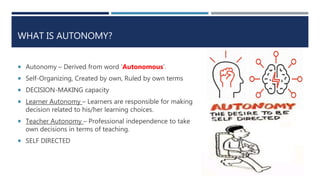
 Autonomy – Derived from word ‘Autonomous’.
 Self-Organizing, Created by own, Ruled by own terms
 DECISION-MAKING capacity
 Learner Autonomy – Learners are responsible for making
decision related to his/her learning choices.
 Teacher Autonomy – Professional independence to take
own decisions in terms of teaching.
 SELF DIRECTED
LITERATURE REVIEWS
 Many ongoing researches World wide.
 Learner Autonomy Symposium, AILA Scientific Commission, Japan – 1999
 Dimensions of Teacher Autonomy – Little – 1995, Benson, McGrath, Smith,
Aoki – 2000, defined various aspects and different dimensions
 North – 1987 : Proposed Idea of sharing reflective Journal among teachers.
 Naoko Aoki, Osaka University - She played a leading role in the learner
autonomy field, and generously, but with great modesty and professional
dignity helped many teachers, students and colleagues from around the
world.
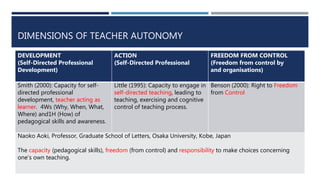
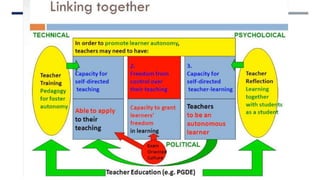
DIMENSIONS OF TEACHER AUTONOMY
DEVELOPMENT
(Self-Directed Professional
Development)
ACTION
(Self-Directed Professional
FREEDOM FROM CONTROL
(Freedom from control by
and organisations)
Smith (2000): Capacity for self-
directed professional
development, teacher acting as
learner. 4Ws (Why, When, What,
Where) and1H (How) of
pedagogical skills and awareness.
Little (1995): Capacity to engage in
self-directed teaching, leading to
teaching, exercising and cognitive
control of teaching process.
Benson (2000): Right to Freedom
from Control
Naoko Aoki, Professor, Graduate School of Letters, Osaka University, Kobe, Japan
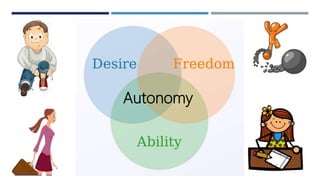
The capacity (pedagogical skills), freedom (from control) and responsibility to make choices concerning
one’s own teaching.
Autonomy
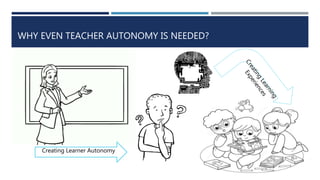
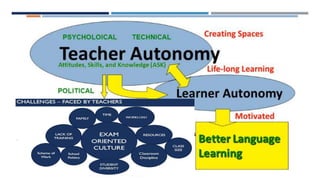
WHY EVEN TEACHER AUTONOMY IS NEEDED?
Creating Learner Autonomy
CHALLENGES – FACED BY TEACHERS
.
EXAM
ORIENTED
CULTURE
WORKLOADFAMILY
TIME
LACK OF
TRAINING
RESOURCES
Classroom
Discipline
CLASS
SIZE
School
Politics
Scheme
of Work
STUDENT
DIVERSITY
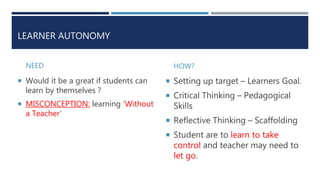
LEARNER AUTONOMY
NEED
 Would it be a great if students can
learn by themselves ?
 MISCONCEPTION: learning ‘Without
a Teacher’
HOW?
 Setting up target – Learners Goal.
 Critical Thinking – Pedagogical
Skills
 Reflective Thinking – Scaffolding
 Student are to learn to take
control and teacher may need to
let go.
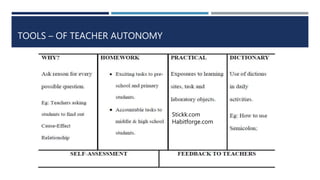
TOOLS – OF TEACHER AUTONOMY
Stickk.com
Habitforge.com
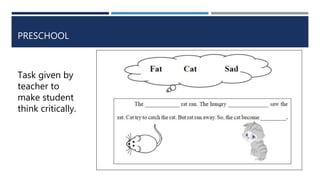
PRESCHOOL
Task given by
teacher to
make student
think critically.
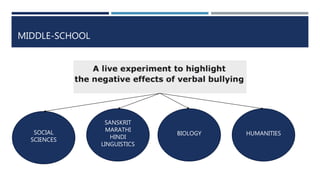
MIDDLE-SCHOOL
HUMANITIESSOCIAL
SCIENCES
SANSKRIT
MARATHI
HINDI
LINGUISTICS
BIOLOGY
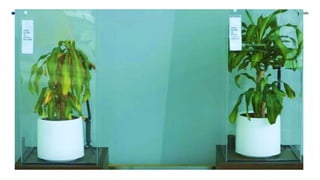
TWO PLANTS – SAME HEIGHT, WEIGHT AND SPECIES
One being BULLIED, One being PRAISED
REFERENCES
 Aoki, N. (2000) Aspects of teacher autonomy: Capacity, freedom and responsibility. Paper presented at
2000 Hong Kong University of Science and Technology Language Centre Conference.
 Benson, P. (2016, February 17). Teachers' perspectives on autonomy [PPT]. Sydney: Slideshare.
 Dam, L. (ed.) (2002) AILA Review 15.(Special issue containing papers from Symposium of the Scientific
Commission on Learner Autonomy, AILA 1999, Waseda University, Tokyo, August 1999).
 Griner, D. (2018, May 08). Ikea 'Bullied' a Potted Plant While Encouraging Another, Then Showed
Schoolkids the Impact. Retrieved September, 2018, from https://www.adweek.com/brand-
marketing/ikea-bullied-a-potted-plant-while-encouraging-another-then-showed-schoolkids-the-
impact/
 McGrath, I. (2000) Teacher autonomy. In B. Sinclair, I. McGrath and T. Lamb (eds.) Learner autonomy,
teacher autonomy: Future directions. London: Longman. 100-110.
Teacher autonomy : a tool to create learner autonomy

Teacher autonomy : a tool to create learner autonomy

  • 1.
    TEACHER AUTONOMY A TOOLFOR CREATING LEARNER AUTONOMY Presenter: Aditi Bhushan B.Ed., BLIS, BCA, M.Sc (CA), M.Ed. (Purs.) CTET and BTET Qualified Certified Professional in English Grammar (Univ. of Queensland), Australia Certified Professional in Classroom Management (Univ. of Pennsylvania),USA
  • 2.
    WHAT IS AUTONOMY? Autonomy – Derived from word ‘Autonomous’.  Self-Organizing, Created by own, Ruled by own terms  DECISION-MAKING capacity  Learner Autonomy – Learners are responsible for making decision related to his/her learning choices.  Teacher Autonomy – Professional independence to take own decisions in terms of teaching.  SELF DIRECTED
  • 3.
    LITERATURE REVIEWS  Manyongoing researches World wide.  Learner Autonomy Symposium, AILA Scientific Commission, Japan – 1999  Dimensions of Teacher Autonomy – Little – 1995, Benson, McGrath, Smith, Aoki – 2000, defined various aspects and different dimensions  North – 1987 : Proposed Idea of sharing reflective Journal among teachers.  Naoko Aoki, Osaka University - She played a leading role in the learner autonomy field, and generously, but with great modesty and professional dignity helped many teachers, students and colleagues from around the world.
  • 4.
    DIMENSIONS OF TEACHERAUTONOMY DEVELOPMENT (Self-Directed Professional Development) ACTION (Self-Directed Professional FREEDOM FROM CONTROL (Freedom from control by and organisations) Smith (2000): Capacity for self- directed professional development, teacher acting as learner. 4Ws (Why, When, What, Where) and1H (How) of pedagogical skills and awareness. Little (1995): Capacity to engage in self-directed teaching, leading to teaching, exercising and cognitive control of teaching process. Benson (2000): Right to Freedom from Control Naoko Aoki, Professor, Graduate School of Letters, Osaka University, Kobe, Japan The capacity (pedagogical skills), freedom (from control) and responsibility to make choices concerning one’s own teaching.
  • 5.
  • 6.
    WHY EVEN TEACHERAUTONOMY IS NEEDED? Creating Learner Autonomy
  • 7.
    CHALLENGES – FACEDBY TEACHERS . EXAM ORIENTED CULTURE WORKLOADFAMILY TIME LACK OF TRAINING RESOURCES Classroom Discipline CLASS SIZE School Politics Scheme of Work STUDENT DIVERSITY
  • 8.
    LEARNER AUTONOMY NEED  Wouldit be a great if students can learn by themselves ?  MISCONCEPTION: learning ‘Without a Teacher’ HOW?  Setting up target – Learners Goal.  Critical Thinking – Pedagogical Skills  Reflective Thinking – Scaffolding  Student are to learn to take control and teacher may need to let go.
  • 11.
    TOOLS – OFTEACHER AUTONOMY Stickk.com Habitforge.com
  • 13.
    PRESCHOOL Task given by teacherto make student think critically.
  • 14.
  • 15.
    TWO PLANTS –SAME HEIGHT, WEIGHT AND SPECIES One being BULLIED, One being PRAISED
  • 19.
    REFERENCES  Aoki, N.(2000) Aspects of teacher autonomy: Capacity, freedom and responsibility. Paper presented at 2000 Hong Kong University of Science and Technology Language Centre Conference.  Benson, P. (2016, February 17). Teachers' perspectives on autonomy [PPT]. Sydney: Slideshare.  Dam, L. (ed.) (2002) AILA Review 15.(Special issue containing papers from Symposium of the Scientific Commission on Learner Autonomy, AILA 1999, Waseda University, Tokyo, August 1999).  Griner, D. (2018, May 08). Ikea 'Bullied' a Potted Plant While Encouraging Another, Then Showed Schoolkids the Impact. Retrieved September, 2018, from https://www.adweek.com/brand- marketing/ikea-bullied-a-potted-plant-while-encouraging-another-then-showed-schoolkids-the- impact/  McGrath, I. (2000) Teacher autonomy. In B. Sinclair, I. McGrath and T. Lamb (eds.) Learner autonomy, teacher autonomy: Future directions. London: Longman. 100-110.