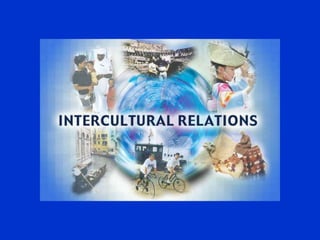
CULTURE, CONFLICT AND
 COMMUICATION IN THE
  GLOBAL WORKFORCE

      March 27, 2008
    University of Illinois
    Dr. Gary R. Weaver
    American University
WHY IS DIVERSITY
 IMPORTANT?
Changing demographics
Not just in urban areas
“Globalization”
The American Culture
            Today
•   Not a Cultural Cookie Cutter or Melting Pot
•   Patchwork Quilt
•   Salad Bowl
•   Mosaic
•   Tapestry
Minorities in USA Today

  12% African American
  15% Hispanic
  4% Asian and Pacific
  Islanders
  1% American Indian
TO MORE EFFECTIVELY
  SERVE YOUR CLIENTS

Conveying information
Developing skills
Overcoming barriers caused by differences
Using differences to create synergy
TRAITS THAT CORRELATE
WITH FAILURE IN CROSS-
CULTURAL INTERACTIONS

• Low tolerance to ambiguity or high
    uncertainty avoidance
• Overly task-oriented or high need
    for individual achievement
• Overly closed-minded and inflexible
What is “Culture?”
• culture - the way of life (values, beliefs
  and behaviors) of a people passed
  down from one generation to the next
  through learning
Generalization vs.
                Stereotype
• Cultural Generalization     • Cultural Stereotype
  – Never applies to everyone   – Applies to everyone
    in every situation            in every situation –
  – Only a first “guess”          no exceptions
  – Discard it when no longer   – Retained even when
    accurate or useful            no longer accurate or
                                  useful
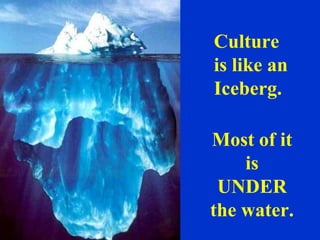
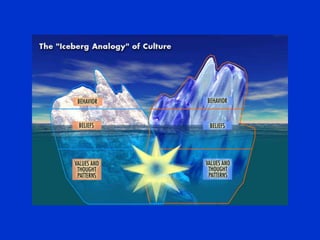
Culture
is like an
Iceberg.

Most of it
    is
 UNDER
the water.
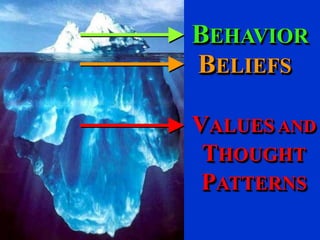
BEHAVIOR
BELIEFS

VALUES AND
 THOUGHT
 PATTERNS
As we interact, differences will
   become LESS important.
• Leon Festinger
  – Theory of Cognitive Dissonance

• Muzafir Sherif
  – Development of a “Superordinate Goal”
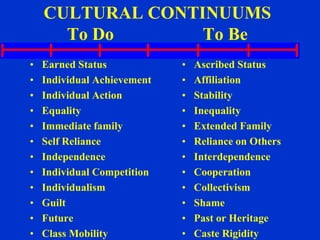
CULTURAL CONTINUUMS
      To Do       To Be
•   Earned Status            •   Ascribed Status
•   Individual Achievement   •   Affiliation
•   Individual Action        •   Stability
•   Equality                 •   Inequality
•   Immediate family         •   Extended Family
•   Self Reliance            •   Reliance on Others
•   Independence             •   Interdependence
•   Individual Competition   •   Cooperation
•   Individualism            •   Collectivism
•   Guilt                    •   Shame
•   Future                   •   Past or Heritage
•   Class Mobility           •   Caste Rigidity
CROSS-CULTURAL
COMMUNICATION
What Doesn’t Fit?
Nice weather we’re having!

Sunny, high in the 70s.

Haven’t we met before?
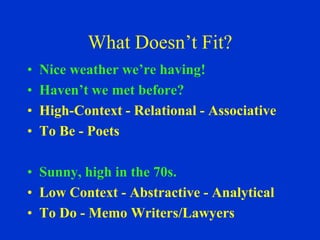
What Doesn’t Fit?
•   Nice weather we’re having!
•   Haven’t we met before?
•   High-Context - Relational - Associative
•   To Be - Poets

• Sunny, high in the 70s.
• Low Context - Abstractive - Analytical
• To Do - Memo Writers/Lawyers
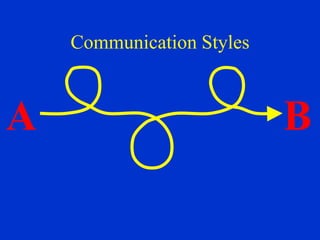
Communication Styles


A                          B
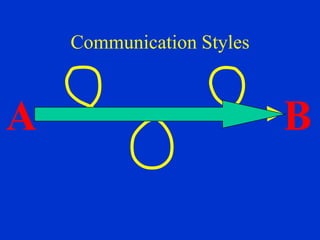
Communication Styles


A                          B
Communication Styles


A                          B
Communication Styles


A                          B
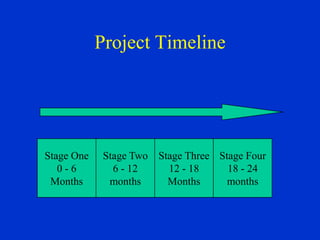
Project Timeline


Stage One    Stage Two   Stage Three Stage Four
   0-6         6 - 12      12 - 18     18 - 24
 Months       months       Months      months
Project Timeline


                        Stage Stage
Stage One   Stage Two
                         Three   Four
  0 - 12     12 - 18
                        18 - 22 22 -24
 Months      Months
                        Months Months
NONVERBAL
       COMMUNICATION

We send messages, not meaning

To Do people tend to be verbally-oriented

To Do people trust vision
Cross-Cultural
   Conflict
QUESTIONS:

How do you know if it’s a conflict?
Is it escalating or de-escalating?
When do you resolve it?
When it is beyond resolution?
How do you resolve the conflict?
Resources
• Hall, Edward. Beyond Culture.
• Weaver, Gary R., ed. Culture, Communication
  and Conflict, 2nd edition. Boston, MA:Pearson
  Publishing, 2000.
• Weaver, Gary R. and Adam Mendelson,
  America’s Midlife Crisis: The Future of a
  Troubled Superpower, Boston, MA: Intercultural
  Press, 2008
• www.interculturalpress.com
• www.imi.american.edu

Culture Conflict Communication

  • 2.
    CULTURE, CONFLICT AND COMMUICATION IN THE GLOBAL WORKFORCE March 27, 2008 University of Illinois Dr. Gary R. Weaver American University
  • 3.
    WHY IS DIVERSITY IMPORTANT? Changing demographics Not just in urban areas “Globalization”
  • 4.
    The American Culture Today • Not a Cultural Cookie Cutter or Melting Pot • Patchwork Quilt • Salad Bowl • Mosaic • Tapestry
  • 5.
    Minorities in USAToday 12% African American 15% Hispanic 4% Asian and Pacific Islanders 1% American Indian
  • 6.
    TO MORE EFFECTIVELY SERVE YOUR CLIENTS Conveying information Developing skills Overcoming barriers caused by differences Using differences to create synergy
  • 7.
    TRAITS THAT CORRELATE WITHFAILURE IN CROSS- CULTURAL INTERACTIONS • Low tolerance to ambiguity or high uncertainty avoidance • Overly task-oriented or high need for individual achievement • Overly closed-minded and inflexible
  • 8.
    What is “Culture?” •culture - the way of life (values, beliefs and behaviors) of a people passed down from one generation to the next through learning
  • 9.
    Generalization vs. Stereotype • Cultural Generalization • Cultural Stereotype – Never applies to everyone – Applies to everyone in every situation in every situation – – Only a first “guess” no exceptions – Discard it when no longer – Retained even when accurate or useful no longer accurate or useful
  • 12.
    Culture is like an Iceberg. Mostof it is UNDER the water.
  • 13.
  • 14.
    As we interact,differences will become LESS important. • Leon Festinger – Theory of Cognitive Dissonance • Muzafir Sherif – Development of a “Superordinate Goal”
  • 15.
    CULTURAL CONTINUUMS To Do To Be • Earned Status • Ascribed Status • Individual Achievement • Affiliation • Individual Action • Stability • Equality • Inequality • Immediate family • Extended Family • Self Reliance • Reliance on Others • Independence • Interdependence • Individual Competition • Cooperation • Individualism • Collectivism • Guilt • Shame • Future • Past or Heritage • Class Mobility • Caste Rigidity
  • 17.
  • 18.
    What Doesn’t Fit? Niceweather we’re having! Sunny, high in the 70s. Haven’t we met before?
  • 19.
    What Doesn’t Fit? • Nice weather we’re having! • Haven’t we met before? • High-Context - Relational - Associative • To Be - Poets • Sunny, high in the 70s. • Low Context - Abstractive - Analytical • To Do - Memo Writers/Lawyers
  • 20.
  • 21.
  • 22.
  • 23.
  • 24.
    Project Timeline Stage One Stage Two Stage Three Stage Four 0-6 6 - 12 12 - 18 18 - 24 Months months Months months
  • 25.
    Project Timeline Stage Stage Stage One Stage Two Three Four 0 - 12 12 - 18 18 - 22 22 -24 Months Months Months Months
  • 26.
    NONVERBAL COMMUNICATION We send messages, not meaning To Do people tend to be verbally-oriented To Do people trust vision
  • 27.
  • 28.
    QUESTIONS: How do youknow if it’s a conflict? Is it escalating or de-escalating? When do you resolve it? When it is beyond resolution? How do you resolve the conflict?
  • 29.
    Resources • Hall, Edward.Beyond Culture. • Weaver, Gary R., ed. Culture, Communication and Conflict, 2nd edition. Boston, MA:Pearson Publishing, 2000. • Weaver, Gary R. and Adam Mendelson, America’s Midlife Crisis: The Future of a Troubled Superpower, Boston, MA: Intercultural Press, 2008 • www.interculturalpress.com • www.imi.american.edu