Why did she do that?   Ways of viewing intercultural communication
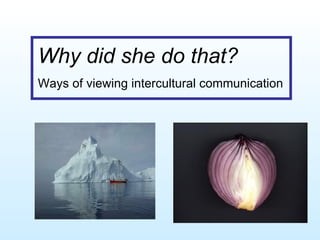
The iceberg view of culture Ways of doing: Food Dress Religious rituals Ways of thinking: Attitudes Communication styles Perceptions Assumptions Ways of being: Beliefs Values World view Adapted from UBC Centre for Intercultural Communication 2005
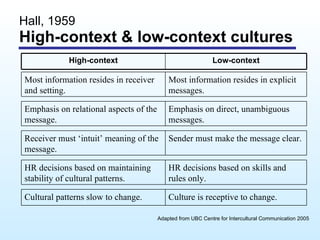
Hall, 1959 High-context & low-context cultures Adapted from UBC Centre for Intercultural Communication 2005 Low-context High-context Most information resides in explicit messages. Most information resides in receiver and setting. Sender must make the message clear. Receiver must ‘intuit’ meaning of the message. Emphasis on direct, unambiguous messages. Emphasis on relational aspects of the message. HR decisions based on skills and rules only. HR decisions based on maintaining stability of cultural patterns. Culture is receptive to change. Cultural patterns slow to change.
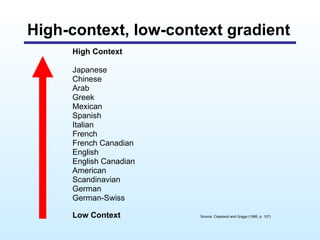
High-context, low-context gradient High Context Japanese Chinese Arab Greek Mexican Spanish Italian French French Canadian English English Canadian American Scandinavian German German-Swiss Low Context Source: Copeland and Griggs (1985, p. 107)
Hofstede, 1996 - Values Framework Collectivism vs. Individualism Adapted from UBC Centre for Intercultural Communication 2005 Individualist Collectivist Individual responsible for self and immediate family Extended families/groups provide protection; require loyalty Low-context communication (Hall) High-context communication (Hall) Speaking one’s mind = honesty Harmony important; direct confrontations avoided Task prevails over relationship Relationships prevail over task Everyone has right to privacy Private life invaded by group(s) Ultimate goal: self-actualization Ultimate goal: harmony and consensus
Hofstede, 1996 - Values Framework High vs. low power distance Adapted from UBC Centre for Intercultural Communication 2005 Inequalities are expected and desired Inequalities should be minimized Parents teach children obedience; children treat parents with respect Parents and children are equals Teachers expected to take all initiative Students expected to take some initiative Privileges and status symbols sought Privileges and status symbols frowned upon Wide salary range within organizations Narrow salary range within organizations High power distance Low power distance
Optional discussion topics Culture vs. ethnicity vs. race The D.I.E. model The  Sushi bar video
For definition & discussion Culture Ethnicity Race
Some definitions to consider… 1. Culture: the learned values and behaviour shared by a group that are passed along from generation to generation. Culture changes over time (UBC, 2003) 2. Ethnicity: a group that is differentiated from other groups by its national origin or distinctive cultural patterns. The group shares a common historical or geographical background (UBC, 2003) 3. Race: a socially-defined group which sees itself and/or is seen by others as being different from other groups in its common descent or external features (Ontario Anti-Racism Secretariat, 1993)
D.I.E. Model D escribe objectively/observe I nterpret possible solutions/explanations E valuate –  after  you have gathered information “ Observing without evaluating is the highest form of intelligence.” J. Krishnamurti (Indian philosopher)

Culture & Communication

  • 1.
    Why did shedo that? Ways of viewing intercultural communication
  • 2.
    The iceberg viewof culture Ways of doing: Food Dress Religious rituals Ways of thinking: Attitudes Communication styles Perceptions Assumptions Ways of being: Beliefs Values World view Adapted from UBC Centre for Intercultural Communication 2005
  • 3.
    Hall, 1959 High-context& low-context cultures Adapted from UBC Centre for Intercultural Communication 2005 Low-context High-context Most information resides in explicit messages. Most information resides in receiver and setting. Sender must make the message clear. Receiver must ‘intuit’ meaning of the message. Emphasis on direct, unambiguous messages. Emphasis on relational aspects of the message. HR decisions based on skills and rules only. HR decisions based on maintaining stability of cultural patterns. Culture is receptive to change. Cultural patterns slow to change.
  • 4.
    High-context, low-context gradientHigh Context Japanese Chinese Arab Greek Mexican Spanish Italian French French Canadian English English Canadian American Scandinavian German German-Swiss Low Context Source: Copeland and Griggs (1985, p. 107)
  • 5.
    Hofstede, 1996 -Values Framework Collectivism vs. Individualism Adapted from UBC Centre for Intercultural Communication 2005 Individualist Collectivist Individual responsible for self and immediate family Extended families/groups provide protection; require loyalty Low-context communication (Hall) High-context communication (Hall) Speaking one’s mind = honesty Harmony important; direct confrontations avoided Task prevails over relationship Relationships prevail over task Everyone has right to privacy Private life invaded by group(s) Ultimate goal: self-actualization Ultimate goal: harmony and consensus
  • 6.
    Hofstede, 1996 -Values Framework High vs. low power distance Adapted from UBC Centre for Intercultural Communication 2005 Inequalities are expected and desired Inequalities should be minimized Parents teach children obedience; children treat parents with respect Parents and children are equals Teachers expected to take all initiative Students expected to take some initiative Privileges and status symbols sought Privileges and status symbols frowned upon Wide salary range within organizations Narrow salary range within organizations High power distance Low power distance
  • 7.
    Optional discussion topicsCulture vs. ethnicity vs. race The D.I.E. model The Sushi bar video
  • 8.
    For definition &discussion Culture Ethnicity Race
  • 9.
    Some definitions toconsider… 1. Culture: the learned values and behaviour shared by a group that are passed along from generation to generation. Culture changes over time (UBC, 2003) 2. Ethnicity: a group that is differentiated from other groups by its national origin or distinctive cultural patterns. The group shares a common historical or geographical background (UBC, 2003) 3. Race: a socially-defined group which sees itself and/or is seen by others as being different from other groups in its common descent or external features (Ontario Anti-Racism Secretariat, 1993)
  • 10.
    D.I.E. Model Describe objectively/observe I nterpret possible solutions/explanations E valuate – after you have gathered information “ Observing without evaluating is the highest form of intelligence.” J. Krishnamurti (Indian philosopher)