MODUL - 5 
ANGKA INDEKS 
• Indeks Sederhana 
• Indeks Agregatif 
• Indeks Agregatif Tertimbang 
Statistika I: Angka Indeks 1
DEFINISI DAN KLASIFIKASI 
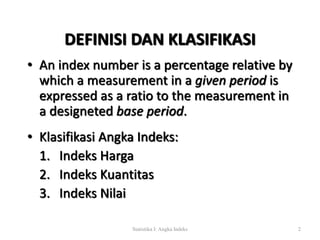
• An index number is a percentage relative by 
which a measurement in a given period is 
expressed as a ratio to the measurement in 
a designeted base period. 
• Klasifikasi Angka Indeks: 
1. Indeks Harga 
2. Indeks Kuantitas 
3. Indeks Nilai 
Statistika I: Angka Indeks 2
Indeks Sederhana 
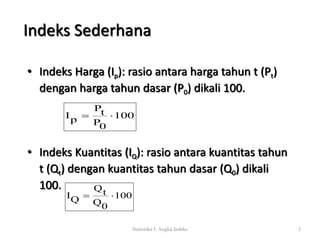
• Indeks Harga (Ip): rasio antara harga tahun t (Pt) 
dengan harga tahun dasar (P0) dikali 100. 
100 
Pt 
Ip  ļƒ— 
• Indeks Kuantitas (IQ): rasio antara kuantitas tahun 
t (Qt) dengan kuantitas tahun dasar (Q0) dikali 
100. 
Statistika I: Angka Indeks 3 
P0 
100 
Qt 
IQ  ļƒ— 
Q0
Lanjutan 
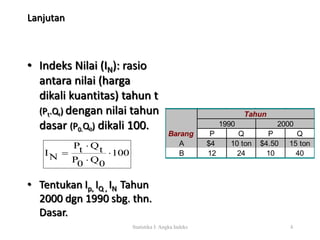
• Indeks Nilai (IN): rasio 
antara nilai (harga 
dikali kuantitas) tahun t 
(Pt.Qt) dengan nilai tahun 
dasar (P0.Q0) dikali 100. 
Pt ļƒ— 
Qt 
IN ļƒ— 
• Tentukan Ip, IQ , IN Tahun 
2000 dgn 1990 sbg. thn. 
Dasar. 
Tahun 
1990 2000 
P Q P Q 
Barang 
A $4 10 ton $4.50 15 ton 
B 12 24 10 40 
Statistika I: Angka Indeks 4 
100 
P0 ļƒ— 
Q0 

Indeks Agregatif (Komposit) 
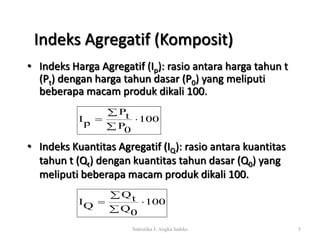
• Indeks Harga Agregatif (Ip): rasio antara harga tahun t 
(Pt) dengan harga tahun dasar (P0) yang meliputi 
beberapa macam produk dikali 100. 
100 
Pt 
 
Ip ļƒ— 
• Indeks Kuantitas Agregatif (IQ): rasio antara kuantitas 
tahun t (Qt) dengan kuantitas tahun dasar (Q0) yang 
meliputi beberapa macam produk dikali 100. 
Qt 
 
IQ ļƒ— 
Statistika I: Angka Indeks 5 
P0 
 
 
100 
Q0 
 

Lanjutan . . . 
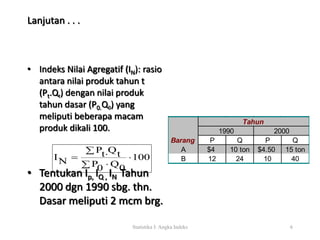
• Indeks Nilai Agregatif (IN): rasio 
antara nilai produk tahun t 
(Pt.Qt) dengan nilai produk 
tahun dasar (P0.Q0) yang 
meliputi beberapa macam 
produk dikali 100. 
100 
Pt Qt 
 ļƒ—  
IN ļƒ— 
 ļƒ— 
• Tentukan Ip, IQ , IN Tahun 
2000 dgn 1990 sbg. thn. 
Dasar meliputi 2 mcm brg. 
Tahun 
1990 2000 
P Q P Q 
Barang 
A $4 10 ton $4.50 15 ton 
B 12 24 10 40 
Statistika I: Angka Indeks 6 
P0 Q0
Indeks Agregatif Tertimbang 
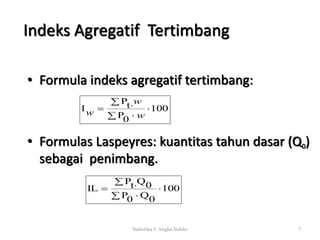
• Formula indeks agregatif tertimbang: 
100 
Pt 
 ļƒ—  
w 
I ļƒ— 
 ļƒ— 
• Formulas Laspeyres: kuantitas tahun dasar (Q0) 
sebagai penimbang. 
Pt Q0 
 ļƒ—  
IL ļƒ— 
 ļƒ— 
Statistika I: Angka Indeks 7 
P0 
w 
w 
100 
P0 Q0
Lanjutan 
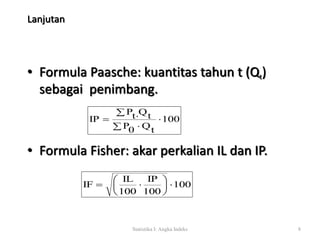
• Formula Paasche: kuantitas tahun t (Qt) 
sebagai penimbang. 
100 
Pt Qt 
 ļƒ—  
IP ļƒ— 
 ļƒ— 
P0 Qt 
• Formula Fisher: akar perkalian IL dan IP. 
100 
IP 
 
 
IF ļƒ—  
100 
IL 
 ļƒ— 
100 
Statistika I: Angka Indeks 8 
 

Lanjutan 
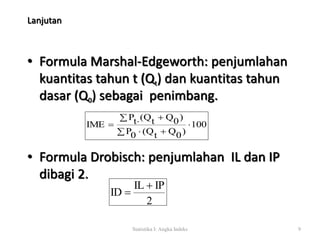
• Formula Marshal-Edgeworth: penjumlahan 
kuantitas tahun t (Qt) dan kuantitas tahun 
dasar (Q0) sebagai penimbang. 
100 
Pt (Qt Q0) 
 ļƒ—   
IME ļƒ— 
 ļƒ—  
P0 (Qt Q0) 
• Formula Drobisch: penjumlahan IL dan IP 
dibagi 2. 
IL IP 
2 
Statistika I: Angka Indeks 9 
ID 
 

Lanjutan 
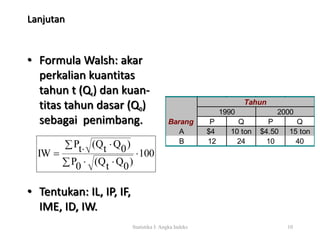
• Formula Walsh: akar 
perkalian kuantitas 
tahun t (Qt) dan kuan-titas 
tahun dasar (Q0) 
sebagai penimbang. 
 ļƒ— ļƒ—  
P0 (Qt Q0) 
• Tentukan: IL, IP, IF, 
IME, ID, IW. 
Tahun 
1990 2000 
P Q P Q 
Barang 
A $4 10 ton $4.50 15 ton 
B 12 24 10 40 
100 
Statistika I: Angka Indeks 10 
Pt (Qt Q0) 
IW ļƒ— 
 ļƒ— ļƒ—
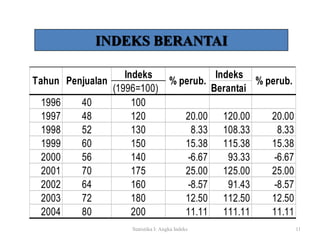
INDEKS BERANTAI 
Indeks Indeks 
Tahun Penjualan % perub. % perub. 
(1996=100) Berantai 
1996 40 100 
1997 48 120 20.00 120.00 20.00 
1998 52 130 8.33 108.33 8.33 
1999 60 150 15.38 115.38 15.38 
2000 56 140 -6.67 93.33 -6.67 
2001 70 175 25.00 125.00 25.00 
2002 64 160 -8.57 91.43 -8.57 
2003 72 180 12.50 112.50 12.50 
2004 80 200 11.11 111.11 11.11 
Statistika I: Angka Indeks 11
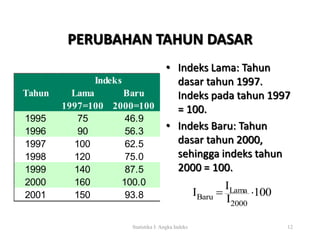
PERUBAHAN TAHUN DASAR 
Indeks 
Lama Baru 
1997=100 2000=100 
Tahun 
1995 75 46.9 
1996 90 56.3 
1997 100 62.5 
1998 120 75.0 
1999 140 87.5 
2000 160 100.0 
2001 150 93.8 
• Indeks Lama: Tahun 
dasar tahun 1997. 
Indeks pada tahun 1997 
= 100. 
• Indeks Baru: Tahun 
dasar tahun 2000, 
sehingga indeks tahun 
2000 = 100. 
Baru  ļƒ— 
100 
I 
Lama 
I 
I 
2000 
Statistika I: Angka Indeks 12

Statistika Angka Indeks

  • 1.
    MODUL - 5 ANGKA INDEKS • Indeks Sederhana • Indeks Agregatif • Indeks Agregatif Tertimbang Statistika I: Angka Indeks 1
  • 2.
    DEFINISI DAN KLASIFIKASI • An index number is a percentage relative by which a measurement in a given period is expressed as a ratio to the measurement in a designeted base period. • Klasifikasi Angka Indeks: 1. Indeks Harga 2. Indeks Kuantitas 3. Indeks Nilai Statistika I: Angka Indeks 2
  • 3.
    Indeks Sederhana •Indeks Harga (Ip): rasio antara harga tahun t (Pt) dengan harga tahun dasar (P0) dikali 100. 100 Pt Ip  ļƒ— • Indeks Kuantitas (IQ): rasio antara kuantitas tahun t (Qt) dengan kuantitas tahun dasar (Q0) dikali 100. Statistika I: Angka Indeks 3 P0 100 Qt IQ  ļƒ— Q0
  • 4.
    Lanjutan • IndeksNilai (IN): rasio antara nilai (harga dikali kuantitas) tahun t (Pt.Qt) dengan nilai tahun dasar (P0.Q0) dikali 100. Pt ļƒ— Qt IN ļƒ— • Tentukan Ip, IQ , IN Tahun 2000 dgn 1990 sbg. thn. Dasar. Tahun 1990 2000 P Q P Q Barang A $4 10 ton $4.50 15 ton B 12 24 10 40 Statistika I: Angka Indeks 4 100 P0 ļƒ— Q0 
  • 5.
    Indeks Agregatif (Komposit) • Indeks Harga Agregatif (Ip): rasio antara harga tahun t (Pt) dengan harga tahun dasar (P0) yang meliputi beberapa macam produk dikali 100. 100 Pt  Ip ļƒ— • Indeks Kuantitas Agregatif (IQ): rasio antara kuantitas tahun t (Qt) dengan kuantitas tahun dasar (Q0) yang meliputi beberapa macam produk dikali 100. Qt  IQ ļƒ— Statistika I: Angka Indeks 5 P0   100 Q0  
  • 6.
    Lanjutan . .. • Indeks Nilai Agregatif (IN): rasio antara nilai produk tahun t (Pt.Qt) dengan nilai produk tahun dasar (P0.Q0) yang meliputi beberapa macam produk dikali 100. 100 Pt Qt  ļƒ—  IN ļƒ—  ļƒ— • Tentukan Ip, IQ , IN Tahun 2000 dgn 1990 sbg. thn. Dasar meliputi 2 mcm brg. Tahun 1990 2000 P Q P Q Barang A $4 10 ton $4.50 15 ton B 12 24 10 40 Statistika I: Angka Indeks 6 P0 Q0
  • 7.
    Indeks Agregatif Tertimbang • Formula indeks agregatif tertimbang: 100 Pt  ļƒ—  w I ļƒ—  ļƒ— • Formulas Laspeyres: kuantitas tahun dasar (Q0) sebagai penimbang. Pt Q0  ļƒ—  IL ļƒ—  ļƒ— Statistika I: Angka Indeks 7 P0 w w 100 P0 Q0
  • 8.
    Lanjutan • FormulaPaasche: kuantitas tahun t (Qt) sebagai penimbang. 100 Pt Qt  ļƒ—  IP ļƒ—  ļƒ— P0 Qt • Formula Fisher: akar perkalian IL dan IP. 100 IP   IF ļƒ—  100 IL  ļƒ— 100 Statistika I: Angka Indeks 8  
  • 9.
    Lanjutan • FormulaMarshal-Edgeworth: penjumlahan kuantitas tahun t (Qt) dan kuantitas tahun dasar (Q0) sebagai penimbang. 100 Pt (Qt Q0)  ļƒ—   IME ļƒ—  ļƒ—  P0 (Qt Q0) • Formula Drobisch: penjumlahan IL dan IP dibagi 2. IL IP 2 Statistika I: Angka Indeks 9 ID  
  • 10.
    Lanjutan • FormulaWalsh: akar perkalian kuantitas tahun t (Qt) dan kuan-titas tahun dasar (Q0) sebagai penimbang.  ļƒ— ļƒ—  P0 (Qt Q0) • Tentukan: IL, IP, IF, IME, ID, IW. Tahun 1990 2000 P Q P Q Barang A $4 10 ton $4.50 15 ton B 12 24 10 40 100 Statistika I: Angka Indeks 10 Pt (Qt Q0) IW ļƒ—  ļƒ— ļƒ—
  • 11.
    INDEKS BERANTAI IndeksIndeks Tahun Penjualan % perub. % perub. (1996=100) Berantai 1996 40 100 1997 48 120 20.00 120.00 20.00 1998 52 130 8.33 108.33 8.33 1999 60 150 15.38 115.38 15.38 2000 56 140 -6.67 93.33 -6.67 2001 70 175 25.00 125.00 25.00 2002 64 160 -8.57 91.43 -8.57 2003 72 180 12.50 112.50 12.50 2004 80 200 11.11 111.11 11.11 Statistika I: Angka Indeks 11
  • 12.
    PERUBAHAN TAHUN DASAR Indeks Lama Baru 1997=100 2000=100 Tahun 1995 75 46.9 1996 90 56.3 1997 100 62.5 1998 120 75.0 1999 140 87.5 2000 160 100.0 2001 150 93.8 • Indeks Lama: Tahun dasar tahun 1997. Indeks pada tahun 1997 = 100. • Indeks Baru: Tahun dasar tahun 2000, sehingga indeks tahun 2000 = 100. Baru  ļƒ— 100 I Lama I I 2000 Statistika I: Angka Indeks 12