Communication strategies forCommunication strategies for
rural marketsrural markets
2014
Road map to rural India...!!!
Φ Virtual tour
Φ FORMAL/ CONVENTIONAL MEDIA
Φ INFORMAL/ RURAL SPECIFIC MEDIA
Φ Some Famous Examples:
Φ ITC e- choupal
Φ Hindustan Lever Limited and the
Soap Market
Φ Coca cola
Come...Lets go to village virtual tour
 Large but scattered population
 69.9% of Indians in rural areas as of 2010 (world bank report
2012)
 700 million people spread around 6,27,000 villages.
 87.5% of the rural population belongs to bottom of the pyramid
 Average income of less Rs.2000/- per month
 54 % to GDP
 About 50% of income comes from agriculture.
Estimated annual size of the rural market
 FMCG Rs. 65,000 Crore
 Durables Rs. 5,000 Crore
 Agri-Inputs Rs. 45,000 Crore
 2 / 4 Wheelers Rs. 8,000 Crore
FORMAL/ CONVENTIONAL MEDIA
 Do not provide the touch and feel of the product
 Mass media (reaches around 60% rural
population)
 2 out of 5 Indians are unreachable by mass media
TV
– Tv is the most preferred (40% access to TV):
power cuts are common and this restricts
viewing time.
– Doordarshan most popular channel
Print media (Print media reaches 23%)
Cinema (reach 30%)
Outdoor (wall paintings, hoardings, tree boards)
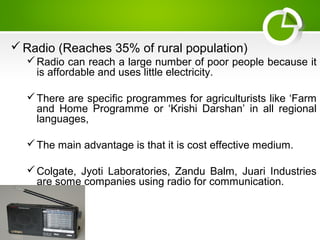
Radio (Reaches 35% of rural population)
Radio can reach a large number of poor people because it
is affordable and uses little electricity.
There are specific programmes for agriculturists like ‘Farm
and Home Programme or ‘Krishi Darshan’ in all regional
languages,
The main advantage is that it is cost effective medium.
Colgate, Jyoti Laboratories, Zandu Balm, Juari Industries
are some companies using radio for communication.
INFORMAL/ RURAL SPECIFIC MEDIA
Haats & Melas
Over 47,000 haats and 25,000 melas are held annually.
The average daily sale at a Haat isabout Rs.2.25 Lacs
Annual sales at melas amount to Rs.3,500 crore.
Over half the shoppers at haats have shopping lists.
More than 10,000 melas draw visitors from all over
India.
Nearly half the outlets at melas are for manufactured
goods.
Mobile supermarkets (75% are held once a week, 20%
twice a week and the rest are organised daily)
Good platform for demonstrations
Good for introducing new brands and building brands
About 5000 are commercial in nature, used for brand
promotions
Women's are present in large number
Kumbh mela (Haridwar, Allahabad, Ujjain, Nasik)
Sonepur mela (Bihar)
HLL, P&G set up kiosks.
Mahindra & Mahindra set up information counter for its
tractor at Pushkar mela (Rajasthan)
Nestle arranges coffee and Maggie shop
Opinion leaders
Mandis
– These are agricultural markets set up by govt. to
procure agri. Produce from farmers
– Serve as a platform for product demo and on the
spot sales
– Used for promoting durables and agricultural
products
 Farm to farm/ house to house
– Hindustan lever (fair and lovely) in villages with
population of 2000+ to expand user base
– Reached 10% of villages and 17% of households in
MP,UP and Bihar
– 46% brand conversions (35% was from non users)
 Group meetings
– MRF tractor owners meet (TOMEE)
– TAFE (direct contact exercises in 9 states – 44
centres): sales growth of 12% after one month of
campaign
Audio Visual publicity vans
– Create word of mouth publicity
– HLL (fair and lovely) home to home campaign was
supported by Audio visual show and product
demonstrations
– Costly to hire and maintain
– Cost per contact is more than conventional media
Demonstrations
– Dalda launch, fed pakodas on street corner to convey
that they can use it for frying (method demonstration)
– Hero, TVS and Kinetic gave live demonstrations in
Kolhapur for Maharashtra sugar co operative (they got
400 orders)
Folk Media
Folk theatre
Magic show
Puppet shows
Popular in Rajasthan
LIC uses it to educate masses in UP, Bihar and MP
The number of inquiries at LIC offices after the show
was higher.
Interactive games
Street theatre
Deeply rooted in the Indian tradition
To propagate social and political messages and to
create an awareness regarding critical issues.
Street theatre breaks the formal barriers and
approaches the people directly.
Games
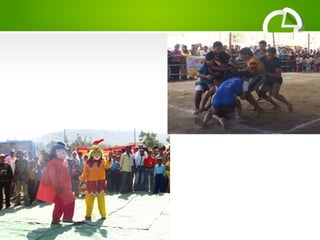
Rajdoot organizes wrestling competition for the villagers
in which one of the wrestler brought by them. The other
one is a villager.
The winner get to test ride their bikes. The wrestling is a
symbol of their products USP. That is: ruggedness
ITC e- choupal
 Initiative by ITC (2000)
 Directly links the rural farmers with the company
 Procured by such companies from mandis .
 The PCs and Internet access at certain centres enable the
farmers to obtain information on mandi prices , good
farming practices, and to place orders for agricultural
inputs, such as seeds and fertilizers.
 This access to information helps farmers in improving the
quality of produce and obtaining better prices.
 A literate farmer elected from the village acts as the
interface between the illiterate farmers and the computer.
Selling Health: Hindustan Lever Limited and
the Soap Market
Results of research done among focus
group in rural areas.
– 5 of 13 washed their hands before eating
– 10 of 18 washed their hands before preparing
food
– If they did wash hands, often used water or a
proxy product for soap such as mud or ash.
– after handling cow dung 5 of 7 rinsed their
hands with water
– one washed with mud, and one used soap.
o School and village presentation
o Children aged 5-13
o Through stories
o Learn about germs how they cause diseases
o Importance of using soap and when to use
o Demonstration to show that Visual clean is not safe clean
o Lifebuoy village health day
o Health camp and check up
o Village doctor as opinion leader
o Healthy child award
o Health skits and poems by kids to gain involvement
o Demonstrations and awards for best presenters
o Diarrhea management workshop
o For young mothers and pregnant women
o Dangers of diarrhea
o Health checks
o Launch of the Lifebuoy health club
o Formation of health club which includes activities centered
on hygiene and keeping the village clean
o Facilitators return 4-6 times more
o HLL created health based brand differentiation
o Increased the sale of its low cost mass market soap
o Built new habits, involving its brand
o Built brand loyalty
o Fulfilling its corporate purpose ‘to raise the quality of life’
Coca cola: India’s Thirst for Rural Market
Coca cola India’s Rural Marketing Strategy
Based on three A’s
– Availability : availability of the product to customer
– Affordability: Product Pricing
– Acceptability : convincing the customer to buy the
product
 Extensive marketing in the mass
media and outdoor advertising
 Aggressive rural communication
campaign
 Hoardings
 Participation in weekly mandis
 TV commercials
 Print Advertisement in several regional
newspapers
 Painted the name Coca cola on the
compounds of the residences in the
villages
 Increased Ad- spend on Doordarshan
 2002: Commercial featuring Amir Khan to communicate the
message of price cut and launch of Chota Coke (200ml Rs.5
bottle)
 To strengthen the brand image- aimed at making Coke a
generic name for “thanda”- a popular dialect of North.
 Launched 3 commercials with tagline “Thanda matlab Coca-
cola”- Aimed to make rural and semi urban consumers
connect with Coca- Cola
 The 3 commercials showed progression in associating ‘Coke’
with ‘Thanda’.
Rural communication

Rural communication

  • 1.
    Communication strategies forCommunicationstrategies for rural marketsrural markets 2014
  • 2.
    Road map torural India...!!! Φ Virtual tour Φ FORMAL/ CONVENTIONAL MEDIA Φ INFORMAL/ RURAL SPECIFIC MEDIA Φ Some Famous Examples: Φ ITC e- choupal Φ Hindustan Lever Limited and the Soap Market Φ Coca cola
  • 3.
    Come...Lets go tovillage virtual tour  Large but scattered population  69.9% of Indians in rural areas as of 2010 (world bank report 2012)  700 million people spread around 6,27,000 villages.  87.5% of the rural population belongs to bottom of the pyramid  Average income of less Rs.2000/- per month  54 % to GDP  About 50% of income comes from agriculture. Estimated annual size of the rural market  FMCG Rs. 65,000 Crore  Durables Rs. 5,000 Crore  Agri-Inputs Rs. 45,000 Crore  2 / 4 Wheelers Rs. 8,000 Crore
  • 4.
    FORMAL/ CONVENTIONAL MEDIA Do not provide the touch and feel of the product  Mass media (reaches around 60% rural population)  2 out of 5 Indians are unreachable by mass media TV – Tv is the most preferred (40% access to TV): power cuts are common and this restricts viewing time. – Doordarshan most popular channel Print media (Print media reaches 23%) Cinema (reach 30%) Outdoor (wall paintings, hoardings, tree boards)
  • 5.
    Radio (Reaches 35%of rural population) Radio can reach a large number of poor people because it is affordable and uses little electricity. There are specific programmes for agriculturists like ‘Farm and Home Programme or ‘Krishi Darshan’ in all regional languages, The main advantage is that it is cost effective medium. Colgate, Jyoti Laboratories, Zandu Balm, Juari Industries are some companies using radio for communication.
  • 7.
    INFORMAL/ RURAL SPECIFICMEDIA Haats & Melas Over 47,000 haats and 25,000 melas are held annually. The average daily sale at a Haat isabout Rs.2.25 Lacs Annual sales at melas amount to Rs.3,500 crore. Over half the shoppers at haats have shopping lists. More than 10,000 melas draw visitors from all over India. Nearly half the outlets at melas are for manufactured goods. Mobile supermarkets (75% are held once a week, 20% twice a week and the rest are organised daily) Good platform for demonstrations
  • 8.
    Good for introducingnew brands and building brands About 5000 are commercial in nature, used for brand promotions Women's are present in large number Kumbh mela (Haridwar, Allahabad, Ujjain, Nasik) Sonepur mela (Bihar) HLL, P&G set up kiosks. Mahindra & Mahindra set up information counter for its tractor at Pushkar mela (Rajasthan) Nestle arranges coffee and Maggie shop
  • 10.
    Opinion leaders Mandis – Theseare agricultural markets set up by govt. to procure agri. Produce from farmers – Serve as a platform for product demo and on the spot sales – Used for promoting durables and agricultural products
  • 11.
     Farm tofarm/ house to house – Hindustan lever (fair and lovely) in villages with population of 2000+ to expand user base – Reached 10% of villages and 17% of households in MP,UP and Bihar – 46% brand conversions (35% was from non users)  Group meetings – MRF tractor owners meet (TOMEE) – TAFE (direct contact exercises in 9 states – 44 centres): sales growth of 12% after one month of campaign
  • 12.
    Audio Visual publicityvans – Create word of mouth publicity – HLL (fair and lovely) home to home campaign was supported by Audio visual show and product demonstrations – Costly to hire and maintain – Cost per contact is more than conventional media Demonstrations – Dalda launch, fed pakodas on street corner to convey that they can use it for frying (method demonstration) – Hero, TVS and Kinetic gave live demonstrations in Kolhapur for Maharashtra sugar co operative (they got 400 orders)
  • 13.
    Folk Media Folk theatre Magicshow Puppet shows Popular in Rajasthan LIC uses it to educate masses in UP, Bihar and MP The number of inquiries at LIC offices after the show was higher. Interactive games
  • 15.
    Street theatre Deeply rootedin the Indian tradition To propagate social and political messages and to create an awareness regarding critical issues. Street theatre breaks the formal barriers and approaches the people directly. Games Rajdoot organizes wrestling competition for the villagers in which one of the wrestler brought by them. The other one is a villager. The winner get to test ride their bikes. The wrestling is a symbol of their products USP. That is: ruggedness
  • 17.
    ITC e- choupal Initiative by ITC (2000)  Directly links the rural farmers with the company  Procured by such companies from mandis .  The PCs and Internet access at certain centres enable the farmers to obtain information on mandi prices , good farming practices, and to place orders for agricultural inputs, such as seeds and fertilizers.  This access to information helps farmers in improving the quality of produce and obtaining better prices.  A literate farmer elected from the village acts as the interface between the illiterate farmers and the computer.
  • 18.
    Selling Health: HindustanLever Limited and the Soap Market Results of research done among focus group in rural areas. – 5 of 13 washed their hands before eating – 10 of 18 washed their hands before preparing food – If they did wash hands, often used water or a proxy product for soap such as mud or ash. – after handling cow dung 5 of 7 rinsed their hands with water – one washed with mud, and one used soap.
  • 19.
    o School andvillage presentation o Children aged 5-13 o Through stories o Learn about germs how they cause diseases o Importance of using soap and when to use o Demonstration to show that Visual clean is not safe clean o Lifebuoy village health day o Health camp and check up o Village doctor as opinion leader o Healthy child award o Health skits and poems by kids to gain involvement o Demonstrations and awards for best presenters
  • 20.
    o Diarrhea managementworkshop o For young mothers and pregnant women o Dangers of diarrhea o Health checks o Launch of the Lifebuoy health club o Formation of health club which includes activities centered on hygiene and keeping the village clean o Facilitators return 4-6 times more o HLL created health based brand differentiation o Increased the sale of its low cost mass market soap o Built new habits, involving its brand o Built brand loyalty o Fulfilling its corporate purpose ‘to raise the quality of life’
  • 21.
    Coca cola: India’sThirst for Rural Market Coca cola India’s Rural Marketing Strategy Based on three A’s – Availability : availability of the product to customer – Affordability: Product Pricing – Acceptability : convincing the customer to buy the product
  • 22.
     Extensive marketingin the mass media and outdoor advertising  Aggressive rural communication campaign  Hoardings  Participation in weekly mandis  TV commercials  Print Advertisement in several regional newspapers  Painted the name Coca cola on the compounds of the residences in the villages
  • 23.
     Increased Ad-spend on Doordarshan  2002: Commercial featuring Amir Khan to communicate the message of price cut and launch of Chota Coke (200ml Rs.5 bottle)  To strengthen the brand image- aimed at making Coke a generic name for “thanda”- a popular dialect of North.  Launched 3 commercials with tagline “Thanda matlab Coca- cola”- Aimed to make rural and semi urban consumers connect with Coca- Cola  The 3 commercials showed progression in associating ‘Coke’ with ‘Thanda’.