
Multicultural Marketing
       ICD – International Business School
                        Prof: Baber MIRZA
                              First Session
                              6th March ‘13
Before we begin…
   About your professor
    ◦ I like creativity with a touch of practicality
    ◦ Rules
   About the teaching style
    ◦ Mostly French students
    ◦ English will be used with simple terms
   About the course
    ◦ Material (book that I am using)
    ◦ You don’t need to buy a book, you can use this
      PowerPoint and my lecture as your notes
    ◦ Quizzes and Final Project
       Next class there will be a quiz
       I will also give you details about your final project in your
        next class
Marketing and Consumer
Behavior
 Marketing is about creating value for
  the customer
 The customer is influenced by many
  factors such as culture, social group,
  personality
 Culture is complex and is the target for
  marketers for profitable associations
Today’s topics
   The Cultural Variable(Factor) in
    International Marketing
    ◦ The cultural process
    ◦ Cultural dynamics part I: Time and Space
    ◦ Cultural dynamics part II: Interactions,
      Mindsets, and Behaviors
PART ONE

  THE CULTURAL PROCESS
Definitions of culture
   Linton (1945, p. 21): 'A culture is the configuration
    of learned behaviour and results of behaviour
    whose component elements are shared and
    transmitted by the members of a particular society.’

   Goodenough (1971): culture is a set of beliefs or
    standards, shared by a group of people, which help
    the individual decide what is, what can be, how to
    feel, what to do and how to go about doing it.
Sources of Culture
 Language(s)
 Nationality
 Education
 Profession
 Group
 Religion
 Family
 Sex
 Social class
 Corporate or organizational culture
Elements of culture
   Biological Foundations

 Language and communication
 Institutions
 Material Productions
 Symbolic Productions
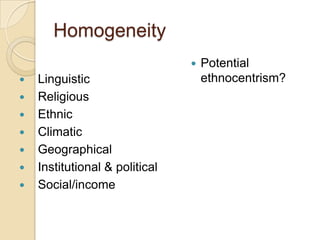
Homogeneity
                                   Potential
   Linguistic                      ethnocentrism?
   Religious
   Ethnic
   Climatic
   Geographical
   Institutional & political
   Social/income
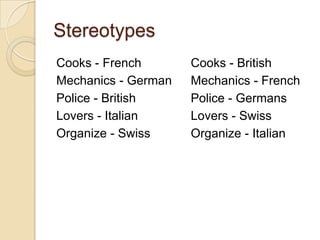
Stereotypes
Cooks - French       Cooks - British
Mechanics - German   Mechanics - French
Police - British     Police - Germans
Lovers - Italian     Lovers - Swiss
Organize - Swiss     Organize - Italian
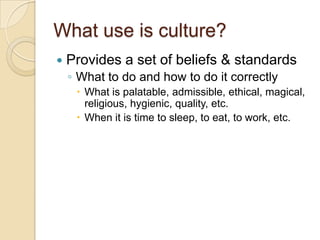
What use is culture?
   Provides a set of beliefs & standards
    ◦ What to do and how to do it correctly
      What is palatable, admissible, ethical, magical,
       religious, hygienic, quality, etc.
      When it is time to sleep, to eat, to work, etc.
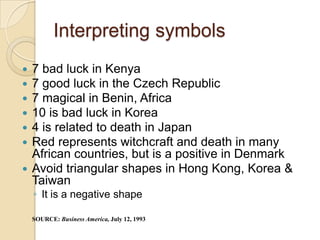
Interpreting symbols
 7 bad luck in Kenya
 7 good luck in the Czech Republic
 7 magical in Benin, Africa
 10 is bad luck in Korea
 4 is related to death in Japan
 Red represents witchcraft and death in many
  African countries, but is a positive in Denmark
 Avoid triangular shapes in Hong Kong, Korea &
  Taiwan
    ◦ It is a negative shape

    SOURCE: Business America, July 12, 1993
PART TWO

  CULTURAL DYNAMICS

         TIME AND SPACE
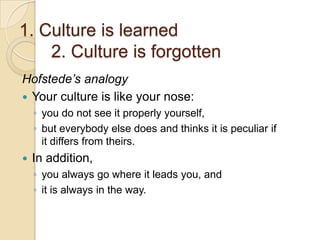
1. Culture is learned
    2. Culture is forgotten
Hofstede’s analogy
 Your culture is like your nose:
    ◦ you do not see it properly yourself,
    ◦ but everybody else does and thinks it is peculiar if
      it differs from theirs.
   In addition,
    ◦ you always go where it leads you, and
    ◦ it is always in the way.
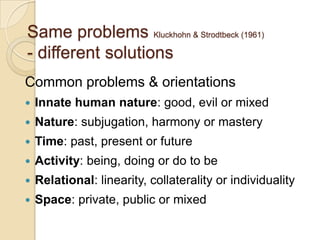
Same problems Kluckhohn & Strodtbeck (1961)
- different solutions
Common problems & orientations
   Innate human nature: good, evil or mixed
   Nature: subjugation, harmony or mastery
   Time: past, present or future
   Activity: being, doing or do to be
   Relational: linearity, collaterality or individuality
   Space: private, public or mixed
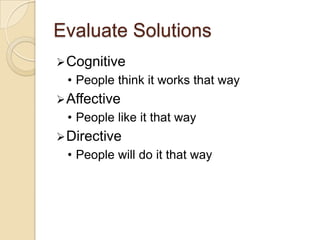
Evaluate Solutions
 Cognitive
 • People think it works that way
 Affective
 • People like it that way
 Directive
 • People will do it that way
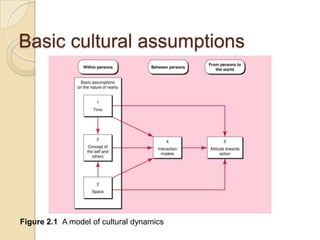
Basic cultural assumptions


Figure 2.1 A model of cultural dynamics
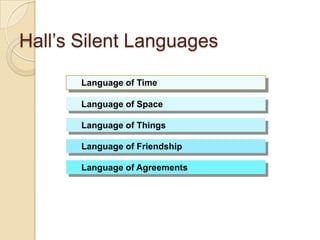
Hall’s Silent Languages

       Language of Time

       Language of Space

       Language of Things

       Language of Friendship

       Language of Agreements
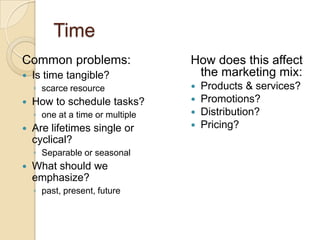
Time
Common problems:                  How does this affect
   Is time tangible?              the marketing mix:
    ◦ scarce resource                Products & services?
   How to schedule tasks?           Promotions?
    ◦ one at a time or multiple      Distribution?
   Are lifetimes single or          Pricing?
    cyclical?
    ◦ Separable or seasonal
   What should we
    emphasize?
    ◦ past, present, future
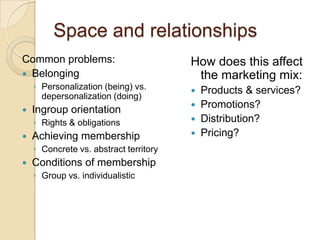
Space and relationships
Common problems:                        How does this affect
 Belonging                              the marketing mix:
    ◦ Personalization (being) vs.          Products & services?
      depersonalization (doing)
   Ingroup orientation                    Promotions?
    ◦ Rights & obligations                 Distribution?
   Achieving membership                   Pricing?
    ◦ Concrete vs. abstract territory
   Conditions of membership
    ◦ Group vs. individualistic
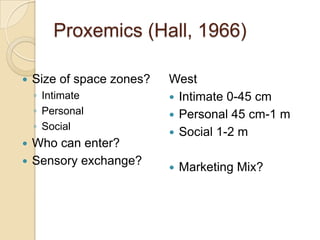
Proxemics (Hall, 1966)

   Size of space zones?   West
    ◦ Intimate              Intimate 0-45 cm
    ◦ Personal              Personal 45 cm-1 m
    ◦ Social
                            Social 1-2 m
 Who can enter?
 Sensory exchange?
                              Marketing Mix?
TASK                                            RELATIONSHIP
                  Mediterranean
  Northwestern     European       Traditional
 Central European


                          Latin
            North        American
           American                   Middle
                                      Eastern

                                             Global Business
                                           Schuster & Copeland
                                                 (1996)
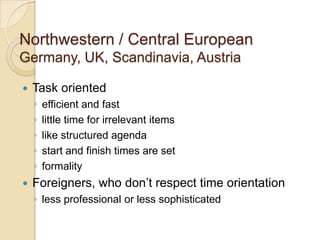
Northwestern / Central European
Germany, UK, Scandinavia, Austria

   Task oriented
    ◦   efficient and fast
    ◦   little time for irrelevant items
    ◦   like structured agenda
    ◦   start and finish times are set
    ◦   formality
   Foreigners, who don’t respect time orientation
    ◦ less professional or less sophisticated
Canada, USA, Australia
       Similar task orientation
        ◦ More casual, less formal
          Greetings and small talk, first name
        ◦ agendas are flexible
        ◦ Relationships are ‘business’
Mediterranean Europe
non-Parisian French, Iberian, Italian,
Greek
   Can use task orientation
    ◦ Extended tribe
    ◦ Develop a connection or personal bond
      meet informality probe personal connection
   Task important but time is flexible
    ◦ late, delay delivery is OK
    ◦ Competed tasks measure success
   Foreigners
    ◦ disconnect if no relationship
    ◦ connect on similarities e.g. tour, language
Latin American
   Increased relationship emphasis
    ◦ extended tribe include any Latin, Spanish country
    ◦ Can be task oriented but not preferred
    ◦ Relationship important, even for foreigners
      demonstrate trust, credibility or interest
      Rules change with relationship
      includes obligations and duties (multi-dimension)
    ◦ Task is important but so is trust, honour and
      compatibility
Traditional Cultures
    Asian, developing, centrally-controlled

◦   Similarities in orientation to sales
◦   Clan - identity, protection and preference
◦   Part of group or product in demand
◦   Relationships are the gateway
     cold selling not usually effective
◦   High context - words not so important
◦   Low context - responsibility, date, penalty
◦   Identify appropriate network
◦   Unique product
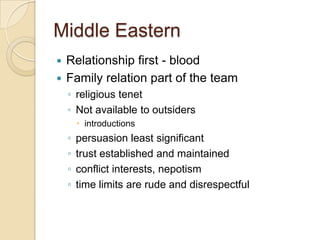
Middle Eastern
 Relationship first - blood
 Family relation part of the team
    ◦ religious tenet
    ◦ Not available to outsiders
         introductions
    ◦   persuasion least significant
    ◦   trust established and maintained
    ◦   conflict interests, nepotism
    ◦   time limits are rude and disrespectful
Traits of successful expatriate
 manager

 Ability to get along well with people
 awareness of cultural difference
 open-mindedness
 tolerance of foreign cultures
 adaptability
 interest
 previous experience
 ability to learn foreign languages
PART THREE

  CULTURAL DYNAMICS

     INTERACTIONS, MINDSETS
     AND BEHAVIOURS
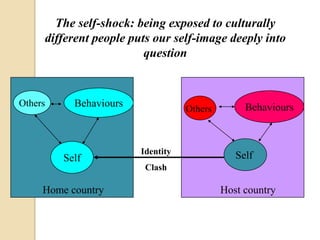
The self-shock: being exposed to culturally
     different people puts our self-image deeply into
                         question


Others     Behaviours                 Other     Behaviours
                                   Others


                        Identity              Self
         Self
                         Clash

     Home country                        Host country
Self and others
                                   How does this affect
                                    the marketing mix?
Common problems:
                                      Products & services?
   Treat strangers?                  Promotions?
    ◦ Nature good or bad?             Distribution?
   Appraise others?                  Pricing?
    ◦ Who do we trust?
   Appraise ourselves?
    ◦ What is valued?
   Relate to our group?
    ◦ Individualism-collectivism
Characterizing Dimensions


   Relation to authority
      hierarchical relations (power distance)
   Relation to self
      self-concept and personality (individualism)
   Relation to risk
      tolerance for unknown and deviations (uncertainty
       avoidance, tightness)
   Propensity to change
      receptivity of changes (Long term orientation)

                                             Clark (1990)
20 Statements
 I am _________
 I am _________
 I am _________
Collectivism vs. Individualism
   Collectivism                    Individualism
    ◦ emphasis ingroup needs &       ◦ emphasis self needs &
      goals                            goals
    ◦ beliefs shared with in-        ◦ beliefs distinguish from
      group                            others
    ◦ homogeneous ingroups           ◦ homogeneous outgroups
      heterogeneous outgroups          heterogeneous ingroups
    ◦ norms predict behaviour        ◦ attitudes predict behaviour
      better than attitudes            better than norms
Countries (1980)

   Individualism          Collectivism
    ◦   United States       ◦   Japan
    ◦   Great Britain       ◦   Iran
    ◦   Canada              ◦   Taiwan
    ◦   Italy               ◦   Colombia
    ◦   Australia
Application: (Nakata and Sivakumar 1996)
Individualism – increases self-reliance

 Individualism promotes new product
  development during the initial or
  conceptualization phase - nonconformity
 Collectivism promotes new product
  development during the implementation
  phase - interdependence
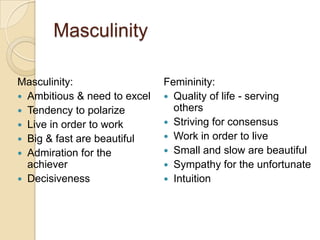
Masculinity

Masculinity:                  Femininity:
 Ambitious & need to excel    Quality of life - serving
 Tendency to polarize          others
 Live in order to work        Striving for consensus
 Big & fast are beautiful     Work in order to live
 Admiration for the           Small and slow are beautiful
  achiever                     Sympathy for the unfortunate
 Decisiveness                 Intuition
Countries (1980)

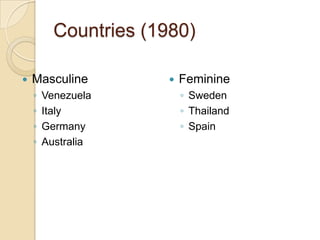
   Masculine            Feminine
    ◦   Venezuela         ◦ Sweden
    ◦   Italy             ◦ Thailand
    ◦   Germany           ◦ Spain
    ◦   Australia
Application: (Nakata and Sivakumar 1996)
Masculinity - increases self-reliance
 Femininity positively affects the
  conceptualization stage of new
  product development - supportive
  climate
 Masculinity promotes the
  implementation stage - goal
  directedness and formalization
Power Distance

Large                     Small
 High dependence needs    Low dependence needs
 Inequality accepted      Inequality minimized
 Hierarchy needed
                           Hierarchy for convenience
 Superiors often
                           Superiors accessible
  inaccessible
 Power-holders have       All have equal rights
  privileges
 Change by revolution       Change by evolution
Countries (1980)

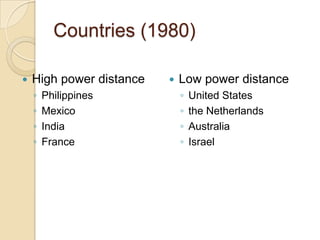
   High power distance      Low power distance
    ◦   Philippines           ◦   United States
    ◦   Mexico                ◦   the Netherlands
    ◦   India                 ◦   Australia
    ◦   France                ◦   Israel
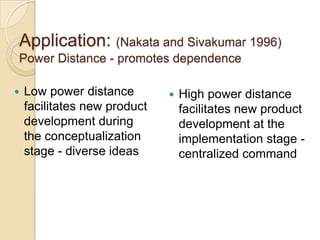
Application: (Nakata and Sivakumar 1996)
Power Distance - promotes dependence

   Low power distance           High power distance
    facilitates new product       facilitates new product
    development during            development at the
    the conceptualization         implementation stage -
    stage - diverse ideas         centralized command
Uncertainty Avoidance

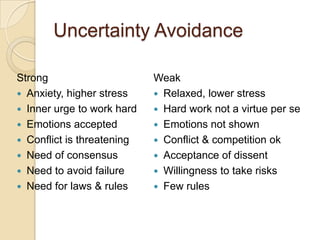
Strong                      Weak
 Anxiety, higher stress     Relaxed, lower stress
 Inner urge to work hard    Hard work not a virtue per se
 Emotions accepted          Emotions not shown
 Conflict is threatening    Conflict & competition ok
 Need of consensus          Acceptance of dissent
 Need to avoid failure      Willingness to take risks
 Need for laws & rules      Few rules
Countries (1980)

   High uncertainty      Low uncertainty
    avoidance              avoidance
    ◦   France             ◦   United States
    ◦   Belgium            ◦   Hong Kong
    ◦   Greece             ◦   Canada
    ◦   Portugal           ◦   Singapore
Application: (Nakata and Sivakumar 1996)
Uncertainty Avoidance - promotes dependence?


 Low uncertainty avoidance facilitates the
  initiation phase - risk taking and minimal
  controls
 High uncertainty avoidance facilitates
  implementation stage - tight planning and
  controls
Long/short term orientation or
         Confucian Dynamic

High                        Low
   Many truths                Absolute truth
    ◦ (time, context)
   Pragmatic                Conventional/traditional
   Long-term orientation    Short term orientation
   Acceptance of change     Concern for stability
   Perseverance             Quick results expected
   Thrift for investment    Spending for today
   Long term orientation      Short term orientation
    ◦   Hong Kong               ◦ West Africa
    ◦   Taiwan                  ◦ Canada
    ◦   Japan                   ◦ Pakistan
    ◦   South Korea
    ◦   Brazil
Application: (Nakata and Sivakumar 1996)

 Long term orientation promotes new
  product development
 Short term orientation impedes new
  product development
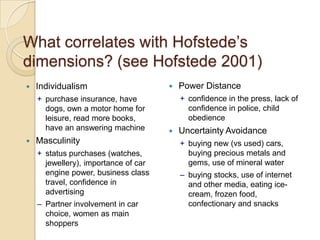
What correlates with Hofstede’s
dimensions? (see Hofstede 2001)
   Individualism                        Power Distance
    + purchase insurance, have            + confidence in the press, lack of
      dogs, own a motor home for            confidence in police, child
      leisure, read more books,             obedience
      have an answering machine          Uncertainty Avoidance
   Masculinity                           + buying new (vs used) cars,
    + status purchases (watches,            buying precious metals and
      jewellery), importance of car         gems, use of mineral water
      engine power, business class        – buying stocks, use of internet
      travel, confidence in                 and other media, eating ice-
      advertising                           cream, frozen food,
    – Partner involvement in car            confectionary and snacks
      choice, women as main
      shoppers
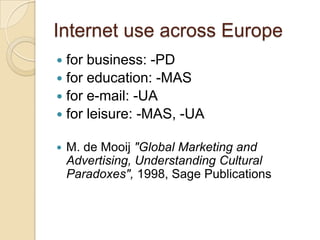
Internet use across Europe
 for business: -PD
 for education: -MAS
 for e-mail: -UA
 for leisure: -MAS, -UA

   M. de Mooij "Global Marketing and
    Advertising, Understanding Cultural
    Paradoxes", 1998, Sage Publications
Convergence of cultures so
far?
   Evidence says NO
    ◦ even if you only look at the rich countries
   People use the new media to
    strengthen their cultural identity
    ◦ immigrants, researchers, family members,
      hobbyists, extremists...
    ◦ living together apart
Schwartz Values & Individualism
More individualist
societies & young,
educated, urban

                                  Self-
                                Direction   Universalism

                       Simulation
                                                 Benevolence


                     Hedonism                Conformity Tradition


                       Achievement                 Security            More
                                                                    collectivist
                                       Power                         societies
                                                                    & religious
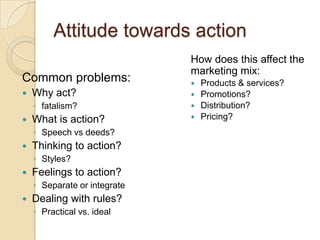
Attitude towards action
                              How does this affect the
                              marketing mix:
Common problems:                 Products & services?
   Why act?                     Promotions?
    ◦ fatalism?                  Distribution?
   What is action?              Pricing?
    ◦ Speech vs deeds?
   Thinking to action?
    ◦ Styles?
   Feelings to action?
    ◦ Separate or integrate
   Dealing with rules?
    ◦ Practical vs. ideal
Cultural assumptions &
           behaviour


Figure 3.2 Basic and cultural assumptions and actual behaviour
(Source: Derr and Laurent, 1989. Reproduced with permission)

Multicultural marketing - 1st Session

  • 1.
    Multicultural Marketing ICD – International Business School Prof: Baber MIRZA First Session 6th March ‘13
  • 2.
    Before we begin…  About your professor ◦ I like creativity with a touch of practicality ◦ Rules  About the teaching style ◦ Mostly French students ◦ English will be used with simple terms  About the course ◦ Material (book that I am using) ◦ You don’t need to buy a book, you can use this PowerPoint and my lecture as your notes ◦ Quizzes and Final Project  Next class there will be a quiz  I will also give you details about your final project in your next class
  • 3.
    Marketing and Consumer Behavior Marketing is about creating value for the customer  The customer is influenced by many factors such as culture, social group, personality  Culture is complex and is the target for marketers for profitable associations
  • 4.
    Today’s topics  The Cultural Variable(Factor) in International Marketing ◦ The cultural process ◦ Cultural dynamics part I: Time and Space ◦ Cultural dynamics part II: Interactions, Mindsets, and Behaviors
  • 5.
    PART ONE THE CULTURAL PROCESS
  • 6.
    Definitions of culture  Linton (1945, p. 21): 'A culture is the configuration of learned behaviour and results of behaviour whose component elements are shared and transmitted by the members of a particular society.’  Goodenough (1971): culture is a set of beliefs or standards, shared by a group of people, which help the individual decide what is, what can be, how to feel, what to do and how to go about doing it.
  • 7.
    Sources of Culture Language(s)  Nationality  Education  Profession  Group  Religion  Family  Sex  Social class  Corporate or organizational culture
  • 8.
    Elements of culture  Biological Foundations  Language and communication  Institutions  Material Productions  Symbolic Productions
  • 9.
    Homogeneity  Potential  Linguistic ethnocentrism?  Religious  Ethnic  Climatic  Geographical  Institutional & political  Social/income
  • 10.
    Stereotypes Cooks - French Cooks - British Mechanics - German Mechanics - French Police - British Police - Germans Lovers - Italian Lovers - Swiss Organize - Swiss Organize - Italian
  • 11.
    What use isculture?  Provides a set of beliefs & standards ◦ What to do and how to do it correctly  What is palatable, admissible, ethical, magical, religious, hygienic, quality, etc.  When it is time to sleep, to eat, to work, etc.
  • 12.
    Interpreting symbols  7bad luck in Kenya  7 good luck in the Czech Republic  7 magical in Benin, Africa  10 is bad luck in Korea  4 is related to death in Japan  Red represents witchcraft and death in many African countries, but is a positive in Denmark  Avoid triangular shapes in Hong Kong, Korea & Taiwan ◦ It is a negative shape SOURCE: Business America, July 12, 1993
  • 13.
    PART TWO CULTURAL DYNAMICS TIME AND SPACE
  • 14.
    1. Culture islearned 2. Culture is forgotten Hofstede’s analogy  Your culture is like your nose: ◦ you do not see it properly yourself, ◦ but everybody else does and thinks it is peculiar if it differs from theirs.  In addition, ◦ you always go where it leads you, and ◦ it is always in the way.
  • 15.
    Same problems Kluckhohn& Strodtbeck (1961) - different solutions Common problems & orientations  Innate human nature: good, evil or mixed  Nature: subjugation, harmony or mastery  Time: past, present or future  Activity: being, doing or do to be  Relational: linearity, collaterality or individuality  Space: private, public or mixed
  • 16.
    Evaluate Solutions  Cognitive • People think it works that way  Affective • People like it that way  Directive • People will do it that way
  • 17.
    Basic cultural assumptions Figure2.1 A model of cultural dynamics
  • 18.
    Hall’s Silent Languages Language of Time Language of Space Language of Things Language of Friendship Language of Agreements
  • 19.
    Time Common problems: How does this affect  Is time tangible? the marketing mix: ◦ scarce resource  Products & services?  How to schedule tasks?  Promotions? ◦ one at a time or multiple  Distribution?  Are lifetimes single or  Pricing? cyclical? ◦ Separable or seasonal  What should we emphasize? ◦ past, present, future
  • 20.
    Space and relationships Commonproblems: How does this affect  Belonging the marketing mix: ◦ Personalization (being) vs.  Products & services? depersonalization (doing)  Ingroup orientation  Promotions? ◦ Rights & obligations  Distribution?  Achieving membership  Pricing? ◦ Concrete vs. abstract territory  Conditions of membership ◦ Group vs. individualistic
  • 21.
    Proxemics (Hall, 1966)  Size of space zones? West ◦ Intimate  Intimate 0-45 cm ◦ Personal  Personal 45 cm-1 m ◦ Social  Social 1-2 m  Who can enter?  Sensory exchange?  Marketing Mix?
  • 22.
    TASK RELATIONSHIP Mediterranean Northwestern European Traditional Central European Latin North American American Middle Eastern Global Business Schuster & Copeland (1996)
  • 23.
    Northwestern / CentralEuropean Germany, UK, Scandinavia, Austria  Task oriented ◦ efficient and fast ◦ little time for irrelevant items ◦ like structured agenda ◦ start and finish times are set ◦ formality  Foreigners, who don’t respect time orientation ◦ less professional or less sophisticated
  • 24.
    Canada, USA, Australia  Similar task orientation ◦ More casual, less formal  Greetings and small talk, first name ◦ agendas are flexible ◦ Relationships are ‘business’
  • 25.
    Mediterranean Europe non-Parisian French,Iberian, Italian, Greek  Can use task orientation ◦ Extended tribe ◦ Develop a connection or personal bond  meet informality probe personal connection  Task important but time is flexible ◦ late, delay delivery is OK ◦ Competed tasks measure success  Foreigners ◦ disconnect if no relationship ◦ connect on similarities e.g. tour, language
  • 26.
    Latin American  Increased relationship emphasis ◦ extended tribe include any Latin, Spanish country ◦ Can be task oriented but not preferred ◦ Relationship important, even for foreigners  demonstrate trust, credibility or interest  Rules change with relationship  includes obligations and duties (multi-dimension) ◦ Task is important but so is trust, honour and compatibility
  • 27.
    Traditional Cultures Asian, developing, centrally-controlled ◦ Similarities in orientation to sales ◦ Clan - identity, protection and preference ◦ Part of group or product in demand ◦ Relationships are the gateway  cold selling not usually effective ◦ High context - words not so important ◦ Low context - responsibility, date, penalty ◦ Identify appropriate network ◦ Unique product
  • 28.
    Middle Eastern  Relationshipfirst - blood  Family relation part of the team ◦ religious tenet ◦ Not available to outsiders  introductions ◦ persuasion least significant ◦ trust established and maintained ◦ conflict interests, nepotism ◦ time limits are rude and disrespectful
  • 29.
    Traits of successfulexpatriate manager  Ability to get along well with people  awareness of cultural difference  open-mindedness  tolerance of foreign cultures  adaptability  interest  previous experience  ability to learn foreign languages
  • 30.
    PART THREE CULTURAL DYNAMICS INTERACTIONS, MINDSETS AND BEHAVIOURS
  • 31.
    The self-shock: beingexposed to culturally different people puts our self-image deeply into question Others Behaviours Other Behaviours Others Identity Self Self Clash Home country Host country
  • 32.
    Self and others How does this affect the marketing mix? Common problems:  Products & services?  Treat strangers?  Promotions? ◦ Nature good or bad?  Distribution?  Appraise others?  Pricing? ◦ Who do we trust?  Appraise ourselves? ◦ What is valued?  Relate to our group? ◦ Individualism-collectivism
  • 33.
    Characterizing Dimensions  Relation to authority  hierarchical relations (power distance)  Relation to self  self-concept and personality (individualism)  Relation to risk  tolerance for unknown and deviations (uncertainty avoidance, tightness)  Propensity to change  receptivity of changes (Long term orientation) Clark (1990)
  • 34.
    20 Statements  Iam _________  I am _________  I am _________
  • 35.
    Collectivism vs. Individualism  Collectivism  Individualism ◦ emphasis ingroup needs & ◦ emphasis self needs & goals goals ◦ beliefs shared with in- ◦ beliefs distinguish from group others ◦ homogeneous ingroups ◦ homogeneous outgroups heterogeneous outgroups heterogeneous ingroups ◦ norms predict behaviour ◦ attitudes predict behaviour better than attitudes better than norms
  • 36.
    Countries (1980)  Individualism  Collectivism ◦ United States ◦ Japan ◦ Great Britain ◦ Iran ◦ Canada ◦ Taiwan ◦ Italy ◦ Colombia ◦ Australia
  • 37.
    Application: (Nakata andSivakumar 1996) Individualism – increases self-reliance  Individualism promotes new product development during the initial or conceptualization phase - nonconformity  Collectivism promotes new product development during the implementation phase - interdependence
  • 38.
    Masculinity Masculinity: Femininity:  Ambitious & need to excel  Quality of life - serving  Tendency to polarize others  Live in order to work  Striving for consensus  Big & fast are beautiful  Work in order to live  Admiration for the  Small and slow are beautiful achiever  Sympathy for the unfortunate  Decisiveness  Intuition
  • 39.
    Countries (1980)  Masculine  Feminine ◦ Venezuela ◦ Sweden ◦ Italy ◦ Thailand ◦ Germany ◦ Spain ◦ Australia
  • 40.
    Application: (Nakata andSivakumar 1996) Masculinity - increases self-reliance  Femininity positively affects the conceptualization stage of new product development - supportive climate  Masculinity promotes the implementation stage - goal directedness and formalization
  • 41.
    Power Distance Large Small  High dependence needs  Low dependence needs  Inequality accepted  Inequality minimized  Hierarchy needed  Hierarchy for convenience  Superiors often  Superiors accessible inaccessible  Power-holders have  All have equal rights privileges  Change by revolution  Change by evolution
  • 42.
    Countries (1980)  High power distance  Low power distance ◦ Philippines ◦ United States ◦ Mexico ◦ the Netherlands ◦ India ◦ Australia ◦ France ◦ Israel
  • 43.
    Application: (Nakata andSivakumar 1996) Power Distance - promotes dependence  Low power distance  High power distance facilitates new product facilitates new product development during development at the the conceptualization implementation stage - stage - diverse ideas centralized command
  • 44.
    Uncertainty Avoidance Strong Weak  Anxiety, higher stress  Relaxed, lower stress  Inner urge to work hard  Hard work not a virtue per se  Emotions accepted  Emotions not shown  Conflict is threatening  Conflict & competition ok  Need of consensus  Acceptance of dissent  Need to avoid failure  Willingness to take risks  Need for laws & rules  Few rules
  • 45.
    Countries (1980)  High uncertainty  Low uncertainty avoidance avoidance ◦ France ◦ United States ◦ Belgium ◦ Hong Kong ◦ Greece ◦ Canada ◦ Portugal ◦ Singapore
  • 46.
    Application: (Nakata andSivakumar 1996) Uncertainty Avoidance - promotes dependence?  Low uncertainty avoidance facilitates the initiation phase - risk taking and minimal controls  High uncertainty avoidance facilitates implementation stage - tight planning and controls
  • 47.
    Long/short term orientationor Confucian Dynamic High Low  Many truths  Absolute truth ◦ (time, context)  Pragmatic  Conventional/traditional  Long-term orientation  Short term orientation  Acceptance of change  Concern for stability  Perseverance  Quick results expected  Thrift for investment  Spending for today
  • 48.
    Long term orientation  Short term orientation ◦ Hong Kong ◦ West Africa ◦ Taiwan ◦ Canada ◦ Japan ◦ Pakistan ◦ South Korea ◦ Brazil
  • 49.
    Application: (Nakata andSivakumar 1996)  Long term orientation promotes new product development  Short term orientation impedes new product development
  • 50.
    What correlates withHofstede’s dimensions? (see Hofstede 2001)  Individualism  Power Distance + purchase insurance, have + confidence in the press, lack of dogs, own a motor home for confidence in police, child leisure, read more books, obedience have an answering machine  Uncertainty Avoidance  Masculinity + buying new (vs used) cars, + status purchases (watches, buying precious metals and jewellery), importance of car gems, use of mineral water engine power, business class – buying stocks, use of internet travel, confidence in and other media, eating ice- advertising cream, frozen food, – Partner involvement in car confectionary and snacks choice, women as main shoppers
  • 51.
    Internet use acrossEurope  for business: -PD  for education: -MAS  for e-mail: -UA  for leisure: -MAS, -UA  M. de Mooij "Global Marketing and Advertising, Understanding Cultural Paradoxes", 1998, Sage Publications
  • 52.
    Convergence of culturesso far?  Evidence says NO ◦ even if you only look at the rich countries  People use the new media to strengthen their cultural identity ◦ immigrants, researchers, family members, hobbyists, extremists... ◦ living together apart
  • 53.
    Schwartz Values &Individualism More individualist societies & young, educated, urban Self- Direction Universalism Simulation Benevolence Hedonism Conformity Tradition Achievement Security More collectivist Power societies & religious
  • 54.
    Attitude towards action How does this affect the marketing mix: Common problems:  Products & services?  Why act?  Promotions? ◦ fatalism?  Distribution?  What is action?  Pricing? ◦ Speech vs deeds?  Thinking to action? ◦ Styles?  Feelings to action? ◦ Separate or integrate  Dealing with rules? ◦ Practical vs. ideal
  • 55.
    Cultural assumptions & behaviour Figure 3.2 Basic and cultural assumptions and actual behaviour (Source: Derr and Laurent, 1989. Reproduced with permission)

Editor's Notes

  • #9 Whorf defends the idea that the language we learn in the community where we are born and raised shapes and structures our world-view and our social behaviour. It influences the way in which we select issues, solve problems and finally, act.Institutional elements are the ‘spine’ of the cultural process. They link the individual to the group. Institutions may include family as well as political institutions, or any kind of social organization within which the individual has to comply with rules in exchange for various rewards (e.g. being fed, loved, paid, and so on). These rules are not static and an individual may also sometimes act as a proactive agent of change.the relationship between the purely biological needs of people and the way in which people are organized and regulated within the framework of the cultural community. ‘We have to base our theory of culture on the fact that all human beings belong to an animal species. . . . No culture can continue if the group is not replenished continually and normally.’ example of eating habits, which must be regarded as both biological and cultural
  • #10 Homogeneity clearly favours the emergence of a coherent culture in a nation-state, perhaps leading to the possible confusion of culture and country and the treatment of country as a culturally unified, coherent segment.