LE CORBUSIER  BIOGRAPHY
EARLY YEARS: Charles-Edouard Jeanneret-Gris was born in
Switzerland on 6th October 1887. His father was a artist in the
watch industry and his mother a piano teacher. Le Corbusier left
primary school at the age of 13 in order to attend Arts Décoratifs at
La Chaux-de-Fonds, where he would learn the art of enamelling
and engraving watches following his fathers footsteps. He was then
coached by L’Eplattenier who he called “my master”. L’Eplattenier
taught him art history, drawing and the naturalist aesthetics of art
nouveau. Corbusier abandoned watchmaking and continued with
his studies in art and decoration, he intended to become a painter.
L’Eplattenier insisted that all his students study architecture and
arranged Corbusier’s first commissions working on a local project.
He designed his first home in 1907 at age 20, after this he took
trips through central Europe and the Mediterranean. On his travels
he worked as an apprentice for various architects, most significantly
with Auguste Perret; a pioneer of reinforced concrete construction
and later on he worked with Peter Behrens in 1910 near Berlin.
EARLY CAREER: These trips played a major role in Corbusier’s
education. He made three large discoveries, in various settings he
found the importance of (1) the contrast between large collective
spaces and individual compartmentalised spaces, (2) classical
proportion via Renaissance architecture; and (3) geometric forms
and the use of landscapes as an architectural tool. In 1912, Le
Corbusier taught alongside L’Eplattenier and opened his own
architecture practice. He designed villas and began to create
theories on the use of reinforced concrete as a structural frame. He
used these theories as a concept to design affordable homes that
would help to rebuild cities after the first world war. His floor plans
were very open and left out obstructive support poles and the usual
structural constraints. This was the design system Le Corbusier
used in his architecture for the next 10 years.
MOVE TO PARIS: In 1917 he moved to Paris where he worked for the
government on concrete structures. He spent most of his time on
more influential paintings. Then in 1918 he met Amédée Ozenfant,
a cubist painter, who encouraged him to paint. They began to
collaborate and rejected cubism as an art form, this lead to the
release of their book ‘After Cubism’ a new artistic movement called
purism. They met a poet called Paul Dermé and established a Purist
journal ‘The New Spirit’.
CITROHAN AND THE CONTEMPORARY CITY: He proposed new
architecture that would satisfy the demands of the industry, hence
the functionalism and concerns of architecture forms. His proposals
included his first city plan and two types of houses that were the
basis for much of the architecture throughout his life. He
envisioned prefabricated houses that imitated the concept of an
assembly line, like how cars are made. Maison Citrohan had
characteristic that would later define modern architecture; support
pillars, a roof terrace, an open floor plan, an ornamentation-free
façade and horizontal windows in strips for maximum natural light.
The interior had typical spatial contrast between open living space
and cell-like bedrooms. The city featured parks and gardens at the
feet of skyscrapers. In 1925-1926 he built a workers’ city of 40
houses in the style of the Citrohan house. Unfortunately the chosen
design and colours provoked the authorities, who refused to
provide the homes with water supply and the buildings were
uninhabited for six years.
THE RADIANT CITY: in the 1930s he reformulated his ideas about
urbanism and published them in ‘The Radiant City’ in 1935. The
distinction between the Contemporary City and the Radiant City is
that the class system was abandoned and housing was now
assigned by family size, not economic position. He dreamt of
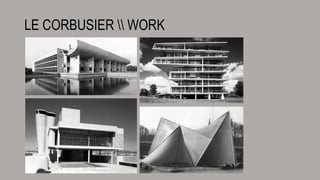
LE CORBUSIER  WORK
LE CORBUSIER  MAIN INFLUENCES
• L’Eplattenier was in his eyes his ‘only teacher’. L’Eplattenier was the man who made Le Corbusier
learn about architecture was probably one of his biggest influences as he was taught by him from
the age of 13. L’Eplattenier was a Swiss painter and architect himself which could explain Le
Corbusier’s main interests were painting and architecture.
• His visits to Central Europe and the Mediterranean may have had huge influences on his work. In
Central Europe, the Art Nouveau period Architecture was very influential on a wide range of art
forms, such as painting.
• Auguste Perret was a pioneer of reinforced concrete construction. It is evident in Le Corbusier’s
work that this apprenticeship was very influential because he designed his two city plans based on
the idea of prefabricated reinforced concrete.
• Peter Behrens was a German designer of many practices; he was an architect, painter and graphic
designer. Le Corbusier worked as an apprentice for him while he was traveling around Europe.
• Amédée Ozenfant was a French cubist painter. Along with Le Corbusier they founded the cubist
rejection movement Purism. Together, they published a book called ‘After Cubism’.
• Paul Dermé was a Belgian writer, poet and literature critique. As a trio – Le Corbusier, Amédée
Ozenfant and Paul Dermé – they release a Purist journal called ‘The Free Spirit’.
LE CORBUSIER  THINKING APPROACH
After he had been travelling he noticed the importance of three key factors:
1) The contrast between large collective spaces and individual compartmentalised spaces.
2) Classical proportion via Renaissance architecture.
3) Geometric forms and the use of landscapes as an architectural tool.
‘A house is a machine for living in’
A machine is seen as something functional rather than aesthetically sound but Corbusier managed to
combine the two and create modernist works of architecture.
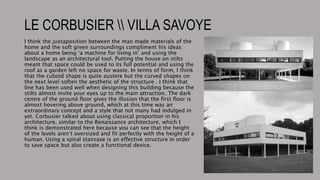
LE CORBUSIER  VILLA SAVOYE
I think the juxtaposition between the man made materials of the
home and the soft green surroundings compliment his ideas
about a home being ‘a machine for living in’ and using the
landscape as an architectural tool. Putting the house on stilts
meant that space could be used to its full potential and using the
roof as a garden left no space for waste. In terms of form, I think
that the cuboid shape is quite austere but the curved shapes on
the next level soften the aesthetic of the structure . I think that
line has been used well when designing this building because the
stilts almost invite your eyes up to the main attraction. The dark
centre of the ground floor gives the illusion that the first floor is
almost hovering above ground, which at this time was an
extraordinary concept and a style that not many had indulged in
yet. Corbusier talked about using classical proportion in his
architecture, similar to the Renaissance architecture, which I
think is demonstrated here because you can see that the height
of the levels aren’t oversized and fit perfectly with the height of a
human. Using a spiral staircase is an effective structure in order
to save space but also create a functional device.
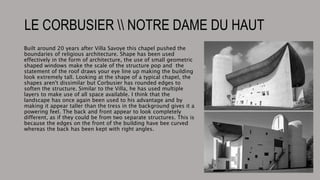
LE CORBUSIER  NOTRE DAME DU HAUT
Built around 20 years after Villa Savoye this chapel pushed the
boundaries of religious architecture. Shape has been used
effectively in the form of architecture, the use of small geometric
shaped windows make the scale of the structure pop and the
statement of the roof draws your eye line up making the building
look extremely tall. Looking at the shape of a typical chapel, the
shapes aren't dissimilar but Corbusier has rounded edges to
soften the structure. Similar to the Villa, he has used multiple
layers to make use of all space available. I think that the
landscape has once again been used to his advantage and by
making it appear taller than the tress in the background gives it a
powering feel. The back and front appear to look completely
different, as if they could be from two separate structures. This is
because the edges on the front of the building have bee curved
whereas the back has been kept with right angles.
CONSTANTIN BRANCUSI  BIOGRAPHY
EARLY YEARS: Romanian Constantin Brancusi was born on 19th February
1876 in Romania. His parents were peasants who lived in the Romanian
countryside; Brancusi did not go to school like many of the other village
children at that time. At the age of seven he worked as a herdsman, at
first watching the family flock and then working for other people in the
Carpathian Mountains. It was in the mountains that young Brancusi
learnt how to carve wood, a popular art in rural Romania for making
spoons and bedposts, which were all ornamented with carvings. The
style of these ornaments would influence his later works. When he was
nine he went to a town called Tîrgu Jiu to look for work. He first worked
for a dyer; two years later he worked as a grocer; and then became a
domestic in a public house. He kept his taste for working in wood and
undertook big carving projects such as constructing a violin from and
orange crate. This work attracted an industrialist who in 1894 entered
him in the Craivoa School of Arts and Crafts; in order to attend the
school, Brancusi had to learn to read and write. In 1896, aged 20,
Brancusi travelled for the first time; he went to Vienna and hired himself
out as a woodworker to pay for his stay. In 1898 he entered the contest
for admission to the Buchrest School of Fine Arts because he wanted to
be a sculptor; he was admitted.
In 1903, when he had returned from military service, he was interested
in Auguste Rodin’s fame from Paris to Bucharest. Rodin inspired
Brancusi to be curious about what happened behind the limits and
boundaries of art in his own country, so he took a trip to Munich where
he stayed until the spring of 1904 and then he decided to go to Paris.
He made most of the trip by foot and had to sell a watch to pay for a
boat crossing. Brancusi entered Antonin Mercié’s workshop, who got his
work from Florentine Renaissance statutory. He worked with Mercié for
two years but in order to earn a living he worked on other odd jobs.
Brancusi took orders for portraits to make extra money. In 1906 he
exhibited for the first time in Paris in the state-sponsored Salon. His
spirit was still quite classical but his first works were influenced by
Rodin. To get away from Rodin’s influence he refused to enter Rodin’s
workshop. In 1907 Brancusi was commissioned to make a rich
landowner’s funeral monument in Romania; he sculpted a young girl
This was the first stage of hi evolution towards simplified forms. He
exhibited an annual exhibition that showcased new talent. In 1908 he
revealed his first truly original work; ‘The Kiss’.
MATURITY: In 1910 Brancusi began to experiment with ovoid-shaped
pieces in different materials such as bronze and plaster. For Brancusi
this ovoid mass represents the simple essence of form or a foundation
of from that the artist did not care to alter with traditional sculptural
techniques. His experiments extended with him simplifying forms to his
exploration of the bird in 1912 with Maiastra. The original sculpture
was made from marble and was followed by 28 other variations over the
next two decades. It evolved into a series of polished-bronze
sculptures. During his years of experimentation he began to have an
increasingly large international audience. In 1913 while continuing to
exhibit in the Salon in Paris he participated in the Armory Show in New
York, Chicago and Boston. He had found faithful collectors but critics
around the world attacked the radical nature of his work. His 1920
piece ‘Princess X’ was removed by the police due to its improper
interpretation. In 1922 he began to sculpt versions of his earlier works
in wood. His shipping to France got him a two year court case because
of a copper piece. They did not believe it was a sculpture because it was
so abstract.
LATE LIFE: He was commissioned to create a temple that would house
his sculptures in India. He worked several years to create this temple
but it was never realised. Brancusi had returned to New York for a new
exhibition. He continued to explore his favourite themes in his later
years. A large amount od exhibitions in the USA would secure his fame.
In his will Brancusi gave everything in his workshop to the Musée
National d’Art Moderne in Paris, on the condition that the workshop its
self be moved to the museum.
CONSTANTIN BRANCUSI  WORK
CONSTANTIN BRANCUSI  MAIN INFLUENCES
• The Carpathian Mountains where he spent a lot of time as a child and learnt how to sculpt wood.
Without these key years in his life he wouldn’t have started sculpture.
• Auguste Rodin was a massive influence of Brancusi’s throughout the early years of his career.
Rodin was a French sculptor who was influenced by Florentine Renaissance.
• Antonin Mercié was another French sculptor who Brancusi worked for on his travels in Paris.
CONSTANTIN BRANCUSI  THINKING
APPROACH
1) Create like a god, command like a king, work like a slave.
2) Architecture is inhabited sculpture.
3) Simplicity is not an objective in art, but one achieves simplicity despite one's self by entering into
the real sense of things.
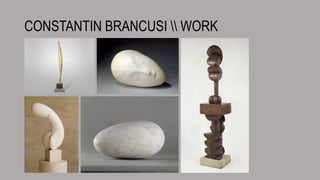
CONSTANTIN BRANCUSI  THE KISS
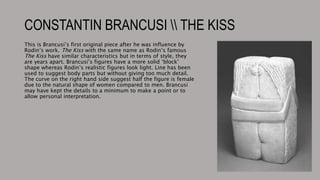
This is Brancusi’s first original piece after he was influence by
Rodin’s work. The Kiss with the same name as Rodin’s famous
The Kiss have similar characteristics but in terms of style, they
are years apart. Brancusi’s figures have a more solid ‘block’
shape whereas Rodin’s realistic figures look light. Line has been
used to suggest body parts but without giving too much detail.
The curve on the right hand side suggest half the figure is female
due to the natural shape of women compared to men. Brancusi
may have kept the details to a minimum to make a point or to
allow personal interpretation.
CONSTANTIN BRANCUSI  BEGINNING OF THE
WORLD
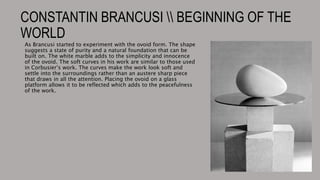
As Brancusi started to experiment with the ovoid form. The shape
suggests a state of purity and a natural foundation that can be
built on. The white marble adds to the simplicity and innocence
of the ovoid. The soft curves in his work are similar to those used
in Corbusier’s work. The curves make the work look soft and
settle into the surroundings rather than an austere sharp piece
that draws in all the attention. Placing the ovoid on a glass
platform allows it to be reflected which adds to the peacefulness
of the work.

Le corbsuier and Constantin Brancusi

  • 1.
    LE CORBUSIER BIOGRAPHY EARLY YEARS: Charles-Edouard Jeanneret-Gris was born in Switzerland on 6th October 1887. His father was a artist in the watch industry and his mother a piano teacher. Le Corbusier left primary school at the age of 13 in order to attend Arts Décoratifs at La Chaux-de-Fonds, where he would learn the art of enamelling and engraving watches following his fathers footsteps. He was then coached by L’Eplattenier who he called “my master”. L’Eplattenier taught him art history, drawing and the naturalist aesthetics of art nouveau. Corbusier abandoned watchmaking and continued with his studies in art and decoration, he intended to become a painter. L’Eplattenier insisted that all his students study architecture and arranged Corbusier’s first commissions working on a local project. He designed his first home in 1907 at age 20, after this he took trips through central Europe and the Mediterranean. On his travels he worked as an apprentice for various architects, most significantly with Auguste Perret; a pioneer of reinforced concrete construction and later on he worked with Peter Behrens in 1910 near Berlin. EARLY CAREER: These trips played a major role in Corbusier’s education. He made three large discoveries, in various settings he found the importance of (1) the contrast between large collective spaces and individual compartmentalised spaces, (2) classical proportion via Renaissance architecture; and (3) geometric forms and the use of landscapes as an architectural tool. In 1912, Le Corbusier taught alongside L’Eplattenier and opened his own architecture practice. He designed villas and began to create theories on the use of reinforced concrete as a structural frame. He used these theories as a concept to design affordable homes that would help to rebuild cities after the first world war. His floor plans were very open and left out obstructive support poles and the usual structural constraints. This was the design system Le Corbusier used in his architecture for the next 10 years. MOVE TO PARIS: In 1917 he moved to Paris where he worked for the government on concrete structures. He spent most of his time on more influential paintings. Then in 1918 he met Amédée Ozenfant, a cubist painter, who encouraged him to paint. They began to collaborate and rejected cubism as an art form, this lead to the release of their book ‘After Cubism’ a new artistic movement called purism. They met a poet called Paul Dermé and established a Purist journal ‘The New Spirit’. CITROHAN AND THE CONTEMPORARY CITY: He proposed new architecture that would satisfy the demands of the industry, hence the functionalism and concerns of architecture forms. His proposals included his first city plan and two types of houses that were the basis for much of the architecture throughout his life. He envisioned prefabricated houses that imitated the concept of an assembly line, like how cars are made. Maison Citrohan had characteristic that would later define modern architecture; support pillars, a roof terrace, an open floor plan, an ornamentation-free façade and horizontal windows in strips for maximum natural light. The interior had typical spatial contrast between open living space and cell-like bedrooms. The city featured parks and gardens at the feet of skyscrapers. In 1925-1926 he built a workers’ city of 40 houses in the style of the Citrohan house. Unfortunately the chosen design and colours provoked the authorities, who refused to provide the homes with water supply and the buildings were uninhabited for six years. THE RADIANT CITY: in the 1930s he reformulated his ideas about urbanism and published them in ‘The Radiant City’ in 1935. The distinction between the Contemporary City and the Radiant City is that the class system was abandoned and housing was now assigned by family size, not economic position. He dreamt of
  • 2.
  • 3.
    LE CORBUSIER MAIN INFLUENCES • L’Eplattenier was in his eyes his ‘only teacher’. L’Eplattenier was the man who made Le Corbusier learn about architecture was probably one of his biggest influences as he was taught by him from the age of 13. L’Eplattenier was a Swiss painter and architect himself which could explain Le Corbusier’s main interests were painting and architecture. • His visits to Central Europe and the Mediterranean may have had huge influences on his work. In Central Europe, the Art Nouveau period Architecture was very influential on a wide range of art forms, such as painting. • Auguste Perret was a pioneer of reinforced concrete construction. It is evident in Le Corbusier’s work that this apprenticeship was very influential because he designed his two city plans based on the idea of prefabricated reinforced concrete. • Peter Behrens was a German designer of many practices; he was an architect, painter and graphic designer. Le Corbusier worked as an apprentice for him while he was traveling around Europe. • Amédée Ozenfant was a French cubist painter. Along with Le Corbusier they founded the cubist rejection movement Purism. Together, they published a book called ‘After Cubism’. • Paul Dermé was a Belgian writer, poet and literature critique. As a trio – Le Corbusier, Amédée Ozenfant and Paul Dermé – they release a Purist journal called ‘The Free Spirit’.
  • 4.
    LE CORBUSIER THINKING APPROACH After he had been travelling he noticed the importance of three key factors: 1) The contrast between large collective spaces and individual compartmentalised spaces. 2) Classical proportion via Renaissance architecture. 3) Geometric forms and the use of landscapes as an architectural tool. ‘A house is a machine for living in’ A machine is seen as something functional rather than aesthetically sound but Corbusier managed to combine the two and create modernist works of architecture.
  • 5.
    LE CORBUSIER VILLA SAVOYE I think the juxtaposition between the man made materials of the home and the soft green surroundings compliment his ideas about a home being ‘a machine for living in’ and using the landscape as an architectural tool. Putting the house on stilts meant that space could be used to its full potential and using the roof as a garden left no space for waste. In terms of form, I think that the cuboid shape is quite austere but the curved shapes on the next level soften the aesthetic of the structure . I think that line has been used well when designing this building because the stilts almost invite your eyes up to the main attraction. The dark centre of the ground floor gives the illusion that the first floor is almost hovering above ground, which at this time was an extraordinary concept and a style that not many had indulged in yet. Corbusier talked about using classical proportion in his architecture, similar to the Renaissance architecture, which I think is demonstrated here because you can see that the height of the levels aren’t oversized and fit perfectly with the height of a human. Using a spiral staircase is an effective structure in order to save space but also create a functional device.
  • 6.
    LE CORBUSIER NOTRE DAME DU HAUT Built around 20 years after Villa Savoye this chapel pushed the boundaries of religious architecture. Shape has been used effectively in the form of architecture, the use of small geometric shaped windows make the scale of the structure pop and the statement of the roof draws your eye line up making the building look extremely tall. Looking at the shape of a typical chapel, the shapes aren't dissimilar but Corbusier has rounded edges to soften the structure. Similar to the Villa, he has used multiple layers to make use of all space available. I think that the landscape has once again been used to his advantage and by making it appear taller than the tress in the background gives it a powering feel. The back and front appear to look completely different, as if they could be from two separate structures. This is because the edges on the front of the building have bee curved whereas the back has been kept with right angles.
  • 7.
    CONSTANTIN BRANCUSI BIOGRAPHY EARLY YEARS: Romanian Constantin Brancusi was born on 19th February 1876 in Romania. His parents were peasants who lived in the Romanian countryside; Brancusi did not go to school like many of the other village children at that time. At the age of seven he worked as a herdsman, at first watching the family flock and then working for other people in the Carpathian Mountains. It was in the mountains that young Brancusi learnt how to carve wood, a popular art in rural Romania for making spoons and bedposts, which were all ornamented with carvings. The style of these ornaments would influence his later works. When he was nine he went to a town called Tîrgu Jiu to look for work. He first worked for a dyer; two years later he worked as a grocer; and then became a domestic in a public house. He kept his taste for working in wood and undertook big carving projects such as constructing a violin from and orange crate. This work attracted an industrialist who in 1894 entered him in the Craivoa School of Arts and Crafts; in order to attend the school, Brancusi had to learn to read and write. In 1896, aged 20, Brancusi travelled for the first time; he went to Vienna and hired himself out as a woodworker to pay for his stay. In 1898 he entered the contest for admission to the Buchrest School of Fine Arts because he wanted to be a sculptor; he was admitted. In 1903, when he had returned from military service, he was interested in Auguste Rodin’s fame from Paris to Bucharest. Rodin inspired Brancusi to be curious about what happened behind the limits and boundaries of art in his own country, so he took a trip to Munich where he stayed until the spring of 1904 and then he decided to go to Paris. He made most of the trip by foot and had to sell a watch to pay for a boat crossing. Brancusi entered Antonin Mercié’s workshop, who got his work from Florentine Renaissance statutory. He worked with Mercié for two years but in order to earn a living he worked on other odd jobs. Brancusi took orders for portraits to make extra money. In 1906 he exhibited for the first time in Paris in the state-sponsored Salon. His spirit was still quite classical but his first works were influenced by Rodin. To get away from Rodin’s influence he refused to enter Rodin’s workshop. In 1907 Brancusi was commissioned to make a rich landowner’s funeral monument in Romania; he sculpted a young girl This was the first stage of hi evolution towards simplified forms. He exhibited an annual exhibition that showcased new talent. In 1908 he revealed his first truly original work; ‘The Kiss’. MATURITY: In 1910 Brancusi began to experiment with ovoid-shaped pieces in different materials such as bronze and plaster. For Brancusi this ovoid mass represents the simple essence of form or a foundation of from that the artist did not care to alter with traditional sculptural techniques. His experiments extended with him simplifying forms to his exploration of the bird in 1912 with Maiastra. The original sculpture was made from marble and was followed by 28 other variations over the next two decades. It evolved into a series of polished-bronze sculptures. During his years of experimentation he began to have an increasingly large international audience. In 1913 while continuing to exhibit in the Salon in Paris he participated in the Armory Show in New York, Chicago and Boston. He had found faithful collectors but critics around the world attacked the radical nature of his work. His 1920 piece ‘Princess X’ was removed by the police due to its improper interpretation. In 1922 he began to sculpt versions of his earlier works in wood. His shipping to France got him a two year court case because of a copper piece. They did not believe it was a sculpture because it was so abstract. LATE LIFE: He was commissioned to create a temple that would house his sculptures in India. He worked several years to create this temple but it was never realised. Brancusi had returned to New York for a new exhibition. He continued to explore his favourite themes in his later years. A large amount od exhibitions in the USA would secure his fame. In his will Brancusi gave everything in his workshop to the Musée National d’Art Moderne in Paris, on the condition that the workshop its self be moved to the museum.
  • 8.
  • 9.
    CONSTANTIN BRANCUSI MAIN INFLUENCES • The Carpathian Mountains where he spent a lot of time as a child and learnt how to sculpt wood. Without these key years in his life he wouldn’t have started sculpture. • Auguste Rodin was a massive influence of Brancusi’s throughout the early years of his career. Rodin was a French sculptor who was influenced by Florentine Renaissance. • Antonin Mercié was another French sculptor who Brancusi worked for on his travels in Paris.
  • 10.
    CONSTANTIN BRANCUSI THINKING APPROACH 1) Create like a god, command like a king, work like a slave. 2) Architecture is inhabited sculpture. 3) Simplicity is not an objective in art, but one achieves simplicity despite one's self by entering into the real sense of things.
  • 11.
    CONSTANTIN BRANCUSI THE KISS This is Brancusi’s first original piece after he was influence by Rodin’s work. The Kiss with the same name as Rodin’s famous The Kiss have similar characteristics but in terms of style, they are years apart. Brancusi’s figures have a more solid ‘block’ shape whereas Rodin’s realistic figures look light. Line has been used to suggest body parts but without giving too much detail. The curve on the right hand side suggest half the figure is female due to the natural shape of women compared to men. Brancusi may have kept the details to a minimum to make a point or to allow personal interpretation.
  • 12.
    CONSTANTIN BRANCUSI BEGINNING OF THE WORLD As Brancusi started to experiment with the ovoid form. The shape suggests a state of purity and a natural foundation that can be built on. The white marble adds to the simplicity and innocence of the ovoid. The soft curves in his work are similar to those used in Corbusier’s work. The curves make the work look soft and settle into the surroundings rather than an austere sharp piece that draws in all the attention. Placing the ovoid on a glass platform allows it to be reflected which adds to the peacefulness of the work.