MAP AND DESCARTES JCCS Training 11/18/08
JCCS Assessment 101 Assessment Content Type Reading Math ELA Hist/SS Science Standardized Adaptive Diagnostic Progress Monitor Summative High Stakes MAP X X X     X X X X     CAHSEE X X X     X       X X CST X X X X X X       X X CELDT X   X     X   X X X X JCCS Writing Sample     X         X X     Textbook Tests X X X X X     X X X   Teacher-Created Tests X X X X X     X X X  
JCCS Assessment 101 ASSESSMENT FREQUENCY GRADE LEVELS MAP Intake/Every 90 Days 2 through 12 CAHSEE Up to 6 Times per Year 10 through 12 CST Once per Year 2 through 11 CELDT Up to 2 Times per Year K through 12 JCCS Writing Sample Intake/Every 90 Days 6 through 12 Textbook Tests Ongoing ALL Teacher-Created Tests Ongoing ALL
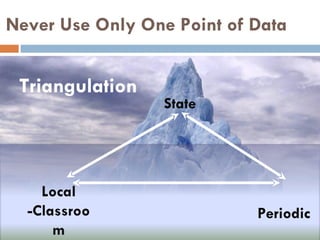
Never Use Only One Point of Data Local -Classroom State Periodic Triangulation
Measures of Academic Progress The MAP test uses a measurement scale that has proven to be exceptionally stable and valid over time. The scale is based on the same modern test theory that aligns student achievement levels with item difficulties on the same scale. The scale is divided into equal parts (an equal interval scale), like centimeters on a ruler. We call these parts RITs, which is short for Rasch Unit (after the test theory's founder, Danish statistician Georg Rasch). Like using a ruler to measure a child's growth in height, we use the RIT scale to measure a student’s academic growth over time.
The Test Theory and the MAP Low High Item Difficulty Low High Adaptive Peaked Conventional Rectangular  Conventional From Weiss, 1985 Measurement Precision
The Test Theory and the MAP Beginning Literacy Adult Reading 9 th  Grade x x x x x x x x x x x x x x x MAP Test + + - + - - - + + + + 215 150 250
Predicting CAHSEE Passing with MAP
The MAP and the GED GED Reading Level is  9th Grade Corresponding MAP Reading RIT is 226
What is a Lexile? A unit for measuring text difficulty that is linked to the RIT score A resource that allows teachers to use the student’s RIT score to find appropriately challenging books, periodicals, and other reading material Our JCCS Novel Kits are ALL lexiled…
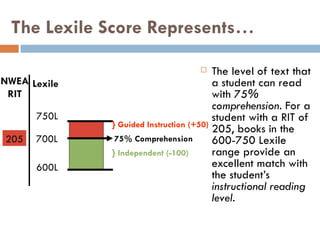
The Lexile Score Represents… The level of text that a student can read with  75% comprehension . For a student with a RIT of 205, books in the 600-750 Lexile range provide an excellent match with the student’s  instructional reading level . } Guided Instruction (+50) 75% Comprehension } Independent (-100) Lexile NWEA RIT 600L 700L 750L 205
DesCartes The purpose of DesCartes is to help guide instruction based on reports from computerized Measures of Academic Progress (MAP) assessment. DesCartes enhances a teacher’s ability to provide targeted instruction for individual students or groups of students.
DesCartes DesCartes contains separate sections for reading, language usage, and mathematics. These three learning areas align directly to the CAHSEE.
MAP/CAHSEE Alignment Mathematics Number Sense Algebra & Functions Measurement & Geometry Statistics & Probability Mathematical Reasoning Reading and Language Usage Word Analysis & Vocabulary Information Structure & Critique Comprehend & Analyze Text Literary Response & Analysis Writing Strategies Writing Applications Grammar and Mechanics Mathematics Number Sense Algebra & Functions Measurement & Geometry Statistics & Probability Mathematical Reasoning Algebra 1 English/Language Arts Word Analysis  Reading Comprehension Literary Analysis Writing Strategies Writing Applications Writing Conventions MAP CAHSEE
Interpreting DesCartes (Sample Page)
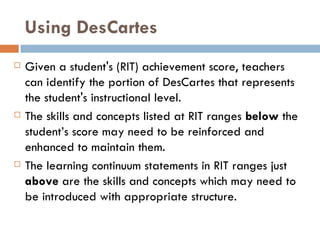
Using DesCartes Given a student's (RIT) achievement score, teachers can identify the portion of DesCartes that represents the student's instructional level.  The skills and concepts listed at RIT ranges  below  the student’s score may need to be reinforced and enhanced to maintain them.  The learning continuum statements in RIT ranges just  above  are the skills and concepts which may need to be introduced with appropriate structure.
An Example… One student, Marty, has an overall score of 187 in reading. By using the table of contents in the Reading section of the DesCartes notebook, Marty’s teacher can find the page with RIT scores between 181and 190.
An Example… Having located this page, Marty’s teacher will refer to the center column (Skills and Concepts to Develop) and use these statements as a guideline for targeted instruction.
Skills and Concepts to Enhance When a student responds correctly to test items 75% of the time, we consider the related skills and concepts appropriate to  enhance.
Skills and Concepts to Develop When a student responds correctly to test items 50% of the time, we consider the related skills and concepts appropriate to develop. The statements in the skills and concepts to develop column are those that a student is  ready  to learn.
Skills and Concepts to Introduce When a student responds correctly to test items 25% of the time, we consider the related skills and concepts appropriate to introduce. Many students can learn skills and concepts in this column if the appropriate groundwork is laid or if a task is presented in a more structured format.
Tips on Ways to Use DesCartes Give meaning to RIT scores The RIT scale provides the framework by which we measure student growth. DesCartes puts flesh on that framework, providing a better picture of what students already know and what they need to learn next.
Tips on Ways to Use DesCartes Assist teachers in selecting and sharing appropriate instructional materials By knowing where students are performing, teachers can collaborate with one another and can utilize sets of resources typically found outside their individual classrooms. This helps to ensure that the appropriate materials needed for each child are available.
Tips on Ways to Use DesCartes Guide teachers as they develop needs-based, or flexible groups, for instruction DesCartes provides a map for individual students and groups of students based on students’ specific instructional levels and needs. Look at DesCartes to find skills that may supplement specific grade-level standards as well as skills that fall below and above that standard. Based on their RIT ranges, divide the students into three or four groups. Work with them in these groups once or twice a week on specific skills related to their goal area.
Tips on Ways to Use DesCartes Assist in establishing goals for students and teachers and communicating with parents By providing general information about students’ instructional needs, goals can be specific, measurable, and attainable by every student.
Tips on Ways to Use DesCartes Develop learning plans that focus instruction on the specific needs of students DesCartes is an excellent guide to put together individualized plans for each student in a classroom.  Create a specific set of learning goals for a student by listing certain skills and competencies that he or she should focus on for the next determined period of time.

Map And Descartes

  • 1.
    MAP AND DESCARTESJCCS Training 11/18/08
  • 2.
    JCCS Assessment 101Assessment Content Type Reading Math ELA Hist/SS Science Standardized Adaptive Diagnostic Progress Monitor Summative High Stakes MAP X X X     X X X X     CAHSEE X X X     X       X X CST X X X X X X       X X CELDT X   X     X   X X X X JCCS Writing Sample     X         X X     Textbook Tests X X X X X     X X X   Teacher-Created Tests X X X X X     X X X  
  • 3.
    JCCS Assessment 101ASSESSMENT FREQUENCY GRADE LEVELS MAP Intake/Every 90 Days 2 through 12 CAHSEE Up to 6 Times per Year 10 through 12 CST Once per Year 2 through 11 CELDT Up to 2 Times per Year K through 12 JCCS Writing Sample Intake/Every 90 Days 6 through 12 Textbook Tests Ongoing ALL Teacher-Created Tests Ongoing ALL
  • 4.
    Never Use OnlyOne Point of Data Local -Classroom State Periodic Triangulation
  • 5.
    Measures of AcademicProgress The MAP test uses a measurement scale that has proven to be exceptionally stable and valid over time. The scale is based on the same modern test theory that aligns student achievement levels with item difficulties on the same scale. The scale is divided into equal parts (an equal interval scale), like centimeters on a ruler. We call these parts RITs, which is short for Rasch Unit (after the test theory's founder, Danish statistician Georg Rasch). Like using a ruler to measure a child's growth in height, we use the RIT scale to measure a student’s academic growth over time.
  • 6.
    The Test Theoryand the MAP Low High Item Difficulty Low High Adaptive Peaked Conventional Rectangular Conventional From Weiss, 1985 Measurement Precision
  • 7.
    The Test Theoryand the MAP Beginning Literacy Adult Reading 9 th Grade x x x x x x x x x x x x x x x MAP Test + + - + - - - + + + + 215 150 250
  • 8.
  • 9.
  • 10.
    The MAP andthe GED GED Reading Level is 9th Grade Corresponding MAP Reading RIT is 226
  • 11.
    What is aLexile? A unit for measuring text difficulty that is linked to the RIT score A resource that allows teachers to use the student’s RIT score to find appropriately challenging books, periodicals, and other reading material Our JCCS Novel Kits are ALL lexiled…
  • 12.
    The Lexile ScoreRepresents… The level of text that a student can read with 75% comprehension . For a student with a RIT of 205, books in the 600-750 Lexile range provide an excellent match with the student’s instructional reading level . } Guided Instruction (+50) 75% Comprehension } Independent (-100) Lexile NWEA RIT 600L 700L 750L 205
  • 13.
    DesCartes The purposeof DesCartes is to help guide instruction based on reports from computerized Measures of Academic Progress (MAP) assessment. DesCartes enhances a teacher’s ability to provide targeted instruction for individual students or groups of students.
  • 14.
    DesCartes DesCartes containsseparate sections for reading, language usage, and mathematics. These three learning areas align directly to the CAHSEE.
  • 15.
    MAP/CAHSEE Alignment MathematicsNumber Sense Algebra & Functions Measurement & Geometry Statistics & Probability Mathematical Reasoning Reading and Language Usage Word Analysis & Vocabulary Information Structure & Critique Comprehend & Analyze Text Literary Response & Analysis Writing Strategies Writing Applications Grammar and Mechanics Mathematics Number Sense Algebra & Functions Measurement & Geometry Statistics & Probability Mathematical Reasoning Algebra 1 English/Language Arts Word Analysis Reading Comprehension Literary Analysis Writing Strategies Writing Applications Writing Conventions MAP CAHSEE
  • 16.
  • 17.
    Using DesCartes Givena student's (RIT) achievement score, teachers can identify the portion of DesCartes that represents the student's instructional level. The skills and concepts listed at RIT ranges below the student’s score may need to be reinforced and enhanced to maintain them. The learning continuum statements in RIT ranges just above are the skills and concepts which may need to be introduced with appropriate structure.
  • 18.
    An Example… Onestudent, Marty, has an overall score of 187 in reading. By using the table of contents in the Reading section of the DesCartes notebook, Marty’s teacher can find the page with RIT scores between 181and 190.
  • 19.
    An Example… Havinglocated this page, Marty’s teacher will refer to the center column (Skills and Concepts to Develop) and use these statements as a guideline for targeted instruction.
  • 20.
    Skills and Conceptsto Enhance When a student responds correctly to test items 75% of the time, we consider the related skills and concepts appropriate to enhance.
  • 21.
    Skills and Conceptsto Develop When a student responds correctly to test items 50% of the time, we consider the related skills and concepts appropriate to develop. The statements in the skills and concepts to develop column are those that a student is ready to learn.
  • 22.
    Skills and Conceptsto Introduce When a student responds correctly to test items 25% of the time, we consider the related skills and concepts appropriate to introduce. Many students can learn skills and concepts in this column if the appropriate groundwork is laid or if a task is presented in a more structured format.
  • 23.
    Tips on Waysto Use DesCartes Give meaning to RIT scores The RIT scale provides the framework by which we measure student growth. DesCartes puts flesh on that framework, providing a better picture of what students already know and what they need to learn next.
  • 24.
    Tips on Waysto Use DesCartes Assist teachers in selecting and sharing appropriate instructional materials By knowing where students are performing, teachers can collaborate with one another and can utilize sets of resources typically found outside their individual classrooms. This helps to ensure that the appropriate materials needed for each child are available.
  • 25.
    Tips on Waysto Use DesCartes Guide teachers as they develop needs-based, or flexible groups, for instruction DesCartes provides a map for individual students and groups of students based on students’ specific instructional levels and needs. Look at DesCartes to find skills that may supplement specific grade-level standards as well as skills that fall below and above that standard. Based on their RIT ranges, divide the students into three or four groups. Work with them in these groups once or twice a week on specific skills related to their goal area.
  • 26.
    Tips on Waysto Use DesCartes Assist in establishing goals for students and teachers and communicating with parents By providing general information about students’ instructional needs, goals can be specific, measurable, and attainable by every student.
  • 27.
    Tips on Waysto Use DesCartes Develop learning plans that focus instruction on the specific needs of students DesCartes is an excellent guide to put together individualized plans for each student in a classroom. Create a specific set of learning goals for a student by listing certain skills and competencies that he or she should focus on for the next determined period of time.