Think how important language is in children’s
everyday lives. They need language to speak
with others, listen to others, read, and write.
Their language enables them to describe past
events in detail and to plan for the future.
Language lets us pass down information from
one generation to the next and create a rich
cultural heritage.
SO, WHAT IS LANGUAGE?
Language is a form of communication—
whether spoken, written, or signed—that is
based on a system of symbols.
Language consists of the words used by a
community (vocabulary) and the rules for
varying and combining them (grammar and
syntax).
When we say “rules,” we mean that language is
orderly and that rules describe the way
language works (Berko Gleason & Ratner,
2009). Language involves five systems of rules:
phonology, morphology, syntax, semantics, and
pragmatics.
Phonology Every language is made up of basic sounds. Phonology is the sound
system of a language, including the sounds used and how they may be
combined (Stoel-Gammon & Sosa, 2010). For example, English has the sounds
sp, ba, and ar, but the sound sequences zx and qp do not occur.
Morphology The morphology of a language refers to the units of meaning
involved in word formation. A morpheme is a minimal unit of meaning; it is a
word or a part of a word that cannot be broken into smaller meaningful parts.
Every word in the English language is made up of one or more morphemes.
Some words consist of a single morpheme (for example, help ), whereas others
are made up of more than one morpheme (for example, helper, which has two
morphemes, help 1 er, with the morpheme - er meaning “one who”—in this
case “one who helps”). Th us, not all morphemes are words by themselves; for
example, pre -, -tion , and -ing are morphemes.
Syntax The way words are combined to form acceptable phrases and
sentences is their syntax (Naigles & Swensen, 2010). If someone says to
you, “Bob slugged Tom” or “Bob was slugged by Tom,” you know who did
the slugging and who was slugged in each case because you have a
syntactic understanding of these sentence structures. You also understand
that the sentence “You didn’t stay, did you?” is a grammatical sentence but
that “You didn’t stay, didn’t you?” is unacceptable and ambiguous.
Semantics The term semantics refers to the meaning of words and
sentences. Every word has a set of semantic features, or required attributes
related to meaning (Diesendruck, 2010). Girl and women, for example,
share many semantic features, but they differ semantically in regard to age.
Pragmatics A final set of language rules involves pragmatics, the
appropriate use of language in different contexts. Pragmatics covers a lot of
territory. When you take turns speaking in a discussion, you are
demonstrating knowledge of pragmatics (Siegal & Surian, 2010). You also
apply the pragmatics of English when you use polite language in
appropriate situations (for example, when talking to a teacher) or tell stories
that are interesting.
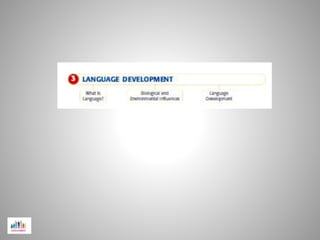
BIOLOGICALAND ENVIRONMENTAL INFLUENCES
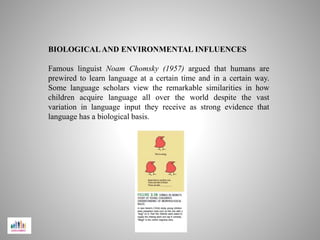
Famous linguist Noam Chomsky (1957) argued that humans are
prewired to learn language at a certain time and in a certain way.
Some language scholars view the remarkable similarities in how
children acquire language all over the world despite the vast
variation in language input they receive as strong evidence that
language has a biological basis.
LANGUAGE DEVELOPMENT
What are some of the key developmental
milestones in language
development? We will examine these
milestones in infancy, early
childhood, middle and late childhood, and
adolescence.
Infancy Language acquisition advances past a
number of milestones in infancy (Sachs, 2009).
Because the main focus of this text is on
children and adolescents
Early Childhood As children leave the two-
word stage, they move rather quickly into
three-, four-, and five-word combinations.
The transition from simple sentences
expressing a single proposition to complex
sentences begins between 2 and 3 years of age
and continues into the elementary school years
(Bloom, 1998).

Psikologi pendidikan

  • 2.
    Think how importantlanguage is in children’s everyday lives. They need language to speak with others, listen to others, read, and write. Their language enables them to describe past events in detail and to plan for the future. Language lets us pass down information from one generation to the next and create a rich cultural heritage.
  • 3.
    SO, WHAT ISLANGUAGE?
  • 4.
    Language is aform of communication— whether spoken, written, or signed—that is based on a system of symbols. Language consists of the words used by a community (vocabulary) and the rules for varying and combining them (grammar and syntax).
  • 5.
    When we say“rules,” we mean that language is orderly and that rules describe the way language works (Berko Gleason & Ratner, 2009). Language involves five systems of rules: phonology, morphology, syntax, semantics, and pragmatics.
  • 6.
    Phonology Every languageis made up of basic sounds. Phonology is the sound system of a language, including the sounds used and how they may be combined (Stoel-Gammon & Sosa, 2010). For example, English has the sounds sp, ba, and ar, but the sound sequences zx and qp do not occur. Morphology The morphology of a language refers to the units of meaning involved in word formation. A morpheme is a minimal unit of meaning; it is a word or a part of a word that cannot be broken into smaller meaningful parts. Every word in the English language is made up of one or more morphemes. Some words consist of a single morpheme (for example, help ), whereas others are made up of more than one morpheme (for example, helper, which has two morphemes, help 1 er, with the morpheme - er meaning “one who”—in this case “one who helps”). Th us, not all morphemes are words by themselves; for example, pre -, -tion , and -ing are morphemes.
  • 7.
    Syntax The waywords are combined to form acceptable phrases and sentences is their syntax (Naigles & Swensen, 2010). If someone says to you, “Bob slugged Tom” or “Bob was slugged by Tom,” you know who did the slugging and who was slugged in each case because you have a syntactic understanding of these sentence structures. You also understand that the sentence “You didn’t stay, did you?” is a grammatical sentence but that “You didn’t stay, didn’t you?” is unacceptable and ambiguous. Semantics The term semantics refers to the meaning of words and sentences. Every word has a set of semantic features, or required attributes related to meaning (Diesendruck, 2010). Girl and women, for example, share many semantic features, but they differ semantically in regard to age. Pragmatics A final set of language rules involves pragmatics, the appropriate use of language in different contexts. Pragmatics covers a lot of territory. When you take turns speaking in a discussion, you are demonstrating knowledge of pragmatics (Siegal & Surian, 2010). You also apply the pragmatics of English when you use polite language in appropriate situations (for example, when talking to a teacher) or tell stories that are interesting.
  • 8.
    BIOLOGICALAND ENVIRONMENTAL INFLUENCES Famouslinguist Noam Chomsky (1957) argued that humans are prewired to learn language at a certain time and in a certain way. Some language scholars view the remarkable similarities in how children acquire language all over the world despite the vast variation in language input they receive as strong evidence that language has a biological basis.
  • 9.
    LANGUAGE DEVELOPMENT What aresome of the key developmental milestones in language development? We will examine these milestones in infancy, early childhood, middle and late childhood, and adolescence. Infancy Language acquisition advances past a number of milestones in infancy (Sachs, 2009). Because the main focus of this text is on children and adolescents Early Childhood As children leave the two- word stage, they move rather quickly into three-, four-, and five-word combinations. The transition from simple sentences expressing a single proposition to complex sentences begins between 2 and 3 years of age and continues into the elementary school years (Bloom, 1998).