
Chapter 2 Learning
about Language
Structure
Introduction
Language-What it can do for us! It allows us to
express hopes and dreams, as this young boy has
done in his chat with a friend. It takes us beyond the
here and now. It connects one individual to another. It
communicates the heights of joy and depths of
despair. Language belongs to everyone, from the
preschooler to the professor. Almost all aspects of a
person’s life are touched by language: Everyone
speaks and everyone listens. People argue about
language, sometimes quite passionately and
eloquently. Language is universal, and yet each
language has evolved to meet the experiences, needs,
and desires of that language’s community.
Why language is dynamic?
Languages change overtime. Vocabulary changes are
the most obvious. Words disappear, such as tang and
swik. Words expand their meanings such as chip and
mouse. New words appear such as visitability and
cyberbalkanization. But languages change in many
ways, not just in semantic meaning. Pronunciation
(phonology) changes. We recognize that pronunciation
in English has altered overtime because the spelling of
some words is archaic. We no longer pronounce the k in
know or the w in write; at one time, the vowel sounds in
tie, sky, and high did not rhyme. Even common words
such as tomato and park are pronounced differently
depending on which part of the country the speaker is
from, indicating that part of the dynamics of language
comes from dialectal differences.
Morphological (word form) changes have
occurred in English, such as the gradual
elimination of declension endings in nouns and
verbs. Only the change in form of the third
person ( he goes) remains in the declension of
present-tense verbs, and only the plural shift
remains in the inflection of nouns. Syntactically,
as the inflections dropped off nouns, word order
became fixed.
Pragmatically, the fusing of English second
person into the single form you avoided many of
the status distinctions still preserved in
European languages. Teachers who respect the
dynamic nature of language can take delight in
learners’ approximations of English rather than
be annoyed by constructions that can be
considered mistakes. When a student writes,
“When school was out he fell in love with a young
girl July” (meaning “Julie”), rather that correcting
the misspelling, a teacher can consider that
“July” may be a better way to spell the name of a
summer love!
Why language is complex?
Without question, using language is one of the most complex of
human activities. The wide range of concepts, both concrete and
abstract, that language can convey-and the fact that this ability is
the norm for human beings rather than the exception combines
with its dynamic quality to provide the human race with a
psychological tool unmatched in power and flexibility.
No languages are “primitive”. All languages are equally complex,
capable of expressing a wide range of ideas, and expandable to
include a new words for new concepts. Language is arbitrary. The
relationships between the sounds and the meanings of spoken
languages and between gestures and meanings of sign
languages are, for the most part, not caused by natural or
necessary reason (such as reflecting a sound, like “buzz” for the
sound that bees make when they fly). There is no inherent reason
to call an object “table” or “mesa” or “danh t”. Those just happen
to be the sounds that English, Spanish, Vietnamese speakers
use.
Language comes easily to human beings.
Every normal child, born anywhere in the
world, of any racial, geographical, social, or
economic heritage, is capable of learning
any language to which he or she is
exposed.
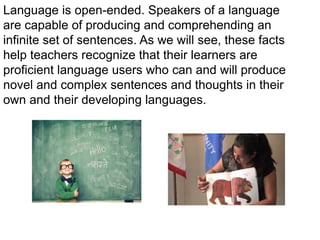
Language is open-ended. Speakers of a language
are capable of producing and comprehending an
infinite set of sentences. As we will see, these facts
help teachers recognize that their learners are
proficient language users who can and will produce
novel and complex sentences and thoughts in their
own and their developing languages.
All languages Have Structure
All human languages use a finite set of sounds (or
gestures) that are combined to form meaningful elements
or words, which themselves form an infinite set of possible
sentences. Every spoken language also uses discrete
sound segments, such as /p/, /n/, or /a/, and has a class of
vowels and class of consonants.
Phonology: The Sound Patterns of Language
Phonology is the study of the system or pattern of speech
sounds. The word phonology (as in the phonology of
English) can also refer to the phonological system (sound
system) of a given language. This is one of the
fundamental systems which a language is considered to
comprise, like its syntax and its vocabulary.
Phonology is often distinguished from phonetics. While
phonetics concerns the physical production, acoustic
transmission and perception of the sounds of speech.
What are phonemes?
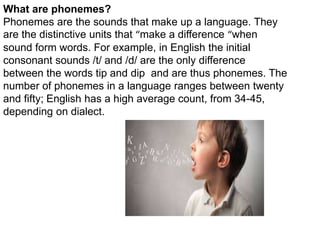
Phonemes are the sounds that make up a language. They
are the distinctive units that “make a difference “when
sound form words. For example, in English the initial
consonant sounds /t/ and /d/ are the only difference
between the words tip and dip and are thus phonemes. The
number of phonemes in a language ranges between twenty
and fifty; English has a high average count, from 34-45,
depending on dialect.
Fig 3 A simplified procedures for determining whether two sounds
represent the same or different phonemes
What is syntax?
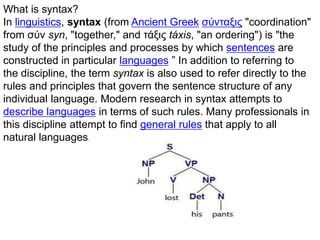
In linguistics, syntax (from Ancient Greek σύνταξις "coordination"
from σύν syn, "together," and τάξις táxis, "an ordering") is "the
study of the principles and processes by which sentences are
constructed in particular languages ” In addition to referring to
the discipline, the term syntax is also used to refer directly to the
rules and principles that govern the sentence structure of any
individual language. Modern research in syntax attempts to
describe languages in terms of such rules. Many professionals in
this discipline attempt to find general rules that apply to all
natural languages.
What is semantics?
In linguistics, semantic analysis is the process of
relating syntactic structures, from the levels of
phrases, clauses, sentences and paragraphs to the
level of the writing as a whole, to their language-
independent meanings. It also involves removing
features specific to particular linguistic and cultural
contexts, to the extent that such a project is possible.
The elements of idiom and figurative speech, being
cultural, are often also converted into relatively
invariant meanings in semantic analysis.
With the availability of enough material to analyze,
semantic analysis can be used to catalog and trace
the style of writing of specific authors.
Summary:
Learning about language structure explores various aspects of language.
Language is dynamic and young people are usually on the cutting edge of
language change.
Language is complex-combines with dynamic quality to provide the human
race with a psychological tool unmatched in power and flexibility.
Conclusion:
Grammar need not to be a difficult or boring subject. Grammar
rules must easy to learn. And need to adapt other ways of
learning.

Learning about language structure

  • 1.
    Chapter 2 Learning aboutLanguage Structure
  • 2.
    Introduction Language-What it cando for us! It allows us to express hopes and dreams, as this young boy has done in his chat with a friend. It takes us beyond the here and now. It connects one individual to another. It communicates the heights of joy and depths of despair. Language belongs to everyone, from the preschooler to the professor. Almost all aspects of a person’s life are touched by language: Everyone speaks and everyone listens. People argue about language, sometimes quite passionately and eloquently. Language is universal, and yet each language has evolved to meet the experiences, needs, and desires of that language’s community.
  • 4.
    Why language isdynamic? Languages change overtime. Vocabulary changes are the most obvious. Words disappear, such as tang and swik. Words expand their meanings such as chip and mouse. New words appear such as visitability and cyberbalkanization. But languages change in many ways, not just in semantic meaning. Pronunciation (phonology) changes. We recognize that pronunciation in English has altered overtime because the spelling of some words is archaic. We no longer pronounce the k in know or the w in write; at one time, the vowel sounds in tie, sky, and high did not rhyme. Even common words such as tomato and park are pronounced differently depending on which part of the country the speaker is from, indicating that part of the dynamics of language comes from dialectal differences.
  • 6.
    Morphological (word form)changes have occurred in English, such as the gradual elimination of declension endings in nouns and verbs. Only the change in form of the third person ( he goes) remains in the declension of present-tense verbs, and only the plural shift remains in the inflection of nouns. Syntactically, as the inflections dropped off nouns, word order became fixed.
  • 7.
    Pragmatically, the fusingof English second person into the single form you avoided many of the status distinctions still preserved in European languages. Teachers who respect the dynamic nature of language can take delight in learners’ approximations of English rather than be annoyed by constructions that can be considered mistakes. When a student writes, “When school was out he fell in love with a young girl July” (meaning “Julie”), rather that correcting the misspelling, a teacher can consider that “July” may be a better way to spell the name of a summer love!
  • 9.
    Why language iscomplex? Without question, using language is one of the most complex of human activities. The wide range of concepts, both concrete and abstract, that language can convey-and the fact that this ability is the norm for human beings rather than the exception combines with its dynamic quality to provide the human race with a psychological tool unmatched in power and flexibility. No languages are “primitive”. All languages are equally complex, capable of expressing a wide range of ideas, and expandable to include a new words for new concepts. Language is arbitrary. The relationships between the sounds and the meanings of spoken languages and between gestures and meanings of sign languages are, for the most part, not caused by natural or necessary reason (such as reflecting a sound, like “buzz” for the sound that bees make when they fly). There is no inherent reason to call an object “table” or “mesa” or “danh t”. Those just happen to be the sounds that English, Spanish, Vietnamese speakers use.
  • 10.
    Language comes easilyto human beings. Every normal child, born anywhere in the world, of any racial, geographical, social, or economic heritage, is capable of learning any language to which he or she is exposed.
  • 11.
    Language is open-ended.Speakers of a language are capable of producing and comprehending an infinite set of sentences. As we will see, these facts help teachers recognize that their learners are proficient language users who can and will produce novel and complex sentences and thoughts in their own and their developing languages.
  • 12.
  • 13.
    All human languagesuse a finite set of sounds (or gestures) that are combined to form meaningful elements or words, which themselves form an infinite set of possible sentences. Every spoken language also uses discrete sound segments, such as /p/, /n/, or /a/, and has a class of vowels and class of consonants. Phonology: The Sound Patterns of Language Phonology is the study of the system or pattern of speech sounds. The word phonology (as in the phonology of English) can also refer to the phonological system (sound system) of a given language. This is one of the fundamental systems which a language is considered to comprise, like its syntax and its vocabulary. Phonology is often distinguished from phonetics. While phonetics concerns the physical production, acoustic transmission and perception of the sounds of speech.
  • 15.
    What are phonemes? Phonemesare the sounds that make up a language. They are the distinctive units that “make a difference “when sound form words. For example, in English the initial consonant sounds /t/ and /d/ are the only difference between the words tip and dip and are thus phonemes. The number of phonemes in a language ranges between twenty and fifty; English has a high average count, from 34-45, depending on dialect.
  • 16.
    Fig 3 Asimplified procedures for determining whether two sounds represent the same or different phonemes
  • 17.
    What is syntax? Inlinguistics, syntax (from Ancient Greek σύνταξις "coordination" from σύν syn, "together," and τάξις táxis, "an ordering") is "the study of the principles and processes by which sentences are constructed in particular languages ” In addition to referring to the discipline, the term syntax is also used to refer directly to the rules and principles that govern the sentence structure of any individual language. Modern research in syntax attempts to describe languages in terms of such rules. Many professionals in this discipline attempt to find general rules that apply to all natural languages.
  • 19.
  • 20.
    In linguistics, semanticanalysis is the process of relating syntactic structures, from the levels of phrases, clauses, sentences and paragraphs to the level of the writing as a whole, to their language- independent meanings. It also involves removing features specific to particular linguistic and cultural contexts, to the extent that such a project is possible. The elements of idiom and figurative speech, being cultural, are often also converted into relatively invariant meanings in semantic analysis. With the availability of enough material to analyze, semantic analysis can be used to catalog and trace the style of writing of specific authors.
  • 21.
    Summary: Learning about languagestructure explores various aspects of language. Language is dynamic and young people are usually on the cutting edge of language change. Language is complex-combines with dynamic quality to provide the human race with a psychological tool unmatched in power and flexibility. Conclusion: Grammar need not to be a difficult or boring subject. Grammar rules must easy to learn. And need to adapt other ways of learning.