CTEL Exam PrepModule 2Mark Rounds
Contact Informationemail:       mrounds@sdcoe.netwiki: ctelresources.wetpaint.com
Module 2Domain 2 - Foundations of English Language/Literacy Development and Content InstructionDomain 3 - Approaches and Methods for ELD and Content InstructionDomain 1 - Assessment of English Learners
CTEL Module 2 Domain 2 004Foundations of Programs for English LearnersReading: CTEL Text, Ch. 4
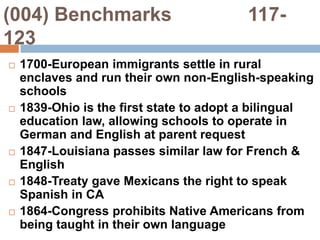
(004) Benchmarks              117-1231700-European immigrants settle in rural enclaves and run their own non-English-speaking schools1839-Ohio is the first state to adopt a bilingual education law, allowing schools to operate in German and English at parent request1847-Louisiana passes similar law for French & English1848-Treaty gave Mexicans the right to speak Spanish in CA1864-Congress prohibits Native Americans from being taught in their own language
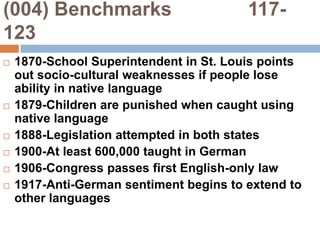
(004) Benchmarks              117-1231870-School Superintendent in St. Louis points out socio-cultural weaknesses if people lose ability in native language1879-Children are punished when caught using native language1888-Legislation attempted in both states1900-At least 600,000 taught in German1906-Congress passes first English-only law1917-Anti-German sentiment begins to extend to other languages
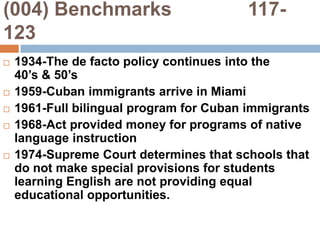
(004) Benchmarks              117-1231934-The de facto policy continues into the       40’s & 50’s1959-Cuban immigrants arrive in Miami1961-Full bilingual program for Cuban immigrants1968-Act provided money for programs of native language instruction1974-Supreme Court determines that schools that do not make special provisions for students learning English are not providing equal educational opportunities.
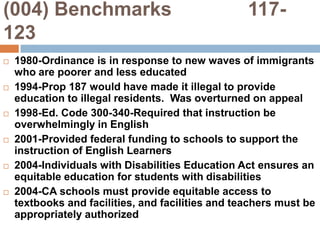
(004) Benchmarks              117-1231980-Ordinance is in response to new waves of immigrants who are poorer and less educated1994-Prop 187 would have made it illegal to provide education to illegal residents.  Was overturned on appeal1998-Ed. Code 300-340-Required that instruction be overwhelmingly in English2001-Provided federal funding to schools to support the instruction of English Learners2004-Individuals with Disabilities Education Act ensures an equitable education for students with disabilities2004-CA schools must provide equitable access to textbooks and facilities, and facilities and teachers must be appropriately authorized
(004) Lau vs Nichols                  126Supreme Court decision (1974) of a suit brought by native Chinese speaker in San Francisco schoolsMade illegal those educational practices that excluded children from effective education on the basis of languageCourt ruled that simply providing same instruction and materials in English was not equitable
(004) Lau Remedies          126-127Published by US Commissioner for Ed.Standardized requirements for identifying and evaluating ELs.Defined instructional treatments, procedures to transfer to all-English classes, and professional standards for teachers.Still in use in states without regulations.
(004) NCLB (Title III)                124States that “English Learners will develop high levels of academic proficiency and meet the same challenging academic standards as do their native-English speaking peers.”Funding for ELs and immigrantsAccountability requires annual progress in learning English, progress towards reclassification, and academic progressAlso see 129
(004) IDEA                                    123Individuals with Disabilities Education ActReauthorized previous Special Education lawStipulates that children not be labeled disabled if poor school achievement is due to ethnic, linguistic, or racial difference
(004) Prop 227                             125Ed. Code 300-340Instruction overwhelmingly in EnglishAlternative programs through waiver processThe single year flies in the face of academic language acquisition research…4-9 years
(004) Williams vs CA                 126Requires equity in provision of textbooks, maintenance of facilities, and appropriately authorized staff (including teachers of English Learners)
(004) Heritage Language        127AKA “developmental bilingual programs”Designed for students with a primary language other than English. Goals include maintenance and development of native language
(004) Dual Immersion              127Half EL, half EOGoal is for students to be proficient in both languages … AKA additive bilingualismHigh level of academic competence in two languages by ELs and EOs
(004) English Only                     128Goal of assimilationBelief that common language is a unifierBelief that students will be more academically successful
(004) Equity Issues                    130Program PlacementLength of time in programTrackingSpecial EdStudent DataRetention/promotionDropout rates/expulsion and detention ratesStaffingTeacher qualificationTeacher retentionFunding
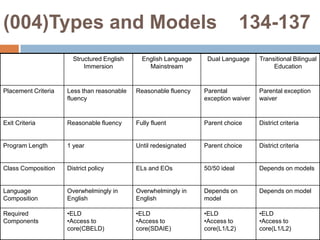
(004)Types and Models    134-137
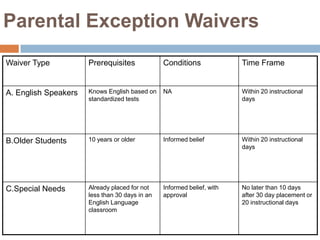
Parental Exception Waivers
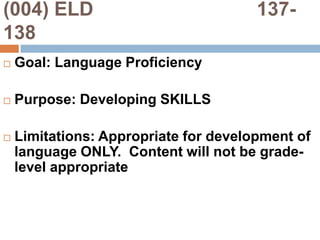
(004) ELD                              137-138Goal: Language ProficiencyPurpose: Developing SKILLSLimitations: Appropriate for development of language ONLY.  Content will not be grade-level appropriate
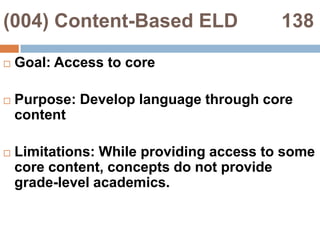
(004) Content-Based ELD        138Goal: Access to corePurpose: Develop language through core contentLimitations: While providing access to some core content, concepts do not provide grade-level academics.
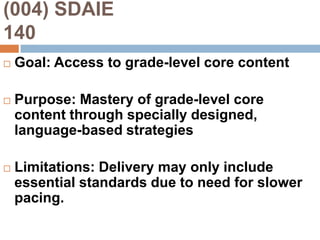
(004) SDAIE                                  140Goal: Access to grade-level core contentPurpose: Mastery of grade-level core content through specially designed, language-based strategiesLimitations: Delivery may only include essential standards due to need for slower pacing.
CTEL Module 2 Domain 2 005Foundations of English LiteracyReading:  from CTEL Text, Ch. 6
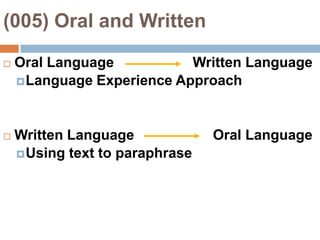
(005) Oral and WrittenOral Language                    Written LanguageLanguage Experience ApproachWritten Language                    Oral LanguageUsing text to paraphrase
(005) Vocabulary KnowledgeHow well developed vocabulary isLevel of vocabulary: social vs academic
(005) Educational BackgroundPrior knowledgeLiteracy skillsPrevious schoolingBackground knowledge(familiarity with concepts)
(005) Level of English ProficiencyBeginnerEarly IntermediateIntermediateEarly AdvancedAdvanced
(005) Primary LanguageHow well developed literacy skills areLinguistic differences between primary language and English
(005) MotivationNecessityPersonal importanceAffiliation (e.g. teacher, peers)
(005) Pedagogical Practices Integrate listening, speaking, reading, and writingBeing cognizant of integrating L S R W while teaching Math, Social Studies, Science.Example: After a science experiment, use the Language Experience Approach to develop literacy through science
(005) Pedagogical Practices Provides a balanced, comprehensive reading programBalance between phonics and comprehension; integrates L S R W
(005) Pedagogical Practices Uses standards-based thematic unit organizationThemes based on standardsExample: 6th grade Ancient Egypt
(005) Pedagogical Practices Creates a language-rich environmentAccessible contextualized print
(005) Pedagogical Practices Adapts instruction and materials to meet the special needs of English LearnersCulturally and linguistically appropriateUse effective strategies (graphic organizers, visuals, contextualization, realia, etc.)
(005) Pedagogical Practices Plans meaningful and purposeful literacy activitiesRelating your content and instruction to real life
(005) Pedagogical Practices Selects appropriate reading materialsVariety of genres, multicultural text, high interest, relevantMake sure that EL proficiency level is taken into consideration
(005) Pedagogical Practices Utilizes English Learners’ prior knowledge to promote English language development in reading and writingConnect to students’ backgrounds
(005) Pedagogical Practices Scaffolds literacy activitiesProvide well structured activities with ample supportExample: Brainstorm/outline before required to write
(005) Pedagogical Practices Provides organized, systematic, explicit instruction in key skillsMake no assumptionsSkills must be taught
(005) Effective Approaches    157Frontloading Vocabulary 247Language Experience Approach 229Interactive Journals 233Shared ReadingLearning LogsProcess Writing 234-236Graphic Organizers 158-162Pre-Reading Activities
CTEL Module 2 Domain 2 006Instructional Planning and Organization for ELD and SDAIEReading:  from CTEL Text, Ch. 6
(006) ELD Standards The Role of ELD StandardsRelationship to Native SpeakersLevels of English Proficiency
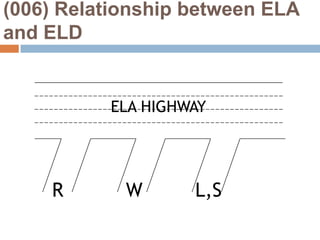
(006) Relationship between ELA and ELD ELA HIGHWAYRWL,S
(006) SDAIE                          176-186What is SDAIE?Who should receive SDAIE and why?Why is SDAIE more than “just good teaching”?What is the role of primary language in a SDAIE class?What are some successful SDAIE strategies?
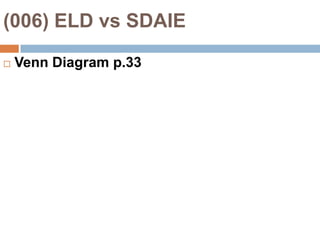
(006) ELD vs SDAIE Venn Diagram p.33
(006) Content and Language  240Read pp. 240-242 of CTEL TextContent Objectives and Language ObjectivesContent Standard: Students know causes and effects of different types of severe weather…CONTENT Objective: Students will be able to DEFINE and DESCRIBE… RECOGNIZE…LANGUAGE Objective: Students will PARTICIPATE in discussions…DEFINE and DESCRIBE…will be able to PRESENT…
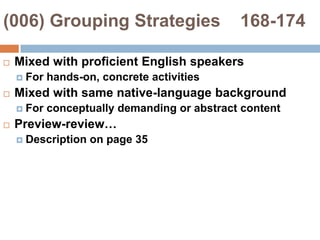
(006) Grouping Strategies    168-174 Mixed with proficient English speakersFor hands-on, concrete activities Mixed with same native-language backgroundFor conceptually demanding or abstract contentPreview-review…Description on page 35
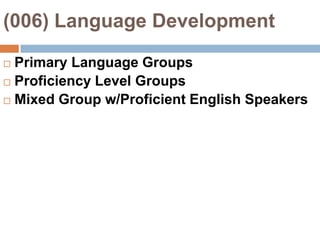
(006) Language Development Primary Language GroupsProficiency Level GroupsMixed Group w/Proficient English Speakers
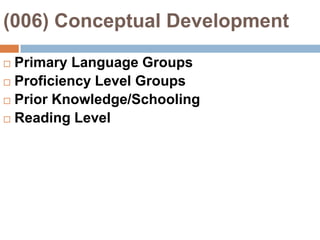
(006) Conceptual Development Primary Language GroupsProficiency Level GroupsPrior Knowledge/SchoolingReading Level
(006) Classroom Community DevelopmentMixed/Heterogeneous
(006) Physical Setting Supports Student InteractionPhysical Arrangement of FurnitureConfigurations for whole group vs small groupTeacher and Student MovementLanguage Rich EnvironmentDisplay and use a variety of print materials in primary language and EnglishOffers Stimuli for ConversationUse of wall space to display content-related informationUse of technology and multimedia
(006) Organizing Role of ParaprofessionalsProvide and monitor small group instructionProvide individual supportAssist in primary language instructionVolunteersOlder students, parents, community membersTeam TeachingBy subject matter or proficiency levelTechnologyMultimedia and specially designed software
CTEL Module 2 Domain 2 007Components of Effective Instructional Delivery in ELD and SDAIEReading:  from CTEL Text, Ch. 7
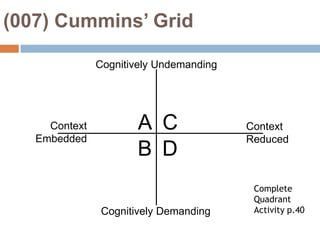
(007) Cummins’ GridCognitively UndemandingACContextEmbeddedContextReducedBDComplete Quadrant Activity p.40Cognitively Demanding
(007) ModificationModifying…vocabularyspeedstressintonationrepetitionamplification
(007) Primary LanguageUsing cognatesPrimary language text materialsPeer support
(007) Prior KnowledgeKWL chartAnticipation guideDiscussion/brainstorm
(007) ContextualizationEmbed language in understandable context such as…Realia - manipulatives, hands-on propsVisual support – multimedia and technology resources, charts/maps, nonverbal language
(007) AssessmentFormativeSummativeRe-teaching as a result
(007) Checking for UnderstandingMonitoring comprehension frequentlyChecking for different levels of comprehensionLiteralInferentialEvaluativeEffective questioning techniquesWait timeFraming questions appropriatelyDifferent types of questions
(007) Explicit TeachingsNameGive the strategy a name…ModelHow do you use the strategy?ExplainDescribe how strategy helps…ApplyTell when and how strategy can be usedExample…
(007) Content-Specific Discoursepp.248-249List some of the discourse skills that are critical to a content area that you teach in the specific categories…
(007) Discourse SkillsContent AreaMath/Science/Social Studies/etc.ProceduralSteps in the processDeclarativeStatement of fact/opinionForm/FunctionHow is language is used in contentGenreAutobiography, Folktale, Non-fiction, etc.
CTEL Module 2 Domain 3 008Effective Resource Use for ELD and SDAIE
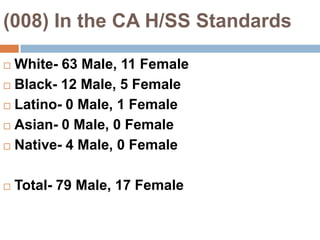
(008) In the CA H/SS StandardsWhite- 63 Male, 11 FemaleBlack- 12 Male, 5 FemaleLatino- 0 Male, 1 FemaleAsian- 0 Male, 0 FemaleNative- 4 Male, 0 FemaleTotal- 79 Male, 17 Female
(008) Textbook AnalysesPicture Analysis“People to Study” AnalysisAnthology AnalysisStoryline Analysis
(008) Brainstorm…How can you modify materials to meet the cognitive, linguistic, cultural, and academic needs of English Learners?What should you consider in choosing basic and supplementary materials?
CTEL Module 2 Domain 3 009Approaches and Methods for ELD and Content Instruction
(009) Brainstorm…Reflect on some of the ways you were taught a foreign language in high school and college. What were some of the activities that you participated in? How well did you learn the language?
(009) Natural Approach             62Theoretical Base: Krashen’s Monitor ModelGoal: ComprehensionKey Features: Closely resembles the way that a child acquires a first language.Effectiveness: Because it is based in acquisition, it is effective when followed explicitly.
(009) Total Physical ResponseTheoretical Base: James Asher, based on association between language and body movementGoal: Comprehension and building a receptive vocabularyKey Features: Listening precedes speakingUnderstanding is developed through body movementSpeaking is never forcedEffectiveness: Allows for low-stress acquisition of receptive vocabulary
(009) CALLA                                 166Theoretical Base: Chamot & O’MalleyGoal: Development of learning strategiesKey Features: CALLA is targeted at EL students at the early intermediate and intermediate levels of English language proficiency.Effectiveness: Because of its cognitive and metacognitive strategies, CALLA is designed provide transitional instruction from CBELD to SDAIE classrooms
(009) Structured InteractionsMeaningfulPurposefulOral and writtenMaximizes language outputCan negotiate meaning in a supportive contextUse during ELD and content instructionDynamic groups--homogeneous, heterogeneous, etc.
(009) StrategiesOral StrategiesNumbered Heads TogetherThink--Pair--ShareTea PartyWritten StrategiesWrite AroundCooperative Paragraph Strips
(009) Explicit Instruction  194-95Error CorrectionTeachable momentTo explain or clarifyLanguage structureWord meaningGrammar DevelopmentGuided by ELD Standards
(009) Implicit Instruction       196Error CorrectionModelingProviding feedbackUsing correct syntactical structureGrammar DevelopmentInteractive journal (writing)SSR (reading)
(009) Content-Based ELD        197Who? - K-3, B-A…4-12, B-EIWhat? - Content instruction is given at the students’ ELD level (not necessarily grade level)Which Standards? - Integrates ELD standards with content standardsWhen? - Throughout the day (outside of ELD instruction)Why? - To provide access to core while developing EnglishHow? - tapping prior knowledge, contextualization, graphic organizers, brainstorming, visuals, C.L., etc.
CTEL Module 2 Domain 3 010ELD--Listening and Speaking
(010) ELD Standards SequenceRead the information on p. 55Create a sequence of student answers to the question, “Do you like math?” to match each proficiency level.
(010) Skills that Promote L/SRead the information on p. 56Choose one skill on which to focus on from each of the three categories (three skills total).Brainstorm one strategy per skill to teach students that skill.
(010) Strategies that Promote L/SFrontloading…Teaching key vocabulary before they encounter itExplicitly teaching language functionsPre-teachingSmall group discussion in L1Preview/reviewUse primary language text before English textBrainstorming…Scaffold with sentence frames
(010) Strategies that Promote L/SCooperative LearningTeaching interactive structure first before it is used academicallyWhole-class and small group discussionsTeaching turn-takingRole-playsModelingInterviewsPracticing questioning and answering techniquesSentence framesDebriefingThink-Pair-Share(or other coop. strategy) to reflect on lesson
(010) ELD Speaking SequenceChoose one of the strategies on p. 59Apply the “ELD Standards Sequence for Oral Communication (p.57) to a content area that you teach.Create a scaffolded sequence for each proficiency level on p.60.
CTEL Module 2 Domain 3 011ELD--Reading and Writing
(011) ELD Writing StandardWrite short narratives that include examples of writing appropriate for LA and other content areasIndependently create cohesive paragraphs that develop a central idea with consistent use of standard English grammatical formsCreate simple sentences or phrases with some assistanceWrite an increasing number of words and simple sentences appropriate for LA and other content areasCreate multi-paragraph narrative compositionsWrite multi-paragraph narrative and expository compositions and examples appropriate for content areas, with consistent use of grammatical forms
(011) ELD Reading StandardRead simple text and orally respond to factual comprehension questions by using key words and phrasesRead simple text and orally respond to factual comprehension questions by using simple sentencesRead literature and orally respond with detailed sentencesIdentify and trace the development of an author’s argument, point of view, or perspective in text
(011) Strategies to Develop SkillsLists of skills on pp.60-61
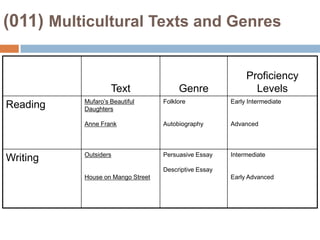
(011) Multicultural Texts and Genres
CTEL Module 2 Domain 3 012Specially Designed Academic Instruction in English (SDAIE)Reading: CTEL Text, Ch. 4
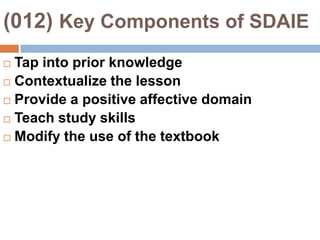
(012) Key Components of SDAIETap into prior knowledgeContextualize the lessonProvide a positive affective domainTeach study skillsModify the use of the textbook
(012) Scaffolding StrategiesProvides a personal connection between learner and topic. Builds on known conceptsHelps simplify complex concepts.  Creates an experiential environmentThe more familiar students are with the features of the text, the more successful…Clarifies procedures and expectationsFosters autonomy through self monitoringPre-teach terms so they will be understood in the lesson
(012) Scaffolding StrategiesStudents extend their understanding by applying it in novel formatsTo promote critical thinking skillsLearning is most effective when students have opportunities to discuss and process contentDifferent ways of determining student performance to provide more accurate evidence as to whether learning has taken placeClarifies misconceptions and further develops proficiency in English
(012) SDAIE Lesson Plan FormatGrade LevelContent StandardELD StandardAssessmentLearning OpportunitiesIntoThrough Beyond
(012) SDAIE Lesson PlanGrade Level-5Content Standard - 5.3.2 Students know when liquid water evaporates, it turns into water vapor in the air and can reappear as a liquid when cooled or as a solid if cooled below the freezing point of water.ELD Standard - Write brief expository compositions(e.g. description, comparison and contrast, cause and effect, and problem and solution) that include a thesis and some points of support.Assessment - Students will write a one paragraph composition comparing and contrasting the different forms of water.
(012) SDAIE Lesson PlanLearning OpportunitiesInto - Using the think-pair-share cooperative grouping model, students will write brief 1-2 sentence narratives of any experience that they have had with the different forms of water. As the T-P-S model dictates, they will pair up to relate their sentences to a partner, then share out in table groups. -Students will read summary of the lesson reading in table groups in order to preload content.                                                                  -Class will review the concept of comparing and contrasting using actual forms of water.
Through - Using a graphic organizer that pictorially represents the water cycle, students will develop understanding of the relationships the different forms of water have with one another. Students will then compare and contrast their charts with the charts of table mates.                                    -Students will develop a paragraph comparing and contrasting the different elements of the water cycle based on teacher-modeled representation.
Beyond - Students will create a haiku that describes water in its liquid, solid and gaseous formsCTEL Module 2 Domain 1 002Role, Purposes, and Types of AssessmentReading: CTEL Text, Ch. 3
(002) CELDTWhat? - State Test of ELD, Based on StandardsWho? - All English learnersWhy? - Initial Identification, Annual Assessment, Redesignation, ReclassificationWhen? - Annual Assessment- 7/1-10/31, Initial Assessment-30 days from enroll date4 grade spans: K-2, 3-5, 6-8, 9-124 parts: L, S, R, W5 Levels: B, EI, I, EA, A
(002) ID and PlacementChart on p. 76
(002) Home Language SurveyExample on p. 77
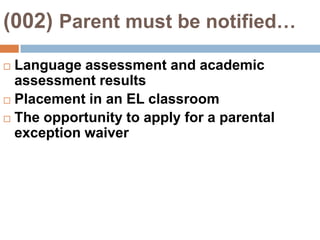
(002) Parent must be notified…Language assessment and academic assessment resultsPlacement in an EL classroomThe opportunity to apply for a parental exception waiver
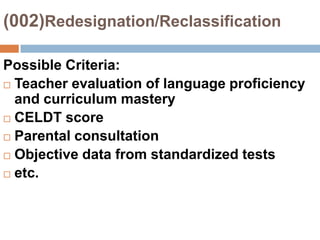
(002)Redesignation/ReclassificationPossible Criteria:Teacher evaluation of language proficiency and curriculum masteryCELDT scoreParental consultationObjective data from standardized testsetc.
(002) IdentificationCELDT Score: Early Advanced L/S: Intermediate or aboveR: Intermediate or aboveW: Intermediate or aboveA student who falls below these criteria is an EL.
(002) ReclassificationCELDT: Meets criteria on previous slideObjective criteria: ELA score of BASIC on California Content Standards Test. Other criteria identified by district: i.e. teacher observation, grades, writing sample, etc.
(002) Validity                              102A test is valid if it measures what it claims to be measuring.
(002) Reliability                        102A test is reliable if it yields predictably similar scores over several administrations.
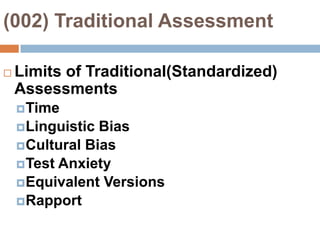
(002) Traditional AssessmentLimits of Traditional(Standardized) AssessmentsTimeLinguistic BiasCultural BiasTest AnxietyEquivalent VersionsRapport
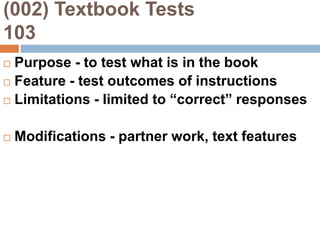
(002) Textbook Tests                  103Purpose - to test what is in the bookFeature - test outcomes of instructionsLimitations - limited to “correct” responsesModifications - partner work, text features
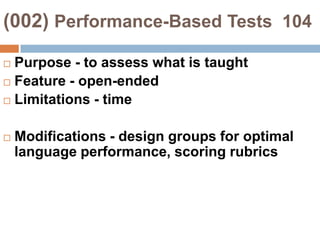
(002) Performance-Based Tests  104Purpose - to assess what is taughtFeature - open-endedLimitations - timeModifications - design groups for optimal language performance, scoring rubrics
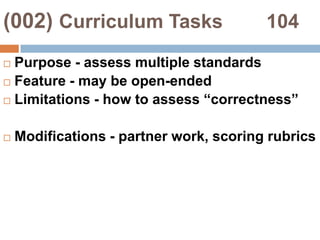
(002) Curriculum Tasks        104Purpose - assess multiple standardsFeature - may be open-endedLimitations - how to assess “correctness”Modifications - partner work, scoring rubrics
(002) Authentic Tests                104Purpose - assess classroom performanceFeature - student shares in processLimitations - lack of comparison group for accountabilityModifications - portfolios, group or individual
(002) Teacher-Made Tests      105Purpose - assess teaching of materialFeature - usually discrete pointLimitations - reliability/validityModifications - focus on message, not form
CTEL Module 2 Domain 1 001Principles of Standards-Based Assessment and Instruction
(001) ELD StandardsELD Standards are a pathway to the ELA standards for ELs.The ELD standards establish clear performance expectations for ELs. The ELD standards are to be used to plan/provide instruction for English Language Development.The ELD standards are based on proficiency levels and grade-level spans in L/S, R, and W.The ELD standards are based on the same components as the ELA standards.  An English Learner may require more explicit steps to reach a standard.The CELDT is aligned with the ELD standards.
(001) Standards-Based…STANDARDS inform ASSESSMENTASSESSMENT informs INSTRUCTIONStudents engage in LEARNINGStudents DEMONSTRATE what they knowStudents experience LEARNING, orTeacher RETEACHES
(001) Standards and EL StudentsELs must have access to the core in order to meet standards.Teachers must develop benchmarks to show that these students are moving toward the standards.Teachers must teach to the ELD standards.
(001) Building a Scaffolded AssessmentRead the information on p.88Complete the exercise on p.89
(001) SDAIE Lesson PlanContent AreaGrade LevelContent StandardContent ObjectivesGraphic OrganizersContextual CluesStrategiesKey VocabularyINTO/THROUGH/BEYOND
CTEL Module 2 Domain 1 003Language and Content-Area Assessment
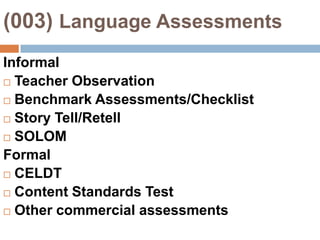
(003) Language AssessmentsInformalTeacher ObservationBenchmark Assessments/ChecklistStory Tell/RetellSOLOMFormalCELDTContent Standards TestOther commercial assessments
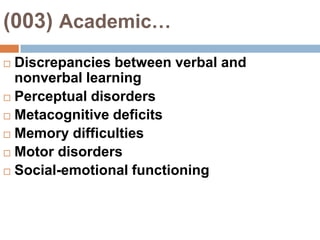
(003) Academic…Discrepancies between verbal and nonverbal learningPerceptual disordersMetacognitive deficitsMemory difficultiesMotor disordersSocial-emotional functioning
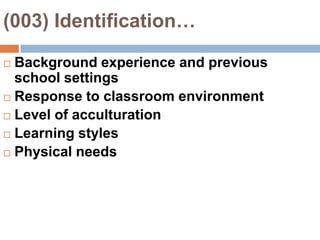
(003) Identification…Background experience and previous school settingsResponse to classroom environmentLevel of acculturationLearning stylesPhysical needs
(003)Underachievement…All ethnic groups score lower than whitesExcept for Asian-Americans all attain lower levels of educationReasons are unclear
(003) Overachievement…“Model Minorities” become over-qualified for jobsTeacher expectations of some groups elicit higher achievementSome subgroups resist assimilation

Ctel2 Spring 11

  • 1.
  • 2.
    Contact Informationemail: mrounds@sdcoe.netwiki: ctelresources.wetpaint.com
  • 3.
    Module 2Domain 2- Foundations of English Language/Literacy Development and Content InstructionDomain 3 - Approaches and Methods for ELD and Content InstructionDomain 1 - Assessment of English Learners
  • 4.
    CTEL Module 2Domain 2 004Foundations of Programs for English LearnersReading: CTEL Text, Ch. 4
  • 5.
    (004) Benchmarks 117-1231700-European immigrants settle in rural enclaves and run their own non-English-speaking schools1839-Ohio is the first state to adopt a bilingual education law, allowing schools to operate in German and English at parent request1847-Louisiana passes similar law for French & English1848-Treaty gave Mexicans the right to speak Spanish in CA1864-Congress prohibits Native Americans from being taught in their own language
  • 6.
    (004) Benchmarks 117-1231870-School Superintendent in St. Louis points out socio-cultural weaknesses if people lose ability in native language1879-Children are punished when caught using native language1888-Legislation attempted in both states1900-At least 600,000 taught in German1906-Congress passes first English-only law1917-Anti-German sentiment begins to extend to other languages
  • 7.
    (004) Benchmarks 117-1231934-The de facto policy continues into the 40’s & 50’s1959-Cuban immigrants arrive in Miami1961-Full bilingual program for Cuban immigrants1968-Act provided money for programs of native language instruction1974-Supreme Court determines that schools that do not make special provisions for students learning English are not providing equal educational opportunities.
  • 8.
    (004) Benchmarks 117-1231980-Ordinance is in response to new waves of immigrants who are poorer and less educated1994-Prop 187 would have made it illegal to provide education to illegal residents. Was overturned on appeal1998-Ed. Code 300-340-Required that instruction be overwhelmingly in English2001-Provided federal funding to schools to support the instruction of English Learners2004-Individuals with Disabilities Education Act ensures an equitable education for students with disabilities2004-CA schools must provide equitable access to textbooks and facilities, and facilities and teachers must be appropriately authorized
  • 9.
    (004) Lau vsNichols 126Supreme Court decision (1974) of a suit brought by native Chinese speaker in San Francisco schoolsMade illegal those educational practices that excluded children from effective education on the basis of languageCourt ruled that simply providing same instruction and materials in English was not equitable
  • 10.
    (004) Lau Remedies 126-127Published by US Commissioner for Ed.Standardized requirements for identifying and evaluating ELs.Defined instructional treatments, procedures to transfer to all-English classes, and professional standards for teachers.Still in use in states without regulations.
  • 11.
    (004) NCLB (TitleIII) 124States that “English Learners will develop high levels of academic proficiency and meet the same challenging academic standards as do their native-English speaking peers.”Funding for ELs and immigrantsAccountability requires annual progress in learning English, progress towards reclassification, and academic progressAlso see 129
  • 12.
    (004) IDEA 123Individuals with Disabilities Education ActReauthorized previous Special Education lawStipulates that children not be labeled disabled if poor school achievement is due to ethnic, linguistic, or racial difference
  • 13.
    (004) Prop 227 125Ed. Code 300-340Instruction overwhelmingly in EnglishAlternative programs through waiver processThe single year flies in the face of academic language acquisition research…4-9 years
  • 14.
    (004) Williams vsCA 126Requires equity in provision of textbooks, maintenance of facilities, and appropriately authorized staff (including teachers of English Learners)
  • 15.
    (004) Heritage Language 127AKA “developmental bilingual programs”Designed for students with a primary language other than English. Goals include maintenance and development of native language
  • 16.
    (004) Dual Immersion 127Half EL, half EOGoal is for students to be proficient in both languages … AKA additive bilingualismHigh level of academic competence in two languages by ELs and EOs
  • 17.
    (004) English Only 128Goal of assimilationBelief that common language is a unifierBelief that students will be more academically successful
  • 18.
    (004) Equity Issues 130Program PlacementLength of time in programTrackingSpecial EdStudent DataRetention/promotionDropout rates/expulsion and detention ratesStaffingTeacher qualificationTeacher retentionFunding
  • 19.
  • 20.
  • 21.
    (004) ELD 137-138Goal: Language ProficiencyPurpose: Developing SKILLSLimitations: Appropriate for development of language ONLY. Content will not be grade-level appropriate
  • 22.
    (004) Content-Based ELD 138Goal: Access to corePurpose: Develop language through core contentLimitations: While providing access to some core content, concepts do not provide grade-level academics.
  • 23.
    (004) SDAIE 140Goal: Access to grade-level core contentPurpose: Mastery of grade-level core content through specially designed, language-based strategiesLimitations: Delivery may only include essential standards due to need for slower pacing.
  • 24.
    CTEL Module 2Domain 2 005Foundations of English LiteracyReading: from CTEL Text, Ch. 6
  • 25.
    (005) Oral andWrittenOral Language Written LanguageLanguage Experience ApproachWritten Language Oral LanguageUsing text to paraphrase
  • 26.
    (005) Vocabulary KnowledgeHowwell developed vocabulary isLevel of vocabulary: social vs academic
  • 27.
    (005) Educational BackgroundPriorknowledgeLiteracy skillsPrevious schoolingBackground knowledge(familiarity with concepts)
  • 28.
    (005) Level ofEnglish ProficiencyBeginnerEarly IntermediateIntermediateEarly AdvancedAdvanced
  • 29.
    (005) Primary LanguageHowwell developed literacy skills areLinguistic differences between primary language and English
  • 30.
  • 31.
    (005) Pedagogical PracticesIntegrate listening, speaking, reading, and writingBeing cognizant of integrating L S R W while teaching Math, Social Studies, Science.Example: After a science experiment, use the Language Experience Approach to develop literacy through science
  • 32.
    (005) Pedagogical PracticesProvides a balanced, comprehensive reading programBalance between phonics and comprehension; integrates L S R W
  • 33.
    (005) Pedagogical PracticesUses standards-based thematic unit organizationThemes based on standardsExample: 6th grade Ancient Egypt
  • 34.
    (005) Pedagogical PracticesCreates a language-rich environmentAccessible contextualized print
  • 35.
    (005) Pedagogical PracticesAdapts instruction and materials to meet the special needs of English LearnersCulturally and linguistically appropriateUse effective strategies (graphic organizers, visuals, contextualization, realia, etc.)
  • 36.
    (005) Pedagogical PracticesPlans meaningful and purposeful literacy activitiesRelating your content and instruction to real life
  • 37.
    (005) Pedagogical PracticesSelects appropriate reading materialsVariety of genres, multicultural text, high interest, relevantMake sure that EL proficiency level is taken into consideration
  • 38.
    (005) Pedagogical PracticesUtilizes English Learners’ prior knowledge to promote English language development in reading and writingConnect to students’ backgrounds
  • 39.
    (005) Pedagogical PracticesScaffolds literacy activitiesProvide well structured activities with ample supportExample: Brainstorm/outline before required to write
  • 40.
    (005) Pedagogical PracticesProvides organized, systematic, explicit instruction in key skillsMake no assumptionsSkills must be taught
  • 41.
    (005) Effective Approaches 157Frontloading Vocabulary 247Language Experience Approach 229Interactive Journals 233Shared ReadingLearning LogsProcess Writing 234-236Graphic Organizers 158-162Pre-Reading Activities
  • 42.
    CTEL Module 2Domain 2 006Instructional Planning and Organization for ELD and SDAIEReading: from CTEL Text, Ch. 6
  • 43.
    (006) ELD StandardsThe Role of ELD StandardsRelationship to Native SpeakersLevels of English Proficiency
  • 44.
    (006) Relationship betweenELA and ELD ELA HIGHWAYRWL,S
  • 45.
    (006) SDAIE 176-186What is SDAIE?Who should receive SDAIE and why?Why is SDAIE more than “just good teaching”?What is the role of primary language in a SDAIE class?What are some successful SDAIE strategies?
  • 46.
    (006) ELD vsSDAIE Venn Diagram p.33
  • 47.
    (006) Content andLanguage 240Read pp. 240-242 of CTEL TextContent Objectives and Language ObjectivesContent Standard: Students know causes and effects of different types of severe weather…CONTENT Objective: Students will be able to DEFINE and DESCRIBE… RECOGNIZE…LANGUAGE Objective: Students will PARTICIPATE in discussions…DEFINE and DESCRIBE…will be able to PRESENT…
  • 48.
    (006) Grouping Strategies 168-174 Mixed with proficient English speakersFor hands-on, concrete activities Mixed with same native-language backgroundFor conceptually demanding or abstract contentPreview-review…Description on page 35
  • 49.
    (006) Language DevelopmentPrimary Language GroupsProficiency Level GroupsMixed Group w/Proficient English Speakers
  • 50.
    (006) Conceptual DevelopmentPrimary Language GroupsProficiency Level GroupsPrior Knowledge/SchoolingReading Level
  • 51.
    (006) Classroom CommunityDevelopmentMixed/Heterogeneous
  • 52.
    (006) Physical SettingSupports Student InteractionPhysical Arrangement of FurnitureConfigurations for whole group vs small groupTeacher and Student MovementLanguage Rich EnvironmentDisplay and use a variety of print materials in primary language and EnglishOffers Stimuli for ConversationUse of wall space to display content-related informationUse of technology and multimedia
  • 53.
    (006) Organizing Roleof ParaprofessionalsProvide and monitor small group instructionProvide individual supportAssist in primary language instructionVolunteersOlder students, parents, community membersTeam TeachingBy subject matter or proficiency levelTechnologyMultimedia and specially designed software
  • 54.
    CTEL Module 2Domain 2 007Components of Effective Instructional Delivery in ELD and SDAIEReading: from CTEL Text, Ch. 7
  • 55.
    (007) Cummins’ GridCognitivelyUndemandingACContextEmbeddedContextReducedBDComplete Quadrant Activity p.40Cognitively Demanding
  • 56.
  • 57.
    (007) Primary LanguageUsingcognatesPrimary language text materialsPeer support
  • 58.
    (007) Prior KnowledgeKWLchartAnticipation guideDiscussion/brainstorm
  • 59.
    (007) ContextualizationEmbed languagein understandable context such as…Realia - manipulatives, hands-on propsVisual support – multimedia and technology resources, charts/maps, nonverbal language
  • 60.
  • 61.
    (007) Checking forUnderstandingMonitoring comprehension frequentlyChecking for different levels of comprehensionLiteralInferentialEvaluativeEffective questioning techniquesWait timeFraming questions appropriatelyDifferent types of questions
  • 62.
    (007) Explicit TeachingsNameGivethe strategy a name…ModelHow do you use the strategy?ExplainDescribe how strategy helps…ApplyTell when and how strategy can be usedExample…
  • 63.
    (007) Content-Specific Discoursepp.248-249Listsome of the discourse skills that are critical to a content area that you teach in the specific categories…
  • 64.
    (007) Discourse SkillsContentAreaMath/Science/Social Studies/etc.ProceduralSteps in the processDeclarativeStatement of fact/opinionForm/FunctionHow is language is used in contentGenreAutobiography, Folktale, Non-fiction, etc.
  • 65.
    CTEL Module 2Domain 3 008Effective Resource Use for ELD and SDAIE
  • 66.
    (008) In theCA H/SS StandardsWhite- 63 Male, 11 FemaleBlack- 12 Male, 5 FemaleLatino- 0 Male, 1 FemaleAsian- 0 Male, 0 FemaleNative- 4 Male, 0 FemaleTotal- 79 Male, 17 Female
  • 67.
    (008) Textbook AnalysesPictureAnalysis“People to Study” AnalysisAnthology AnalysisStoryline Analysis
  • 68.
    (008) Brainstorm…How canyou modify materials to meet the cognitive, linguistic, cultural, and academic needs of English Learners?What should you consider in choosing basic and supplementary materials?
  • 69.
    CTEL Module 2Domain 3 009Approaches and Methods for ELD and Content Instruction
  • 70.
    (009) Brainstorm…Reflect onsome of the ways you were taught a foreign language in high school and college. What were some of the activities that you participated in? How well did you learn the language?
  • 71.
    (009) Natural Approach 62Theoretical Base: Krashen’s Monitor ModelGoal: ComprehensionKey Features: Closely resembles the way that a child acquires a first language.Effectiveness: Because it is based in acquisition, it is effective when followed explicitly.
  • 72.
    (009) Total PhysicalResponseTheoretical Base: James Asher, based on association between language and body movementGoal: Comprehension and building a receptive vocabularyKey Features: Listening precedes speakingUnderstanding is developed through body movementSpeaking is never forcedEffectiveness: Allows for low-stress acquisition of receptive vocabulary
  • 73.
    (009) CALLA 166Theoretical Base: Chamot & O’MalleyGoal: Development of learning strategiesKey Features: CALLA is targeted at EL students at the early intermediate and intermediate levels of English language proficiency.Effectiveness: Because of its cognitive and metacognitive strategies, CALLA is designed provide transitional instruction from CBELD to SDAIE classrooms
  • 74.
    (009) Structured InteractionsMeaningfulPurposefulOraland writtenMaximizes language outputCan negotiate meaning in a supportive contextUse during ELD and content instructionDynamic groups--homogeneous, heterogeneous, etc.
  • 75.
    (009) StrategiesOral StrategiesNumberedHeads TogetherThink--Pair--ShareTea PartyWritten StrategiesWrite AroundCooperative Paragraph Strips
  • 76.
    (009) Explicit Instruction 194-95Error CorrectionTeachable momentTo explain or clarifyLanguage structureWord meaningGrammar DevelopmentGuided by ELD Standards
  • 77.
    (009) Implicit Instruction 196Error CorrectionModelingProviding feedbackUsing correct syntactical structureGrammar DevelopmentInteractive journal (writing)SSR (reading)
  • 78.
    (009) Content-Based ELD 197Who? - K-3, B-A…4-12, B-EIWhat? - Content instruction is given at the students’ ELD level (not necessarily grade level)Which Standards? - Integrates ELD standards with content standardsWhen? - Throughout the day (outside of ELD instruction)Why? - To provide access to core while developing EnglishHow? - tapping prior knowledge, contextualization, graphic organizers, brainstorming, visuals, C.L., etc.
  • 79.
    CTEL Module 2Domain 3 010ELD--Listening and Speaking
  • 80.
    (010) ELD StandardsSequenceRead the information on p. 55Create a sequence of student answers to the question, “Do you like math?” to match each proficiency level.
  • 81.
    (010) Skills thatPromote L/SRead the information on p. 56Choose one skill on which to focus on from each of the three categories (three skills total).Brainstorm one strategy per skill to teach students that skill.
  • 82.
    (010) Strategies thatPromote L/SFrontloading…Teaching key vocabulary before they encounter itExplicitly teaching language functionsPre-teachingSmall group discussion in L1Preview/reviewUse primary language text before English textBrainstorming…Scaffold with sentence frames
  • 83.
    (010) Strategies thatPromote L/SCooperative LearningTeaching interactive structure first before it is used academicallyWhole-class and small group discussionsTeaching turn-takingRole-playsModelingInterviewsPracticing questioning and answering techniquesSentence framesDebriefingThink-Pair-Share(or other coop. strategy) to reflect on lesson
  • 84.
    (010) ELD SpeakingSequenceChoose one of the strategies on p. 59Apply the “ELD Standards Sequence for Oral Communication (p.57) to a content area that you teach.Create a scaffolded sequence for each proficiency level on p.60.
  • 85.
    CTEL Module 2Domain 3 011ELD--Reading and Writing
  • 86.
    (011) ELD WritingStandardWrite short narratives that include examples of writing appropriate for LA and other content areasIndependently create cohesive paragraphs that develop a central idea with consistent use of standard English grammatical formsCreate simple sentences or phrases with some assistanceWrite an increasing number of words and simple sentences appropriate for LA and other content areasCreate multi-paragraph narrative compositionsWrite multi-paragraph narrative and expository compositions and examples appropriate for content areas, with consistent use of grammatical forms
  • 87.
    (011) ELD ReadingStandardRead simple text and orally respond to factual comprehension questions by using key words and phrasesRead simple text and orally respond to factual comprehension questions by using simple sentencesRead literature and orally respond with detailed sentencesIdentify and trace the development of an author’s argument, point of view, or perspective in text
  • 88.
    (011) Strategies toDevelop SkillsLists of skills on pp.60-61
  • 89.
  • 90.
    CTEL Module 2Domain 3 012Specially Designed Academic Instruction in English (SDAIE)Reading: CTEL Text, Ch. 4
  • 91.
    (012) Key Componentsof SDAIETap into prior knowledgeContextualize the lessonProvide a positive affective domainTeach study skillsModify the use of the textbook
  • 92.
    (012) Scaffolding StrategiesProvidesa personal connection between learner and topic. Builds on known conceptsHelps simplify complex concepts. Creates an experiential environmentThe more familiar students are with the features of the text, the more successful…Clarifies procedures and expectationsFosters autonomy through self monitoringPre-teach terms so they will be understood in the lesson
  • 93.
    (012) Scaffolding StrategiesStudentsextend their understanding by applying it in novel formatsTo promote critical thinking skillsLearning is most effective when students have opportunities to discuss and process contentDifferent ways of determining student performance to provide more accurate evidence as to whether learning has taken placeClarifies misconceptions and further develops proficiency in English
  • 94.
    (012) SDAIE LessonPlan FormatGrade LevelContent StandardELD StandardAssessmentLearning OpportunitiesIntoThrough Beyond
  • 95.
    (012) SDAIE LessonPlanGrade Level-5Content Standard - 5.3.2 Students know when liquid water evaporates, it turns into water vapor in the air and can reappear as a liquid when cooled or as a solid if cooled below the freezing point of water.ELD Standard - Write brief expository compositions(e.g. description, comparison and contrast, cause and effect, and problem and solution) that include a thesis and some points of support.Assessment - Students will write a one paragraph composition comparing and contrasting the different forms of water.
  • 96.
    (012) SDAIE LessonPlanLearning OpportunitiesInto - Using the think-pair-share cooperative grouping model, students will write brief 1-2 sentence narratives of any experience that they have had with the different forms of water. As the T-P-S model dictates, they will pair up to relate their sentences to a partner, then share out in table groups. -Students will read summary of the lesson reading in table groups in order to preload content. -Class will review the concept of comparing and contrasting using actual forms of water.
  • 97.
    Through - Usinga graphic organizer that pictorially represents the water cycle, students will develop understanding of the relationships the different forms of water have with one another. Students will then compare and contrast their charts with the charts of table mates. -Students will develop a paragraph comparing and contrasting the different elements of the water cycle based on teacher-modeled representation.
  • 98.
    Beyond - Studentswill create a haiku that describes water in its liquid, solid and gaseous formsCTEL Module 2 Domain 1 002Role, Purposes, and Types of AssessmentReading: CTEL Text, Ch. 3
  • 99.
    (002) CELDTWhat? -State Test of ELD, Based on StandardsWho? - All English learnersWhy? - Initial Identification, Annual Assessment, Redesignation, ReclassificationWhen? - Annual Assessment- 7/1-10/31, Initial Assessment-30 days from enroll date4 grade spans: K-2, 3-5, 6-8, 9-124 parts: L, S, R, W5 Levels: B, EI, I, EA, A
  • 100.
    (002) ID andPlacementChart on p. 76
  • 101.
    (002) Home LanguageSurveyExample on p. 77
  • 102.
    (002) Parent mustbe notified…Language assessment and academic assessment resultsPlacement in an EL classroomThe opportunity to apply for a parental exception waiver
  • 103.
    (002)Redesignation/ReclassificationPossible Criteria:Teacher evaluationof language proficiency and curriculum masteryCELDT scoreParental consultationObjective data from standardized testsetc.
  • 104.
    (002) IdentificationCELDT Score:Early Advanced L/S: Intermediate or aboveR: Intermediate or aboveW: Intermediate or aboveA student who falls below these criteria is an EL.
  • 105.
    (002) ReclassificationCELDT: Meetscriteria on previous slideObjective criteria: ELA score of BASIC on California Content Standards Test. Other criteria identified by district: i.e. teacher observation, grades, writing sample, etc.
  • 106.
    (002) Validity 102A test is valid if it measures what it claims to be measuring.
  • 107.
    (002) Reliability 102A test is reliable if it yields predictably similar scores over several administrations.
  • 108.
    (002) Traditional AssessmentLimitsof Traditional(Standardized) AssessmentsTimeLinguistic BiasCultural BiasTest AnxietyEquivalent VersionsRapport
  • 109.
    (002) Textbook Tests 103Purpose - to test what is in the bookFeature - test outcomes of instructionsLimitations - limited to “correct” responsesModifications - partner work, text features
  • 110.
    (002) Performance-Based Tests 104Purpose - to assess what is taughtFeature - open-endedLimitations - timeModifications - design groups for optimal language performance, scoring rubrics
  • 111.
    (002) Curriculum Tasks 104Purpose - assess multiple standardsFeature - may be open-endedLimitations - how to assess “correctness”Modifications - partner work, scoring rubrics
  • 112.
    (002) Authentic Tests 104Purpose - assess classroom performanceFeature - student shares in processLimitations - lack of comparison group for accountabilityModifications - portfolios, group or individual
  • 113.
    (002) Teacher-Made Tests 105Purpose - assess teaching of materialFeature - usually discrete pointLimitations - reliability/validityModifications - focus on message, not form
  • 114.
    CTEL Module 2Domain 1 001Principles of Standards-Based Assessment and Instruction
  • 115.
    (001) ELD StandardsELDStandards are a pathway to the ELA standards for ELs.The ELD standards establish clear performance expectations for ELs. The ELD standards are to be used to plan/provide instruction for English Language Development.The ELD standards are based on proficiency levels and grade-level spans in L/S, R, and W.The ELD standards are based on the same components as the ELA standards. An English Learner may require more explicit steps to reach a standard.The CELDT is aligned with the ELD standards.
  • 116.
    (001) Standards-Based…STANDARDS informASSESSMENTASSESSMENT informs INSTRUCTIONStudents engage in LEARNINGStudents DEMONSTRATE what they knowStudents experience LEARNING, orTeacher RETEACHES
  • 117.
    (001) Standards andEL StudentsELs must have access to the core in order to meet standards.Teachers must develop benchmarks to show that these students are moving toward the standards.Teachers must teach to the ELD standards.
  • 118.
    (001) Building aScaffolded AssessmentRead the information on p.88Complete the exercise on p.89
  • 119.
    (001) SDAIE LessonPlanContent AreaGrade LevelContent StandardContent ObjectivesGraphic OrganizersContextual CluesStrategiesKey VocabularyINTO/THROUGH/BEYOND
  • 120.
    CTEL Module 2Domain 1 003Language and Content-Area Assessment
  • 121.
    (003) Language AssessmentsInformalTeacherObservationBenchmark Assessments/ChecklistStory Tell/RetellSOLOMFormalCELDTContent Standards TestOther commercial assessments
  • 122.
    (003) Academic…Discrepancies betweenverbal and nonverbal learningPerceptual disordersMetacognitive deficitsMemory difficultiesMotor disordersSocial-emotional functioning
  • 123.
    (003) Identification…Background experienceand previous school settingsResponse to classroom environmentLevel of acculturationLearning stylesPhysical needs
  • 124.
    (003)Underachievement…All ethnic groupsscore lower than whitesExcept for Asian-Americans all attain lower levels of educationReasons are unclear
  • 125.
    (003) Overachievement…“Model Minorities”become over-qualified for jobsTeacher expectations of some groups elicit higher achievementSome subgroups resist assimilation