Compiled by Ayesha Malik – KINNAIRD COLLEGE FOR WOMEN

INTRODUCTION TO APPLIED
LINGUISTICS
Lecture 1
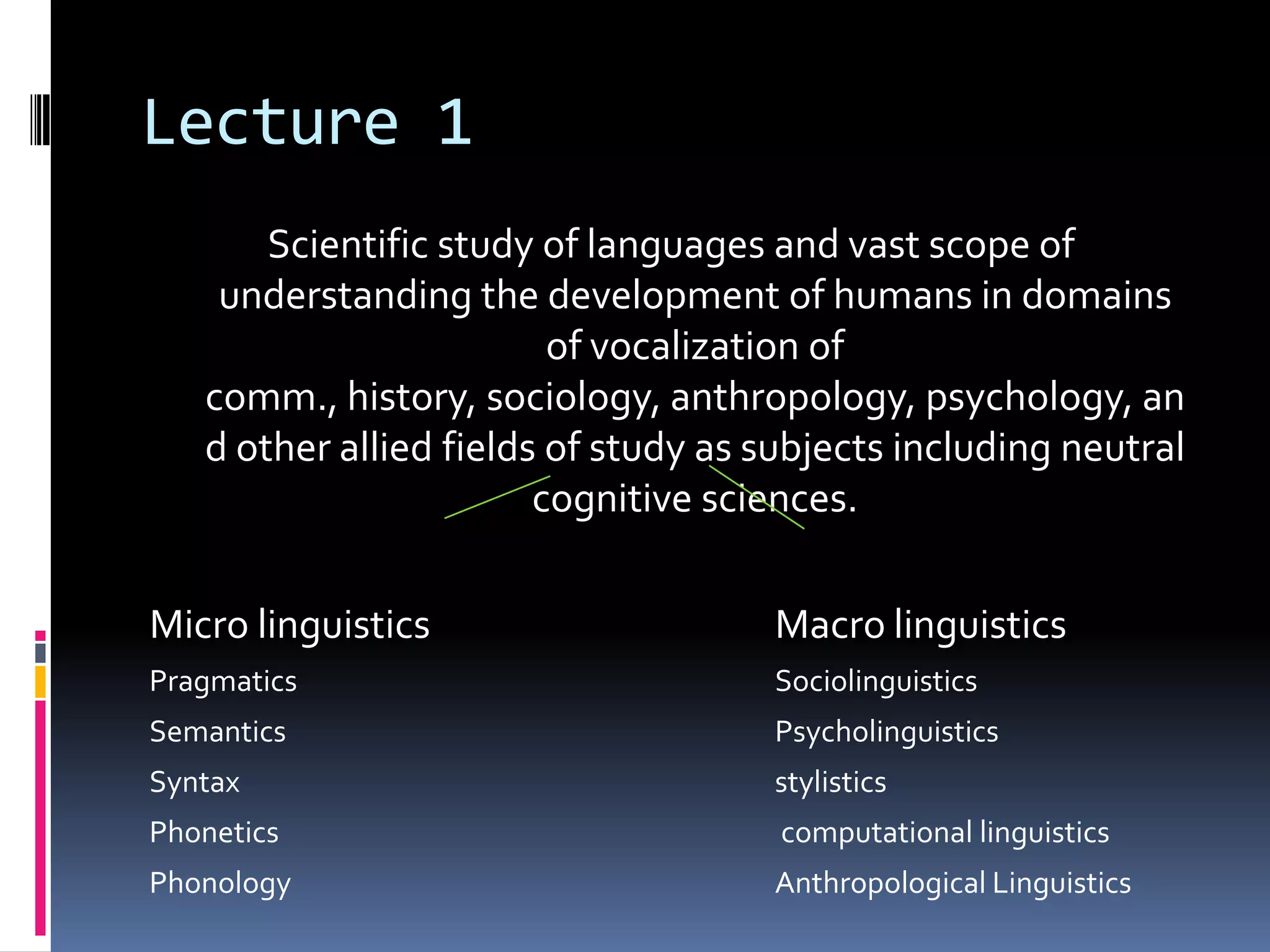
       Scientific study of languages and vast scope of
    understanding the development of humans in domains
                         of vocalization of
   comm., history, sociology, anthropology, psychology, an
   d other allied fields of study as subjects including neutral
                        cognitive sciences.

Micro linguistics                    Macro linguistics
Pragmatics                           Sociolinguistics
Semantics                            Psycholinguistics
Syntax                               stylistics
Phonetics                             computational linguistics
Phonology                            Anthropological Linguistics
MICRO LINGUISTICS
1. PHONETICS
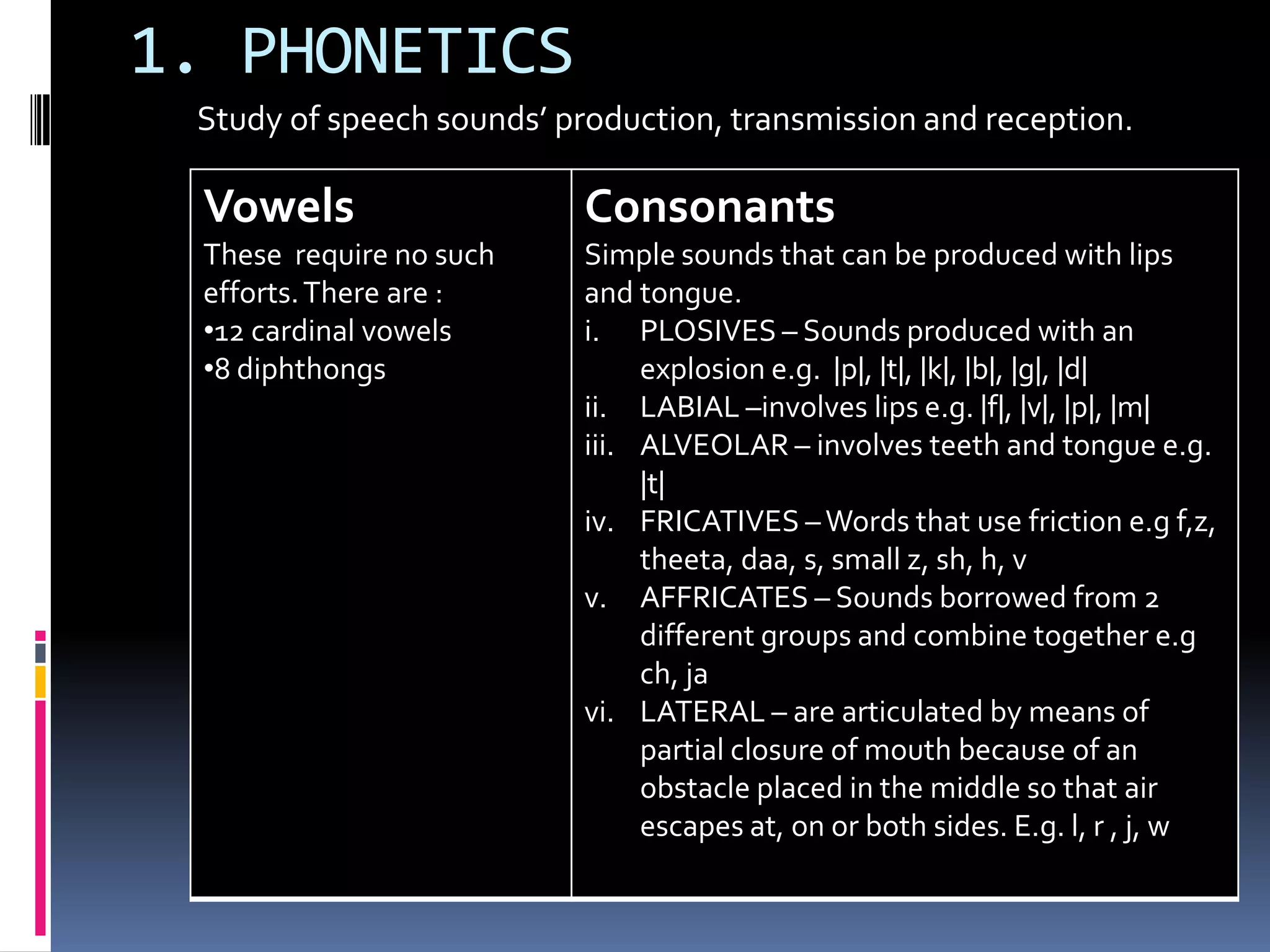
 Study of speech sounds’ production, transmission and reception.

 Vowels                    Consonants
 These require no such     Simple sounds that can be produced with lips
 efforts. There are :      and tongue.
 •12 cardinal vowels       i. PLOSIVES – Sounds produced with an
 •8 diphthongs                  explosion e.g. |p|, |t|, |k|, |b|, |g|, |d|
                           ii. LABIAL –involves lips e.g. |f|, |v|, |p|, |m|
                           iii. ALVEOLAR – involves teeth and tongue e.g.
                                |t|
                           iv. FRICATIVES – Words that use friction e.g f,z,
                                theeta, daa, s, small z, sh, h, v
                           v. AFFRICATES – Sounds borrowed from 2
                                different groups and combine together e.g
                                ch, ja
                           vi. LATERAL – are articulated by means of
                                partial closure of mouth because of an
                                obstacle placed in the middle so that air
                                escapes at, on or both sides. E.g. l, r , j, w
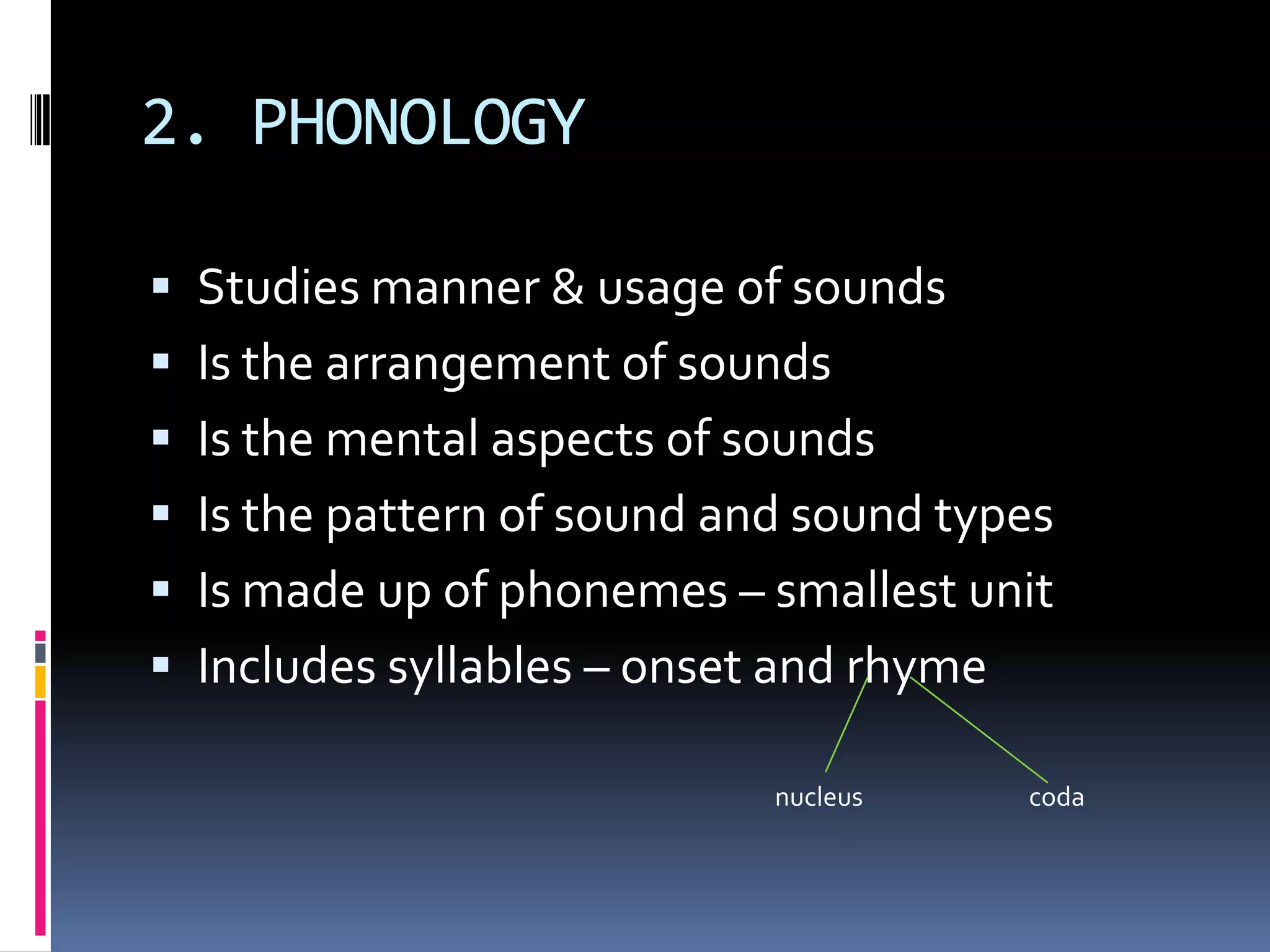
2. PHONOLOGY

 Studies manner & usage of sounds
 Is the arrangement of sounds
 Is the mental aspects of sounds
 Is the pattern of sound and sound types
 Is made up of phonemes – smallest unit
 Includes syllables – onset and rhyme

                            nucleus      coda
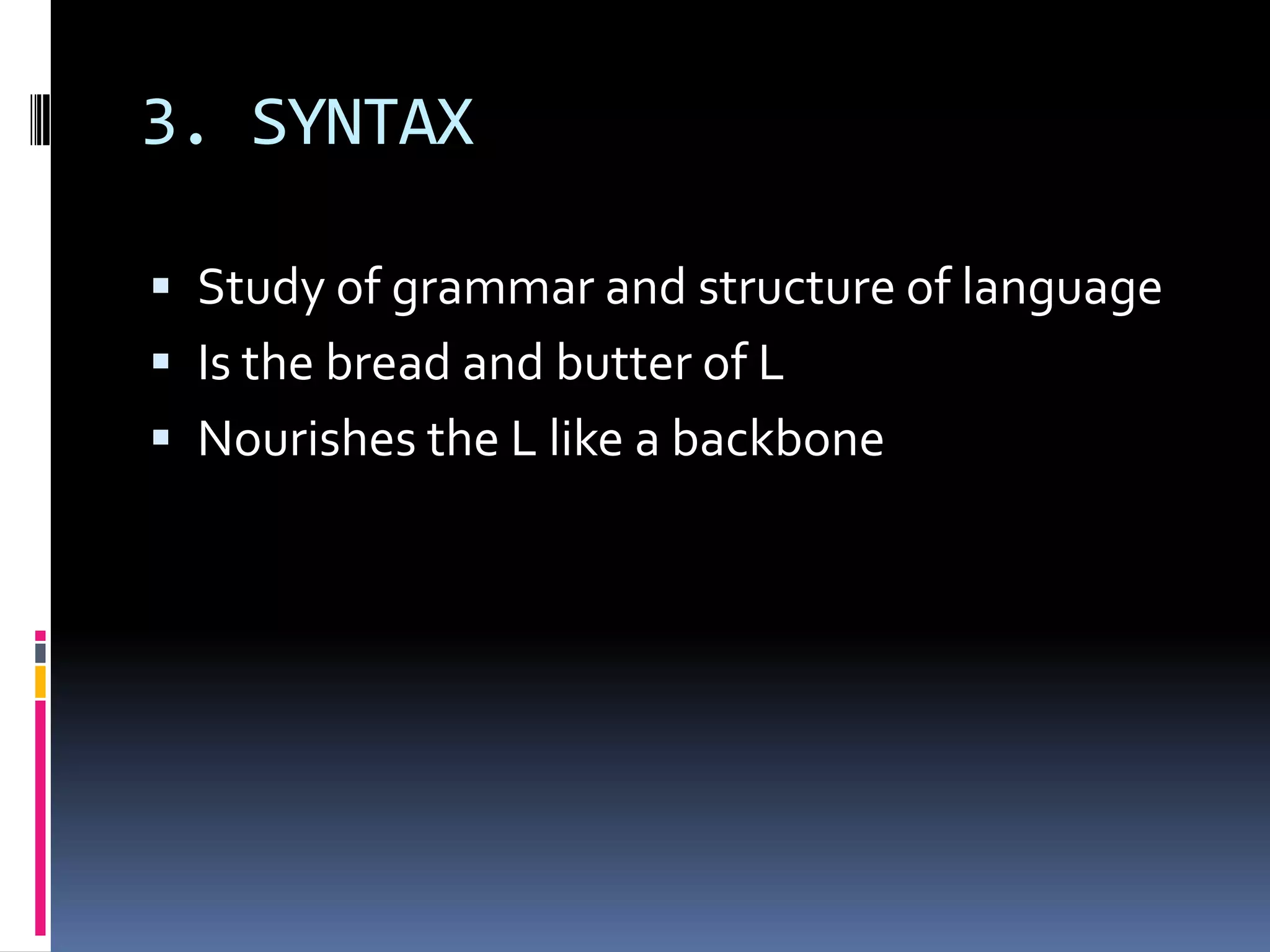
3. SYNTAX

 Study of grammar and structure of language
 Is the bread and butter of L
 Nourishes the L like a backbone
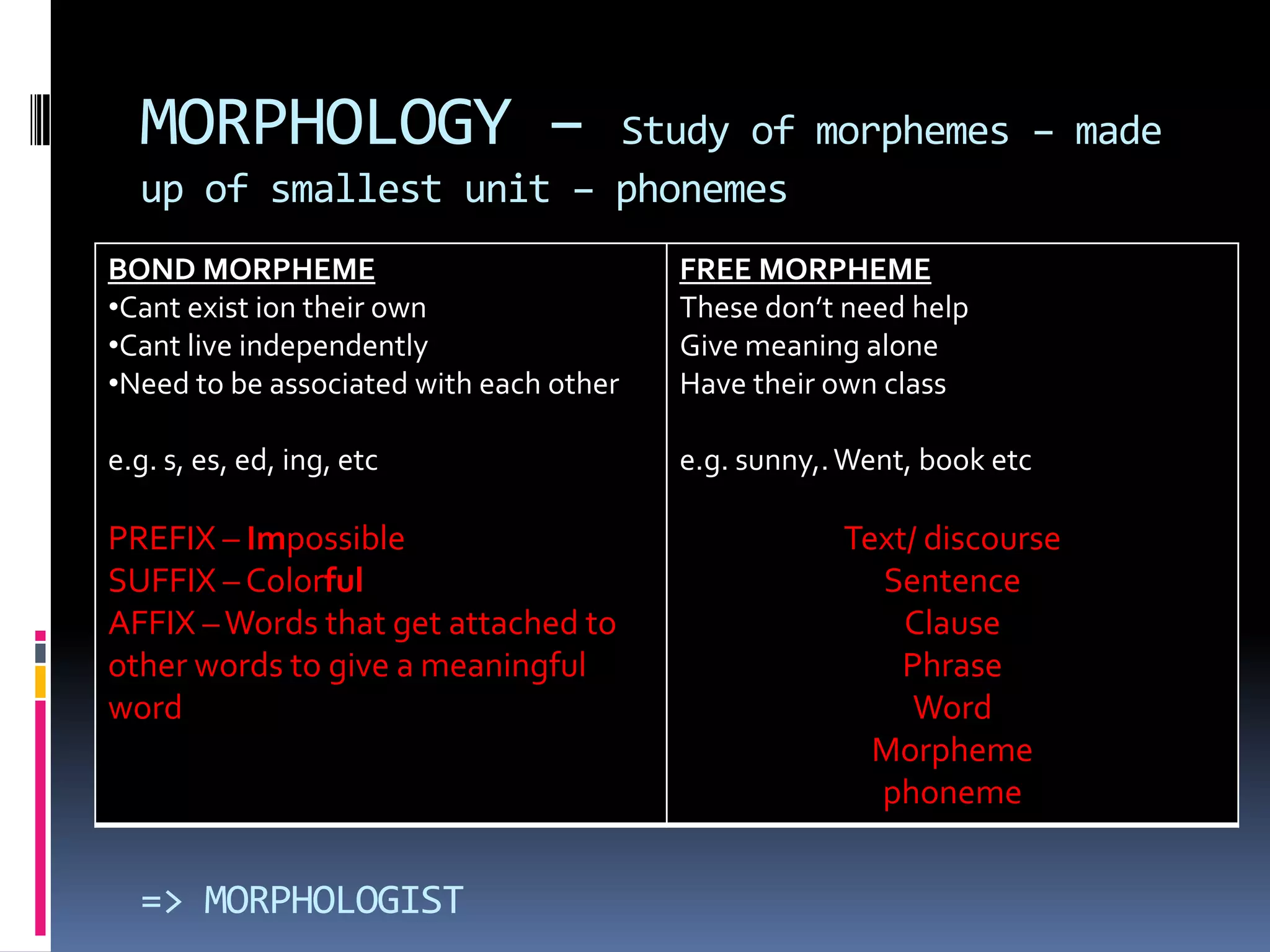
MORPHOLOGY –          Study of morphemes – made
  up of smallest unit – phonemes
BOND MORPHEME                            FREE MORPHEME
•Cant exist ion their own                These don’t need help
•Cant live independently                 Give meaning alone
•Need to be associated with each other   Have their own class

e.g. s, es, ed, ing, etc                 e.g. sunny,. Went, book etc

PREFIX – Impossible                                  Text/ discourse
SUFFIX – Colorful                                      Sentence
AFFIX – Words that get attached to                       Clause
other words to give a meaningful                         Phrase
word                                                      Word
                                                       Morpheme
                                                       phoneme


  => MORPHOLOGIST
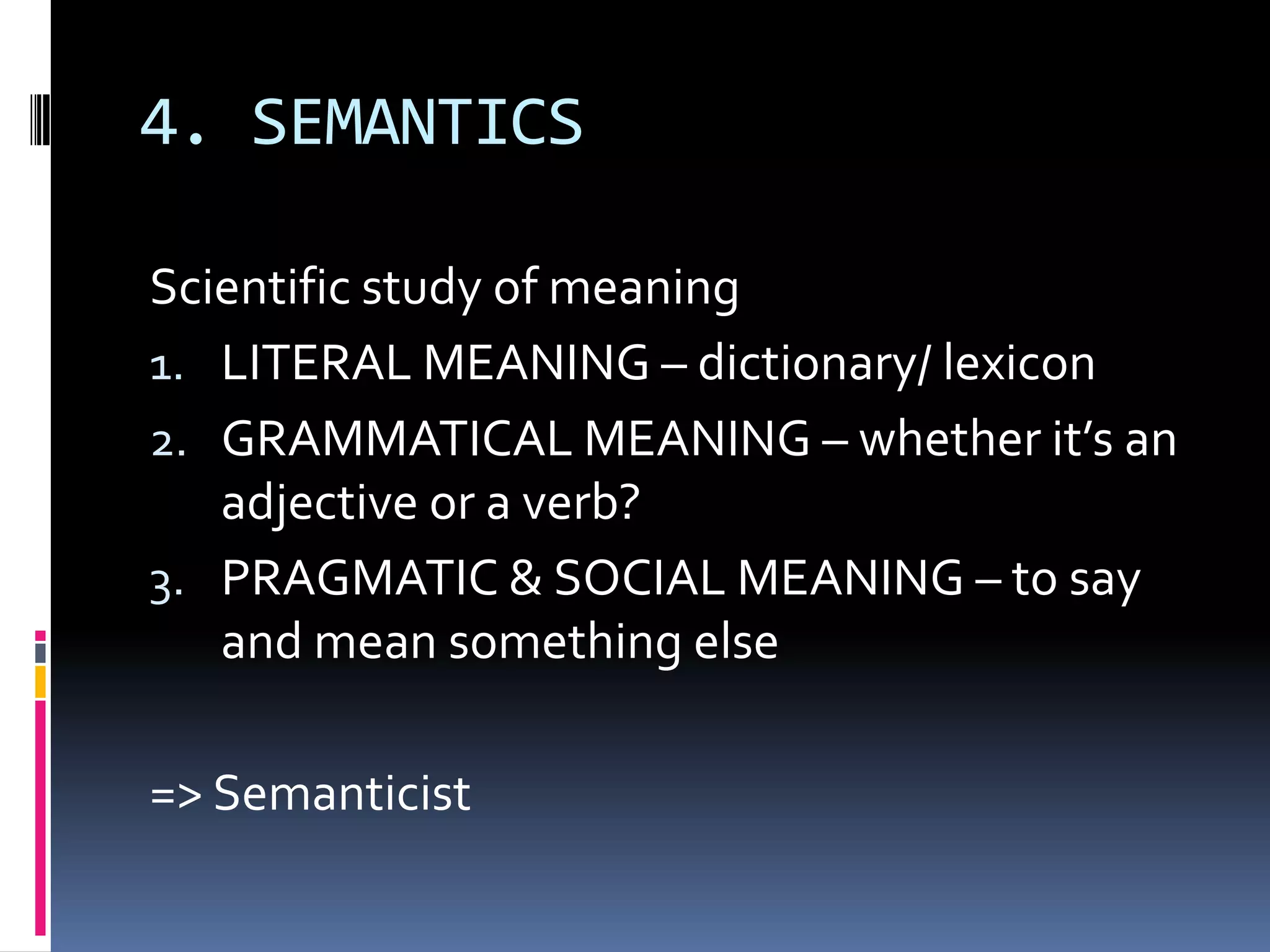
4. SEMANTICS

Scientific study of meaning
1. LITERAL MEANING – dictionary/ lexicon
2. GRAMMATICAL MEANING – whether it’s an
   adjective or a verb?
3. PRAGMATIC & SOCIAL MEANING – to say
   and mean something else

=> Semanticist
5. PRAGMATICS

 Study of meaning of words, phrases and full
  sentences.
 Study of use of language
  e.g. kind of L used in a
  situation, speaker, listener, tones, stress, into
  nation, status of both etc.
MACRO LINGUISTICS
1. STYLISTICS

  Scientific study of style in spoken and written
  text e.g. how we dress up for a particular
  occasion say funeral, wedding , college etc.

It’s a recurrent and consistent pattern based on
   special items. Acc to HALLIDAY, stylistics will
   study the sound, form, structure, language
   and meaning of a text.
It looks at:

1. TIME PERIOD within a certain text is written
   e.g. A poem written in Shakespeare’s time or
   modern century time frame.
2. GENRE – form and type of a text e.g.
   novel, prose, poetry etc.

=> Literary(literature oriented) and non literary
   (others) texts.
3APPROACHES USED IN STYLISTICS:

 DESCRIPTIVE approach – when text is
  described
 ANALYTICAL app – where text is analyzed in
  detail
 INTERPRETATIVE app – trying to describe
  ides/ philosophy behind something.
Acc to JACOBSON, parallelism is imp when
  analyzing a certain text. E.g. the cat sat on
  the mat. (rhyming)
FOREGROUNDING means ways of looking at a
  view, also means highlighting area of a
  certain pattern, also means writing a
  statement / title or something eye catching.
HEMINGTON always talks about weather
  known as Weather foregrounding e.g. a
  newscaster reads title first foregrounding the
  details.
2. PSCHYOLINGUISTICS

Scientific study of language learning and human mind. It
  looks at the role of human memory, the outer environ
  and past experiences in learning a new L or a skill.

There are 3 schools of psycholinguistics:
1. BEHAVIORISM: verbal behavior
                 conditioned response
                 trial and error
                 drilling & imitation
                 reward & punishment
PSYCHOLINGUISTS
1. PABLOV
    Russian psychologist
    Studies how to condition responses e.g. you take your hand off
     from fire
    Derived theory of classical conditioning

2.   DR WATSON
Coined the word behaviorism

3.   SKINNER
    American
    Considered L learning as conditioned response
    Gave formula SRRR – Stimulus Response Reward Reinforcement
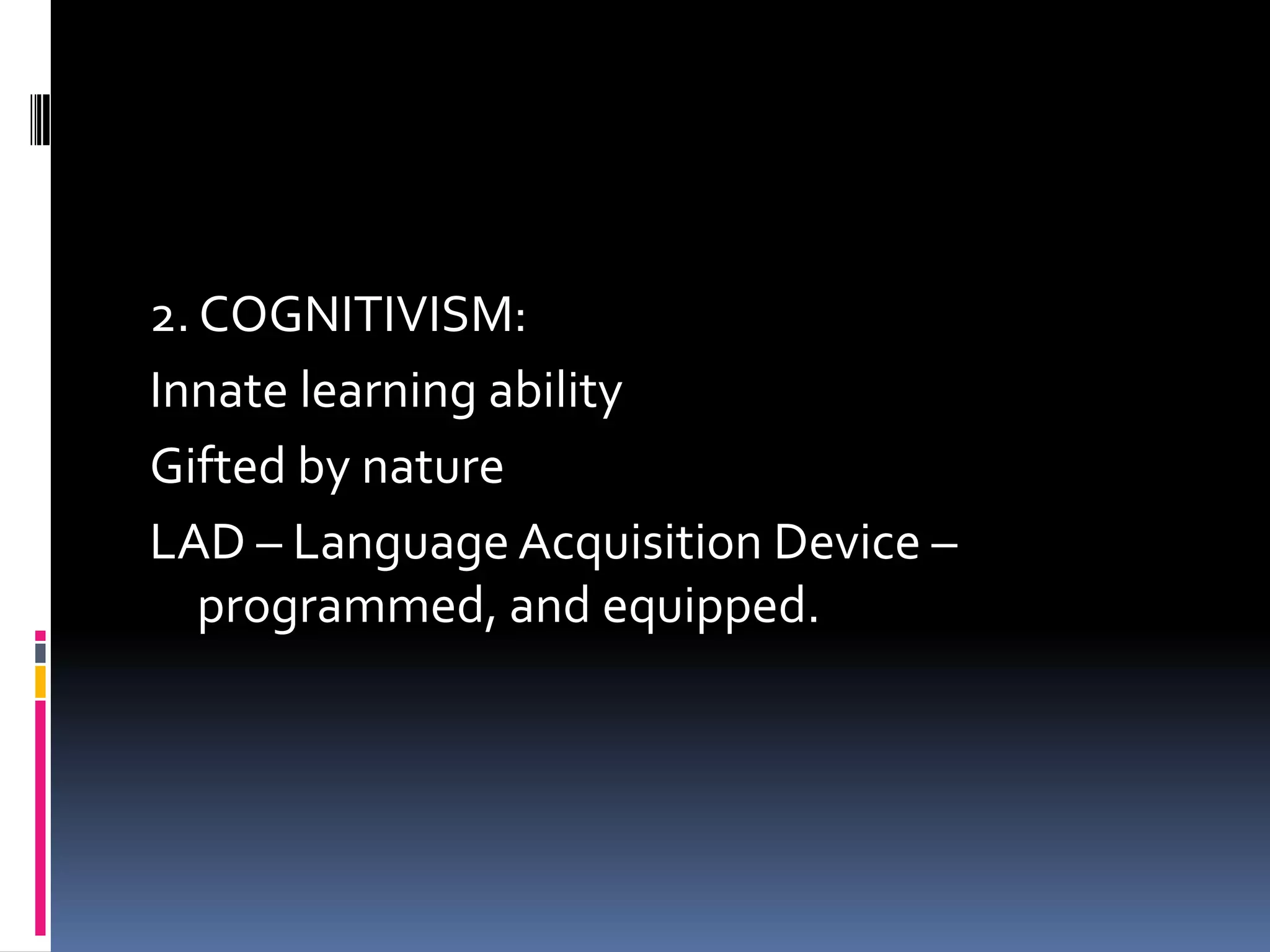
2. COGNITIVISM:
Innate learning ability
Gifted by nature
LAD – Language Acquisition Device –
   programmed, and equipped.
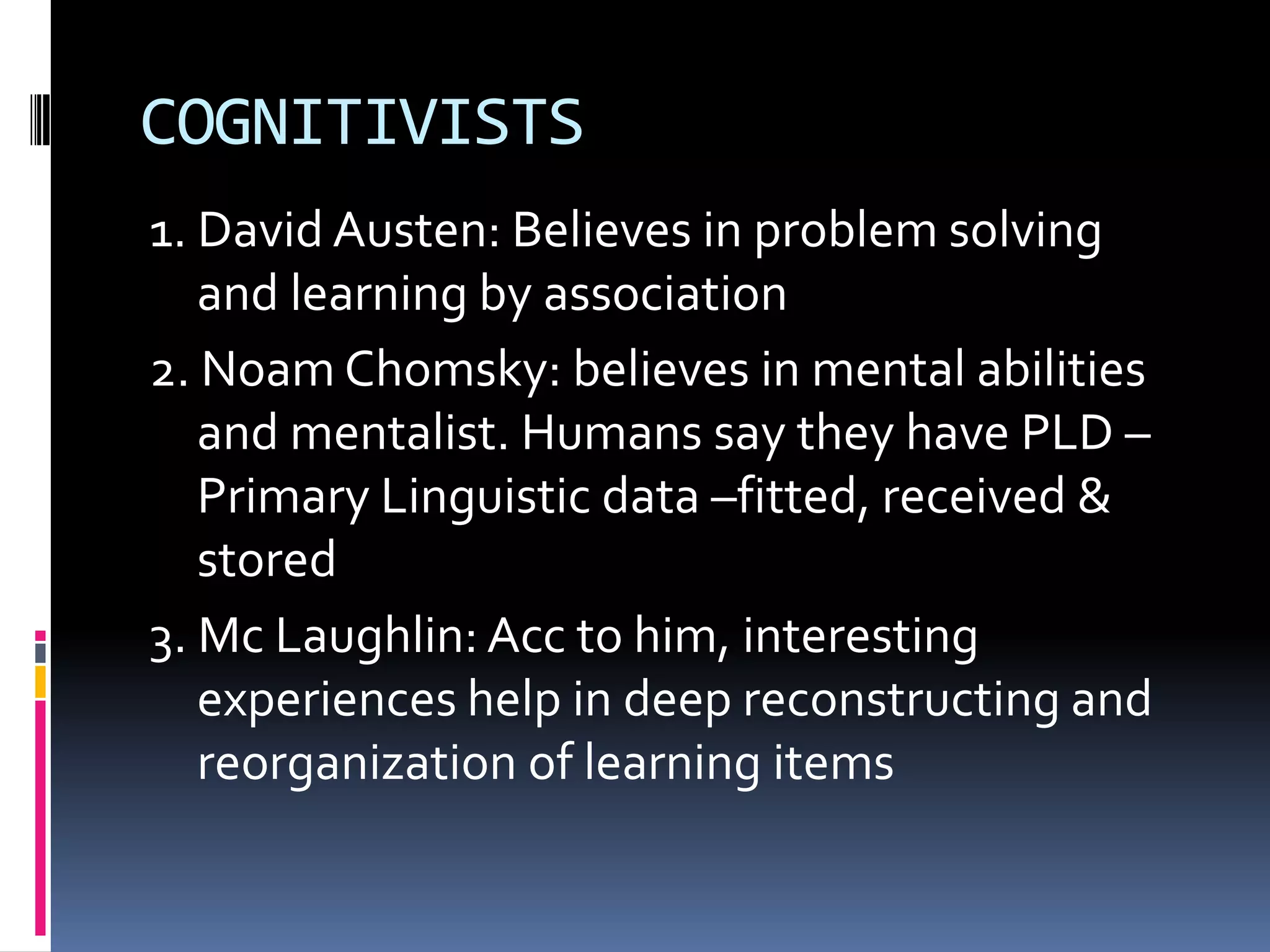
COGNITIVISTS
1. David Austen: Believes in problem solving
   and learning by association
2. Noam Chomsky: believes in mental abilities
   and mentalist. Humans say they have PLD –
   Primary Linguistic data –fitted, received &
   stored
3. Mc Laughlin: Acc to him, interesting
   experiences help in deep reconstructing and
   reorganization of learning items
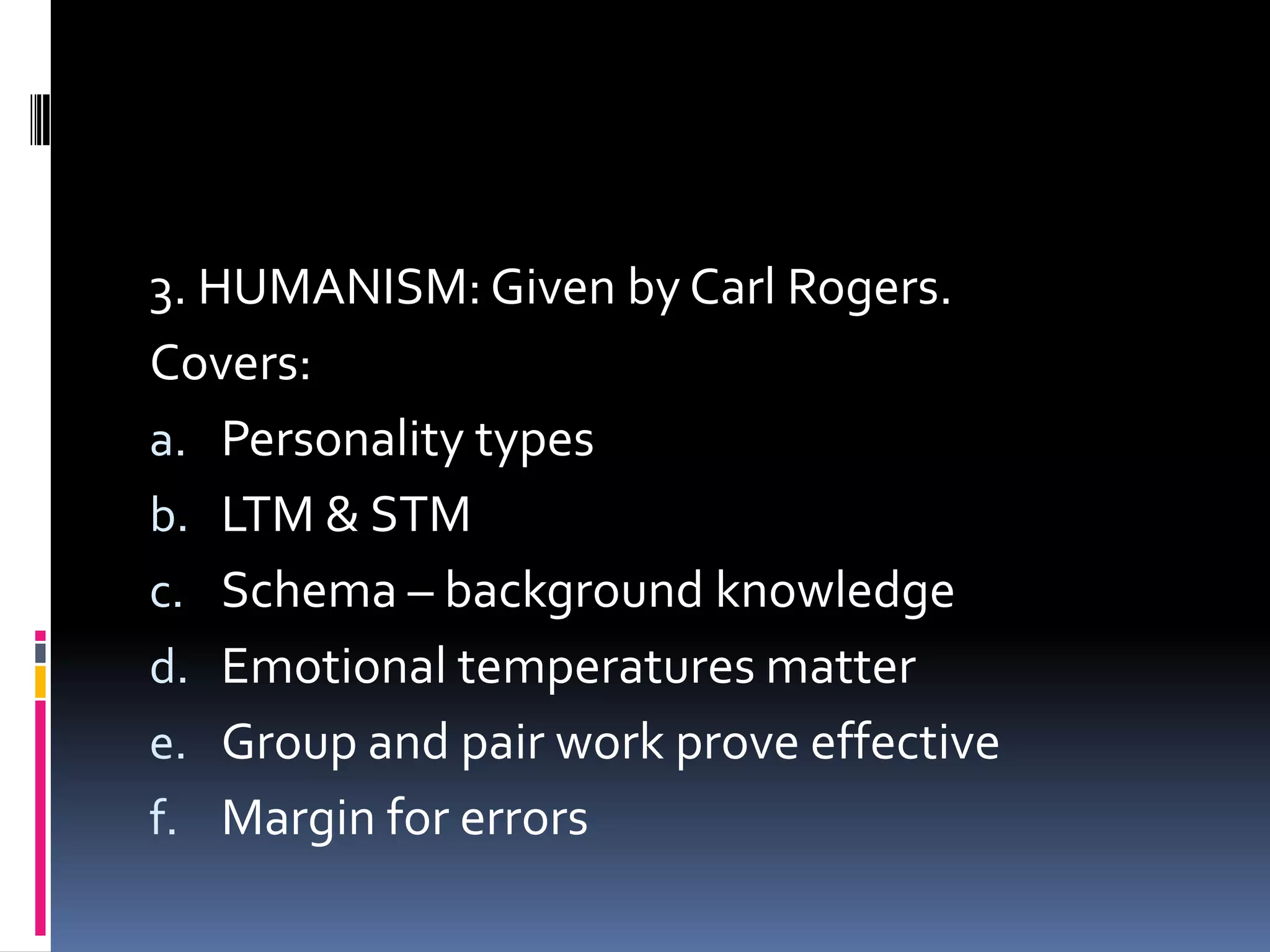
3. HUMANISM: Given by Carl Rogers.
Covers:
a. Personality types
b. LTM & STM
c. Schema – background knowledge
d. Emotional temperatures matter
e. Group and pair work prove effective
f. Margin for errors
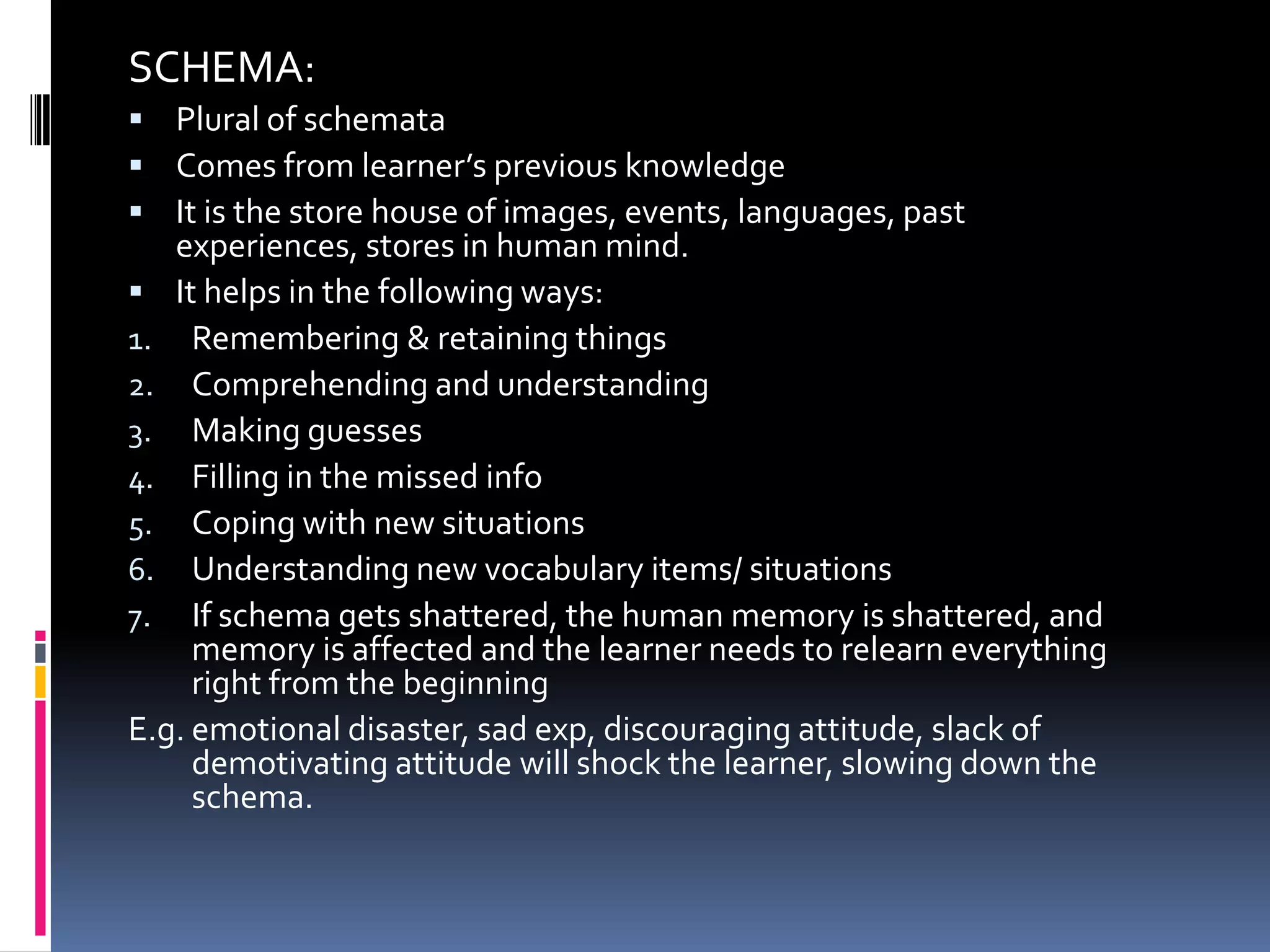
SCHEMA:
 Plural of schemata
 Comes from learner’s previous knowledge
 It is the store house of images, events, languages, past
   experiences, stores in human mind.
 It helps in the following ways:
1. Remembering & retaining things
2. Comprehending and understanding
3. Making guesses
4. Filling in the missed info
5. Coping with new situations
6. Understanding new vocabulary items/ situations
7. If schema gets shattered, the human memory is shattered, and
     memory is affected and the learner needs to relearn everything
     right from the beginning
E.g. emotional disaster, sad exp, discouraging attitude, slack of
     demotivating attitude will shock the learner, slowing down the
     schema.
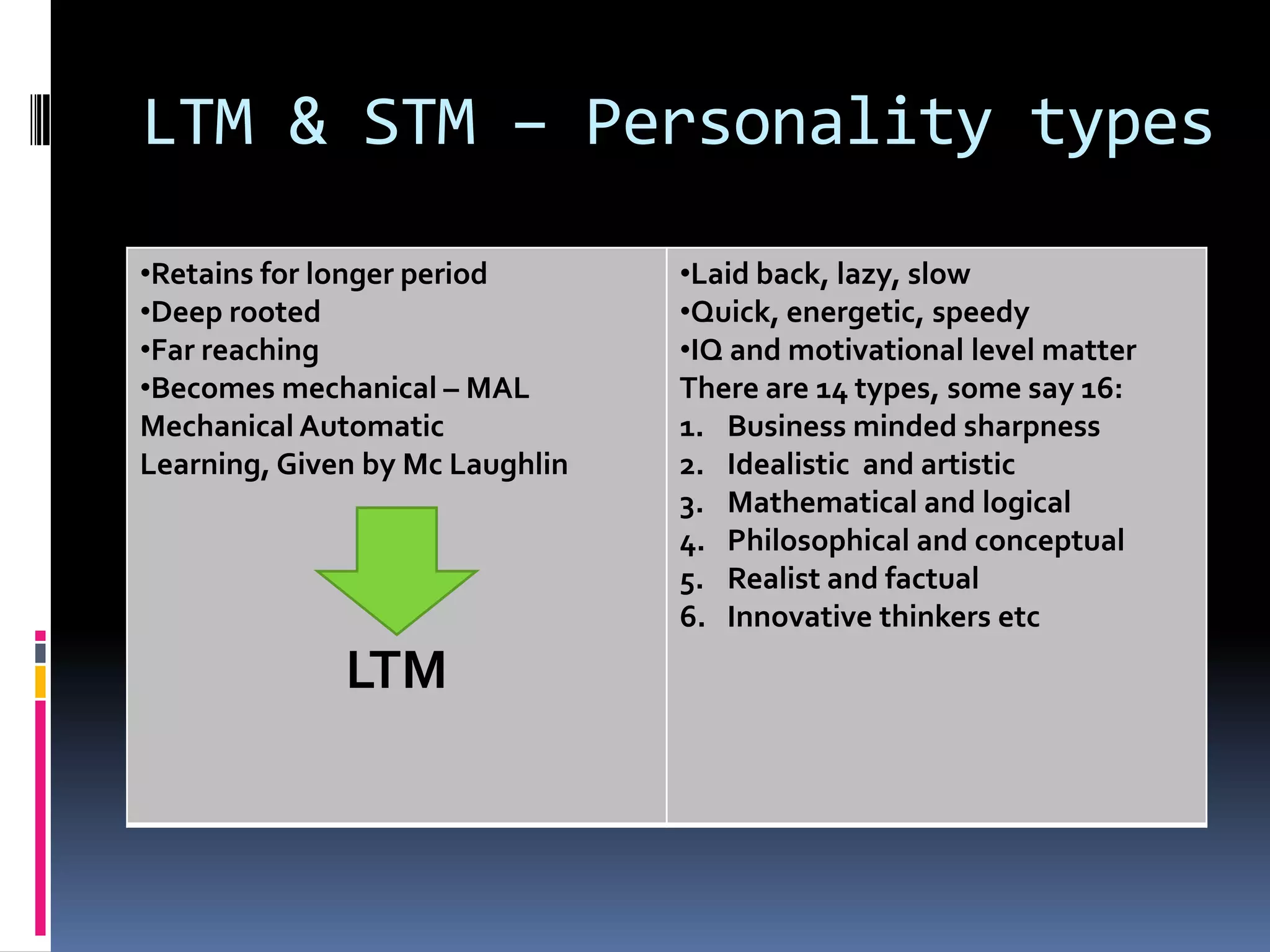
LTM & STM – Personality types
•Retains for longer period       •Laid back, lazy, slow
•Deep rooted                     •Quick, energetic, speedy
•Far reaching                    •IQ and motivational level matter
•Becomes mechanical – MAL        There are 14 types, some say 16:
Mechanical Automatic             1. Business minded sharpness
Learning, Given by Mc Laughlin   2. Idealistic and artistic
                                 3. Mathematical and logical
                                 4. Philosophical and conceptual
                                 5. Realist and factual
                                 6. Innovative thinkers etc
              LTM
 Humanism encourages creativity, free expression, free
    talent, catharsis, friendly attitude and a sense of +ve
    competition
   Encouragement and motivation is high
   Fluency and communication is more imp than grammar
    and accuracy
   Independent learning is imp
   Level of confidence and comfort facilitates the learner
   Group dynamics promote tension free learning
3. SOCIOLINGUISTICS

Scientific study of relationship between society and
   language. It:
1. studies growth and evolution with time.
2. Studies regional differences that affect L
3. Studies individual diff that affect L
4. Studies personal and individual diff
5. Studies dialect and varieties of L
 IDIOLECT – personal variety of L
 DIALECT – regional variety of L
 REGISTER – Professional variety
 STANDARD Language – Official variety
 NATIONAL Language – common L for a
  nation, country, state
 LINGUA FRANCA – global variety of a L
4. ANTHROPOLOGICAL L
Studies the cultural dimensions, norms, values
  and the language use.

Culture has 3 layers to itself:
i. The OUTER layer comprises of food,
     movies, music, architecture etc
ii. The MIDDLE layer includes philosophy,
     honesty, norms, values, ethics
iii. The INNER layer is the mixture of above
     both
Acc to South Asian countries believe more in:
 high power distance HPD
 collectivism C
 short term planning STM.

Progressive countries believe in:
 Low power distance LPD
 Individualism I
 Long term planning LTP.
5. PHILOSOPHICAL L

 GRAMSHY CARTER worked on it.

 This branch deals with the study of
 ideas, philosophies
 (social, political, economic), concepts, basic
 recipe of a certain thing.
Strategies of testing the
     syllogism, debating, arguing, analyzing, looki
     ng at the SW of an idea/philosophy that’ll in
     the wrong run direct:
i.   Policy makers
ii. Social reformers
iii. Education planners
iv. Political administrators etc
e.g. study of God, where , how, how and when he came
     from and further study.
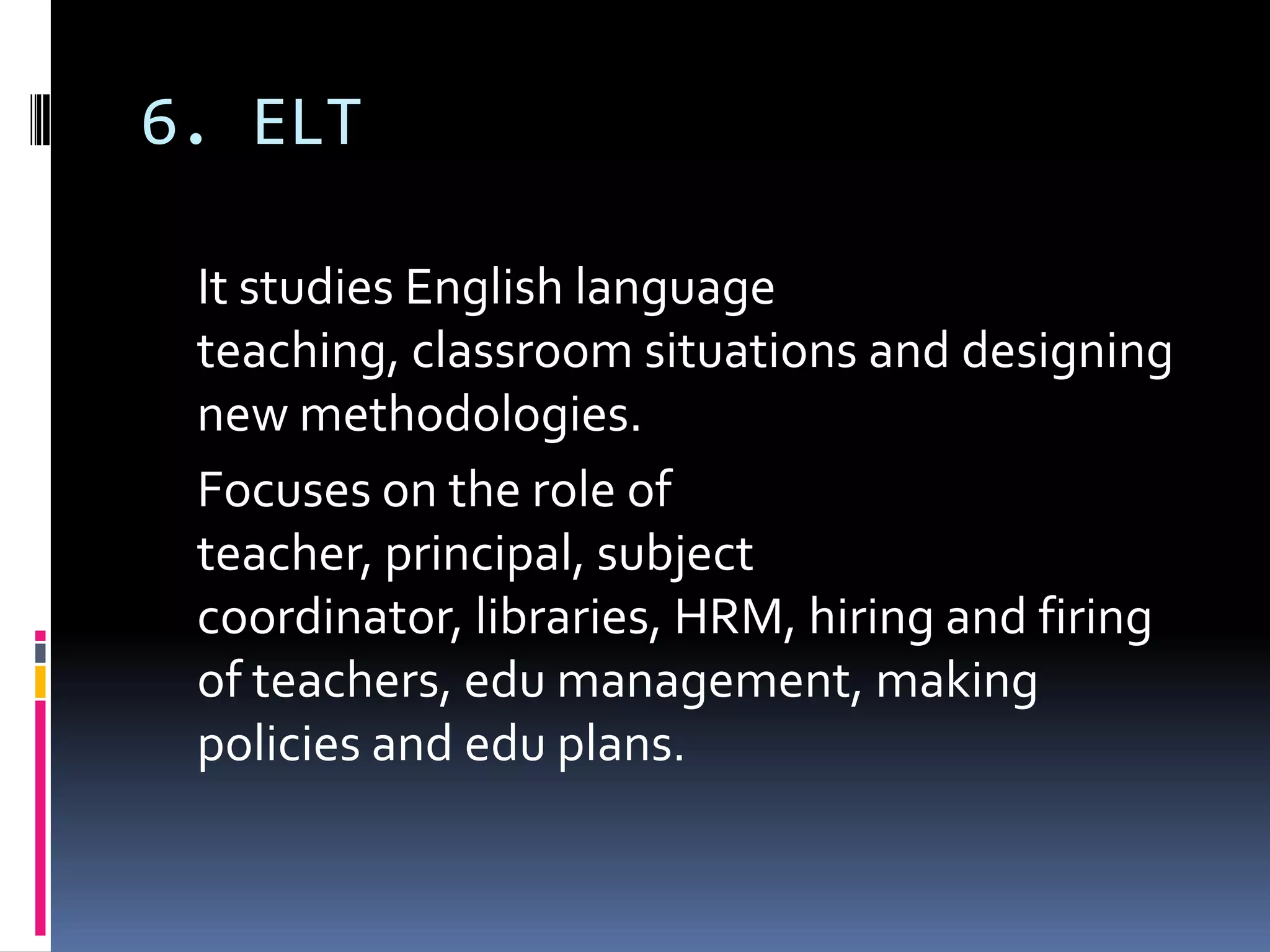
6. ELT

 It studies English language
 teaching, classroom situations and designing
 new methodologies.
 Focuses on the role of
 teacher, principal, subject
 coordinator, libraries, HRM, hiring and firing
 of teachers, edu management, making
 policies and edu plans.
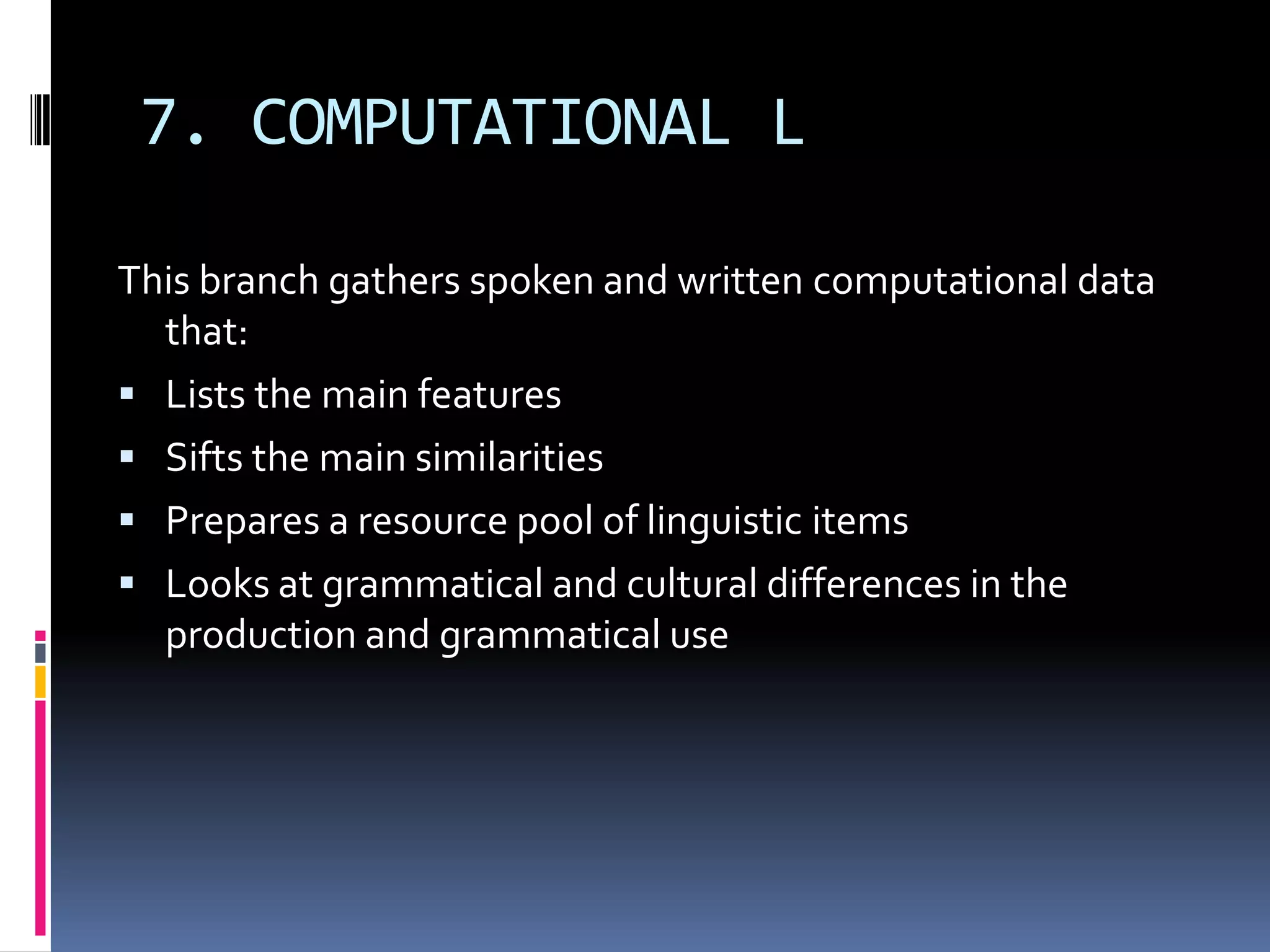
7. COMPUTATIONAL L

This branch gathers spoken and written computational data
  that:
 Lists the main features
 Sifts the main similarities
 Prepares a resource pool of linguistic items
 Looks at grammatical and cultural differences in the
  production and grammatical use
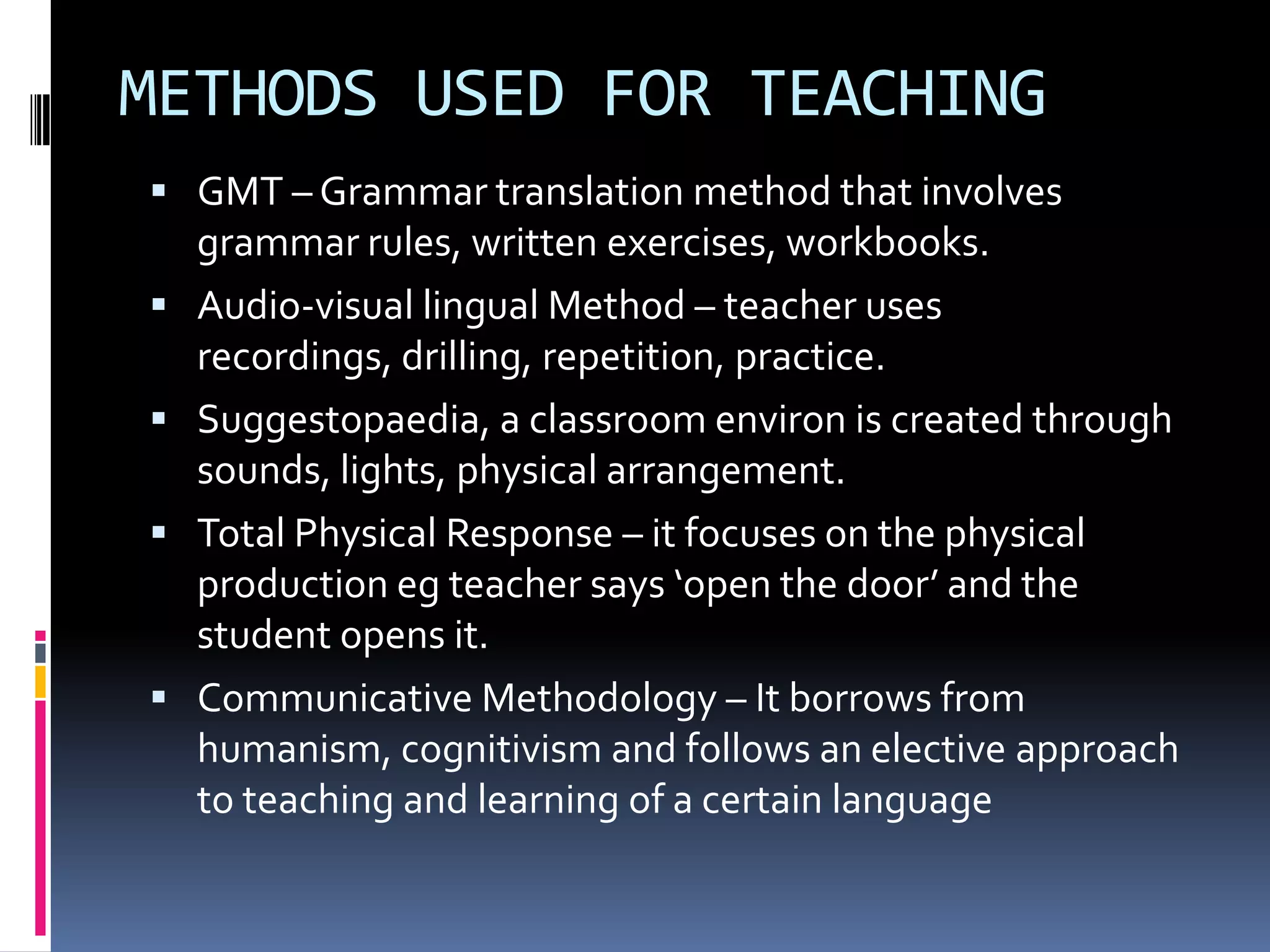
METHODS USED FOR TEACHING
 GMT – Grammar translation method that involves
    grammar rules, written exercises, workbooks.
   Audio-visual lingual Method – teacher uses
    recordings, drilling, repetition, practice.
   Suggestopaedia, a classroom environ is created through
    sounds, lights, physical arrangement.
   Total Physical Response – it focuses on the physical
    production eg teacher says ‘open the door’ and the
    student opens it.
   Communicative Methodology – It borrows from
    humanism, cognitivism and follows an elective approach
    to teaching and learning of a certain language
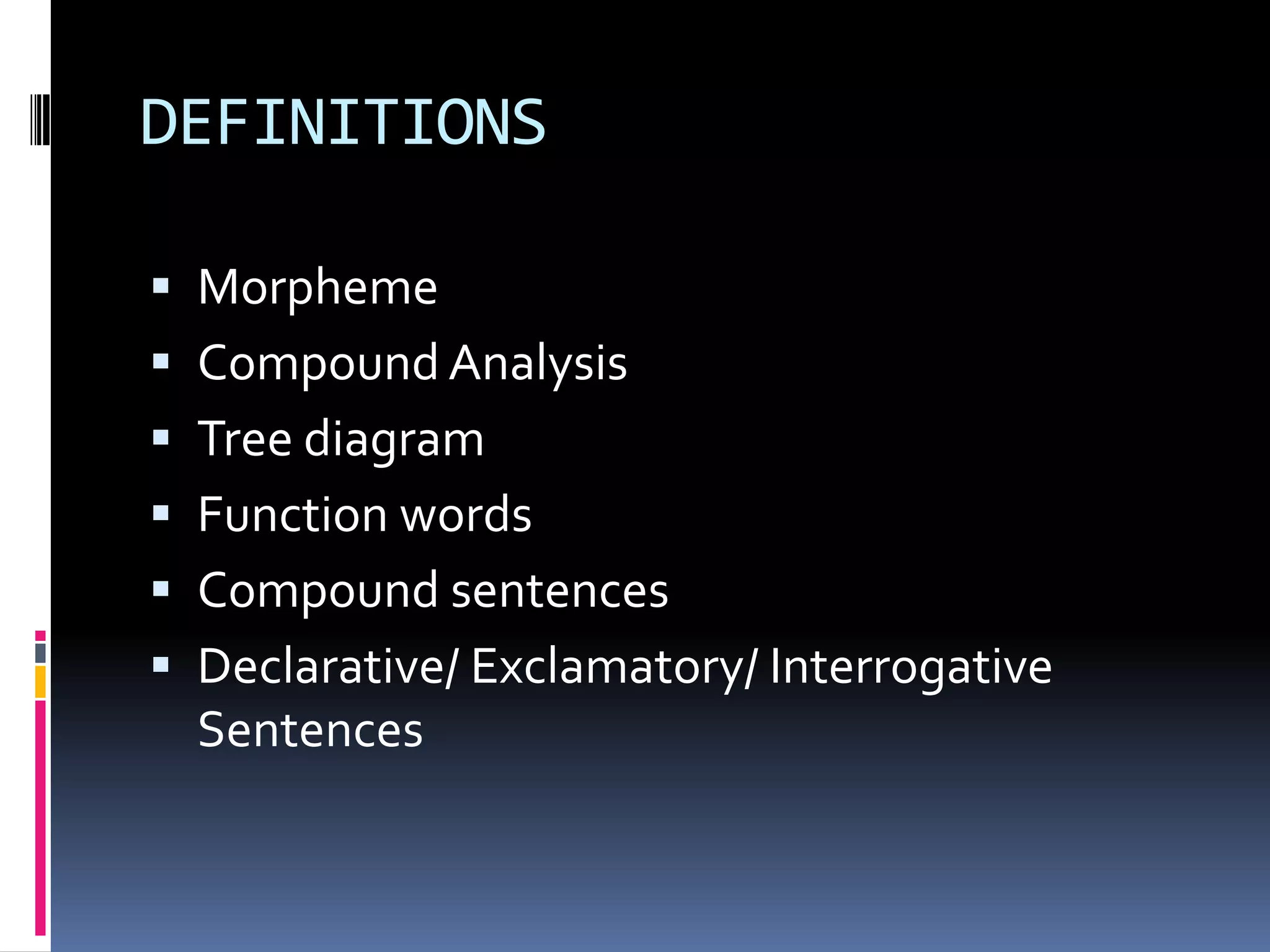
DEFINITIONS

 Morpheme
 Compound Analysis
 Tree diagram
 Function words
 Compound sentences
 Declarative/ Exclamatory/ Interrogative
  Sentences
PHRASES

 Noun phrase
 Verb phrase
 Adjective phrase
 Adverbial phrase
 Etc
Other concepts

 Semantics – Generative semantics + Formal
 Pragmatics
 Association
 Semiotics
 Opposites
 Synonyms
 Homophones
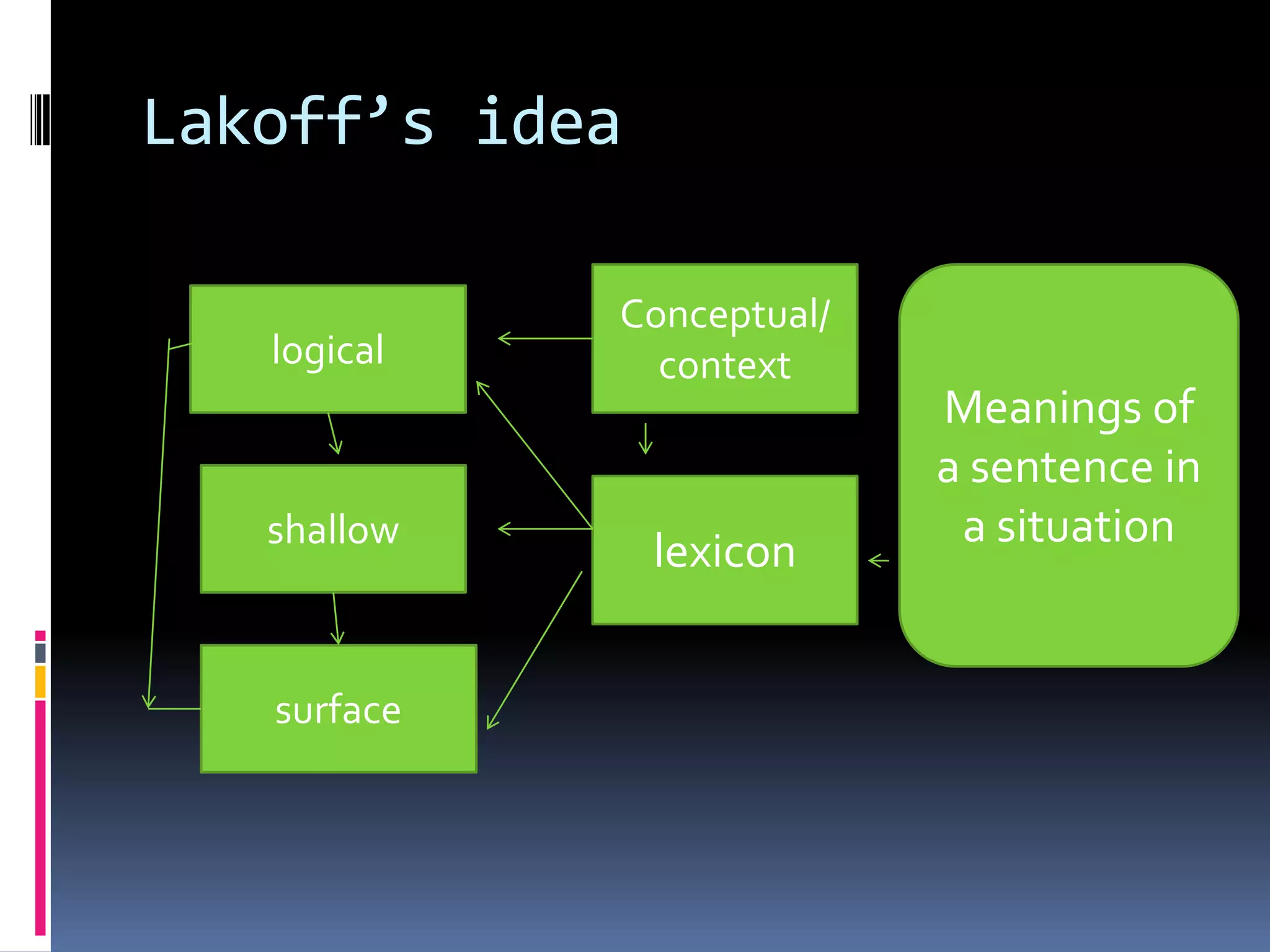
Lakoff’s idea

             Conceptual/
   logical     context
                           Meanings of
                           a sentence in
   shallow                  a situation
                lexicon


   surface
Semantics

 1. Generative: No principles distinction/
  syntactic processes- 1970s

 2. Formal: Meaning of sentences are linked to
  their true conditions – 1920s – 1930s
 E.g. snow is white
 Snow is green
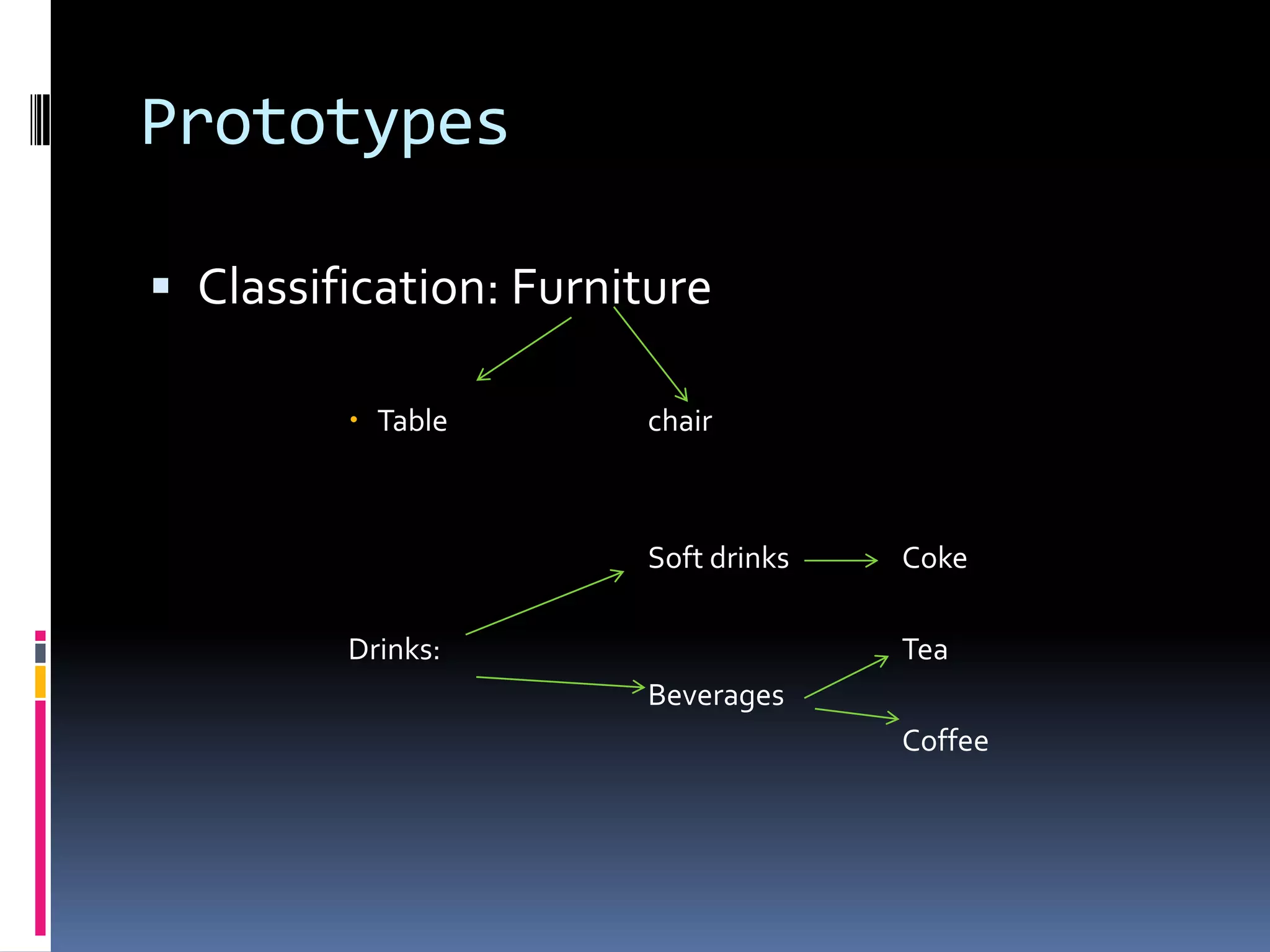
Prototypes

 Classification: Furniture

          Table       chair


                       Soft drinks   Coke

         Drinks:                     Tea
                       Beverages
                                     Coffee
Grading

Some words can take / be graded
E.g. very hot, hottest
Dead / alive = some can’t be graded
SENSE RELATIONS

 Infer meanings
 Logical meanings
 Opposing sense
 Same sense
 Metaphorical meaning
 Symbolic meaning
 Vague meaning
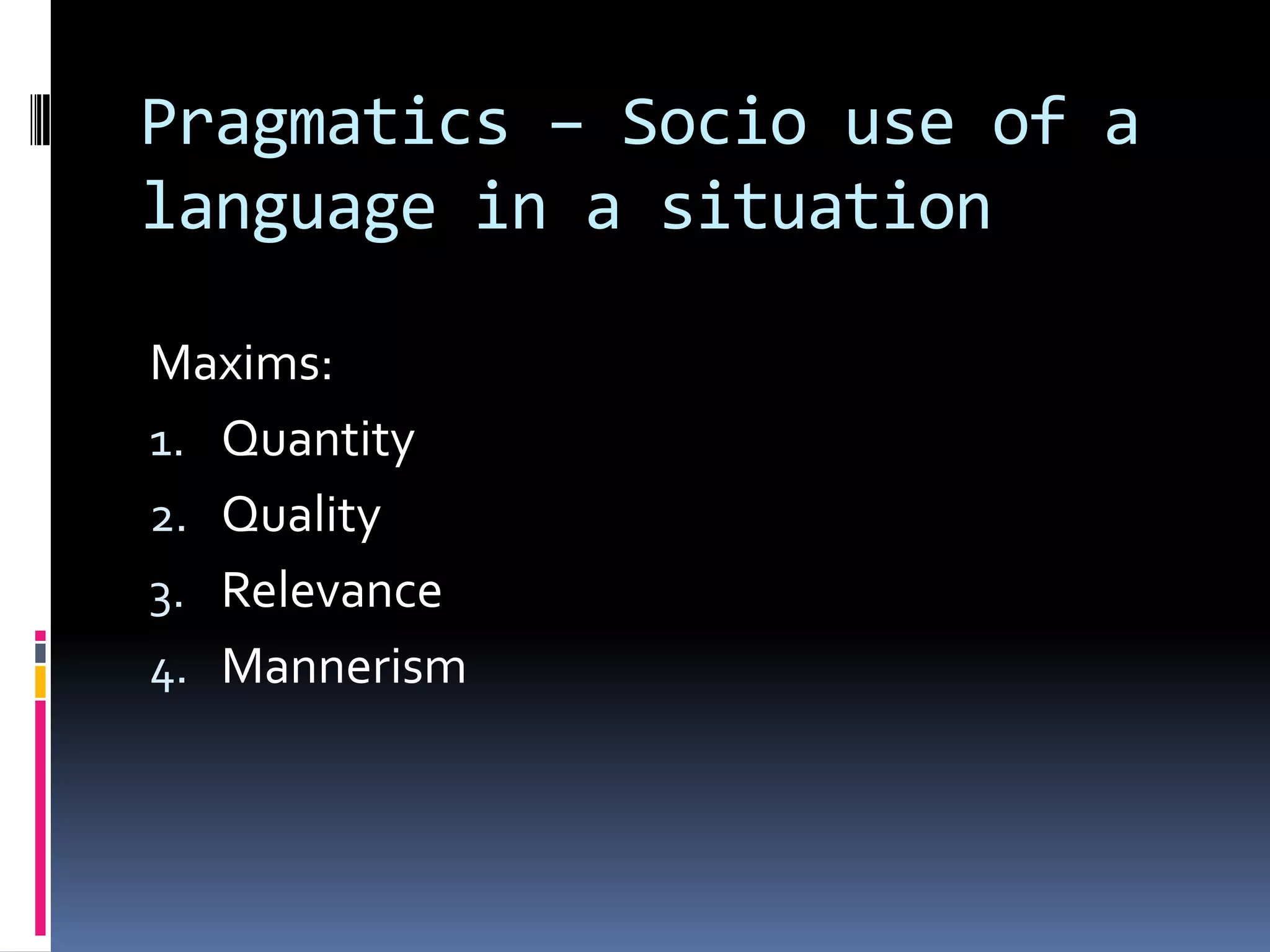
Pragmatics – Socio use of a
language in a situation

Maxims:
1. Quantity
2. Quality
3. Relevance
4. Mannerism
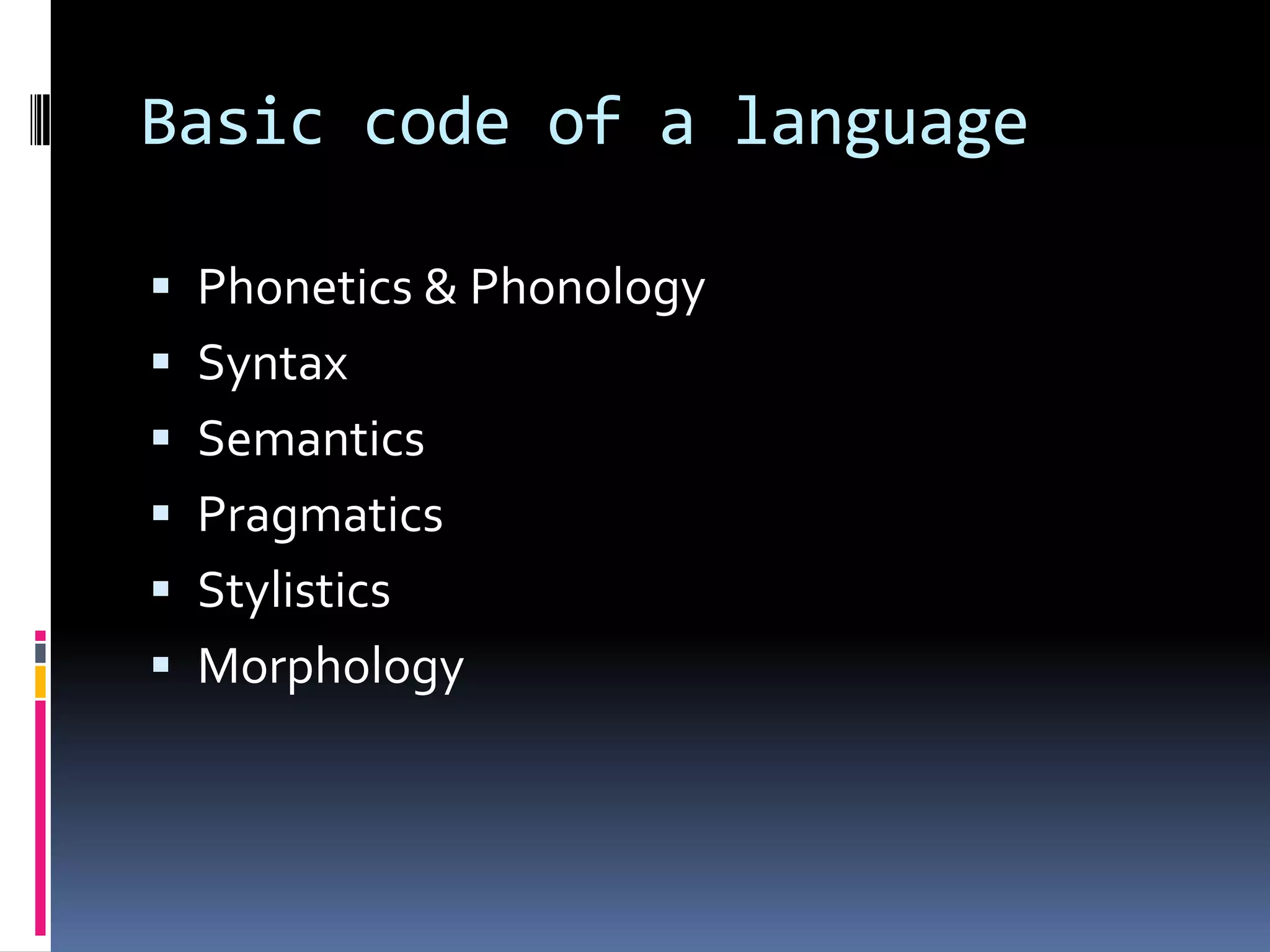
Basic code of a language

 Phonetics & Phonology
 Syntax
 Semantics
 Pragmatics
 Stylistics
 Morphology
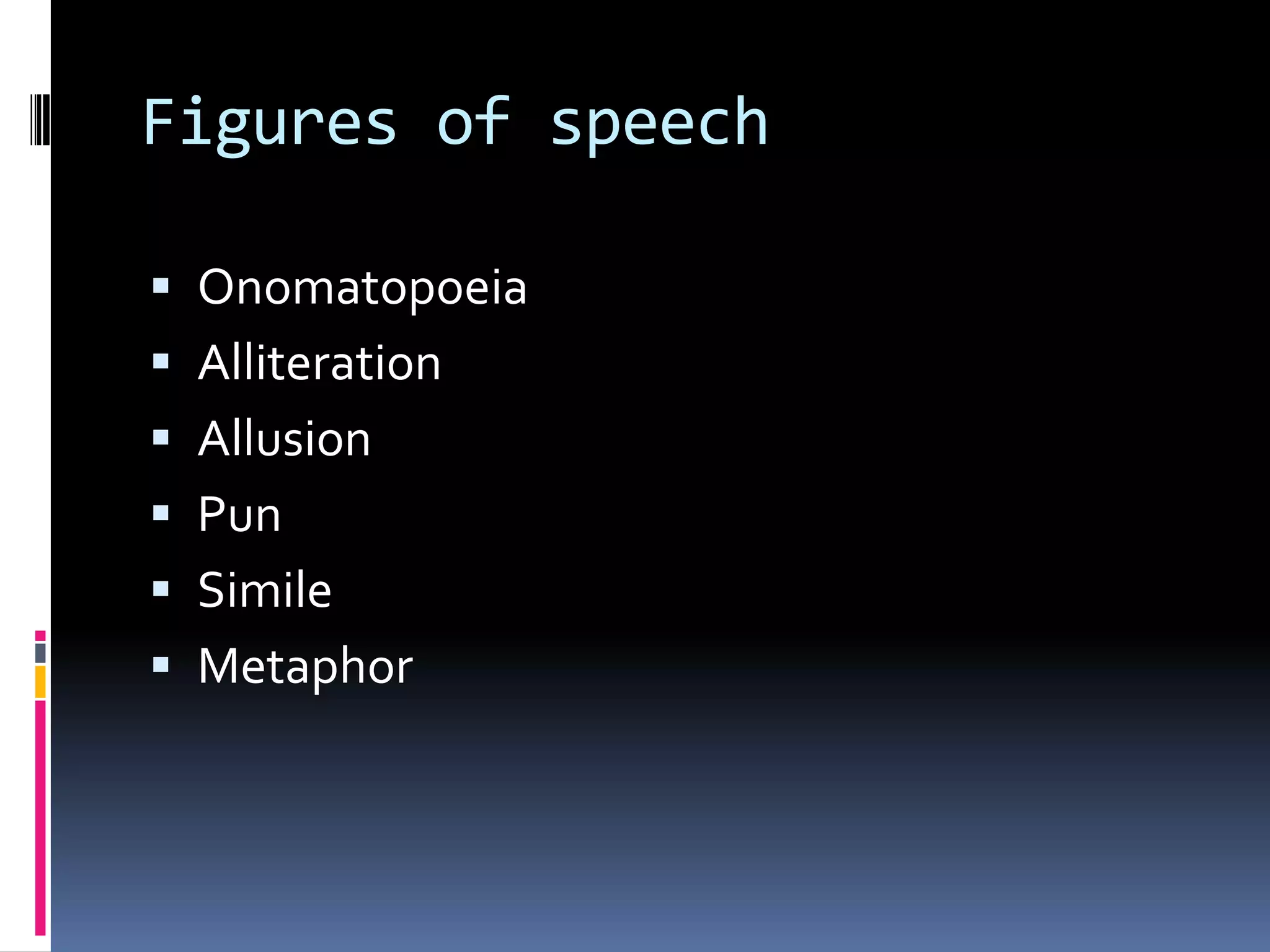
Figures of speech

 Onomatopoeia
 Alliteration
 Allusion
 Pun
 Simile
 Metaphor
Intro to aplg   dr. nadia anjum

Intro to aplg dr. nadia anjum

  • 1.
    Compiled by AyeshaMalik – KINNAIRD COLLEGE FOR WOMEN INTRODUCTION TO APPLIED LINGUISTICS
  • 2.
    Lecture 1 Scientific study of languages and vast scope of understanding the development of humans in domains of vocalization of comm., history, sociology, anthropology, psychology, an d other allied fields of study as subjects including neutral cognitive sciences. Micro linguistics Macro linguistics Pragmatics Sociolinguistics Semantics Psycholinguistics Syntax stylistics Phonetics computational linguistics Phonology Anthropological Linguistics
  • 3.
  • 4.
    1. PHONETICS Studyof speech sounds’ production, transmission and reception. Vowels Consonants These require no such Simple sounds that can be produced with lips efforts. There are : and tongue. •12 cardinal vowels i. PLOSIVES – Sounds produced with an •8 diphthongs explosion e.g. |p|, |t|, |k|, |b|, |g|, |d| ii. LABIAL –involves lips e.g. |f|, |v|, |p|, |m| iii. ALVEOLAR – involves teeth and tongue e.g. |t| iv. FRICATIVES – Words that use friction e.g f,z, theeta, daa, s, small z, sh, h, v v. AFFRICATES – Sounds borrowed from 2 different groups and combine together e.g ch, ja vi. LATERAL – are articulated by means of partial closure of mouth because of an obstacle placed in the middle so that air escapes at, on or both sides. E.g. l, r , j, w
  • 5.
    2. PHONOLOGY  Studiesmanner & usage of sounds  Is the arrangement of sounds  Is the mental aspects of sounds  Is the pattern of sound and sound types  Is made up of phonemes – smallest unit  Includes syllables – onset and rhyme nucleus coda
  • 6.
    3. SYNTAX  Studyof grammar and structure of language  Is the bread and butter of L  Nourishes the L like a backbone
  • 7.
    MORPHOLOGY – Study of morphemes – made up of smallest unit – phonemes BOND MORPHEME FREE MORPHEME •Cant exist ion their own These don’t need help •Cant live independently Give meaning alone •Need to be associated with each other Have their own class e.g. s, es, ed, ing, etc e.g. sunny,. Went, book etc PREFIX – Impossible Text/ discourse SUFFIX – Colorful Sentence AFFIX – Words that get attached to Clause other words to give a meaningful Phrase word Word Morpheme phoneme => MORPHOLOGIST
  • 8.
    4. SEMANTICS Scientific studyof meaning 1. LITERAL MEANING – dictionary/ lexicon 2. GRAMMATICAL MEANING – whether it’s an adjective or a verb? 3. PRAGMATIC & SOCIAL MEANING – to say and mean something else => Semanticist
  • 9.
    5. PRAGMATICS  Studyof meaning of words, phrases and full sentences.  Study of use of language e.g. kind of L used in a situation, speaker, listener, tones, stress, into nation, status of both etc.
  • 10.
  • 11.
    1. STYLISTICS Scientific study of style in spoken and written text e.g. how we dress up for a particular occasion say funeral, wedding , college etc. It’s a recurrent and consistent pattern based on special items. Acc to HALLIDAY, stylistics will study the sound, form, structure, language and meaning of a text.
  • 12.
    It looks at: 1.TIME PERIOD within a certain text is written e.g. A poem written in Shakespeare’s time or modern century time frame. 2. GENRE – form and type of a text e.g. novel, prose, poetry etc. => Literary(literature oriented) and non literary (others) texts.
  • 13.
    3APPROACHES USED INSTYLISTICS:  DESCRIPTIVE approach – when text is described  ANALYTICAL app – where text is analyzed in detail  INTERPRETATIVE app – trying to describe ides/ philosophy behind something.
  • 14.
    Acc to JACOBSON,parallelism is imp when analyzing a certain text. E.g. the cat sat on the mat. (rhyming) FOREGROUNDING means ways of looking at a view, also means highlighting area of a certain pattern, also means writing a statement / title or something eye catching. HEMINGTON always talks about weather known as Weather foregrounding e.g. a newscaster reads title first foregrounding the details.
  • 15.
    2. PSCHYOLINGUISTICS Scientific studyof language learning and human mind. It looks at the role of human memory, the outer environ and past experiences in learning a new L or a skill. There are 3 schools of psycholinguistics: 1. BEHAVIORISM: verbal behavior conditioned response trial and error drilling & imitation reward & punishment
  • 16.
    PSYCHOLINGUISTS 1. PABLOV  Russian psychologist  Studies how to condition responses e.g. you take your hand off from fire  Derived theory of classical conditioning 2. DR WATSON Coined the word behaviorism 3. SKINNER  American  Considered L learning as conditioned response  Gave formula SRRR – Stimulus Response Reward Reinforcement
  • 17.
    2. COGNITIVISM: Innate learningability Gifted by nature LAD – Language Acquisition Device – programmed, and equipped.
  • 18.
    COGNITIVISTS 1. David Austen:Believes in problem solving and learning by association 2. Noam Chomsky: believes in mental abilities and mentalist. Humans say they have PLD – Primary Linguistic data –fitted, received & stored 3. Mc Laughlin: Acc to him, interesting experiences help in deep reconstructing and reorganization of learning items
  • 19.
    3. HUMANISM: Givenby Carl Rogers. Covers: a. Personality types b. LTM & STM c. Schema – background knowledge d. Emotional temperatures matter e. Group and pair work prove effective f. Margin for errors
  • 20.
    SCHEMA:  Plural ofschemata  Comes from learner’s previous knowledge  It is the store house of images, events, languages, past experiences, stores in human mind.  It helps in the following ways: 1. Remembering & retaining things 2. Comprehending and understanding 3. Making guesses 4. Filling in the missed info 5. Coping with new situations 6. Understanding new vocabulary items/ situations 7. If schema gets shattered, the human memory is shattered, and memory is affected and the learner needs to relearn everything right from the beginning E.g. emotional disaster, sad exp, discouraging attitude, slack of demotivating attitude will shock the learner, slowing down the schema.
  • 21.
    LTM & STM– Personality types •Retains for longer period •Laid back, lazy, slow •Deep rooted •Quick, energetic, speedy •Far reaching •IQ and motivational level matter •Becomes mechanical – MAL There are 14 types, some say 16: Mechanical Automatic 1. Business minded sharpness Learning, Given by Mc Laughlin 2. Idealistic and artistic 3. Mathematical and logical 4. Philosophical and conceptual 5. Realist and factual 6. Innovative thinkers etc LTM
  • 22.
     Humanism encouragescreativity, free expression, free talent, catharsis, friendly attitude and a sense of +ve competition  Encouragement and motivation is high  Fluency and communication is more imp than grammar and accuracy  Independent learning is imp  Level of confidence and comfort facilitates the learner  Group dynamics promote tension free learning
  • 23.
    3. SOCIOLINGUISTICS Scientific studyof relationship between society and language. It: 1. studies growth and evolution with time. 2. Studies regional differences that affect L 3. Studies individual diff that affect L 4. Studies personal and individual diff 5. Studies dialect and varieties of L
  • 24.
     IDIOLECT –personal variety of L  DIALECT – regional variety of L  REGISTER – Professional variety  STANDARD Language – Official variety  NATIONAL Language – common L for a nation, country, state  LINGUA FRANCA – global variety of a L
  • 25.
    4. ANTHROPOLOGICAL L Studiesthe cultural dimensions, norms, values and the language use. Culture has 3 layers to itself: i. The OUTER layer comprises of food, movies, music, architecture etc ii. The MIDDLE layer includes philosophy, honesty, norms, values, ethics iii. The INNER layer is the mixture of above both
  • 26.
    Acc to SouthAsian countries believe more in:  high power distance HPD  collectivism C  short term planning STM. Progressive countries believe in:  Low power distance LPD  Individualism I  Long term planning LTP.
  • 27.
    5. PHILOSOPHICAL L GRAMSHY CARTER worked on it. This branch deals with the study of ideas, philosophies (social, political, economic), concepts, basic recipe of a certain thing.
  • 28.
    Strategies of testingthe syllogism, debating, arguing, analyzing, looki ng at the SW of an idea/philosophy that’ll in the wrong run direct: i. Policy makers ii. Social reformers iii. Education planners iv. Political administrators etc e.g. study of God, where , how, how and when he came from and further study.
  • 29.
    6. ELT Itstudies English language teaching, classroom situations and designing new methodologies. Focuses on the role of teacher, principal, subject coordinator, libraries, HRM, hiring and firing of teachers, edu management, making policies and edu plans.
  • 30.
    7. COMPUTATIONAL L Thisbranch gathers spoken and written computational data that:  Lists the main features  Sifts the main similarities  Prepares a resource pool of linguistic items  Looks at grammatical and cultural differences in the production and grammatical use
  • 31.
    METHODS USED FORTEACHING  GMT – Grammar translation method that involves grammar rules, written exercises, workbooks.  Audio-visual lingual Method – teacher uses recordings, drilling, repetition, practice.  Suggestopaedia, a classroom environ is created through sounds, lights, physical arrangement.  Total Physical Response – it focuses on the physical production eg teacher says ‘open the door’ and the student opens it.  Communicative Methodology – It borrows from humanism, cognitivism and follows an elective approach to teaching and learning of a certain language
  • 32.
    DEFINITIONS  Morpheme  CompoundAnalysis  Tree diagram  Function words  Compound sentences  Declarative/ Exclamatory/ Interrogative Sentences
  • 33.
    PHRASES  Noun phrase Verb phrase  Adjective phrase  Adverbial phrase  Etc
  • 34.
    Other concepts  Semantics– Generative semantics + Formal  Pragmatics  Association  Semiotics  Opposites  Synonyms  Homophones
  • 35.
    Lakoff’s idea Conceptual/ logical context Meanings of a sentence in shallow a situation lexicon surface
  • 36.
    Semantics  1. Generative:No principles distinction/ syntactic processes- 1970s  2. Formal: Meaning of sentences are linked to their true conditions – 1920s – 1930s  E.g. snow is white  Snow is green
  • 37.
    Prototypes  Classification: Furniture  Table chair Soft drinks Coke Drinks: Tea Beverages Coffee
  • 38.
    Grading Some words cantake / be graded E.g. very hot, hottest Dead / alive = some can’t be graded
  • 39.
    SENSE RELATIONS  Infermeanings  Logical meanings  Opposing sense  Same sense  Metaphorical meaning  Symbolic meaning  Vague meaning
  • 40.
    Pragmatics – Sociouse of a language in a situation Maxims: 1. Quantity 2. Quality 3. Relevance 4. Mannerism
  • 41.
    Basic code ofa language  Phonetics & Phonology  Syntax  Semantics  Pragmatics  Stylistics  Morphology
  • 42.
    Figures of speech Onomatopoeia  Alliteration  Allusion  Pun  Simile  Metaphor