MUSIC & SOCIETY
DISCO
www.musicstudentinfo.com
Chris Baker
MUSIC & SOCIETY DISCO
Roots in late 1960’s Soul, Philly and New York Soul & Motown
A genre of dance-oriented pop music that was popularized in
dance clubs (discothèques) in the mid-1970’s
The term disco was first used in 1973 Rolling Stone Magazine
Disco sound-urban American phenomenon
DISCO BACKGROUND
• Discothèque Clubs where no live music played a.k.a. disk-only
events
• Occupied France, Jazz and Bebop music & Jitterbug were
banned by the Nazis as decadent American influences
• Resistance met at hidden underground dance clubs called
discotheques
• Danced to American Swing music
• Played on a turntable when a jukebox was not available
DISCO BACKGROUND CONT.
• Sexual revolution United States 1960’s
• Homosexuals were left out
• Homosexual sex acts were illegal in several states
• Gay bars were frequently raided by police
• Police raided Stonewall Inn in the Greenwich Village,
New York, June 1969
DISCO BACKGROUND CONT.
• Patrons fought back, leading to Stonewall Riots
• Riot led to a feeling that the time had come when they
could be themselves
• Due to the sexual revolution, feminism, female sexual
desire -not discussed or understood, became a topic for
discussion
DISCO BACKGROUND CONT.
• Atmosphere in which New York City musicians and
audiences from the female, homosexual, black, and Latino
communities adopted several traits from hippies and
psychedelia
• Included free-form dancing, "trippy" lighting, colorful
costumes, and hallucinogens
• Lack of irony, and earnestness of the hippies influenced pre-
Disco music
MUSIC & SOCIETY DISCO
Characteristics
 Reverberated vocals
 Steady four-on-the-floor
beat
 Open hi-hat on the off-
beat
 Syncopated electric bass
line
Orchestration
 Strings, horns
 Electric pianos
 Lush background sound
 Orchestral instruments
 flute for solo melodies
 Lead guitar rarely used
DISCO PERFORMERS & PRODUCERS
Performers
Evelyn "Champagne" King, Tavares, Chic, Bee Gees, Donna
Summer, Grace Jones, Gloria Gaynor, Diana Ross, The Village
People, Sylvester, The Jackson 5, Stylistics and Barry White
Producers
Important role in Disco, wrote the songs, created sounds
production techniques of the "disco sound” Nile Rogers,
Bernard Edwards-CHIC, Giorgio Moroeder-Donna Summer
DISCO RISE & FALL
Disco Copyists
Non-Disco artists recorded
Disco songs at the height of
Disco's popularity, and films
such as Saturday Night Fever
and Thank God It's Friday
increased it’s popularity
Decline of Disco
Disco declined in popularity
in the early to mid 1980’s,
influence on hip-hop, electric
dance, house, techno, new
wave and hip hop
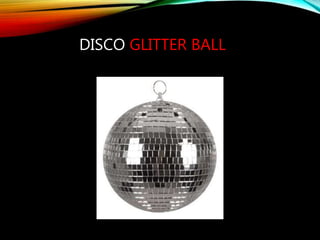
DISCO GLITTER BALL
1970’S DISCO & 1920’S JAZZ
COMPARISM
• Early 1920’s a popularized Jazz
• Jazz dance popular at nightclubs in major cities
• Many similarities dance music of the 1920’s and Disco music
from the 1970’s
• Lavish orchestrations
• Period of social liberalism
• Popularized through black nightclubs
• Disco popularized through gay nightclubs
1970’S DISCO & 1920’S JAZZ
COMPARISM CONT.
• 1920’s Glitter ball first appeared
• Nightclub sequence of Berlin: die sinfonie der großstadt
• The Great Depression
• Socially conservative period
• Gay nightclubs shut down
• Relations between whites and minorities strained
• 1935 Swing music had replace Dance music of the 1920’s
DISCO PRODUCERS & LABELS
• SalSoul Records Joe and Stanley Cayre
• Westend Records Mel Cheren
• Casablanca Records Neil Bogart
• Prelude Records Marvin Schlachter
DISCO PRODUCTION & SOUND
• Shaped legendary Tom Moulton
• Creating the "Remix” influenced Rap, Hip-Hop and Pop
• Extend the enjoyment
• DJs and Remixers would remix (re-edit) existing songs using
reel to reel tape machines
• Remixed versions would add percussion breaks, new sections &
new sounds
PRODUCTION & SOUND REMIX
Disco Remixers
David Mancuso, Tom Moulton, Nicky Siano, Shep Pettibone, Larry
Levan, Walter Gibbons, and Frankie Knuckles
• Sound shaped by nightclub DJ's
• Use multiple record players to seamlessly mix tracks from genres
Soul, Funk and Pop music at discoteques
• Forerunner to later styles such as hip-hop and house
INTERNATIONAL DISCO TRACKS 1
• The Hues Corporation 1974 "Rock The Boat" a U.S. #1 single
and million-seller
• "Walking in Rhythm" by The Blackbyrds 1974,
• Gloria Gaynor remake of The Jackson 5 "Never Can Say
Goodbye"
• The Bee Gees "You Should Be Dancing” 1975
• Barry White "You're the First, the Last, My Everything” 1974
• LaBelle "Lady Marmalade” 1974
INTERNATIONAL DISCO
TRACKS 2
• The Bee Gees "Jive Talkin” 1975
• Chic's "Le Freak” 1978 &"Good Times” 1979
• Boney M a group of four West Indian singers and dancers
masterminded by West German record producer Frank
Farian, charted worldwide hits with such songs as "Daddy
Cool", "Ma Baker" and "Rivers of Babylon"
• All three charted in the U.S.
THE END

Disco Music

  • 1.
  • 2.
    MUSIC & SOCIETYDISCO Roots in late 1960’s Soul, Philly and New York Soul & Motown A genre of dance-oriented pop music that was popularized in dance clubs (discothèques) in the mid-1970’s The term disco was first used in 1973 Rolling Stone Magazine Disco sound-urban American phenomenon
  • 3.
    DISCO BACKGROUND • DiscothèqueClubs where no live music played a.k.a. disk-only events • Occupied France, Jazz and Bebop music & Jitterbug were banned by the Nazis as decadent American influences • Resistance met at hidden underground dance clubs called discotheques • Danced to American Swing music • Played on a turntable when a jukebox was not available
  • 4.
    DISCO BACKGROUND CONT. •Sexual revolution United States 1960’s • Homosexuals were left out • Homosexual sex acts were illegal in several states • Gay bars were frequently raided by police • Police raided Stonewall Inn in the Greenwich Village, New York, June 1969
  • 5.
    DISCO BACKGROUND CONT. •Patrons fought back, leading to Stonewall Riots • Riot led to a feeling that the time had come when they could be themselves • Due to the sexual revolution, feminism, female sexual desire -not discussed or understood, became a topic for discussion
  • 6.
    DISCO BACKGROUND CONT. •Atmosphere in which New York City musicians and audiences from the female, homosexual, black, and Latino communities adopted several traits from hippies and psychedelia • Included free-form dancing, "trippy" lighting, colorful costumes, and hallucinogens • Lack of irony, and earnestness of the hippies influenced pre- Disco music
  • 7.
    MUSIC & SOCIETYDISCO Characteristics  Reverberated vocals  Steady four-on-the-floor beat  Open hi-hat on the off- beat  Syncopated electric bass line Orchestration  Strings, horns  Electric pianos  Lush background sound  Orchestral instruments  flute for solo melodies  Lead guitar rarely used
  • 8.
    DISCO PERFORMERS &PRODUCERS Performers Evelyn "Champagne" King, Tavares, Chic, Bee Gees, Donna Summer, Grace Jones, Gloria Gaynor, Diana Ross, The Village People, Sylvester, The Jackson 5, Stylistics and Barry White Producers Important role in Disco, wrote the songs, created sounds production techniques of the "disco sound” Nile Rogers, Bernard Edwards-CHIC, Giorgio Moroeder-Donna Summer
  • 9.
    DISCO RISE &FALL Disco Copyists Non-Disco artists recorded Disco songs at the height of Disco's popularity, and films such as Saturday Night Fever and Thank God It's Friday increased it’s popularity Decline of Disco Disco declined in popularity in the early to mid 1980’s, influence on hip-hop, electric dance, house, techno, new wave and hip hop
  • 10.
  • 11.
    1970’S DISCO &1920’S JAZZ COMPARISM • Early 1920’s a popularized Jazz • Jazz dance popular at nightclubs in major cities • Many similarities dance music of the 1920’s and Disco music from the 1970’s • Lavish orchestrations • Period of social liberalism • Popularized through black nightclubs • Disco popularized through gay nightclubs
  • 12.
    1970’S DISCO &1920’S JAZZ COMPARISM CONT. • 1920’s Glitter ball first appeared • Nightclub sequence of Berlin: die sinfonie der großstadt • The Great Depression • Socially conservative period • Gay nightclubs shut down • Relations between whites and minorities strained • 1935 Swing music had replace Dance music of the 1920’s
  • 13.
    DISCO PRODUCERS &LABELS • SalSoul Records Joe and Stanley Cayre • Westend Records Mel Cheren • Casablanca Records Neil Bogart • Prelude Records Marvin Schlachter
  • 14.
    DISCO PRODUCTION &SOUND • Shaped legendary Tom Moulton • Creating the "Remix” influenced Rap, Hip-Hop and Pop • Extend the enjoyment • DJs and Remixers would remix (re-edit) existing songs using reel to reel tape machines • Remixed versions would add percussion breaks, new sections & new sounds
  • 15.
    PRODUCTION & SOUNDREMIX Disco Remixers David Mancuso, Tom Moulton, Nicky Siano, Shep Pettibone, Larry Levan, Walter Gibbons, and Frankie Knuckles • Sound shaped by nightclub DJ's • Use multiple record players to seamlessly mix tracks from genres Soul, Funk and Pop music at discoteques • Forerunner to later styles such as hip-hop and house
  • 16.
    INTERNATIONAL DISCO TRACKS1 • The Hues Corporation 1974 "Rock The Boat" a U.S. #1 single and million-seller • "Walking in Rhythm" by The Blackbyrds 1974, • Gloria Gaynor remake of The Jackson 5 "Never Can Say Goodbye" • The Bee Gees "You Should Be Dancing” 1975 • Barry White "You're the First, the Last, My Everything” 1974 • LaBelle "Lady Marmalade” 1974
  • 17.
    INTERNATIONAL DISCO TRACKS 2 •The Bee Gees "Jive Talkin” 1975 • Chic's "Le Freak” 1978 &"Good Times” 1979 • Boney M a group of four West Indian singers and dancers masterminded by West German record producer Frank Farian, charted worldwide hits with such songs as "Daddy Cool", "Ma Baker" and "Rivers of Babylon" • All three charted in the U.S.
  • 18.