SWAMI VIVEKANAND UNIVERSITY
INTRODUCTION TO FORENSIC
BALLISTICS
BY
MR. RAHUL KUMAR SINHA
ASSISTANT PROFESSOR
DEPARTMENT OF FORENSIC
LEARNING OBJECTIVE
Explain Ballistics
Define Internal, external & Terminal ballistics
Explain Forensic
Ballistics
Define Firearms and its components
Explain Ammunition and its components
Describe Firing Mechanism of Firearm
Identification & Individualization of firearm
1
2
3
5
4
7
6
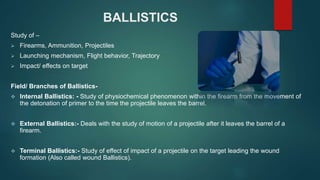
BALLISTICS
Study of –
 Firearms, Ammunition, Projectiles
 Launching mechanism, Flight behavior, Trajectory
 Impact/ effects on target
Field/ Branches of Ballistics-
 Internal Ballistics: - Study of physiochemical phenomenon within the firearm from the movement of
the detonation of primer to the time the projectile leaves the barrel.
 External Ballistics:- Deals with the study of motion of a projectile after it leaves the barrel of a
firearm.
 Terminal Ballistics:- Study of effect of impact of a projectile on the target leading the wound
formation (Also called wound Ballistics).
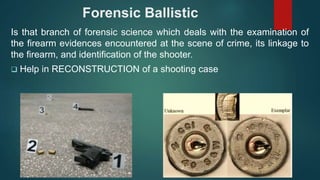
Forensic Ballistic
Is that branch of forensic science which deals with the examination of
the firearm evidences encountered at the scene of crime, its linkage to
the firearm, and identification of the shooter.
 Help in RECONSTRUCTION of a shooting case
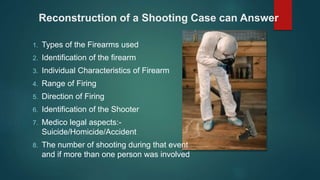
Reconstruction of a Shooting Case can Answer
1. Types of the Firearms used
2. Identification of the firearm
3. Individual Characteristics of Firearm
4. Range of Firing
5. Direction of Firing
6. Identification of the Shooter
7. Medico legal aspects:-
Suicide/Homicide/Accident
8. The number of shooting during that event
and if more than one person was involved
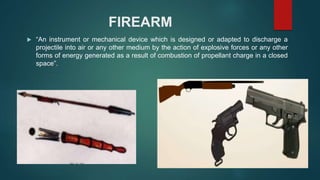
FIREARM
 “An instrument or mechanical device which is designed or adapted to discharge a
projectile into air or any other medium by the action of explosive forces or any other
forms of energy generated as a result of combustion of propellant charge in a closed
space”.
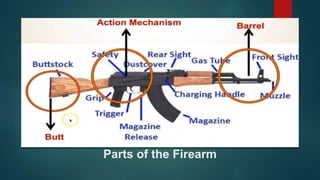
Parts of the Firearm
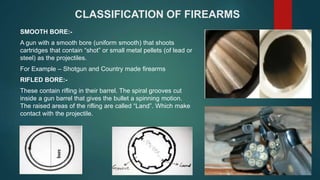
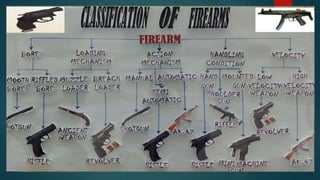
CLASSIFICATION OF FIREARMS
SMOOTH BORE:-
A gun with a smooth bore (uniform smooth) that shoots
cartridges that contain “shot” or small metal pellets (of lead or
steel) as the projectiles.
For Example – Shotgun and Country made firearms
RIFLED BORE:-
These contain rifling in their barrel. The spiral grooves cut
inside a gun barrel that gives the bullet a spinning motion.
The raised areas of the rifling are called “Land”. Which make
contact with the projectile.
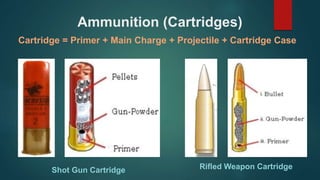
Ammunition (Cartridges)
Shot Gun Cartridge Rifled Weapon Cartridge
Cartridge = Primer + Main Charge + Projectile + Cartridge Case
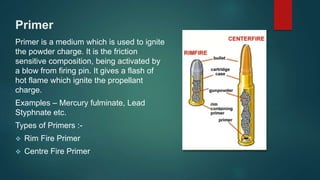
Primer
Primer is a medium which is used to ignite
the powder charge. It is the friction
sensitive composition, being activated by
a blow from firing pin. It gives a flash of
hot flame which ignite the propellant
charge.
Examples – Mercury fulminate, Lead
Styphnate etc.
Types of Primers :-
 Rim Fire Primer
 Centre Fire Primer
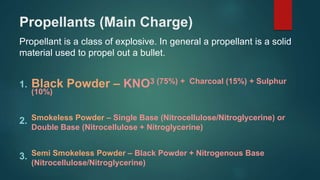
Propellants (Main Charge)
Propellant is a class of explosive. In general a propellant is a solid
material used to propel out a bullet.
1. Black Powder – KNO3 (75%) + Charcoal (15%) + Sulphur
(10%)
2. Smokeless Powder – Single Base (Nitrocellulose/Nitroglycerine) or
Double Base (Nitrocellulose + Nitroglycerine)
3. Semi Smokeless Powder – Black Powder + Nitrogenous Base
(Nitrocellulose/Nitroglycerine)
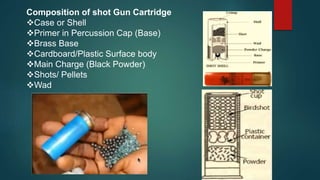
Composition of shot Gun Cartridge
Case or Shell
Primer in Percussion Cap (Base)
Brass Base
Cardboard/Plastic Surface body
Main Charge (Black Powder)
Shots/ Pellets
Wad
FIRING MECHANISM
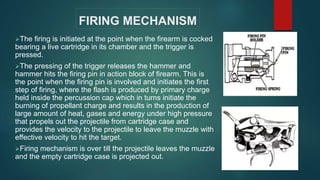
The firing is initiated at the point when the firearm is cocked
bearing a live cartridge in its chamber and the trigger is
pressed.
The pressing of the trigger releases the hammer and
hammer hits the firing pin in action block of firearm. This is
the point when the firing pin is involved and initiates the first
step of firing, where the flash is produced by primary charge
held inside the percussion cap which in turns initiate the
burning of propellant charge and results in the production of
large amount of heat, gases and energy under high pressure
that propels out the projectile from cartridge case and
provides the velocity to the projectile to leave the muzzle with
effective velocity to hit the target.
Firing mechanism is over till the projectile leaves the muzzle
and the empty cartridge case is projected out.
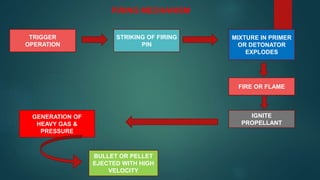
FIRING MECHANISM
TRIGGER
OPERATION
FIRE OR FLAME
STRIKING OF FIRING
PIN
BULLET OR PELLET
EJECTED WITH HIGH
VELOCITY
IGNITE
PROPELLANT
GENERATION OF
HEAVY GAS &
PRESSURE
MIXTURE IN PRIMER
OR DETONATOR
EXPLODES
IDENTIFICATION & INDIVIDUALIZATION OF
FIREARM
Basic Principle:-
 Law of Exchange - “Every contact leaves a trace”
 Law of Individuality -
No two firearms, even those of the same make and model, will produce
the same unique marks on fired bullets and cartridge cases.
Manufacturing process, use, and abuse leave surface characteristics
within the firearm that can not be exactly reproduced in other firearms.
All cases that involve firearms identification start with preliminary
examination of the evidence for similar class characteristics and
different Individual Characteristics.
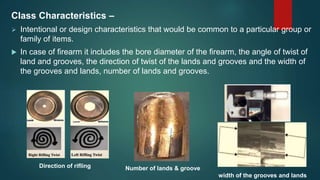
Class Characteristics –
 Intentional or design characteristics that would be common to a particular group or
family of items.
 In case of firearm it includes the bore diameter of the firearm, the angle of twist of
land and grooves, the direction of twist of the lands and grooves and the width of
the grooves and lands, number of lands and grooves.
Direction of rifling Number of lands & groove
width of the grooves and lands
Individual Characteristics -
 These are the finer imperfections of the indentations produced by the firearm. These help us
to find specific firearm. These imperfections due to manufacturing, use of the weapon and
corrosion of the weapon.
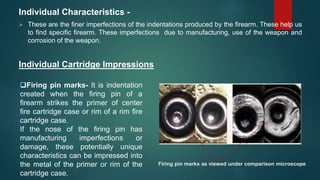
Individual Cartridge Impressions
Firing pin marks- It is indentation
created when the firing pin of a
firearm strikes the primer of center
fire cartridge case or rim of a rim fire
cartridge case.
If the nose of the firing pin has
manufacturing imperfections or
damage, these potentially unique
characteristics can be impressed into
the metal of the primer or rim of the
cartridge case.
Firing pin marks as viewed under comparison microscope
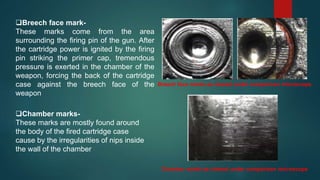
Breech face mark-
These marks come from the area
surrounding the firing pin of the gun. After
the cartridge power is ignited by the firing
pin striking the primer cap, tremendous
pressure is exerted in the chamber of the
weapon, forcing the back of the cartridge
case against the breech face of the
weapon
Chamber marks-
These marks are mostly found around
the body of the fired cartridge case
cause by the irregularities of nips inside
the wall of the chamber
Breech face marks as viewed under comparison microscope
Chamber marks as viewed under comparison microscope
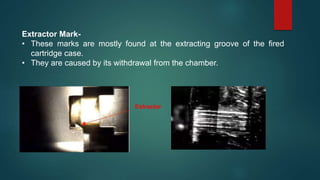
Extractor Mark-
• These marks are mostly found at the extracting groove of the fired
cartridge case.
• They are caused by its withdrawal from the chamber.
Extractor
Forensic ballistics

Forensic ballistics

  • 1.
    SWAMI VIVEKANAND UNIVERSITY INTRODUCTIONTO FORENSIC BALLISTICS BY MR. RAHUL KUMAR SINHA ASSISTANT PROFESSOR DEPARTMENT OF FORENSIC
  • 2.
    LEARNING OBJECTIVE Explain Ballistics DefineInternal, external & Terminal ballistics Explain Forensic Ballistics Define Firearms and its components Explain Ammunition and its components Describe Firing Mechanism of Firearm Identification & Individualization of firearm 1 2 3 5 4 7 6
  • 3.
    BALLISTICS Study of – Firearms, Ammunition, Projectiles  Launching mechanism, Flight behavior, Trajectory  Impact/ effects on target Field/ Branches of Ballistics-  Internal Ballistics: - Study of physiochemical phenomenon within the firearm from the movement of the detonation of primer to the time the projectile leaves the barrel.  External Ballistics:- Deals with the study of motion of a projectile after it leaves the barrel of a firearm.  Terminal Ballistics:- Study of effect of impact of a projectile on the target leading the wound formation (Also called wound Ballistics).
  • 4.
    Forensic Ballistic Is thatbranch of forensic science which deals with the examination of the firearm evidences encountered at the scene of crime, its linkage to the firearm, and identification of the shooter.  Help in RECONSTRUCTION of a shooting case
  • 5.
    Reconstruction of aShooting Case can Answer 1. Types of the Firearms used 2. Identification of the firearm 3. Individual Characteristics of Firearm 4. Range of Firing 5. Direction of Firing 6. Identification of the Shooter 7. Medico legal aspects:- Suicide/Homicide/Accident 8. The number of shooting during that event and if more than one person was involved
  • 6.
    FIREARM  “An instrumentor mechanical device which is designed or adapted to discharge a projectile into air or any other medium by the action of explosive forces or any other forms of energy generated as a result of combustion of propellant charge in a closed space”.
  • 7.
    Parts of theFirearm
  • 8.
    CLASSIFICATION OF FIREARMS SMOOTHBORE:- A gun with a smooth bore (uniform smooth) that shoots cartridges that contain “shot” or small metal pellets (of lead or steel) as the projectiles. For Example – Shotgun and Country made firearms RIFLED BORE:- These contain rifling in their barrel. The spiral grooves cut inside a gun barrel that gives the bullet a spinning motion. The raised areas of the rifling are called “Land”. Which make contact with the projectile.
  • 10.
    Ammunition (Cartridges) Shot GunCartridge Rifled Weapon Cartridge Cartridge = Primer + Main Charge + Projectile + Cartridge Case
  • 11.
    Primer Primer is amedium which is used to ignite the powder charge. It is the friction sensitive composition, being activated by a blow from firing pin. It gives a flash of hot flame which ignite the propellant charge. Examples – Mercury fulminate, Lead Styphnate etc. Types of Primers :-  Rim Fire Primer  Centre Fire Primer
  • 12.
    Propellants (Main Charge) Propellantis a class of explosive. In general a propellant is a solid material used to propel out a bullet. 1. Black Powder – KNO3 (75%) + Charcoal (15%) + Sulphur (10%) 2. Smokeless Powder – Single Base (Nitrocellulose/Nitroglycerine) or Double Base (Nitrocellulose + Nitroglycerine) 3. Semi Smokeless Powder – Black Powder + Nitrogenous Base (Nitrocellulose/Nitroglycerine)
  • 13.
    Composition of shotGun Cartridge Case or Shell Primer in Percussion Cap (Base) Brass Base Cardboard/Plastic Surface body Main Charge (Black Powder) Shots/ Pellets Wad
  • 14.
    FIRING MECHANISM The firingis initiated at the point when the firearm is cocked bearing a live cartridge in its chamber and the trigger is pressed. The pressing of the trigger releases the hammer and hammer hits the firing pin in action block of firearm. This is the point when the firing pin is involved and initiates the first step of firing, where the flash is produced by primary charge held inside the percussion cap which in turns initiate the burning of propellant charge and results in the production of large amount of heat, gases and energy under high pressure that propels out the projectile from cartridge case and provides the velocity to the projectile to leave the muzzle with effective velocity to hit the target. Firing mechanism is over till the projectile leaves the muzzle and the empty cartridge case is projected out.
  • 15.
    FIRING MECHANISM TRIGGER OPERATION FIRE ORFLAME STRIKING OF FIRING PIN BULLET OR PELLET EJECTED WITH HIGH VELOCITY IGNITE PROPELLANT GENERATION OF HEAVY GAS & PRESSURE MIXTURE IN PRIMER OR DETONATOR EXPLODES
  • 16.
    IDENTIFICATION & INDIVIDUALIZATIONOF FIREARM Basic Principle:-  Law of Exchange - “Every contact leaves a trace”  Law of Individuality - No two firearms, even those of the same make and model, will produce the same unique marks on fired bullets and cartridge cases. Manufacturing process, use, and abuse leave surface characteristics within the firearm that can not be exactly reproduced in other firearms. All cases that involve firearms identification start with preliminary examination of the evidence for similar class characteristics and different Individual Characteristics.
  • 17.
    Class Characteristics – Intentional or design characteristics that would be common to a particular group or family of items.  In case of firearm it includes the bore diameter of the firearm, the angle of twist of land and grooves, the direction of twist of the lands and grooves and the width of the grooves and lands, number of lands and grooves. Direction of rifling Number of lands & groove width of the grooves and lands
  • 18.
    Individual Characteristics - These are the finer imperfections of the indentations produced by the firearm. These help us to find specific firearm. These imperfections due to manufacturing, use of the weapon and corrosion of the weapon. Individual Cartridge Impressions Firing pin marks- It is indentation created when the firing pin of a firearm strikes the primer of center fire cartridge case or rim of a rim fire cartridge case. If the nose of the firing pin has manufacturing imperfections or damage, these potentially unique characteristics can be impressed into the metal of the primer or rim of the cartridge case. Firing pin marks as viewed under comparison microscope
  • 19.
    Breech face mark- Thesemarks come from the area surrounding the firing pin of the gun. After the cartridge power is ignited by the firing pin striking the primer cap, tremendous pressure is exerted in the chamber of the weapon, forcing the back of the cartridge case against the breech face of the weapon Chamber marks- These marks are mostly found around the body of the fired cartridge case cause by the irregularities of nips inside the wall of the chamber Breech face marks as viewed under comparison microscope Chamber marks as viewed under comparison microscope
  • 20.
    Extractor Mark- • Thesemarks are mostly found at the extracting groove of the fired cartridge case. • They are caused by its withdrawal from the chamber. Extractor