Dr Anjana Mohite
Assoc Professor ENT.
DY Patil Medical College,Kolhapur,Maharashtra
INDIA
Definition
 Leakage of cerebro spinal fluid into the nose is called
CSF rhinorrhoea.
 Clear fluid.
 Serosanguinous- head injuries.
Physiology
 CSF forms a cushion of fluid around brain and spinal
cord acting as buffer against jerks.
 Secreted by choroid plexuses in 3rd 4th and lateral
ventricle.
 Absorbed by arachnoid villi (which have 1 way channel
allowing CSF of SASp to be absorbed into blood) into
dural sinuses.
 Total volume:90 to 150ml.
 Rate:20ml/hr.
 Total CSF replaced 3 to 4 times a day.
 Pressure:50 to 150mm H2O
 Pr increases on coughing,sneezing, nose blowing,
straining on stools or lifting weights.
Etiology
 Traumatic
 1. Accidental-
Facial injuries
Head injuries
2. Iatrogenic-
FESS
Neurosurgery
Polypectomy
Skull base surgery
 Non traumatic
 1.High pressure-
Tumours
Hydrocephalus
2. Normal pressure-
Congenital anomalies
Meningocele
Meningoencephalocele
Glioma
Osteomylitis skull base
Sites of leak
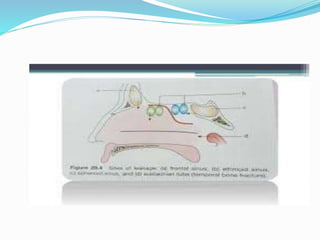
 1. From Anterior cranial fossa to nose:
 A) Cribriform plate of ethmoid bone(commonest site).
 B) Roof of ethmoid sinus.
 C) Posterior wall of frontal sinus.
 2. From middle cranial fossa to nose:
 A) Injuries to sphenoid sinus.
 B) Fracture in temporal bone: CSF reaches the middle
ear and then escapes through the eustachian tube into
the nose- referred to as CSF oto-rhinorrhoea.
Clinical Features:
 1. History of clear watery discharge from nose
increased by bending forwards and straining.
 2. Salty taste in the mouth when ever the discharge
comes out.
 3. Headache(low pressure which is relieved by bending
forwars or straining.
 4. Anosmia.
 5. In head trauma CSF is mixed with blood and shows
double target sign or Halo sign.
Difference between CSF and nasal
secretions
 CSF
 1.H/O nasal or sinus Sx,
head injury or SOL.
 2.Few drops or gush of
fluid more on bending and
straining that cannot be
sniffed back.
 3. thin ,watery, clear.
 4. tastes sweet
 5.Sugar >30mg/dl
 6. beta 2 transferrin always
+
 Nasal secretion
 1.Allergic symptoms
 2.Continuous, no change
on posture or straining,
can be sniffed back.
3. mucoid.
4. Tastes salty.
5. <10mg/dl
6 .absent
Diagnosis
 1. History and clinical features.
 2. Reservoir sign: Pt is made to lie down with head end
elevated for sometime and then suddenly asked to
bend head forwards. A sudden gush of watery
discharge is noticed.
 3. Handkerchief test: CSF does not stiffen a
handkerchief but nasal discharge owing to its mucus
content does.
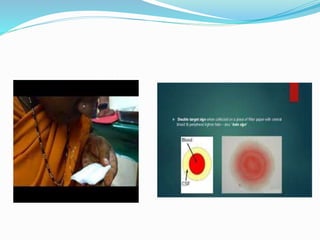
 4. Halo sign or double target sign: When CSF is mixed
with blood in cases of head trauma, then on placing a
drop on a filter paper, there is a central zone of dry
blood and peripheral lighter halo or clear ring.
Laboratory Tests:
 1. Immuno electrophoretic demonstration of beta 2
transferrin is the diagnostic test.
 Beta 2 transferrin is a protein seen in CSF . Its presence
is a specific and sensitive for CSF. Perilymph and
aqueous humour are the only other 2 fluids than CSF
that contain this protein
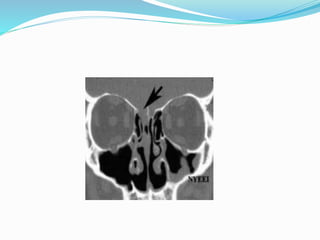
 2.Radiological tests: to localize the site of defect.
 HRCT,
 MRI for active leaks and in cases of encephalocele and
SOL.
 CT cisternogram: It requires intra thecal inj of
iohexol dye and CT to localise the site.
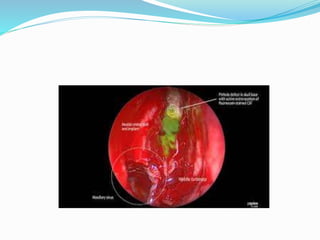
 3. Intrathecal fluorescein study
 Done pre operatively to diagnose the site or intra
operatively at the time of repair.
 Invasive procedure where in 0.25 to 0.5ml of 5%
fluorescein diluted with 10 ml of CSF is injected intra
thecally.
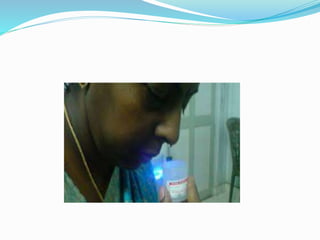
 The dye is detected by nasal endoscopy using a blue
filter and it appears fluorescent green.
 Areas to be examined are: cribriform plate,olfactory
cleft, middle meatus ie frontal and ethmoid sinuses,
spheno-ethmoidal recess for spenoid sinus and area of
torus tubaris for temporal bone fracture.
Management
 In traumatic cases, conservative treatment is advisable to
allow the fistula to heal spontaneously. This includes:
 1. Bed rest in head up position.
 2. Stool softners.
 3. Avoidance of straining , nose blowing, coughing and
sneezing.
 4. Avoid use of nasal decongestant drops.
 5. Prophylactic antibiotics to prevent meningitis.
 6. Acetazolamide to decrease CSF secretion.
 7. Indwelling Lumbar subarchnoid drain to decrease CSF
pressure and allows torn dural flaps to approximate and
heal.
 Most traumatic leaks seal with this treatment by 2 to 3
weeks. If it fails to heal beyond this time, surgical
intervention should be considered.
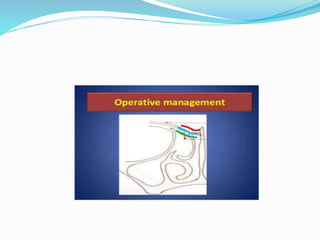
 Closure of leak by:
 1.Intra cranial approach-by neuro surgeon.
 2. Extra cranial approaches-Ext ethmoidectomy for
cribriform plate and ethmoid area, trans septal
sphenoid approach for sphenoid and osteoplastic flap
approach for frontal sinus leak.
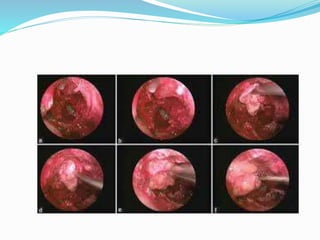
 3.Trans nasal endoscopic approach.
Advantages of Trans nasal
endoscopic repair of CSF leak
 1. Allows accurate localization of leak.
 2. Better positioning of graft is possible.
 3. Does not increase size of defect.
 4. Less morbidity.
 5. Duration of stay in hospital is reduced.
 6. Avoids craniotomy.
 7. Revision surgeries are possible in failed and
recurrent leaks.
Graft materials used to seal defect
 1. Abdominal fat.
 2. Temporalis fascia.
 3. Fascia lata.
 4. Conchal mucoperiostium
 5. Conchal cartilage.
 6. Septal flaps.
 7. Muscle
 If defect is large(1cm) closure is done in multiple
layersusing cartilage or bone and fascia is preferred
called as sandwich graft.
Procedure:
 Define the site.
 Preparation of graft site.
 Underlying grafting of fascia(fat) extra durally.
 Placement of mucosa as free graft or pedicled flap.
 Repair of large bone defect with septal cartilage or conchal
cartilage & then placement of mucosa.
 Placement of surgicel and gelfoam for reinforcement.
 Placement of high antibiotic smeared nasal pack.
 Lumbar drain if pressure is high.
 Antibiotics.
 Leaks from frontal sinus require osteoplastic flap and
obliteration of sinus with fat.
Thank you

Presention 7

  • 1.
    Dr Anjana Mohite AssocProfessor ENT. DY Patil Medical College,Kolhapur,Maharashtra INDIA
  • 2.
    Definition  Leakage ofcerebro spinal fluid into the nose is called CSF rhinorrhoea.  Clear fluid.  Serosanguinous- head injuries.
  • 3.
    Physiology  CSF formsa cushion of fluid around brain and spinal cord acting as buffer against jerks.  Secreted by choroid plexuses in 3rd 4th and lateral ventricle.  Absorbed by arachnoid villi (which have 1 way channel allowing CSF of SASp to be absorbed into blood) into dural sinuses.  Total volume:90 to 150ml.  Rate:20ml/hr.  Total CSF replaced 3 to 4 times a day.  Pressure:50 to 150mm H2O  Pr increases on coughing,sneezing, nose blowing, straining on stools or lifting weights.
  • 4.
    Etiology  Traumatic  1.Accidental- Facial injuries Head injuries 2. Iatrogenic- FESS Neurosurgery Polypectomy Skull base surgery  Non traumatic  1.High pressure- Tumours Hydrocephalus 2. Normal pressure- Congenital anomalies Meningocele Meningoencephalocele Glioma Osteomylitis skull base
  • 5.
    Sites of leak 1. From Anterior cranial fossa to nose:  A) Cribriform plate of ethmoid bone(commonest site).  B) Roof of ethmoid sinus.  C) Posterior wall of frontal sinus.  2. From middle cranial fossa to nose:  A) Injuries to sphenoid sinus.  B) Fracture in temporal bone: CSF reaches the middle ear and then escapes through the eustachian tube into the nose- referred to as CSF oto-rhinorrhoea.
  • 7.
    Clinical Features:  1.History of clear watery discharge from nose increased by bending forwards and straining.  2. Salty taste in the mouth when ever the discharge comes out.  3. Headache(low pressure which is relieved by bending forwars or straining.  4. Anosmia.  5. In head trauma CSF is mixed with blood and shows double target sign or Halo sign.
  • 9.
    Difference between CSFand nasal secretions  CSF  1.H/O nasal or sinus Sx, head injury or SOL.  2.Few drops or gush of fluid more on bending and straining that cannot be sniffed back.  3. thin ,watery, clear.  4. tastes sweet  5.Sugar >30mg/dl  6. beta 2 transferrin always +  Nasal secretion  1.Allergic symptoms  2.Continuous, no change on posture or straining, can be sniffed back. 3. mucoid. 4. Tastes salty. 5. <10mg/dl 6 .absent
  • 10.
    Diagnosis  1. Historyand clinical features.  2. Reservoir sign: Pt is made to lie down with head end elevated for sometime and then suddenly asked to bend head forwards. A sudden gush of watery discharge is noticed.  3. Handkerchief test: CSF does not stiffen a handkerchief but nasal discharge owing to its mucus content does.  4. Halo sign or double target sign: When CSF is mixed with blood in cases of head trauma, then on placing a drop on a filter paper, there is a central zone of dry blood and peripheral lighter halo or clear ring.
  • 12.
    Laboratory Tests:  1.Immuno electrophoretic demonstration of beta 2 transferrin is the diagnostic test.  Beta 2 transferrin is a protein seen in CSF . Its presence is a specific and sensitive for CSF. Perilymph and aqueous humour are the only other 2 fluids than CSF that contain this protein  2.Radiological tests: to localize the site of defect.  HRCT,  MRI for active leaks and in cases of encephalocele and SOL.  CT cisternogram: It requires intra thecal inj of iohexol dye and CT to localise the site.
  • 14.
     3. Intrathecalfluorescein study  Done pre operatively to diagnose the site or intra operatively at the time of repair.  Invasive procedure where in 0.25 to 0.5ml of 5% fluorescein diluted with 10 ml of CSF is injected intra thecally.  The dye is detected by nasal endoscopy using a blue filter and it appears fluorescent green.  Areas to be examined are: cribriform plate,olfactory cleft, middle meatus ie frontal and ethmoid sinuses, spheno-ethmoidal recess for spenoid sinus and area of torus tubaris for temporal bone fracture.
  • 16.
    Management  In traumaticcases, conservative treatment is advisable to allow the fistula to heal spontaneously. This includes:  1. Bed rest in head up position.  2. Stool softners.  3. Avoidance of straining , nose blowing, coughing and sneezing.  4. Avoid use of nasal decongestant drops.  5. Prophylactic antibiotics to prevent meningitis.  6. Acetazolamide to decrease CSF secretion.  7. Indwelling Lumbar subarchnoid drain to decrease CSF pressure and allows torn dural flaps to approximate and heal.
  • 17.
     Most traumaticleaks seal with this treatment by 2 to 3 weeks. If it fails to heal beyond this time, surgical intervention should be considered.  Closure of leak by:  1.Intra cranial approach-by neuro surgeon.  2. Extra cranial approaches-Ext ethmoidectomy for cribriform plate and ethmoid area, trans septal sphenoid approach for sphenoid and osteoplastic flap approach for frontal sinus leak.  3.Trans nasal endoscopic approach.
  • 19.
    Advantages of Transnasal endoscopic repair of CSF leak  1. Allows accurate localization of leak.  2. Better positioning of graft is possible.  3. Does not increase size of defect.  4. Less morbidity.  5. Duration of stay in hospital is reduced.  6. Avoids craniotomy.  7. Revision surgeries are possible in failed and recurrent leaks.
  • 21.
    Graft materials usedto seal defect  1. Abdominal fat.  2. Temporalis fascia.  3. Fascia lata.  4. Conchal mucoperiostium  5. Conchal cartilage.  6. Septal flaps.  7. Muscle  If defect is large(1cm) closure is done in multiple layersusing cartilage or bone and fascia is preferred called as sandwich graft.
  • 22.
    Procedure:  Define thesite.  Preparation of graft site.  Underlying grafting of fascia(fat) extra durally.  Placement of mucosa as free graft or pedicled flap.  Repair of large bone defect with septal cartilage or conchal cartilage & then placement of mucosa.  Placement of surgicel and gelfoam for reinforcement.  Placement of high antibiotic smeared nasal pack.  Lumbar drain if pressure is high.  Antibiotics.  Leaks from frontal sinus require osteoplastic flap and obliteration of sinus with fat.
  • 23.