Inspiring Dropouts and their
Teachers to Connect to
Lifelong Learning Practices


                               1
reAct – about the project
General data


 Lifelong Learning Programme
 Multilateral Project: KA3 (ICT)
 Project Number: 511709-LLP-1-2010-1ES-KA3-KA3MP
 Agreement n° 2010 – 4140/ 001 – 001
 Duration: 01/01/2011 to 31/12/2012


                                                    2
Partners

 SERVEF Servicio Valenciano de Empleo y Formación, Valencia (Spain)
 KEK KRONOS Ltd., Psachna (Greece)
 Training 2000, Mondavio (Italy)
 Tiroler Bildungsservice, Innsbruck (Austria)
 BFI Tirol Bildungs GmbH, Innsbruck (Austria)
 DELFT UNIVERSITY OF TECHNOLOGY, Delft (Netherlands)
 Centro Novas Oportunidades D. Inês de Castro – Alcobaça (Portugal)


                                                                       3
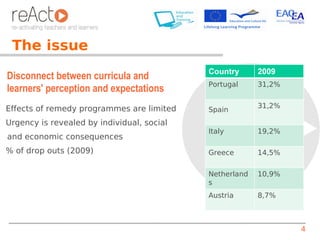
The issue
                                              Country      2009
   Disconnect between curricula and
                                              Portugal     31,2%
   learners' perception and expectations
 Effects of remedy programmes are limited                 31,2%
                                              Spain
 Urgency is revealed by individual, social
                                              Italy        19,2%
   and economic consequences
 % of drop outs (2009)                       Greece       14,5%


                                              Netherland   10,9%
                                              s
                                              Austria      8,7%


                                                                   4
Research suggests


Diminishing early school leave
    Flexible education and training systems
    Variety of learning pathways
    Individual and school-level support


    Difficult to include in the traditional classroom / schoolsystem


                                                                        5
reAct overall objectives

 Develop a new learning approach
 Using new technologies


 To improve the prospects and employability


 Develop insights and skills of teachers and management


               Tapping into motivational behaviour

                                                           6
Project aims


 A change of attitude to learning
 Open minds
 Learn to learn


                                     7
Developing the learning
concept
 Needs analysis
 Design of the methodological approach
 Creation of the toolset


Monitoring, evaluating, assessing
Teacher interviews (online, questionnaires, logbooks)
Students interviews (online, questionnaires)
Project results, products, local & online presence
Partner reports

                                                         8
The learning concept
The 7 learning principles

     Trust
     Challenge
     Self-directed
     Collaboration
     Ownership
     Creativity
     Relevance


                            9
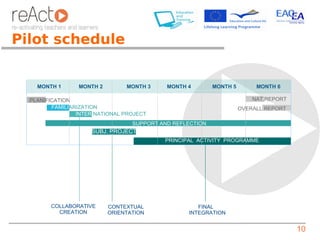
Pilot schedule


    MONTH 1      MONTH 2        MONTH 3     MONTH 4        MONTH 5        MONTH 6

  PLANIFICATION                                                          NAT.REPORT.
         FAMILIARIZATION                                             OVERALL REPORT
                 INTER NATIONAL PROJECT
                                  SUPPORT AND REFLECTION
                     SUBJ. PROJECT
                                           PRINCIPAL ACTIVITY PROGRAMME


        COLLABORATIVE      CONTEXTUAL                FINAL
          CREATION         ORIENTATION            INTEGRATION


                                                                                       10
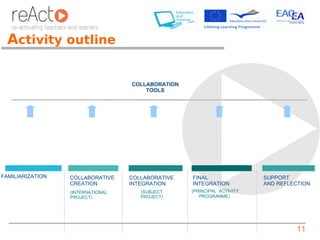
Activity outline

                                   COLLABORATION
                                       TOOLS


FAMILIARIZATION   COLLABORATIVE    COLLABORATIVE   FINAL                 SUPPORT
                  CREATION         INTEGRATION     INTEGRATION           AND REFLECTION
                  (INTERNATIONAL      (SUBJECT     (PRINCIPAL ACTIVITY
                  PROJECT)            PROJECT)        PROGRAMME)


                                                                                  11
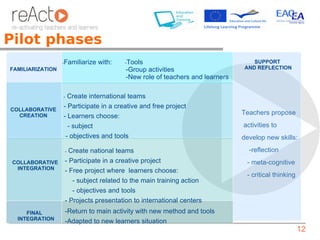
Pilot phases
                  -Familiarize   with:   -Tools                                  SUPPORT
FAMILIARIZATION                          -Group activities                    AND REFLECTION
                                         -New role of teachers and learners

                  - Create international teams
COLLABORATIVE
                  - Participate in a creative and free project
                                                                              Teachers propose
  CREATION        - Learners choose:
                    - subject                                                 activities to
                   - objectives and tools                                     develop new skills:
                  - Create national teams                                       -reflection
 COLLABORATIVE    - Participate in a creative project                          - meta-cognitive
  INTEGRATION     - Free project where learners choose:
                                                                               - critical thinking
                     - subject related to the main training action
                     - objectives and tools
                  - Projects presentation to international centers
     FINAL        -Return to main activity with new method and tools
  INTEGRATION
                  -Adapted to new learners situation
                                                                                                     12
Portuguese experience

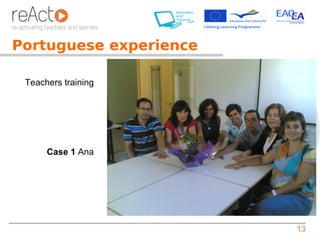
 Teachers training


      Case 1 Ana


                        13
Portuguese experience

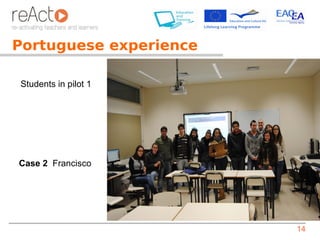
Students in pilot 1


Case 2 Francisco


                        14
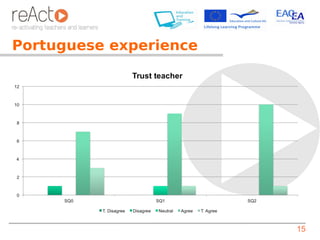
Portuguese experience


                        15
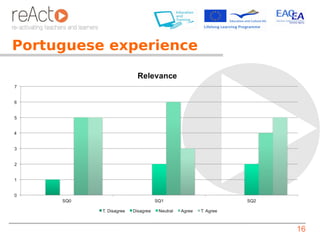
Portuguese experience


                        16
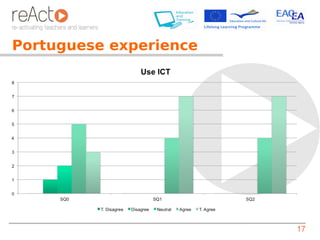
Portuguese experience


                        17
To be continued …


     www.reactproject.eu
                           18

Csedu 2012 re act presentation v1

  • 1.
    Inspiring Dropouts andtheir Teachers to Connect to Lifelong Learning Practices 1
  • 2.
    reAct – aboutthe project General data  Lifelong Learning Programme  Multilateral Project: KA3 (ICT)  Project Number: 511709-LLP-1-2010-1ES-KA3-KA3MP  Agreement n° 2010 – 4140/ 001 – 001  Duration: 01/01/2011 to 31/12/2012 2
  • 3.
    Partners  SERVEF ServicioValenciano de Empleo y Formación, Valencia (Spain)  KEK KRONOS Ltd., Psachna (Greece)  Training 2000, Mondavio (Italy)  Tiroler Bildungsservice, Innsbruck (Austria)  BFI Tirol Bildungs GmbH, Innsbruck (Austria)  DELFT UNIVERSITY OF TECHNOLOGY, Delft (Netherlands)  Centro Novas Oportunidades D. Inês de Castro – Alcobaça (Portugal) 3
  • 4.
    The issue Country 2009 Disconnect between curricula and Portugal 31,2% learners' perception and expectations  Effects of remedy programmes are limited 31,2% Spain  Urgency is revealed by individual, social Italy 19,2% and economic consequences  % of drop outs (2009) Greece 14,5% Netherland 10,9% s Austria 8,7% 4
  • 5.
    Research suggests Diminishing earlyschool leave  Flexible education and training systems  Variety of learning pathways  Individual and school-level support  Difficult to include in the traditional classroom / schoolsystem 5
  • 6.
    reAct overall objectives Develop a new learning approach  Using new technologies  To improve the prospects and employability  Develop insights and skills of teachers and management Tapping into motivational behaviour 6
  • 7.
    Project aims  Achange of attitude to learning  Open minds  Learn to learn 7
  • 8.
    Developing the learning concept Needs analysis  Design of the methodological approach  Creation of the toolset Monitoring, evaluating, assessing Teacher interviews (online, questionnaires, logbooks) Students interviews (online, questionnaires) Project results, products, local & online presence Partner reports 8
  • 9.
    The learning concept The7 learning principles  Trust  Challenge  Self-directed  Collaboration  Ownership  Creativity  Relevance 9
  • 10.
    Pilot schedule MONTH 1 MONTH 2 MONTH 3 MONTH 4 MONTH 5 MONTH 6 PLANIFICATION NAT.REPORT. FAMILIARIZATION OVERALL REPORT INTER NATIONAL PROJECT SUPPORT AND REFLECTION SUBJ. PROJECT PRINCIPAL ACTIVITY PROGRAMME COLLABORATIVE CONTEXTUAL FINAL CREATION ORIENTATION INTEGRATION 10
  • 11.
    Activity outline COLLABORATION TOOLS FAMILIARIZATION COLLABORATIVE COLLABORATIVE FINAL SUPPORT CREATION INTEGRATION INTEGRATION AND REFLECTION (INTERNATIONAL (SUBJECT (PRINCIPAL ACTIVITY PROJECT) PROJECT) PROGRAMME) 11
  • 12.
    Pilot phases -Familiarize with: -Tools SUPPORT FAMILIARIZATION -Group activities AND REFLECTION -New role of teachers and learners - Create international teams COLLABORATIVE - Participate in a creative and free project Teachers propose CREATION - Learners choose: - subject activities to - objectives and tools develop new skills: - Create national teams -reflection COLLABORATIVE - Participate in a creative project - meta-cognitive INTEGRATION - Free project where learners choose: - critical thinking - subject related to the main training action - objectives and tools - Projects presentation to international centers FINAL -Return to main activity with new method and tools INTEGRATION -Adapted to new learners situation 12
  • 13.
    Portuguese experience Teacherstraining Case 1 Ana 13
  • 14.
    Portuguese experience Students inpilot 1 Case 2 Francisco 14
  • 15.
  • 16.
  • 17.
  • 18.
    To be continued… www.reactproject.eu 18

Editor's Notes

  • #2 Dropouts are youngsters (15 – 24) who leave school without a diploma and normal do not return. This project is to motivate them to pick up where they left, but focus on issues that are more relevant to them, more relevant to their actual situation: what we call lifelong learning practices.