The First Lecture Really Achieving Your Career Dreams Emil Chuck, Ph.D. Health Professions Advisor Term Assistant Professor of Biology
All the thank yous University Life Sodexho catering College of Science Science Showcase (Hank, Dwayne, Scott) Student organizations Kaplan Test Prep & Admissions Student Academic Affairs & Advising Introducing and thanking those who helped
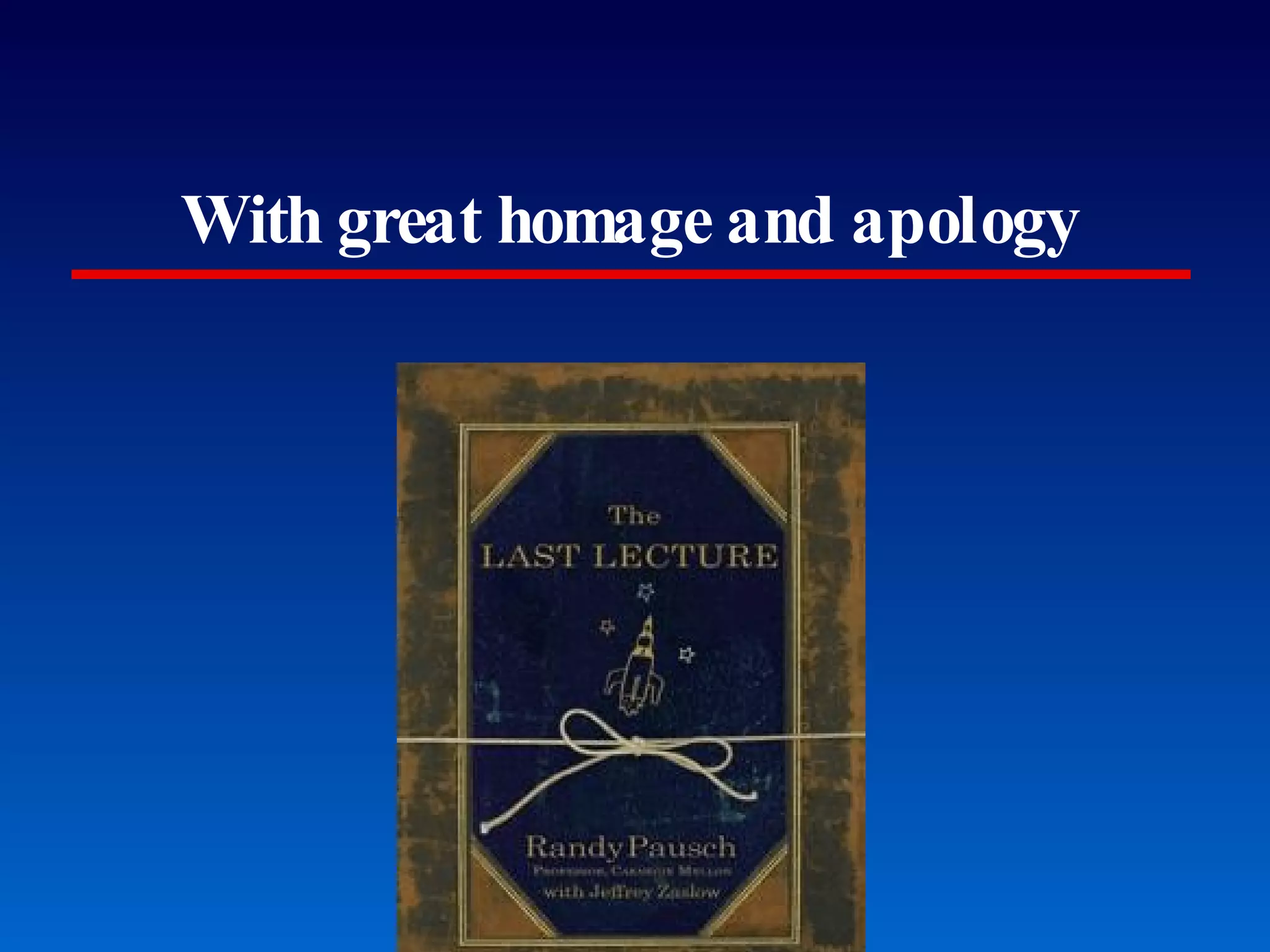
With great homage and apology Randy Pausch (died July 25, 2008)
George Mason University Think Learn Succeed A Habit of Excellence
What is a premed? “The term premed designates a provisional career aspiration far more often than it does a firm commitment.” – Austin (July 31, 2008) “Nationally only 1 student in 12 who enter undergraduate life as a premed will go to medical school.” – Blystone comment Austin (Inside Higher Education)
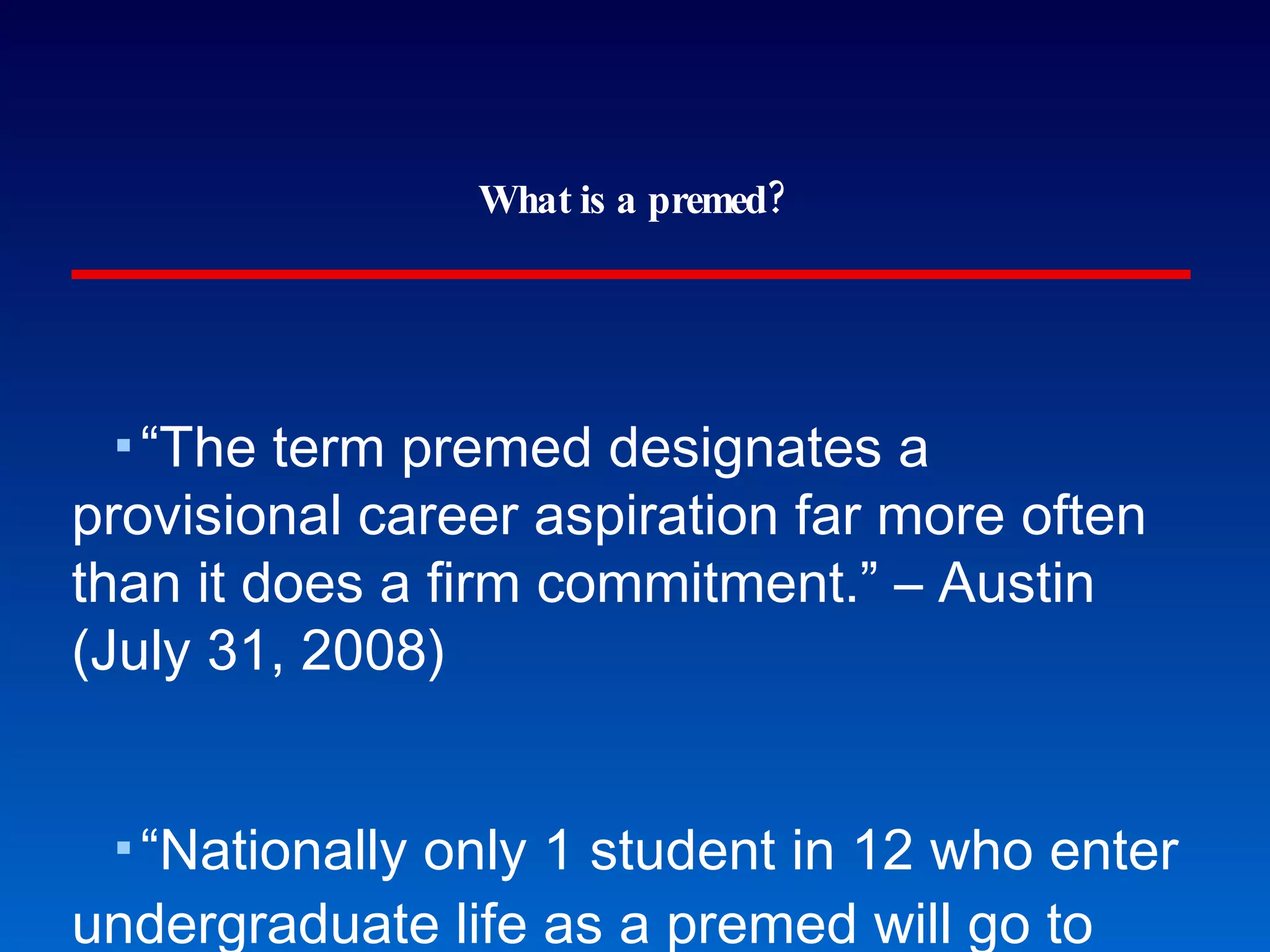
Fear of failure “ The elephant in the room”
Attaining the right goal Perfect is the enemy of good (but not better).
Attaining the right goal Really Achieving Your Career Dreams
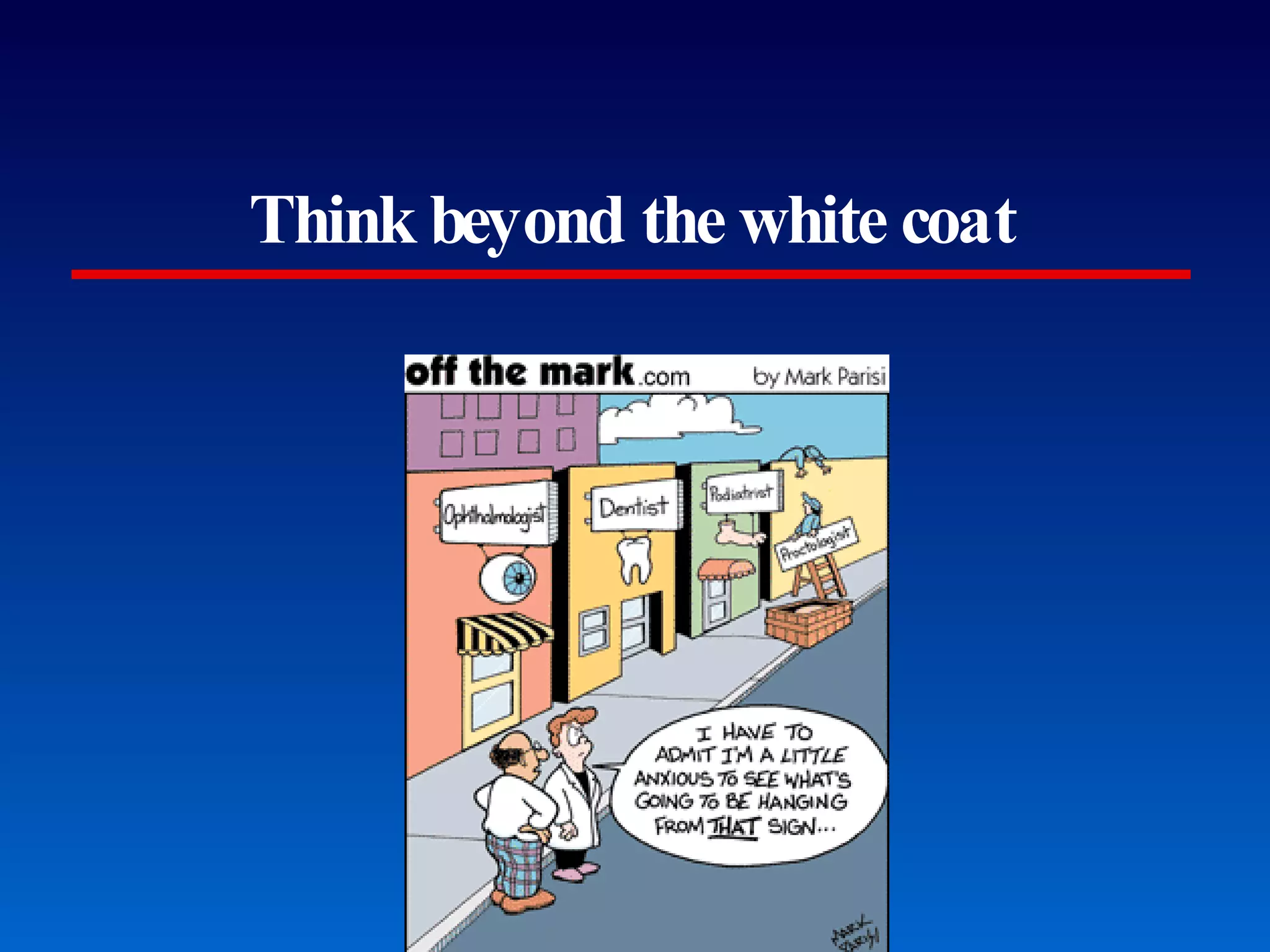
Think beyond the white coat Really Achieving Your Career Dreams
Think beyond the white coat Anesthesiologist Assistant Five Master’s programs in US (100 total students) Premed requirements + calculus + MCAT CWRU average MCAT 25, science GPA 3.4 The average starting salary for a newly graduated anesthesiologist assistant is approximately $115,000 for a 40-hour work week plus benefits and consideration of on-call activity. (CWRU) Did you know...?
Think beyond the white coat We need lab scientists and engineers! Lab safety, librarians, technicians We need innovative scientific businesses! Technology transfer, pharma, biotech We need health communicators! We need politicians who are innovation- friendly and scientifically conscientious. We absolutely need math/science teachers! Really Achieving Your Career Dreams
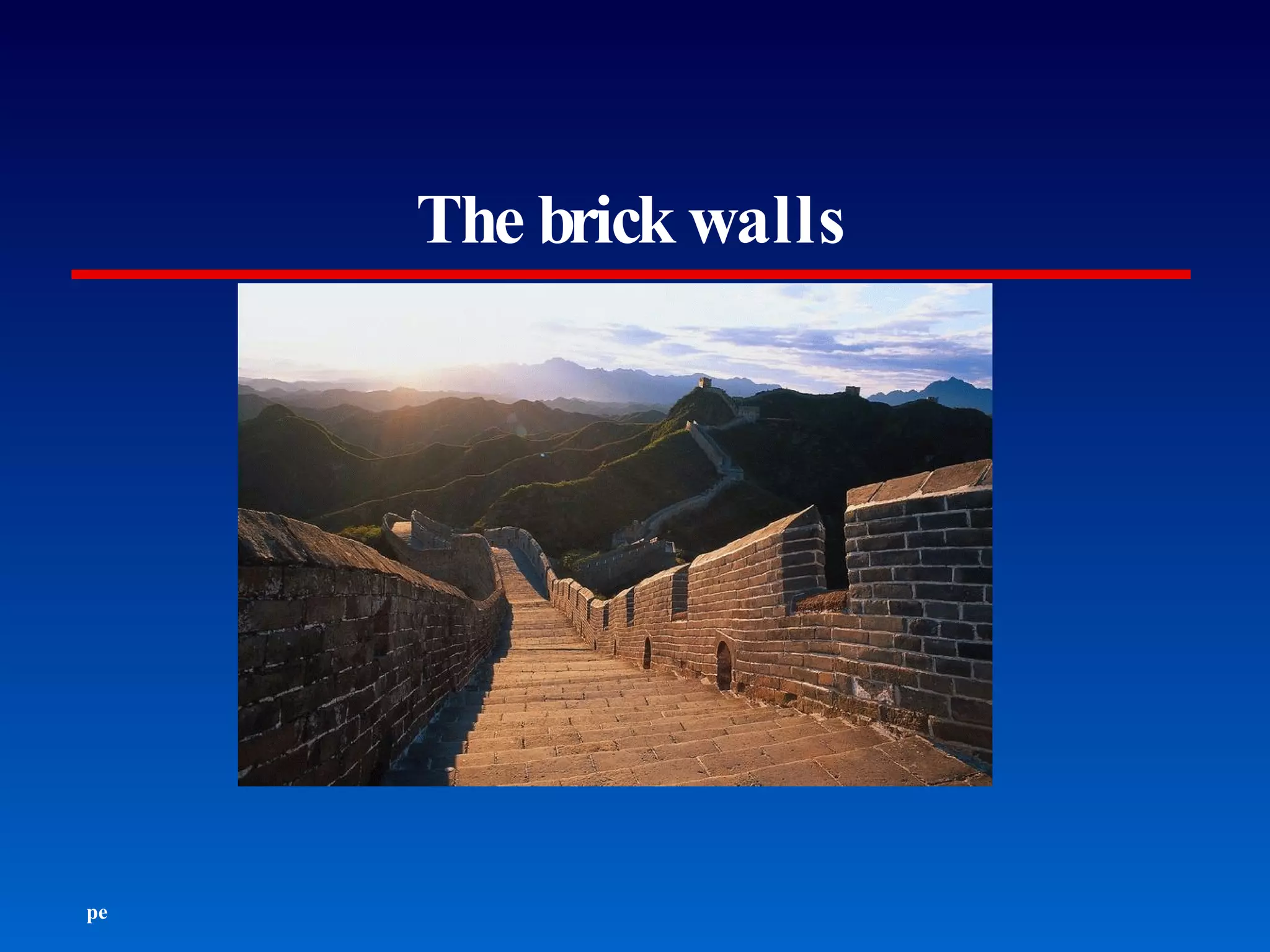
The brick walls The brick walls are not there to keep us out.  The brick walls are there to give us a chance to show how badly we want something.  The brick walls are there to stop the people who don’t want it badly enough.  They’re there to stop other pe ople. ... Sometimes the brick walls are made of flesh.  (Pausch)
Think beyond the lecture “ Large lecture courses... often fail to keep the attention of so me students.”
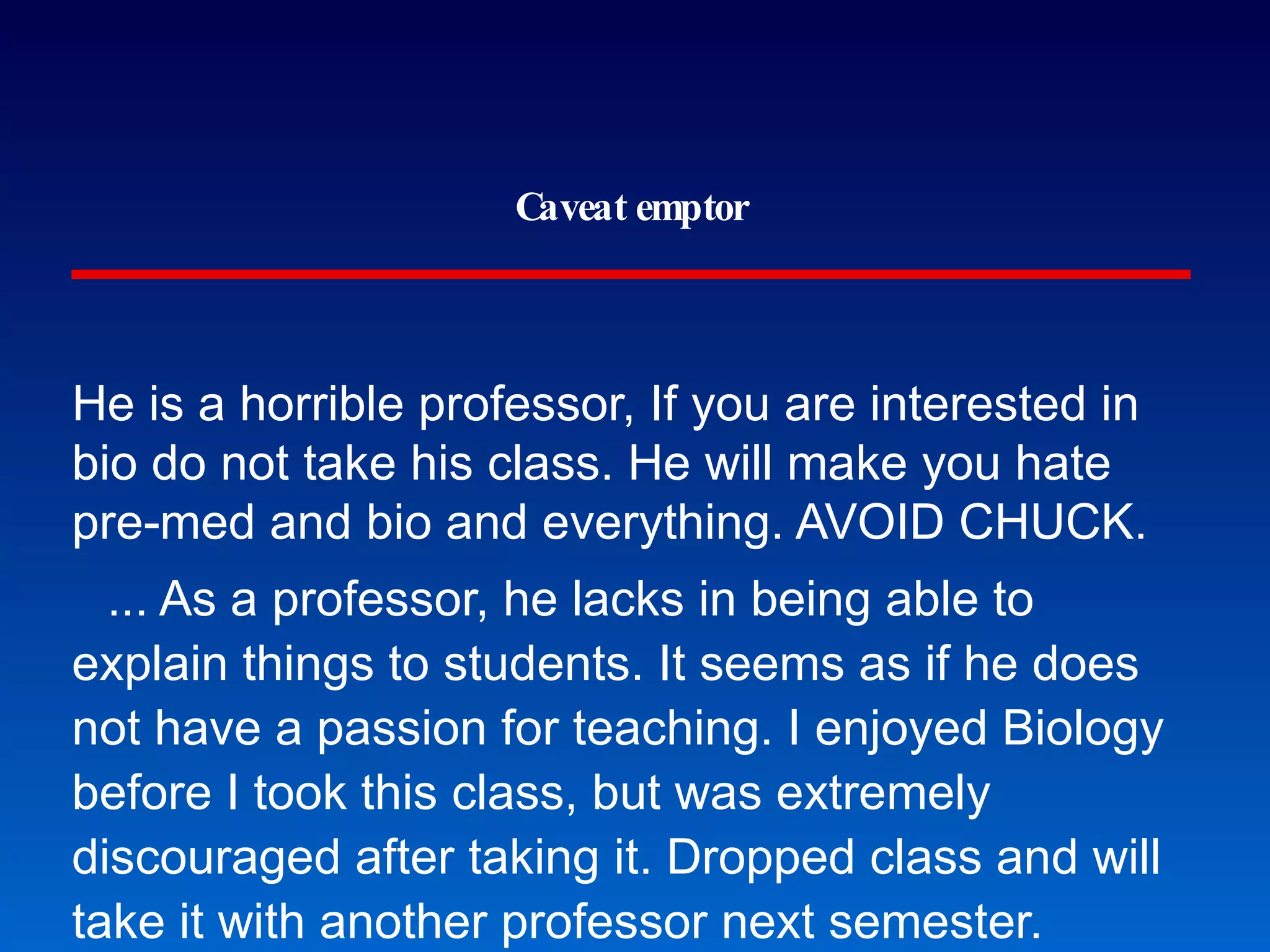
Caveat emptor He is a horrible professor, If you are interested in bio do not take his class. He will make you hate pre-med and bio and everything. AVOID CHUCK. ... As a professor, he lacks in being able to explain things to students. It seems as if he does not have a passion for teaching. I enjoyed Biology before I took this class, but was extremely discouraged after taking it. Dropped class and will take it with another professor next semester. He's one of those Professors who are extremely brilliant but cannot for the life of them teach a class. Unless you are brilliant as well or are only taking his class. I studied like crazy but his exams contain information that isn't even in the textbooks and when you ask for help, all he says is that you should get a study group. GMU students at www.ratemyprofessor.com
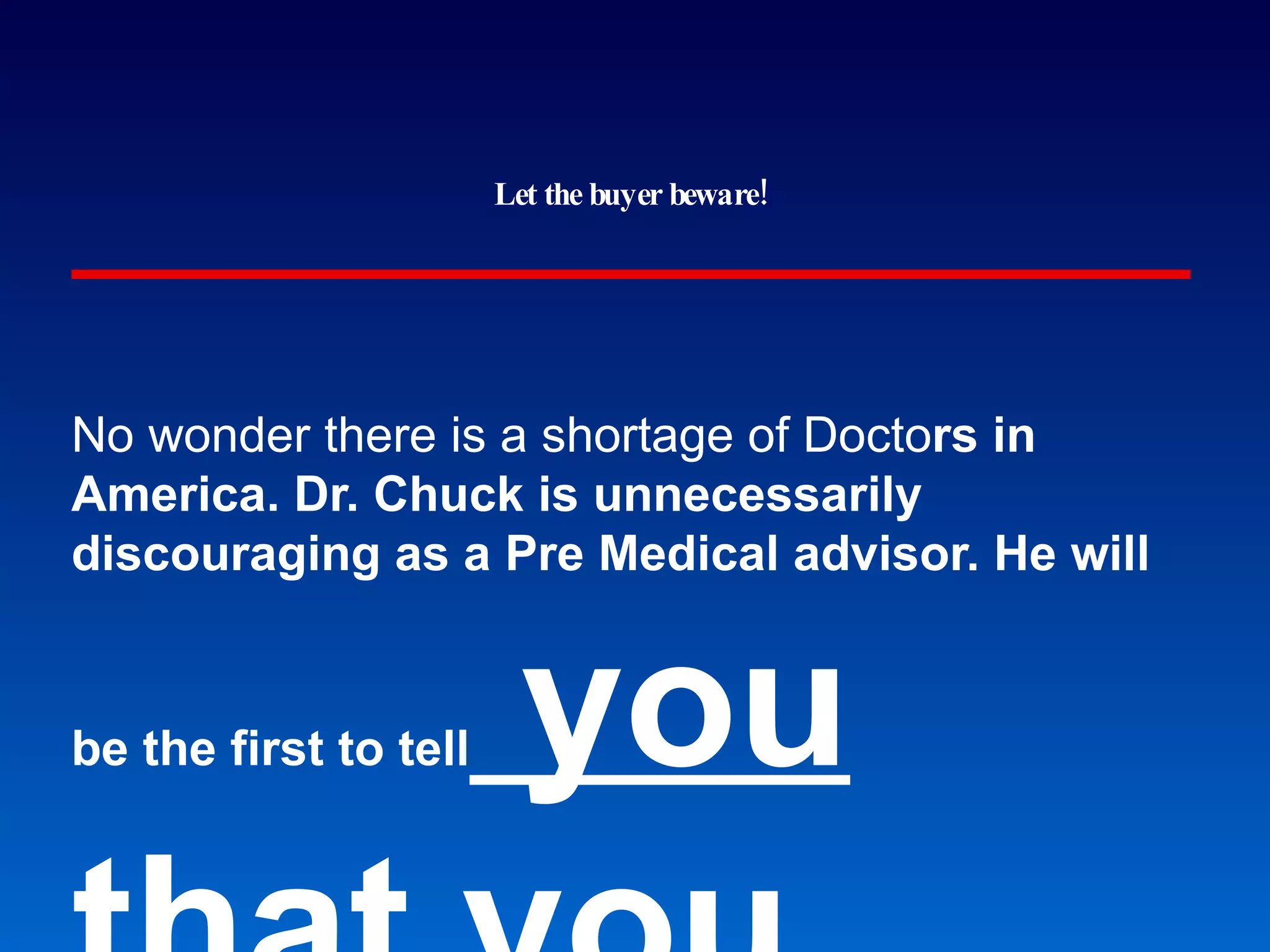
Let the buyer beware! No wonder there is a sh ortage of Docto rs in America. Dr. Chuck is unnecessarily discouraging as a Pre Medical advisor. He will be the first to tell  you that you should not even try even when he doesn't know you that well at all. He's the exact opposite of what he should be as an advisor. Just ignore his discouraging comments and press on! GMU students at www.ratemyprofessor.com
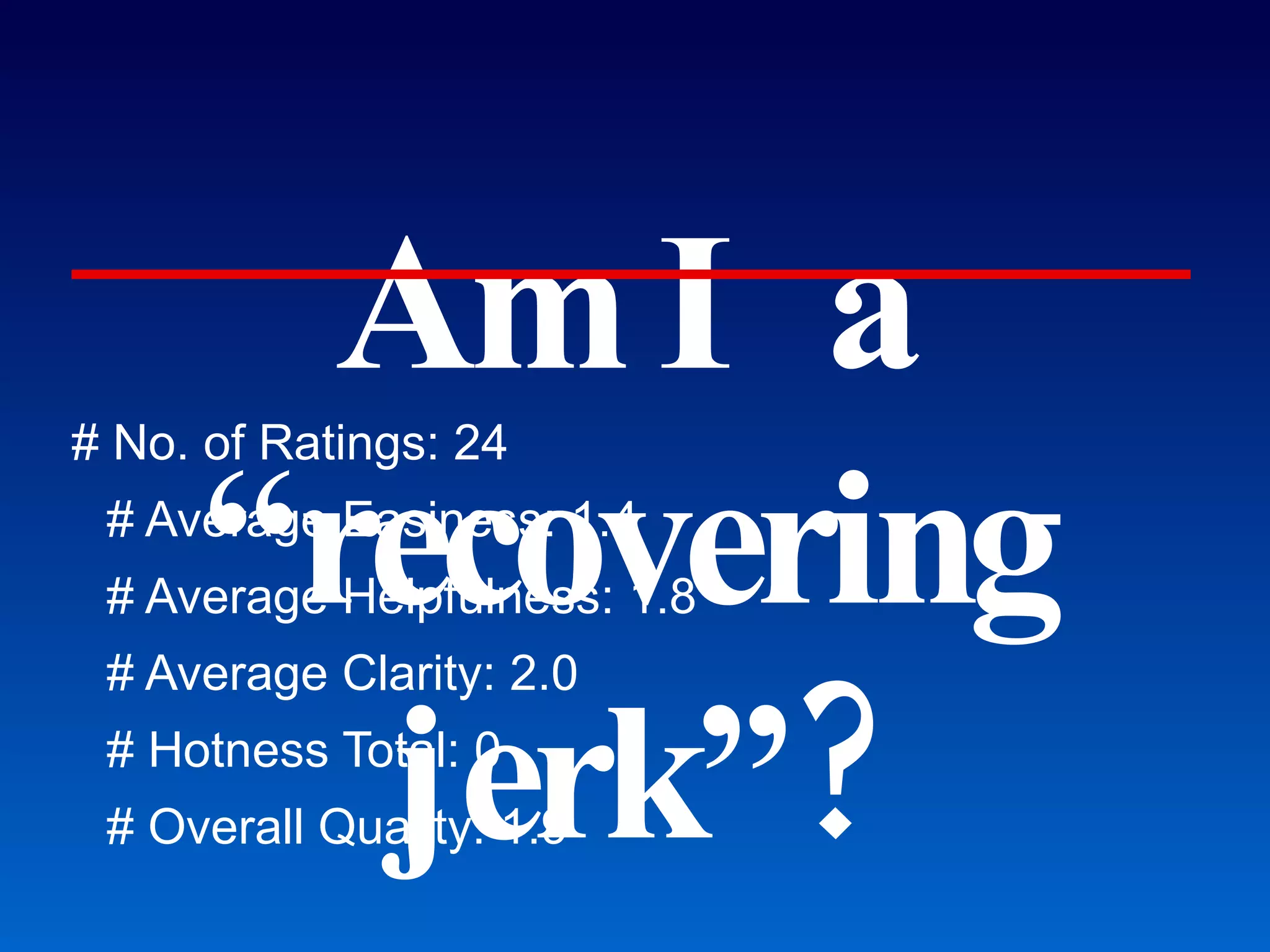
Am I a “recovering jerk”? # No. of Ratings: 24 # Average Easiness: 1.4 # Average Helpfulness: 1.8 # Average Clarity: 2.0 # Hotness Total: 0 # Overall Quality: 1.9 “ ... Higher education too often feels like it is all about customer service.”  GMU students at www.ratemyprofessor.com  Is this a “pragmatic, statistically valid  way” to evaluate my teaching or my advising?
The premed pipeline Welcome Week surveys (excluding  postbacs)
It is our job to be demanding. HHMI Bulletin www.hhmi.org American Scientist Sigma Xi, www.sigmaxi.org Science Nature Cell Students should be aware of cutting-edge discovery. “ A professor’s job is to teach students ho w to see their minds growing...”
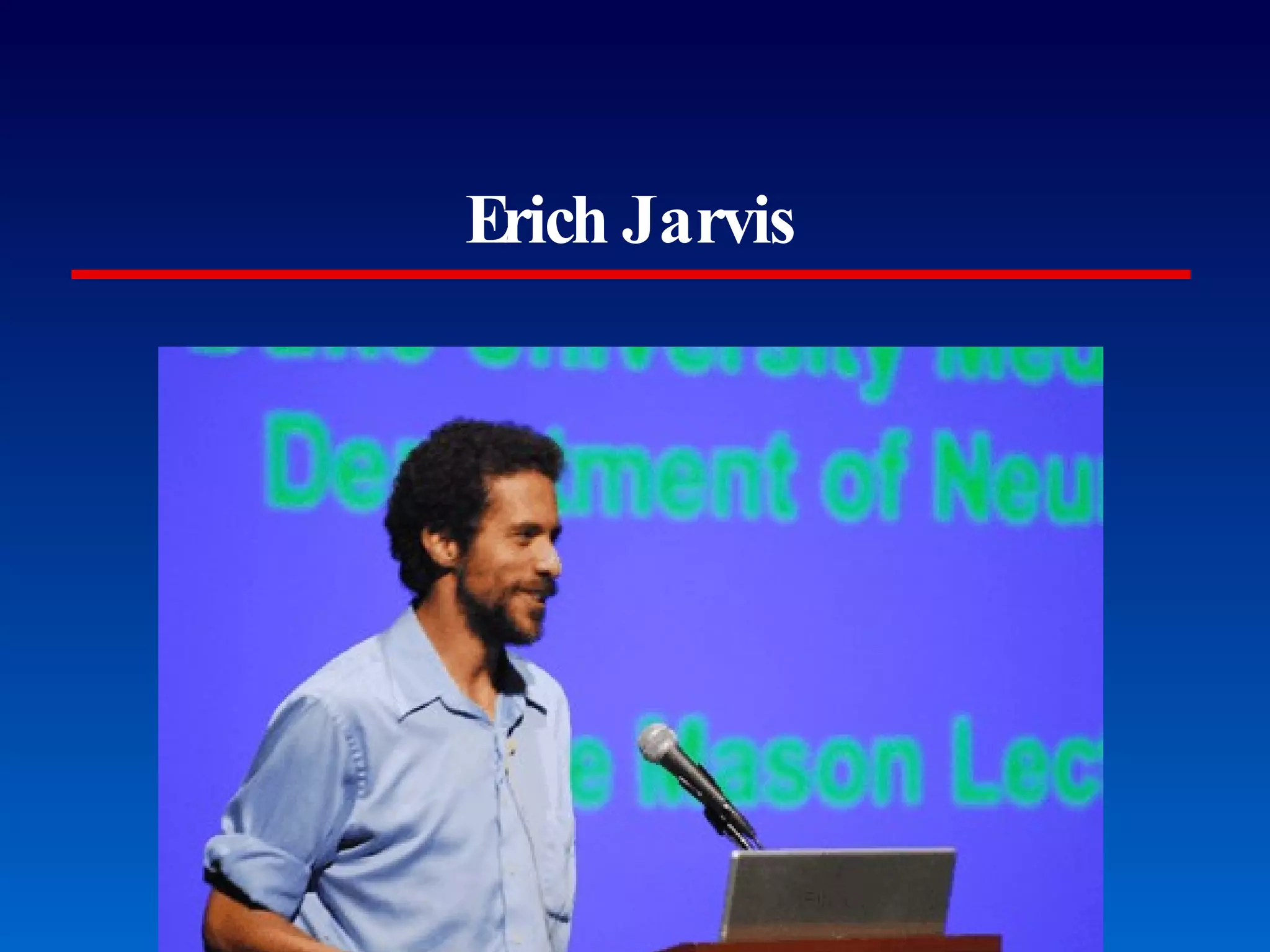
Erich Jarvis Neurobiology, Duke University Medical Center
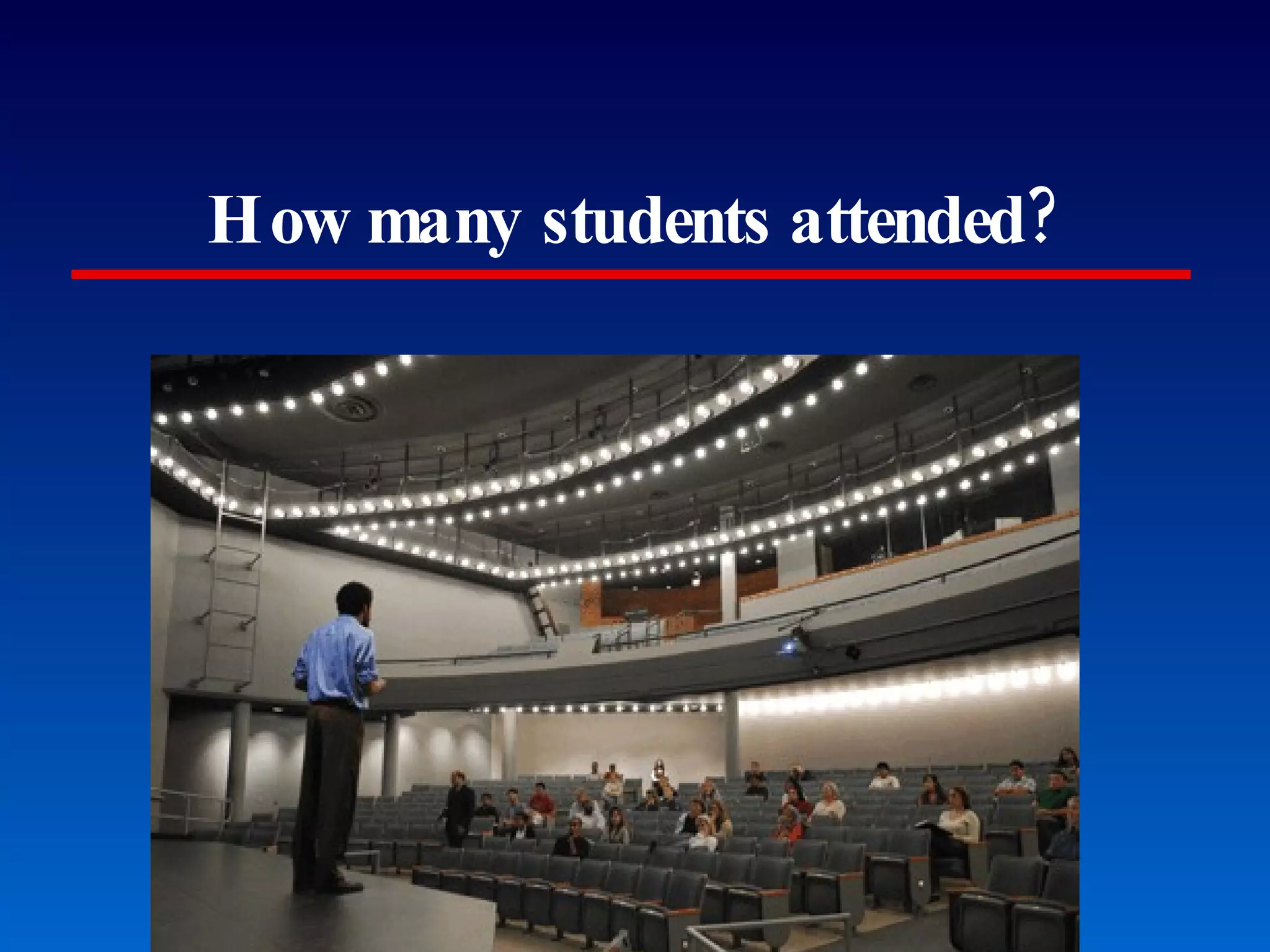
How many students attended? George Mason University lecture, September 19, 2007
The whiners build your walls. Test scores from GMU students. Number of graduates who get offers. Lack of interest in recruiting GMU students to graduate or professional programs. “You should take upper-level coursework at a DC institution with a George in the name but not Mason.” Brick walls built by GMU premed students.
I want climate change. Get involved... On-campus club activities, recruiting sessions, lectures. Off-campus lectures, conferences, programs Calendar on prehealth.gmu.edu website. Newsfeed announcements on website. Listserv announcements in email. Or else, surrender your dreams to the whiners.
Honor code Cheating lets the whiners win. Honest students see cheating students do better. Honest students see cheating students get minimal punishment. Some professors won’t write letters if you didn’t get an A. National test scores do not match expectations for the GPA’s. Test scores become more significant to evaluate Mason applicants. Course evaluations do not reward adherence to honor code. “The way you proctor the exams distracted me.” Little interest in filling vacancies on Honor Committee. Cheating hurts Mason prehealth applicants.
Learn to study smarter Studying more is not studying better. 30% of 236 intro cell biology students (e.g., BIOL 213) do not use efficient learning strategies Morse and Jutra CBE Life Sciences Education 2008; 7(2): 243. Roughly 30-40% of BIOL 213 students have to repeat the class. Becoming a “real man/woman of genius”
Study smarter not harder Non-strategic studying Read and reread Regular revision Do exercises Cram Memorize Morse and Jutra CBE Life Sciences Education (2008)
Study smarter not harder Strategic studying Make summaries Take notes in class Make schemas Listen attentively in class Morse and Jutra CBE Life Sciences Education (2008) Barbeau, Montini, Roy (1997).  Tracer les chemins de la connaissance – la motivation scolaire.  Association Quebecoise de pedagogie collegiale.
Why students fail Struggle with wording of written exams First exposure to test questions that address higher levels of thinking (application, analysis) instead of recall Underestimating the time commitment required to succeed in the course Students learn better if they are active, but most prefer being passive. Freeman et al., CBE Life Science Education (2007): UWash
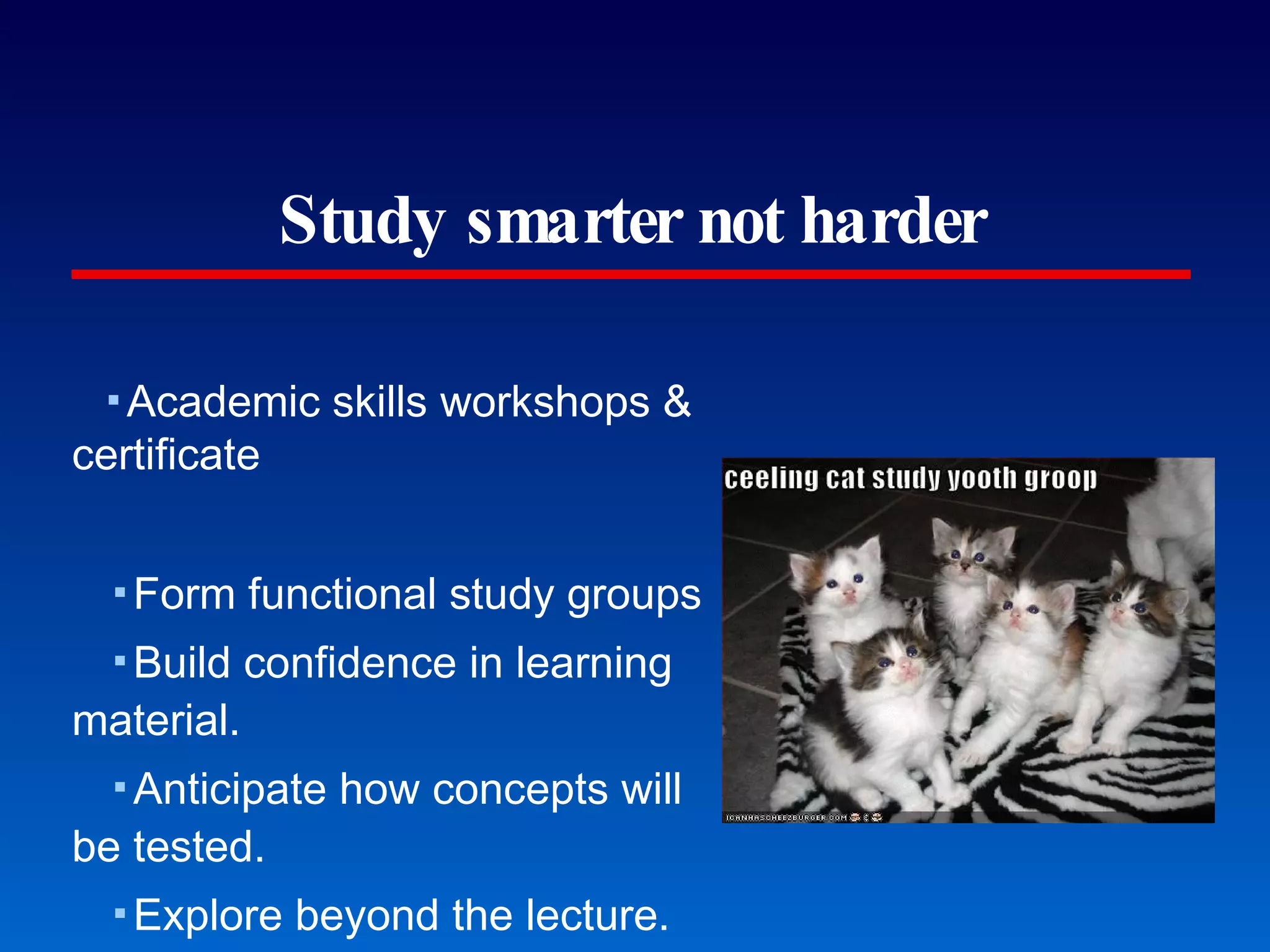
Study smarter not harder Academic skills workshops & certificate Form functional study groups Build confidence in learning material. Anticipate how concepts will be tested. Explore beyond the lecture. http://ccc.byu.edu//learning/groupstr.php Go online!  Second Life!!! Research for the answer! THEN ask a TA or a professor. Morse and Jutra CBE Life Sciences Education (2008)
How to ask for help GO: Office hours are for the “whiners.” Email first and arrange an appointment... Show up promptly if you can. Challenge: Define the problem. Approach: Describe your actions. Request: Make the ask (is there another approach). Think about the answer. Then thank: Give a sincere thank you. Making the best of mentors
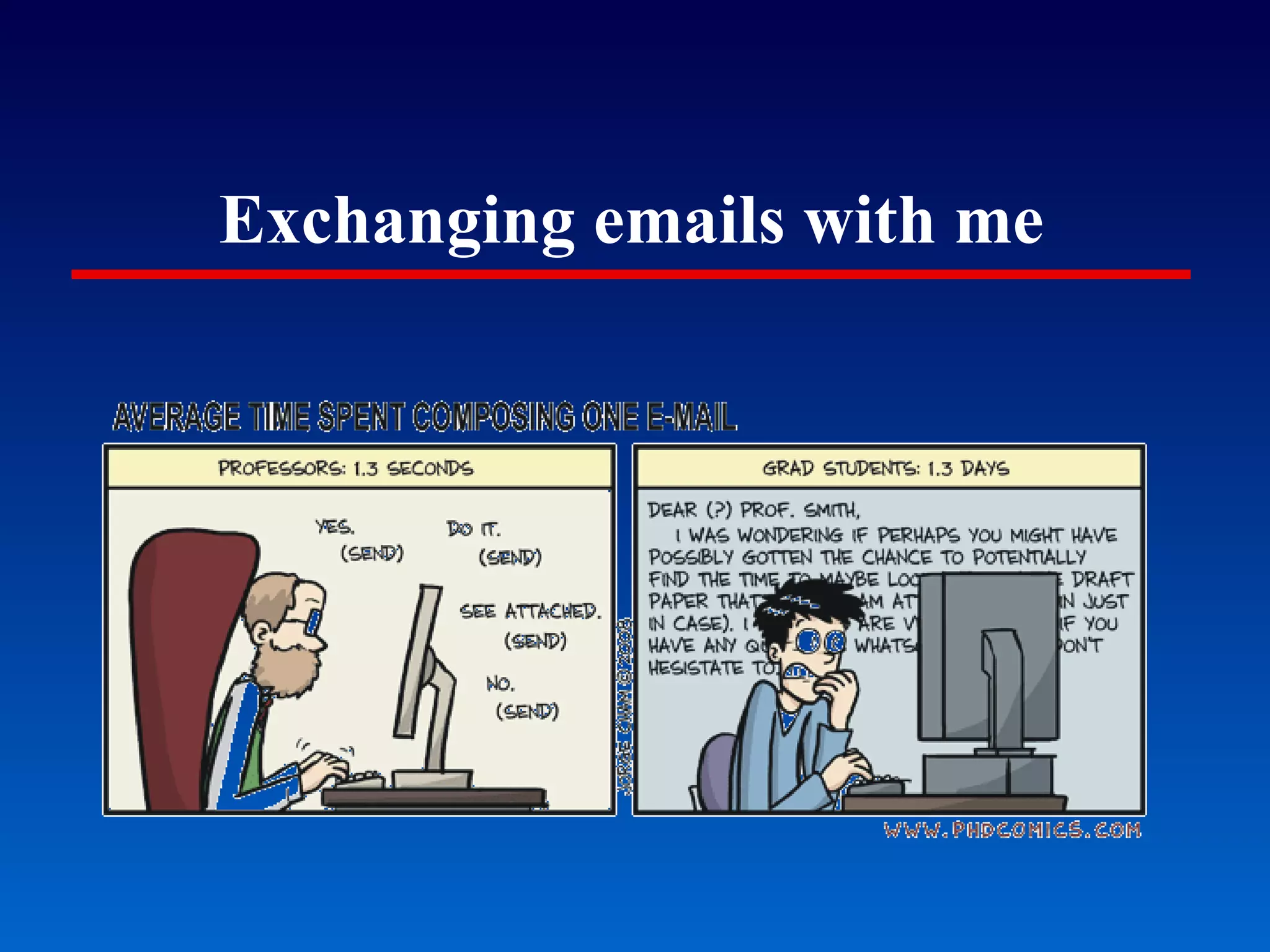
Exchanging emails with me PhDcomics.com
The number one goal of professors Questions Did they recognize true abilities? Did they have a sense of their own flaws? Were they realistic about how others viewed them? The only way any of us can improve is if we develop a real ability to assess ourselves. Help students judge themselves.
How to succeed A diverse academic and rigorous scientific foundation Enjoyment of lifelong learning Interpersonal and multicultural understanding Practical, time, and financial management Personal ethics and emotional stability Perception and observational skills Manual, tactile skills Written communications skills Oral communications skills Understanding of the profession and health care Core competencies for health professionals
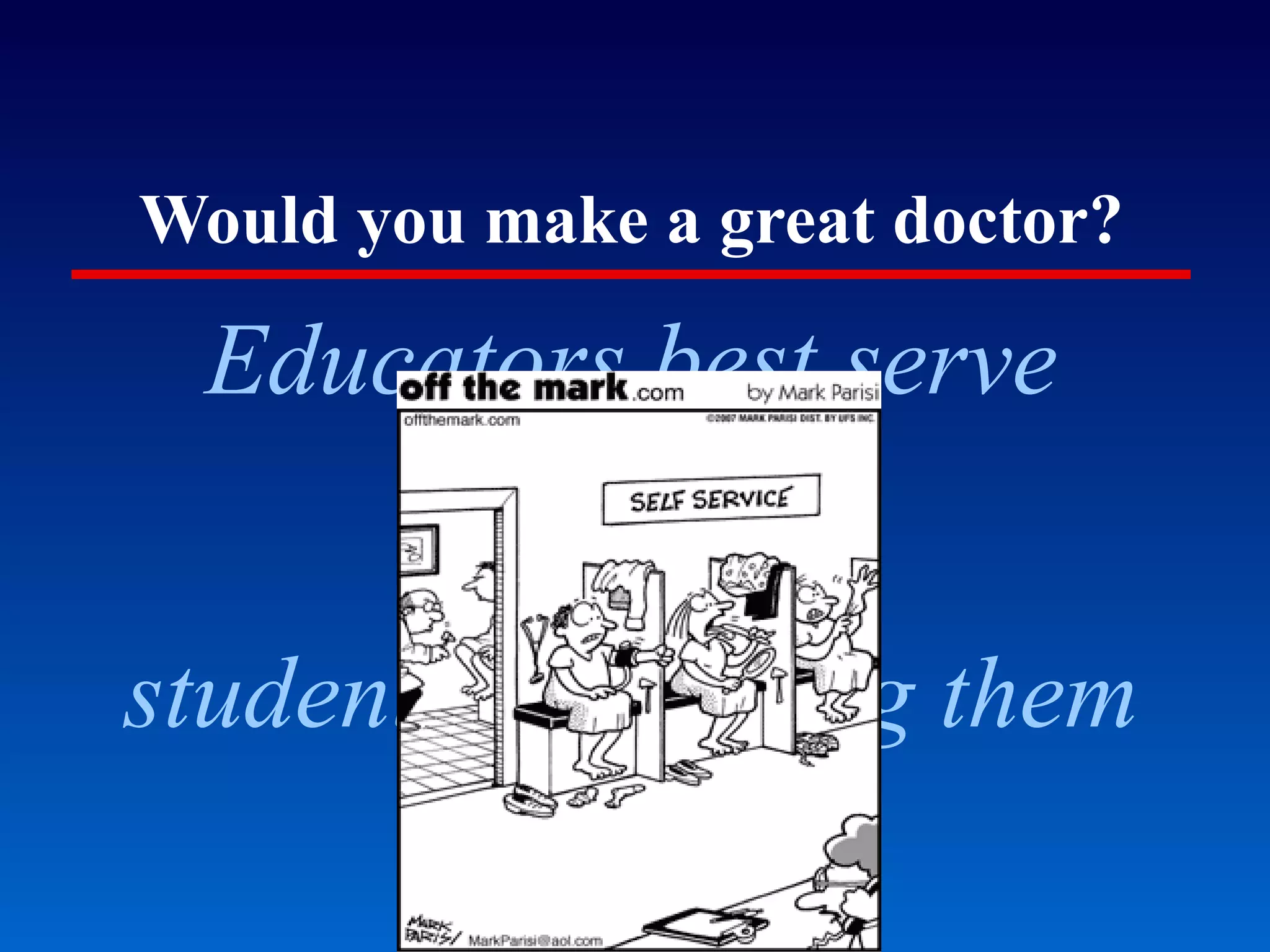
Would you make a great doctor? Educators best serve students by helping them be more self-reflective.
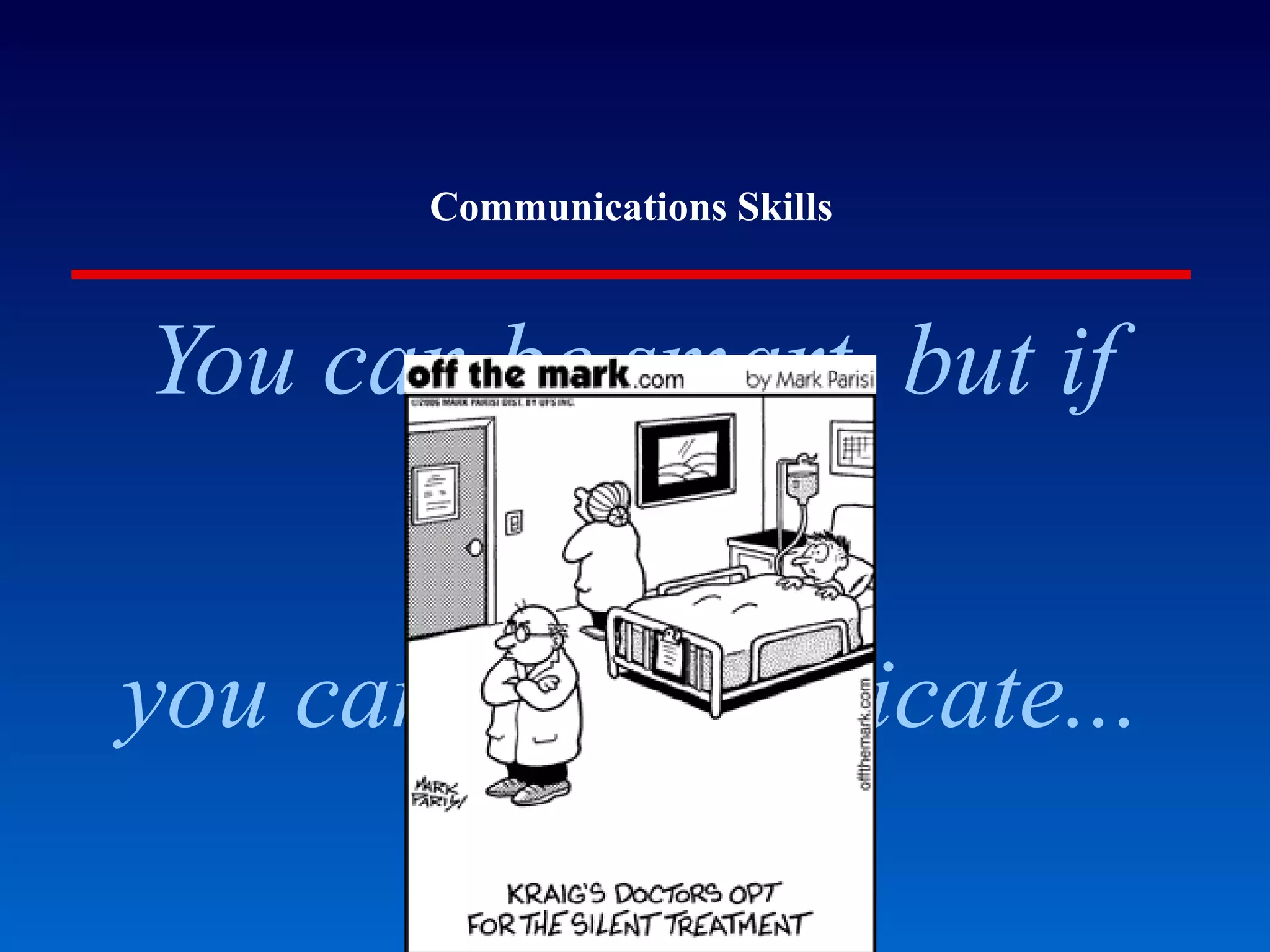
Communications Skills You can be smart, but if you can’t communicate...
Communications Skills Extracting most pertinent information in multi-message situations; Recognizing others' emotions/feelings; Inferring information that has not been directly expressed (i.e., drawing inferences based on unstated information); Interpreting non-verbal cues (i.e. those cues possible in an auditory setting including intonation, tone, volume, etc); Responding non-defensively to verbal attack; Modifying behavior according to evaluative feedback; and Clarifying unclear communication. The future of the MCAT... be afraid, be very afraid. The preliminary test material is centered on three broad objectives: extracting, processing, and responding to information. Some specific assessment objectives include: http://www.aamc.org/students/mcat/research /comskillfaq.htm
“ The Dreams Will Come to You” I would like to formally thank you for serving as my premedical advisor at George Mason University.  When I began my post-baccalaureate coursework at George Mason, I had many uncertainties about the application process for medical school.  Through meeting individually with you, attending many of your information sessions, and going through your pre-application process, I learned a great deal about my strengths and weaknesses as an applicant and developed a clear plan and timeline for applying to medical school. I have greatly appreciated your accessibility to your advisees, particularly your quick response time on email, open door policy, and presence at all of the information sessions.  You were always available to give me feedback at every step of the process.  From my initial meeting with you to mock interviewing before my first interview, you continually provided me with feedback that strengthened my application and demystified the process. Thank you again for everything that you have done for me and the George Mason community.  I feel so fortunate that I was able to receive premedical advising at George Mason and that I had the support of such a knowledgeable and dedicated advisor.  I attribute a large part of my successful admission to medical school to your guidance and insights over the past two years, and I can’t thank you enough. “ The Lost Art of Thank-You Notes”
“ The Dreams Will Come to You” Cornell/Travelers Summer Fellowship Ephrem Teklemariam AMGEN Scholars Program (UWashington) Erica Porter Undergraduate-Faculty Apprenticeship Pgm. For those with at least junior standing (60 ch). Enabling the dreams of others
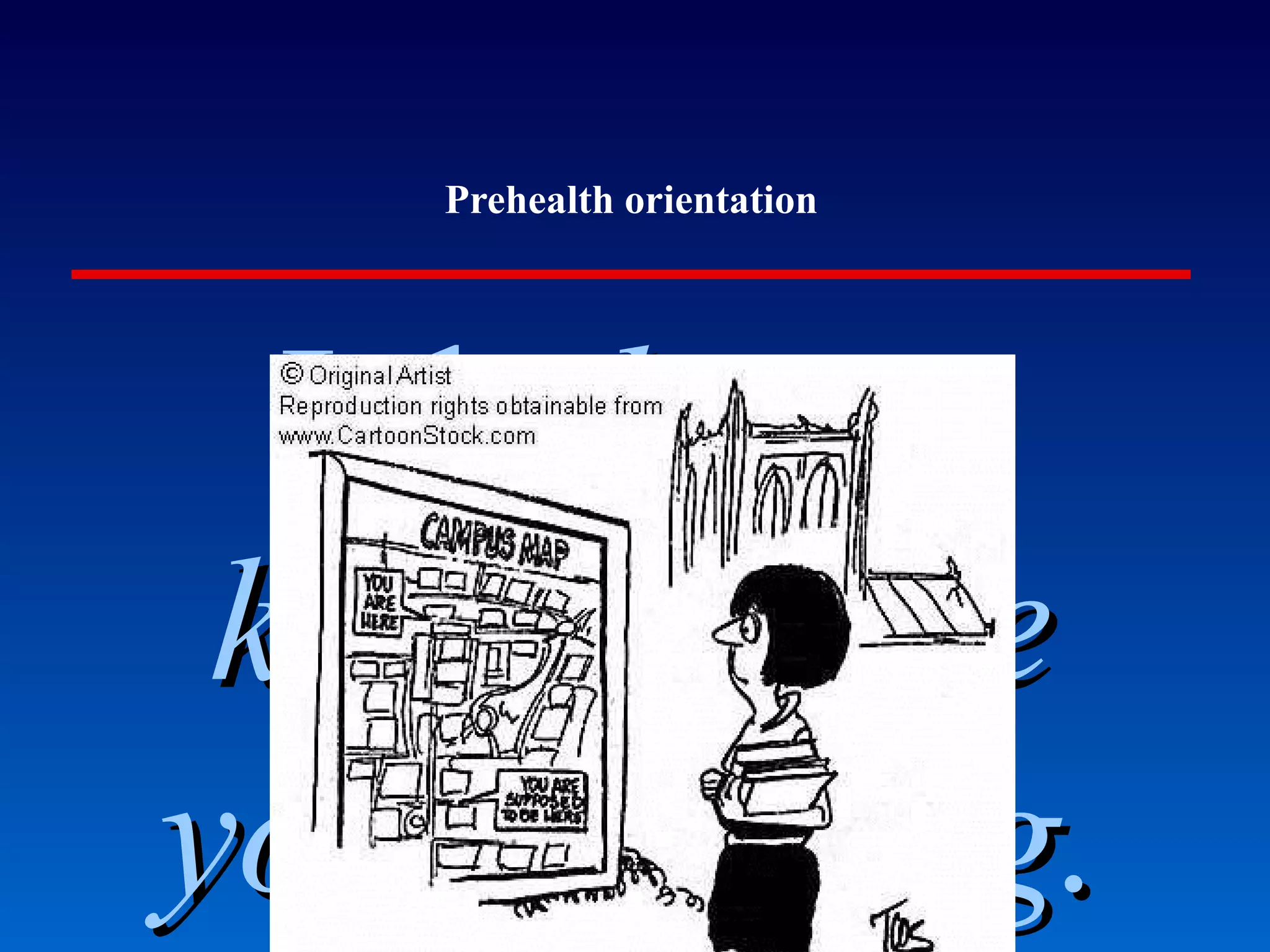
Prehealth orientation It h elps to know where you’re going.
Your roadmap and guide The Red Sheet Science-Minded Advice for the Undergraduate Health Professional (AWIS Fall 2008) The Green Sheet The 12 step program for fall semester The Blue Sheet Top 10 things that guarantee an acceptance; the competencies The Beige Sheet Data and more data The Orange and Gold Sheets GWU and VCU Early Admissions Information If you don’t have copies, we’re making more.
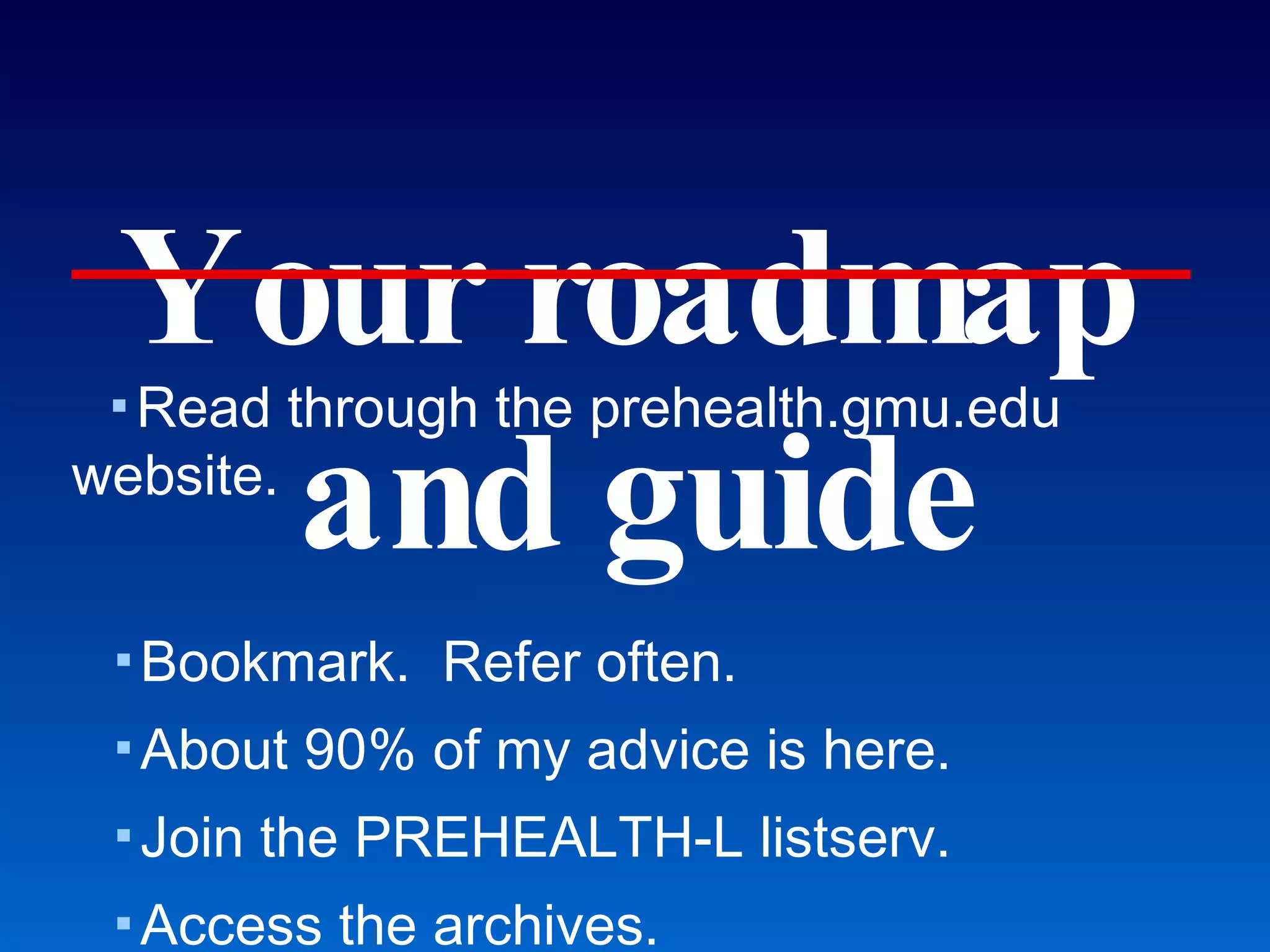
Your roadmap and guide Read through the prehealth.gmu.edu website. Bookmark.  Refer often. About 90% of my advice is here. Join the PREHEALTH-L listserv. Access the archives. Confirm that you are registered at... Until December: webct.gmu.edu Now: courses.gmu.edu These slides are posted at courses.gmu.edu! Health Professions Advising Office
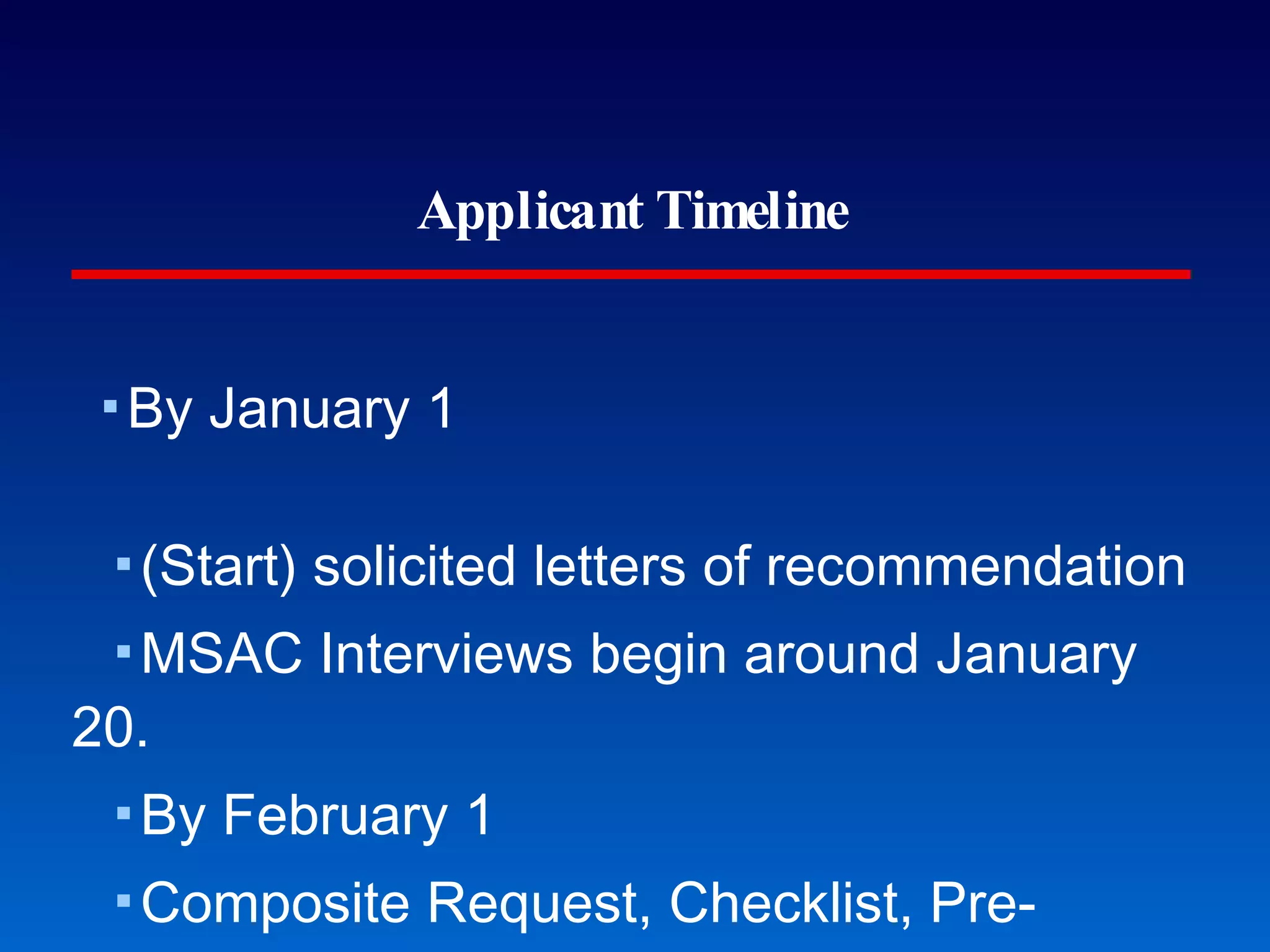
Applicant Timeline By January 1 (Start) solicited letters of recommendation MSAC Interviews begin around January 20. By February 1 Composite Request, Checklist, Pre-application due By April 1 MSAC Committee Interviews to be completed By May 1 Personal statement draft By June 1 Submit primary applications for MD, DO, DMD Take entrance exams (early) All letters are due except spring coursework professors (August 1). 24 months to go...
Get engaged to Mason! Foster student success. Live and act with integrity. Embrace our differences. Catch the Mason spirit. Show you care. Dream big. Celebrate achievements. Pursue lifelong learning. Lead by example. “ It’s how you live your [University] life.”
George Mason University Think Learn Succeed A Habit of Excellence
 
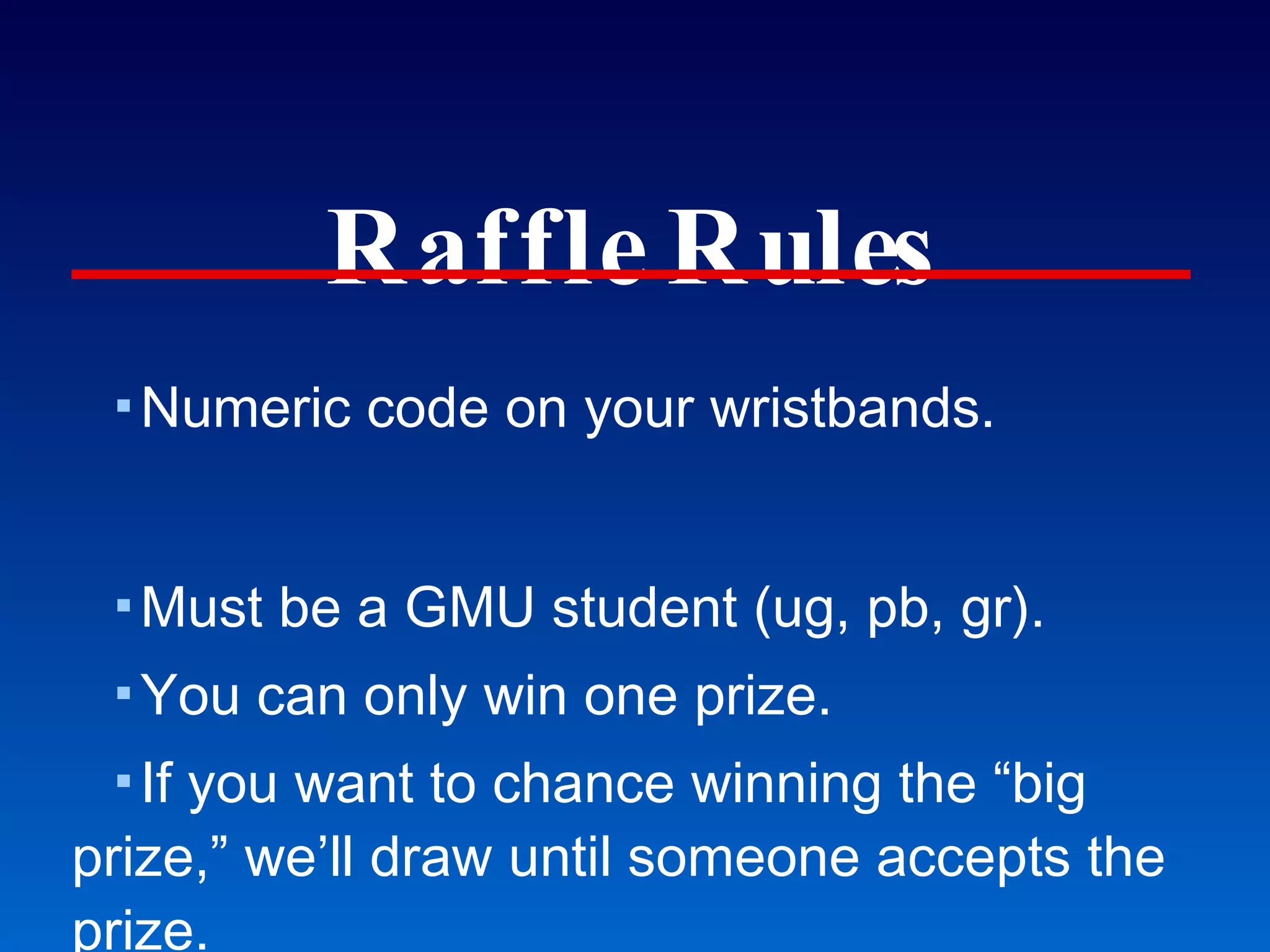
Raffle Rules Numeric code on your wristbands. Must be a GMU student (ug, pb, gr). You can only win one prize. If you want to chance winning the “big prize,” we’ll draw until someone accepts the prize. You must be here to win. Kaplan course MCAT, DAT, GRE, LSAT, OAT, PCAT, GMAT How this works, how you win...
Bio 2010 excerpts Extra text slides
National Academies Bio 2010 The ways in which students are taught and learn biology are as important as the content of the material covered. The large lecture courses that are still the usual format for lower-division science classes often fail to keep the attention of some students. Students come to the classroom with preconceptions about how the world works. If their initial understanding is not engaged, they may fail to grasp the new concepts and information that are taught, or they may learn them for the purposes of a test but revert to their preconceptions outside the classroom. Transforming Undergraduate Education for Future Biologists
Bio 2010 Life sciences majors must acquire a much stronger foundation in the physical sciences (chemistry and physics) and mathematics than they now get. Connections between biology and the other scientific disciplines need to be developed and reinforced so that interdisciplinary thinking and work become second nature. ... Equally important, teaching and learning must be made more active to engage undergraduates, fully prepare them for graduate study, and give them an enduring sense of the power and beauty of creative inquiry. The Future of Biology Requires Interdisciplinary Science
Bio 2010 Scientific discoveries and how they were made can be communicated in mutually reinforcing ways. ... Noteworthy current advances should be presented along with classic discoveries.  The covers of major journals often have striking images depicting important research findings.  They can be used as evocative starting points in lectures and group discussions to motivate as well as to inform students. ... Future research biologists should also be exposed to scientific controversies and their resolution. Students should be aware of cutting-edge discovery.
Functional study groups Did peers think he/she was working hard?  (Exactly how many hours did he/she devote?) How creative was his/her contribution? Was it easy or hard to work with him/her (team player)? Peer feedback (Pausch’s Building Virtual Worlds class)
Lifelong homework Find out who you are and what you excel at. Find out what you can do with the degree you will earn. Develop different ways to learn smarter. It’s okay to explore the world before becoming a physician. It’s okay to not become a physician. Become a self-assessment and self-management master. Visit an ER during the first weekend of class to see GMU students who cannot do this well. Choose friends and mentors wisely. If you’re screwing up and nobody says anything to you anymore, that means they gave up.  Get involved on campus to improve your chances. If you ask for extra tutoring sessions, show up.  Walk the walk. Honor Committee and Judicial Review Board vacancies... What I wished others would tell me (as a premed student).
Independent Study Take academically rigorous science and non-science classes. Integrate and apply science and non-science concepts to health problems. Network!  Find professors and professional mentors who will put their academic reputations on the line for you. Get involved in clinical settings as soon as you can. Meet admissions directors early and respectfully. Plan to do research as early as freshman summer.  (Plan today!) Stretch beyond your own comfort zones. SAFE Zone, NCBI coalition building training, Office of Disability Services Collaborate among disparate (cultural) groups.  (Entrepreneurs) Commit time for service to others. Teach for America, Peace Corps, Habitat for Humanity, etc. Free clinics, Walker-Whitman, La Clinica del Pueblo Don’t work full-time and take a ton of science classes. The First Lecture’s Last Slide

First Lecture 2008

  • 1.
    The First LectureReally Achieving Your Career Dreams Emil Chuck, Ph.D. Health Professions Advisor Term Assistant Professor of Biology
  • 2.
    All the thankyous University Life Sodexho catering College of Science Science Showcase (Hank, Dwayne, Scott) Student organizations Kaplan Test Prep & Admissions Student Academic Affairs & Advising Introducing and thanking those who helped
  • 3.
    With great homageand apology Randy Pausch (died July 25, 2008)
  • 4.
    George Mason UniversityThink Learn Succeed A Habit of Excellence
  • 5.
    What is apremed? “The term premed designates a provisional career aspiration far more often than it does a firm commitment.” – Austin (July 31, 2008) “Nationally only 1 student in 12 who enter undergraduate life as a premed will go to medical school.” – Blystone comment Austin (Inside Higher Education)
  • 6.
    Fear of failure“ The elephant in the room”
  • 7.
    Attaining the rightgoal Perfect is the enemy of good (but not better).
  • 8.
    Attaining the rightgoal Really Achieving Your Career Dreams
  • 9.
    Think beyond thewhite coat Really Achieving Your Career Dreams
  • 10.
    Think beyond thewhite coat Anesthesiologist Assistant Five Master’s programs in US (100 total students) Premed requirements + calculus + MCAT CWRU average MCAT 25, science GPA 3.4 The average starting salary for a newly graduated anesthesiologist assistant is approximately $115,000 for a 40-hour work week plus benefits and consideration of on-call activity. (CWRU) Did you know...?
  • 11.
    Think beyond thewhite coat We need lab scientists and engineers! Lab safety, librarians, technicians We need innovative scientific businesses! Technology transfer, pharma, biotech We need health communicators! We need politicians who are innovation- friendly and scientifically conscientious. We absolutely need math/science teachers! Really Achieving Your Career Dreams
  • 12.
    The brick wallsThe brick walls are not there to keep us out. The brick walls are there to give us a chance to show how badly we want something. The brick walls are there to stop the people who don’t want it badly enough. They’re there to stop other pe ople. ... Sometimes the brick walls are made of flesh. (Pausch)
  • 13.
    Think beyond thelecture “ Large lecture courses... often fail to keep the attention of so me students.”
  • 14.
    Caveat emptor Heis a horrible professor, If you are interested in bio do not take his class. He will make you hate pre-med and bio and everything. AVOID CHUCK. ... As a professor, he lacks in being able to explain things to students. It seems as if he does not have a passion for teaching. I enjoyed Biology before I took this class, but was extremely discouraged after taking it. Dropped class and will take it with another professor next semester. He's one of those Professors who are extremely brilliant but cannot for the life of them teach a class. Unless you are brilliant as well or are only taking his class. I studied like crazy but his exams contain information that isn't even in the textbooks and when you ask for help, all he says is that you should get a study group. GMU students at www.ratemyprofessor.com
  • 15.
    Let the buyerbeware! No wonder there is a sh ortage of Docto rs in America. Dr. Chuck is unnecessarily discouraging as a Pre Medical advisor. He will be the first to tell you that you should not even try even when he doesn't know you that well at all. He's the exact opposite of what he should be as an advisor. Just ignore his discouraging comments and press on! GMU students at www.ratemyprofessor.com
  • 16.
    Am I a“recovering jerk”? # No. of Ratings: 24 # Average Easiness: 1.4 # Average Helpfulness: 1.8 # Average Clarity: 2.0 # Hotness Total: 0 # Overall Quality: 1.9 “ ... Higher education too often feels like it is all about customer service.” GMU students at www.ratemyprofessor.com Is this a “pragmatic, statistically valid way” to evaluate my teaching or my advising?
  • 17.
    The premed pipelineWelcome Week surveys (excluding postbacs)
  • 18.
    It is ourjob to be demanding. HHMI Bulletin www.hhmi.org American Scientist Sigma Xi, www.sigmaxi.org Science Nature Cell Students should be aware of cutting-edge discovery. “ A professor’s job is to teach students ho w to see their minds growing...”
  • 19.
    Erich Jarvis Neurobiology,Duke University Medical Center
  • 20.
    How many studentsattended? George Mason University lecture, September 19, 2007
  • 21.
    The whiners buildyour walls. Test scores from GMU students. Number of graduates who get offers. Lack of interest in recruiting GMU students to graduate or professional programs. “You should take upper-level coursework at a DC institution with a George in the name but not Mason.” Brick walls built by GMU premed students.
  • 22.
    I want climatechange. Get involved... On-campus club activities, recruiting sessions, lectures. Off-campus lectures, conferences, programs Calendar on prehealth.gmu.edu website. Newsfeed announcements on website. Listserv announcements in email. Or else, surrender your dreams to the whiners.
  • 23.
    Honor code Cheatinglets the whiners win. Honest students see cheating students do better. Honest students see cheating students get minimal punishment. Some professors won’t write letters if you didn’t get an A. National test scores do not match expectations for the GPA’s. Test scores become more significant to evaluate Mason applicants. Course evaluations do not reward adherence to honor code. “The way you proctor the exams distracted me.” Little interest in filling vacancies on Honor Committee. Cheating hurts Mason prehealth applicants.
  • 24.
    Learn to studysmarter Studying more is not studying better. 30% of 236 intro cell biology students (e.g., BIOL 213) do not use efficient learning strategies Morse and Jutra CBE Life Sciences Education 2008; 7(2): 243. Roughly 30-40% of BIOL 213 students have to repeat the class. Becoming a “real man/woman of genius”
  • 25.
    Study smarter notharder Non-strategic studying Read and reread Regular revision Do exercises Cram Memorize Morse and Jutra CBE Life Sciences Education (2008)
  • 26.
    Study smarter notharder Strategic studying Make summaries Take notes in class Make schemas Listen attentively in class Morse and Jutra CBE Life Sciences Education (2008) Barbeau, Montini, Roy (1997). Tracer les chemins de la connaissance – la motivation scolaire. Association Quebecoise de pedagogie collegiale.
  • 27.
    Why students failStruggle with wording of written exams First exposure to test questions that address higher levels of thinking (application, analysis) instead of recall Underestimating the time commitment required to succeed in the course Students learn better if they are active, but most prefer being passive. Freeman et al., CBE Life Science Education (2007): UWash
  • 28.
    Study smarter notharder Academic skills workshops & certificate Form functional study groups Build confidence in learning material. Anticipate how concepts will be tested. Explore beyond the lecture. http://ccc.byu.edu//learning/groupstr.php Go online! Second Life!!! Research for the answer! THEN ask a TA or a professor. Morse and Jutra CBE Life Sciences Education (2008)
  • 29.
    How to askfor help GO: Office hours are for the “whiners.” Email first and arrange an appointment... Show up promptly if you can. Challenge: Define the problem. Approach: Describe your actions. Request: Make the ask (is there another approach). Think about the answer. Then thank: Give a sincere thank you. Making the best of mentors
  • 30.
    Exchanging emails withme PhDcomics.com
  • 31.
    The number onegoal of professors Questions Did they recognize true abilities? Did they have a sense of their own flaws? Were they realistic about how others viewed them? The only way any of us can improve is if we develop a real ability to assess ourselves. Help students judge themselves.
  • 32.
    How to succeedA diverse academic and rigorous scientific foundation Enjoyment of lifelong learning Interpersonal and multicultural understanding Practical, time, and financial management Personal ethics and emotional stability Perception and observational skills Manual, tactile skills Written communications skills Oral communications skills Understanding of the profession and health care Core competencies for health professionals
  • 33.
    Would you makea great doctor? Educators best serve students by helping them be more self-reflective.
  • 34.
    Communications Skills Youcan be smart, but if you can’t communicate...
  • 35.
    Communications Skills Extractingmost pertinent information in multi-message situations; Recognizing others' emotions/feelings; Inferring information that has not been directly expressed (i.e., drawing inferences based on unstated information); Interpreting non-verbal cues (i.e. those cues possible in an auditory setting including intonation, tone, volume, etc); Responding non-defensively to verbal attack; Modifying behavior according to evaluative feedback; and Clarifying unclear communication. The future of the MCAT... be afraid, be very afraid. The preliminary test material is centered on three broad objectives: extracting, processing, and responding to information. Some specific assessment objectives include: http://www.aamc.org/students/mcat/research /comskillfaq.htm
  • 36.
    “ The DreamsWill Come to You” I would like to formally thank you for serving as my premedical advisor at George Mason University. When I began my post-baccalaureate coursework at George Mason, I had many uncertainties about the application process for medical school. Through meeting individually with you, attending many of your information sessions, and going through your pre-application process, I learned a great deal about my strengths and weaknesses as an applicant and developed a clear plan and timeline for applying to medical school. I have greatly appreciated your accessibility to your advisees, particularly your quick response time on email, open door policy, and presence at all of the information sessions. You were always available to give me feedback at every step of the process. From my initial meeting with you to mock interviewing before my first interview, you continually provided me with feedback that strengthened my application and demystified the process. Thank you again for everything that you have done for me and the George Mason community. I feel so fortunate that I was able to receive premedical advising at George Mason and that I had the support of such a knowledgeable and dedicated advisor. I attribute a large part of my successful admission to medical school to your guidance and insights over the past two years, and I can’t thank you enough. “ The Lost Art of Thank-You Notes”
  • 37.
    “ The DreamsWill Come to You” Cornell/Travelers Summer Fellowship Ephrem Teklemariam AMGEN Scholars Program (UWashington) Erica Porter Undergraduate-Faculty Apprenticeship Pgm. For those with at least junior standing (60 ch). Enabling the dreams of others
  • 38.
    Prehealth orientation Ith elps to know where you’re going.
  • 39.
    Your roadmap andguide The Red Sheet Science-Minded Advice for the Undergraduate Health Professional (AWIS Fall 2008) The Green Sheet The 12 step program for fall semester The Blue Sheet Top 10 things that guarantee an acceptance; the competencies The Beige Sheet Data and more data The Orange and Gold Sheets GWU and VCU Early Admissions Information If you don’t have copies, we’re making more.
  • 40.
    Your roadmap andguide Read through the prehealth.gmu.edu website. Bookmark. Refer often. About 90% of my advice is here. Join the PREHEALTH-L listserv. Access the archives. Confirm that you are registered at... Until December: webct.gmu.edu Now: courses.gmu.edu These slides are posted at courses.gmu.edu! Health Professions Advising Office
  • 41.
    Applicant Timeline ByJanuary 1 (Start) solicited letters of recommendation MSAC Interviews begin around January 20. By February 1 Composite Request, Checklist, Pre-application due By April 1 MSAC Committee Interviews to be completed By May 1 Personal statement draft By June 1 Submit primary applications for MD, DO, DMD Take entrance exams (early) All letters are due except spring coursework professors (August 1). 24 months to go...
  • 42.
    Get engaged toMason! Foster student success. Live and act with integrity. Embrace our differences. Catch the Mason spirit. Show you care. Dream big. Celebrate achievements. Pursue lifelong learning. Lead by example. “ It’s how you live your [University] life.”
  • 43.
    George Mason UniversityThink Learn Succeed A Habit of Excellence
  • 44.
  • 45.
    Raffle Rules Numericcode on your wristbands. Must be a GMU student (ug, pb, gr). You can only win one prize. If you want to chance winning the “big prize,” we’ll draw until someone accepts the prize. You must be here to win. Kaplan course MCAT, DAT, GRE, LSAT, OAT, PCAT, GMAT How this works, how you win...
  • 46.
    Bio 2010 excerptsExtra text slides
  • 47.
    National Academies Bio2010 The ways in which students are taught and learn biology are as important as the content of the material covered. The large lecture courses that are still the usual format for lower-division science classes often fail to keep the attention of some students. Students come to the classroom with preconceptions about how the world works. If their initial understanding is not engaged, they may fail to grasp the new concepts and information that are taught, or they may learn them for the purposes of a test but revert to their preconceptions outside the classroom. Transforming Undergraduate Education for Future Biologists
  • 48.
    Bio 2010 Lifesciences majors must acquire a much stronger foundation in the physical sciences (chemistry and physics) and mathematics than they now get. Connections between biology and the other scientific disciplines need to be developed and reinforced so that interdisciplinary thinking and work become second nature. ... Equally important, teaching and learning must be made more active to engage undergraduates, fully prepare them for graduate study, and give them an enduring sense of the power and beauty of creative inquiry. The Future of Biology Requires Interdisciplinary Science
  • 49.
    Bio 2010 Scientificdiscoveries and how they were made can be communicated in mutually reinforcing ways. ... Noteworthy current advances should be presented along with classic discoveries. The covers of major journals often have striking images depicting important research findings. They can be used as evocative starting points in lectures and group discussions to motivate as well as to inform students. ... Future research biologists should also be exposed to scientific controversies and their resolution. Students should be aware of cutting-edge discovery.
  • 50.
    Functional study groupsDid peers think he/she was working hard? (Exactly how many hours did he/she devote?) How creative was his/her contribution? Was it easy or hard to work with him/her (team player)? Peer feedback (Pausch’s Building Virtual Worlds class)
  • 51.
    Lifelong homework Findout who you are and what you excel at. Find out what you can do with the degree you will earn. Develop different ways to learn smarter. It’s okay to explore the world before becoming a physician. It’s okay to not become a physician. Become a self-assessment and self-management master. Visit an ER during the first weekend of class to see GMU students who cannot do this well. Choose friends and mentors wisely. If you’re screwing up and nobody says anything to you anymore, that means they gave up. Get involved on campus to improve your chances. If you ask for extra tutoring sessions, show up. Walk the walk. Honor Committee and Judicial Review Board vacancies... What I wished others would tell me (as a premed student).
  • 52.
    Independent Study Takeacademically rigorous science and non-science classes. Integrate and apply science and non-science concepts to health problems. Network! Find professors and professional mentors who will put their academic reputations on the line for you. Get involved in clinical settings as soon as you can. Meet admissions directors early and respectfully. Plan to do research as early as freshman summer. (Plan today!) Stretch beyond your own comfort zones. SAFE Zone, NCBI coalition building training, Office of Disability Services Collaborate among disparate (cultural) groups. (Entrepreneurs) Commit time for service to others. Teach for America, Peace Corps, Habitat for Humanity, etc. Free clinics, Walker-Whitman, La Clinica del Pueblo Don’t work full-time and take a ton of science classes. The First Lecture’s Last Slide