 is a project modeling technique developed in
the late 1957 by Morgan R.Walker and James
E. Kelley, Jr.
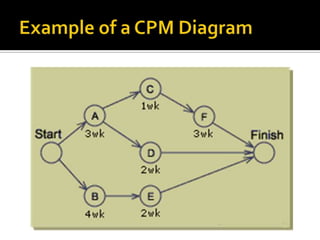
1. Provides a graphical view of the project
2. Predicts the time required to complete the
project
3. Shows which activities are critical to
maintaining the schedule and which are not
 The slack time of an activity is the time
between its earliest and latest start time
 Slack is the amount of time that an activity
can be delayed past its earliest start or
earliest finish without delaying the project
 The critical path is the path through the
project network in which none of the
activities have slack
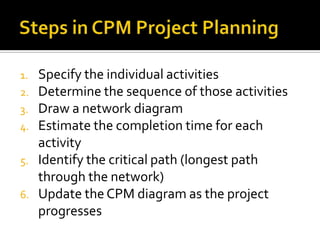
1. Specify the individual activities
2. Determine the sequence of those activities
3. Draw a network diagram
4. Estimate the completion time for each
activity
5. Identify the critical path (longest path
through the network)
6. Update the CPM diagram as the project
progresses

CS4 - CPM

  • 2.
     is aproject modeling technique developed in the late 1957 by Morgan R.Walker and James E. Kelley, Jr.
  • 4.
    1. Provides agraphical view of the project 2. Predicts the time required to complete the project 3. Shows which activities are critical to maintaining the schedule and which are not
  • 5.
     The slacktime of an activity is the time between its earliest and latest start time  Slack is the amount of time that an activity can be delayed past its earliest start or earliest finish without delaying the project  The critical path is the path through the project network in which none of the activities have slack
  • 6.
    1. Specify theindividual activities 2. Determine the sequence of those activities 3. Draw a network diagram 4. Estimate the completion time for each activity 5. Identify the critical path (longest path through the network) 6. Update the CPM diagram as the project progresses