CPM/ PERT
Critical Path Method/ Program
Evaluation and Review Technique
Operation Research II
Prepared By:
Jomari Gingo
BSIE 4-1
CPM/ PERT
• Network-based methods design to assist
planning, scheduling and control of time
consuming project.
• Provides analytic mean for scheduling the
activities.
• Use to know bottlenecks and critical activities
Phases for Project Planning with
CPM/PERT
Define
Project
Activities
Time
Scheduling
Network
Network
Calculation
Defining Project Activities
• CPM
– Assumes deterministic activity duration.
• PERT
– Assumes probabilistic duration. The time to
perform each activities appears uncertain and as
such thru time estimate is needed as (optimistic,
pessimistic and most likely) are used,
Defining Project Activities
• PERT
– Optimistic time- denoted as a, which occurs when
execution goes extremely well.
– Most Likely time- denoted as m, which occurs
when execution is done under normal condition.
– Pessimistic time- denoted as b, which occurs
when execution goes extremely poorly.
Defining Project Activities
• PERT
– Expected time
• “average” of the time (optimistic, pessimistic, and most
likely
Expected time=
(a+4m+b)/6
Defining Project Activities
Other Concept
1. Critical Path- consist of the sequence of those events and connected
activities that require maximum time in the completion of the project it
is that path that takes the longest time. It is critical because it control the
completion date of the project.
2. Bottleneck activities-any delay in the completion of one or more of these
activities will cause delay in the completion of the activity.
3. Earlier Start Time (ES)- Beginning of the activity.
4. Earlier Finish Time (EF)- Sum of the earliest start time and estimated
time to perform the concerned activity.
5. Latest Finish Time (LF)- an activity that can finish without delaying the
project beyond its deadline on the assumption that all subsequent
activities are performed as planned.
6. Latest Start Time (LS)- is the difference between the latest finished time
and the estimated time for the activity to be performed.
Network
Legend for making Network:
Event
ES and EF
LF and LS
Activity
Dummy
Network
Network Representation Rule:
Rule 1: Each activity is represented by one, and only one arc.
Rule 2: Each activity must be identified by two distinct end
nodes.
Rule 3: To maintain the correct precedence relationship, the
following questions must be answered as each activity is
added to network.
1. What activities must immediately precede the current
activity?
2. What activities must follow the current activity?
3. What activities must occur concurrently with the current
activity?
Network
Using Dummy:
1 2
1 3
2
1
1
2
A
B
A
B
C
A
B
C
E
A B
C E
D
Network
Important note: In case of multiple activity
In ES and EF
Choose the largest value
In LS and LF
Choose the smallest value
Example 1: Activity Project
Activity a b m (a+4m+b)/6
A 1 2 3 2
B 1 2 3 2
C 1 2 3 2
D 1 2 9 3
E 2 3 10 4
F DUMMY 0
G 3 6 15 7
H 2 5 14 6
I 1 4 7 4
J 4 9 20 10
K 1 2 9 3
L 4 4 4 4
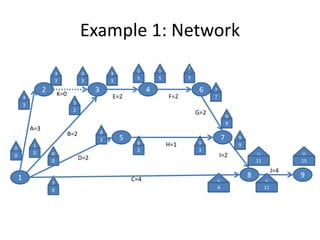
Example 1: Network
1
3
2
4
5
6
8
7
9
A=2
B=2
C=2
D=3
E=4 F=0
H=6
J=10
I=4
G=7
K=3
L=4
5
0
4
0
0
0
6
2
6
2
2
2
6
2
2
2
12
12
15
15
15
10
15
9
15
15
11
5
8
2
7
2
7
2 11
6
11
6
11
6
11
6
12
12
12
8
15
15
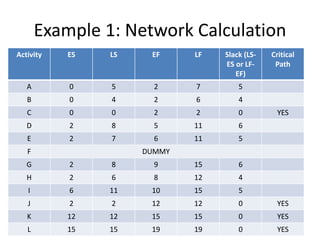
Example 1: Network Calculation
Activity ES LS EF LF Slack (LS-
ES or LF-
EF)
Critical
Path
A 0 5 2 7 5
B 0 4 2 6 4
C 0 0 2 2 0 YES
D 2 8 5 11 6
E 2 7 6 11 5
F DUMMY
G 2 8 9 15 6
H 2 6 8 12 4
I 6 11 10 15 5
J 2 2 12 12 0 YES
K 12 12 15 15 0 YES
L 15 15 19 19 0 YES
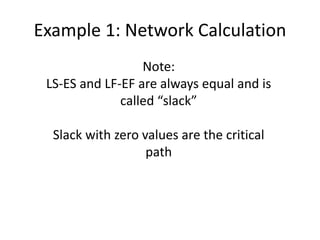
Example 1: Network Calculation
Note:
LS-ES and LF-EF are always equal and is
called “slack”
Slack with zero values are the critical
path
Example 2: Problem
A publisher has a contract with an author to
publish a textbook. The simplified activities
associated with the production of the text
book are given below. The author is required
to submit to the publisher a hard copy and a
computer file of the manuscript. Develop the
associated network for the project.
Example 2: Project Activities
Activity Predecessor(s) Duration (weeks)
A: Manuscript proofreading by editor None 3
B: Sample pages preparation None 2
C: Book cover design None 4
D: Artwork preparation None 3
E: Author’s approval of edited manuscript
and sample pages
A,B 2
F: Book formatting E 4
G: Author’s review of formatted pages F 2
H: Author’s review of artwork D 1
I: Production of printed plates G,H 2
J: Book production and binding C,I 4
Example 1: Network
1
I=2
7
0
2 3 4 6
5 7
8 9
A=3
0
0 6
0
1
0
11
4
11
11
15
15
3
3
3
3
3
2
8
2
3
3
3
3
5
5
5
5
7
7
7
7
7
9
9
8
2
9
3
9
9
B=2
K=0
D=2
C=4
E=2 F=2
H=1
G=2
J=4
11
11
Example 2: Network Calculation
Activity ES LS EF LF Slack (LS-
ES or LF-
EF)
Critical
Path
A 0 0 3 3 0 YES
B 0 1 2 3 1
C 0 7 4 11 7
D 0 7 2 8 6
E 3 3 5 5 0 YES
F 5 5 7 7 0 YES
G 7 7 9 9 0 YES
H 2 8 3 9 6
I 9 9 11 11 0 YES
J 11 11 15 15 0 YES
DUMMY K 0 0 0 0 0 YES
ADDITIONAL TOPIC:
BASIC TIME SCHEDULING
(CONSTRUCTING TIME SCHEDULE)
Time Scheduling
Constructing Time Schedule Table
1.The critical activities (shown by solid lines) must
be stacked one right after the another to ensure
that the project is completed within its maximum
duration. (In problem 2, its 15 days)
2. The non critical activities (shown by dashed lines)
have time spans that are larger than their
respective durations, thus allowing slack ( or
“leeway”) in scheduling them with in their
allotted time intervals.
Example 3: Network
Findings: The critical path is A, D and H. The maximum time is 25
Time Scheduling
Note: Consider time duration and activity predecessor(s).
THANK YOU!

Critical Path Method/ Program Evaluation and Review Technique

  • 1.
    CPM/ PERT Critical PathMethod/ Program Evaluation and Review Technique Operation Research II Prepared By: Jomari Gingo BSIE 4-1
  • 2.
    CPM/ PERT • Network-basedmethods design to assist planning, scheduling and control of time consuming project. • Provides analytic mean for scheduling the activities. • Use to know bottlenecks and critical activities
  • 3.
    Phases for ProjectPlanning with CPM/PERT Define Project Activities Time Scheduling Network Network Calculation
  • 4.
    Defining Project Activities •CPM – Assumes deterministic activity duration. • PERT – Assumes probabilistic duration. The time to perform each activities appears uncertain and as such thru time estimate is needed as (optimistic, pessimistic and most likely) are used,
  • 5.
    Defining Project Activities •PERT – Optimistic time- denoted as a, which occurs when execution goes extremely well. – Most Likely time- denoted as m, which occurs when execution is done under normal condition. – Pessimistic time- denoted as b, which occurs when execution goes extremely poorly.
  • 6.
    Defining Project Activities •PERT – Expected time • “average” of the time (optimistic, pessimistic, and most likely Expected time= (a+4m+b)/6
  • 7.
    Defining Project Activities OtherConcept 1. Critical Path- consist of the sequence of those events and connected activities that require maximum time in the completion of the project it is that path that takes the longest time. It is critical because it control the completion date of the project. 2. Bottleneck activities-any delay in the completion of one or more of these activities will cause delay in the completion of the activity. 3. Earlier Start Time (ES)- Beginning of the activity. 4. Earlier Finish Time (EF)- Sum of the earliest start time and estimated time to perform the concerned activity. 5. Latest Finish Time (LF)- an activity that can finish without delaying the project beyond its deadline on the assumption that all subsequent activities are performed as planned. 6. Latest Start Time (LS)- is the difference between the latest finished time and the estimated time for the activity to be performed.
  • 8.
    Network Legend for makingNetwork: Event ES and EF LF and LS Activity Dummy
  • 9.
    Network Network Representation Rule: Rule1: Each activity is represented by one, and only one arc. Rule 2: Each activity must be identified by two distinct end nodes. Rule 3: To maintain the correct precedence relationship, the following questions must be answered as each activity is added to network. 1. What activities must immediately precede the current activity? 2. What activities must follow the current activity? 3. What activities must occur concurrently with the current activity?
  • 10.
    Network Using Dummy: 1 2 13 2 1 1 2 A B A B C A B C E A B C E D
  • 11.
    Network Important note: Incase of multiple activity In ES and EF Choose the largest value In LS and LF Choose the smallest value
  • 12.
    Example 1: ActivityProject Activity a b m (a+4m+b)/6 A 1 2 3 2 B 1 2 3 2 C 1 2 3 2 D 1 2 9 3 E 2 3 10 4 F DUMMY 0 G 3 6 15 7 H 2 5 14 6 I 1 4 7 4 J 4 9 20 10 K 1 2 9 3 L 4 4 4 4
  • 13.
    Example 1: Network 1 3 2 4 5 6 8 7 9 A=2 B=2 C=2 D=3 E=4F=0 H=6 J=10 I=4 G=7 K=3 L=4 5 0 4 0 0 0 6 2 6 2 2 2 6 2 2 2 12 12 15 15 15 10 15 9 15 15 11 5 8 2 7 2 7 2 11 6 11 6 11 6 11 6 12 12 12 8 15 15
  • 14.
    Example 1: NetworkCalculation Activity ES LS EF LF Slack (LS- ES or LF- EF) Critical Path A 0 5 2 7 5 B 0 4 2 6 4 C 0 0 2 2 0 YES D 2 8 5 11 6 E 2 7 6 11 5 F DUMMY G 2 8 9 15 6 H 2 6 8 12 4 I 6 11 10 15 5 J 2 2 12 12 0 YES K 12 12 15 15 0 YES L 15 15 19 19 0 YES
  • 15.
    Example 1: NetworkCalculation Note: LS-ES and LF-EF are always equal and is called “slack” Slack with zero values are the critical path
  • 16.
    Example 2: Problem Apublisher has a contract with an author to publish a textbook. The simplified activities associated with the production of the text book are given below. The author is required to submit to the publisher a hard copy and a computer file of the manuscript. Develop the associated network for the project.
  • 17.
    Example 2: ProjectActivities Activity Predecessor(s) Duration (weeks) A: Manuscript proofreading by editor None 3 B: Sample pages preparation None 2 C: Book cover design None 4 D: Artwork preparation None 3 E: Author’s approval of edited manuscript and sample pages A,B 2 F: Book formatting E 4 G: Author’s review of formatted pages F 2 H: Author’s review of artwork D 1 I: Production of printed plates G,H 2 J: Book production and binding C,I 4
  • 18.
    Example 1: Network 1 I=2 7 0 23 4 6 5 7 8 9 A=3 0 0 6 0 1 0 11 4 11 11 15 15 3 3 3 3 3 2 8 2 3 3 3 3 5 5 5 5 7 7 7 7 7 9 9 8 2 9 3 9 9 B=2 K=0 D=2 C=4 E=2 F=2 H=1 G=2 J=4 11 11
  • 19.
    Example 2: NetworkCalculation Activity ES LS EF LF Slack (LS- ES or LF- EF) Critical Path A 0 0 3 3 0 YES B 0 1 2 3 1 C 0 7 4 11 7 D 0 7 2 8 6 E 3 3 5 5 0 YES F 5 5 7 7 0 YES G 7 7 9 9 0 YES H 2 8 3 9 6 I 9 9 11 11 0 YES J 11 11 15 15 0 YES DUMMY K 0 0 0 0 0 YES
  • 20.
    ADDITIONAL TOPIC: BASIC TIMESCHEDULING (CONSTRUCTING TIME SCHEDULE)
  • 21.
    Time Scheduling Constructing TimeSchedule Table 1.The critical activities (shown by solid lines) must be stacked one right after the another to ensure that the project is completed within its maximum duration. (In problem 2, its 15 days) 2. The non critical activities (shown by dashed lines) have time spans that are larger than their respective durations, thus allowing slack ( or “leeway”) in scheduling them with in their allotted time intervals.
  • 22.
    Example 3: Network Findings:The critical path is A, D and H. The maximum time is 25
  • 23.
    Time Scheduling Note: Considertime duration and activity predecessor(s).
  • 24.