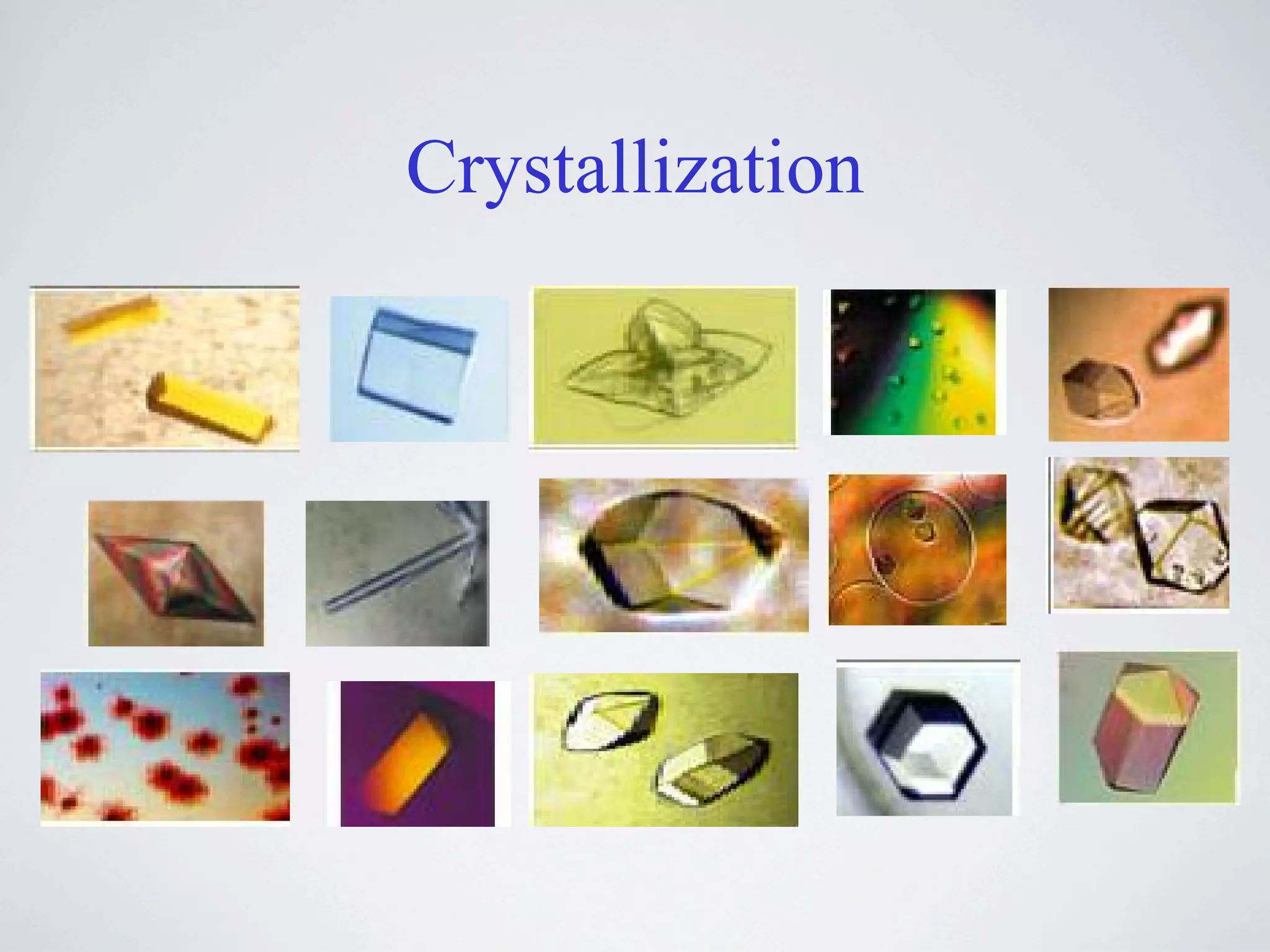
Crystallization
What you need
• Pure Protein
   – Native PAGE                     - IEF
   – SDS PAGE                        - Mass Spec
   – N-terminal sequencing
• Single aggregation state
   – Monomeric, dimeric, heteromeric
   – Dynamic Light Scattering (DLS)
• Stable for a reasonable period of time
   – Dependent on stabilization buffer, 4°C vs Room
     temperture
• Concentrated
   – Need a concentration that will precipitate in screens
     about 30-40% of the time.
What you can do to improve your
   chances of crystallization
• Make a bunch of protein (2-50mg/L is nice)
• Evaluate your construct prior to starting,
  Avoid:
  – Floppy ends
  – Long tags
Effect of protein concentration
• The more concentrated the protein the more it
  interacts with itself in the crystallization solution
  and can form crystals.
• If it’s too concentrated it can aggregate and
  precipitates too readily in the crystallization
  conditions.
• A protein should precipitate about 30-40% of the
  time in a screen.
• Rule of thumb is that the protein should be
  concentrated enough to precipitate in condition #4
  and #6 of the Hampton Screen #1.
Reality of Protein Concentration
• People have been able to crystallize proteins
  at concentrations from 0.5 – 50 mg/ml.
• Larger proteins require less concentrated
  solutions.
• Small highly soluble proteins require more
  concentrated solution.
Theory of Crystallization
• The protein is mixed with a crystallization
  solution containing various precipitants. (usually
  2!l and 2!l) (called the drop)
• The diluted protein and crystallization mixture is
  incubated “over” the concentrated crystallization
  solution (called the well).
• Over time, the drop will equilibrate with the well
  concentrating both the protein and the precipitants.
• As the protein concentrates it can come out of
  solution as either a precipitate, a phase transition
  (oil), or as a crystal.
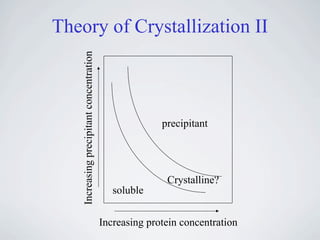
Theory of Crystallization II


   Increasing precipitant concentration


                                                        precipitant


                                                         Crystalline?
                                             soluble

                                          Increasing protein concentration
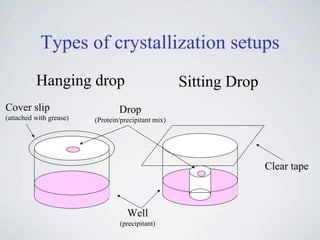
Types of crystallization setups
          Hanging drop                               Sitting Drop
Cover slip                       Drop
(attached with grease)   (Protein/precipitant mix)


                                                                    Clear tape


                                    Well
                                 (precipitant)
What’s in the “well.”
• “Precipitant”
  – Buffers
     • Screens usually contain 100 mM Buffer pH 4.5-9
  – Salts
     • Huge variety here, usually at 200 mM in screens
  – Precipitants
     • Poly Ethylene Glycols (PEGS)
        – 10-30%
        – MW 400 to 10,000 with very different results
     • Salts (AmSO4, LiCl, NaFormate, NaCitrate @ 1-3M)
     • Ethanol, MPD, iso-propanol
Types of screens
•   Hampton Research®: Crystal Screen I and II
•   Emerald Biosystems®: Wizard Screen I and II
•   Usually 24-50 solutions
•   Both Companies go on to produce a variety of
    specialty screens
    –   PEG/ION
    –   CRYO (conditions ready for freezing)
    –   AmSO4
    –   MPD
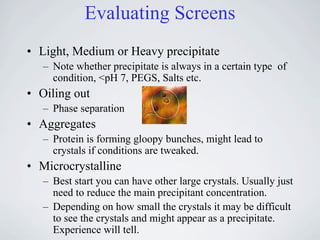
Evaluating Screens
• Light, Medium or Heavy precipitate
   – Note whether precipitate is always in a certain type of
     condition, <pH 7, PEGS, Salts etc.
• Oiling out
   – Phase separation
• Aggregates
   – Protein is forming gloopy bunches, might lead to
     crystals if conditions are tweaked.
• Microcrystalline
   – Best start you can have other large crystals. Usually just
     need to reduce the main precipitant concentration.
   – Depending on how small the crystals it may be difficult
     to see the crystals and might appear as a precipitate.
     Experience will tell.
What to do if you have a hit!
• Usually the screens have too much precipitate
   – Example: Screen may contain 30% PEG 4K but
     crystals optimum is 10-15%
   – Less precipitate usually means larger crystals from
     fewer nucleations.
• Check other salts, buffers and precipitants near to
  the current condition.
   – Check everything you can think of. Do not rely on the
     variety in the screens and assume that all the other
     conditions have been checked.
   – Change pH over range !0.2.
   – Check concentration of best salt (~50-300mM)
• Once stable conditions have been found/repeated,
  then try small amounts of “addatives.”
Additives
• I usually use this term to mean an additional
  chemical added in small amounts to alter the
  crystallization condition.

• 20-100!l of any of the following is a a good start.
  (There are also purchased screens)
   – MPD, Ethanol, iso-propanol, PEG 400, DTT/"ME, 1,4-
     Dioxane, Ethylene Glycol, Glycerol, NaCl, SB-12
What to do if you don’t
• Evaluate the Screen carefully.
   – What pH’s are soluble, what salts
   – Does your protein need more salt/glycerol to remain
     stable?
• Crystallize in the presence of ligand.
• Change the stabilization buffer or protein
  concentration.
• Did you really check the purity thoroughly before?
• Try chemical modification of your protein.
   – Iodoacetate, Iodoamide
• Try and different constructs
   – +/- tags
Value of ligands, substrates or
             inhibitors
• Very important to try to crystallize in the presence
  and absence of ligands.
• Ligands can bind to protein and cause
  conformational changes.
• Might try different ratios of ligand to protein.
• Add multiple substrates at a time.
• Try an inactive protein with substrate rather than
  an inhibitor with the wild-type protein.
Types of protein modifications
• Huge variety I won’t cover here.
• If your protein is too soluble you can modify with
  iodoacetimide.
• If you protein isn’t soluble enough, you can try to
  modify with iodoacetate.
• 5-10mM overnight at room temp. No reductants.
  Then wash out chemical. Modification is hard to
  evaluate, may not be uniform across protein
  population.
Qualities of a Good Crystal
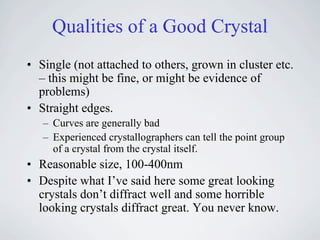
• Single (not attached to others, grown in cluster etc.
  – this might be fine, or might be evidence of
  problems)
• Straight edges.
   – Curves are generally bad
   – Experienced crystallographers can tell the point group
     of a crystal from the crystal itself.
• Reasonable size, 100-400nm
• Despite what I’ve said here some great looking
  crystals don’t diffract well and some horrible
  looking crystals diffract great. You never know.
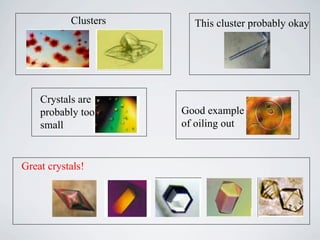
Clusters     This cluster probably okay


    Crystals are
    probably too      Good example
    small             of oiling out


Great crystals!

Crystallization Lab Lecture

  • 1.
  • 2.
    What you need •Pure Protein – Native PAGE - IEF – SDS PAGE - Mass Spec – N-terminal sequencing • Single aggregation state – Monomeric, dimeric, heteromeric – Dynamic Light Scattering (DLS) • Stable for a reasonable period of time – Dependent on stabilization buffer, 4°C vs Room temperture • Concentrated – Need a concentration that will precipitate in screens about 30-40% of the time.
  • 3.
    What you cando to improve your chances of crystallization • Make a bunch of protein (2-50mg/L is nice) • Evaluate your construct prior to starting, Avoid: – Floppy ends – Long tags
  • 4.
    Effect of proteinconcentration • The more concentrated the protein the more it interacts with itself in the crystallization solution and can form crystals. • If it’s too concentrated it can aggregate and precipitates too readily in the crystallization conditions. • A protein should precipitate about 30-40% of the time in a screen. • Rule of thumb is that the protein should be concentrated enough to precipitate in condition #4 and #6 of the Hampton Screen #1.
  • 5.
    Reality of ProteinConcentration • People have been able to crystallize proteins at concentrations from 0.5 – 50 mg/ml. • Larger proteins require less concentrated solutions. • Small highly soluble proteins require more concentrated solution.
  • 6.
    Theory of Crystallization •The protein is mixed with a crystallization solution containing various precipitants. (usually 2!l and 2!l) (called the drop) • The diluted protein and crystallization mixture is incubated “over” the concentrated crystallization solution (called the well). • Over time, the drop will equilibrate with the well concentrating both the protein and the precipitants. • As the protein concentrates it can come out of solution as either a precipitate, a phase transition (oil), or as a crystal.
  • 7.
    Theory of CrystallizationII Increasing precipitant concentration precipitant Crystalline? soluble Increasing protein concentration
  • 8.
    Types of crystallizationsetups Hanging drop Sitting Drop Cover slip Drop (attached with grease) (Protein/precipitant mix) Clear tape Well (precipitant)
  • 9.
    What’s in the“well.” • “Precipitant” – Buffers • Screens usually contain 100 mM Buffer pH 4.5-9 – Salts • Huge variety here, usually at 200 mM in screens – Precipitants • Poly Ethylene Glycols (PEGS) – 10-30% – MW 400 to 10,000 with very different results • Salts (AmSO4, LiCl, NaFormate, NaCitrate @ 1-3M) • Ethanol, MPD, iso-propanol
  • 10.
    Types of screens • Hampton Research®: Crystal Screen I and II • Emerald Biosystems®: Wizard Screen I and II • Usually 24-50 solutions • Both Companies go on to produce a variety of specialty screens – PEG/ION – CRYO (conditions ready for freezing) – AmSO4 – MPD
  • 11.
    Evaluating Screens • Light,Medium or Heavy precipitate – Note whether precipitate is always in a certain type of condition, <pH 7, PEGS, Salts etc. • Oiling out – Phase separation • Aggregates – Protein is forming gloopy bunches, might lead to crystals if conditions are tweaked. • Microcrystalline – Best start you can have other large crystals. Usually just need to reduce the main precipitant concentration. – Depending on how small the crystals it may be difficult to see the crystals and might appear as a precipitate. Experience will tell.
  • 12.
    What to doif you have a hit! • Usually the screens have too much precipitate – Example: Screen may contain 30% PEG 4K but crystals optimum is 10-15% – Less precipitate usually means larger crystals from fewer nucleations. • Check other salts, buffers and precipitants near to the current condition. – Check everything you can think of. Do not rely on the variety in the screens and assume that all the other conditions have been checked. – Change pH over range !0.2. – Check concentration of best salt (~50-300mM) • Once stable conditions have been found/repeated, then try small amounts of “addatives.”
  • 13.
    Additives • I usuallyuse this term to mean an additional chemical added in small amounts to alter the crystallization condition. • 20-100!l of any of the following is a a good start. (There are also purchased screens) – MPD, Ethanol, iso-propanol, PEG 400, DTT/"ME, 1,4- Dioxane, Ethylene Glycol, Glycerol, NaCl, SB-12
  • 14.
    What to doif you don’t • Evaluate the Screen carefully. – What pH’s are soluble, what salts – Does your protein need more salt/glycerol to remain stable? • Crystallize in the presence of ligand. • Change the stabilization buffer or protein concentration. • Did you really check the purity thoroughly before? • Try chemical modification of your protein. – Iodoacetate, Iodoamide • Try and different constructs – +/- tags
  • 15.
    Value of ligands,substrates or inhibitors • Very important to try to crystallize in the presence and absence of ligands. • Ligands can bind to protein and cause conformational changes. • Might try different ratios of ligand to protein. • Add multiple substrates at a time. • Try an inactive protein with substrate rather than an inhibitor with the wild-type protein.
  • 16.
    Types of proteinmodifications • Huge variety I won’t cover here. • If your protein is too soluble you can modify with iodoacetimide. • If you protein isn’t soluble enough, you can try to modify with iodoacetate. • 5-10mM overnight at room temp. No reductants. Then wash out chemical. Modification is hard to evaluate, may not be uniform across protein population.
  • 17.
    Qualities of aGood Crystal • Single (not attached to others, grown in cluster etc. – this might be fine, or might be evidence of problems) • Straight edges. – Curves are generally bad – Experienced crystallographers can tell the point group of a crystal from the crystal itself. • Reasonable size, 100-400nm • Despite what I’ve said here some great looking crystals don’t diffract well and some horrible looking crystals diffract great. You never know.
  • 18.
    Clusters This cluster probably okay Crystals are probably too Good example small of oiling out Great crystals!