D-pharm 1st Year
Presented By
Pragati K. Mahajan
Preparation date :May 2024
Aug -2023
Content
 Definition
 Importance of Particle Size Reduction
 Factors Affecting Size Reduction
 Methods of size reduction
 Hammer mill
 Ball mill
Pragati K. Mahajan
 Definition
 Size Reduction is the process of reducing large solid unit
masses like vegetable and chemical substance into small
unit masses, coarse particles or fine powder.
 Machines used for larger size particles are known as
crusher while machines used foe smaller size particles
are reduced by using mills.
Pragati K. Mahajan
I. To increase the rate of absorption of a drug. The
smaller the particle size, the greater is the rate of
absorption.
II. To allow the rapid penetration of the solvent in case
of crude drugs for the extraction of active
constituents from vegetable and animal drugs
III. To get a uniform powder because particle size
reduction helps in uniform mixing of drug
IV. To improve the stability of certain pharmaceutical
dosage form such as suspensions.
V. To help in the process of separation of solids from
liquids by filtration or by sedimentation.
Pragati K. Mahajan
 Hardness: It is easier to break soft material to a small size than
hard material.
 Toughness: The crude drugs of fibrous nature or those having
higher moisture content, are generally tough in nature. A soft but
tough material may present more problem in size reduction, than a
hard but brittle substance.
 Stickiness: Stickiness causes a lot of difficulty in size reduction.
This is due to the fact that material adheres to the grinding surfaces
or sieve surface of the mill. It is difficult to powder a drugs of
having gummy or resinous nature, if the method used for size
reduction generates heat. Complete dryness of material may help to
overcome this difficulty
Pragati K. Mahajan
 Material structure: Materials which show some special
structure may cause problem during size reduction e.g. vegetable
drugs which have cellular structure, generally produce long fibrous
particles on its size reduction. Similarly a mineral substance having
lines of weakness, produces flake like particles on its size reduction.
 Moisture content: The presence of moisture in the material
influences a number of its properties such as hardness, toughness or
stickiness which in its turn affects the particle size reduction. The
material should be either dry or wet. It should not be damp. The
material having 5% moisture in case of dry grinding and 50%
moisture in wet grinding does not create any problem.
Pragati K. Mahajan
 Softening temperature: Waxy substances such as stearic
acid or drugs containing oils or fats, become softened during
the size reduction processes, if heat is generated. This can be
avoided by cooling the mill.
 Purity required: Various mills used for size reduction often
cause the grinding surfaces to wear off and thus impurities
come in the powder. The mills should be thoroughly cleansed
between batches of different materials in order to maintain
purity.
Pragati K. Mahajan
 Physiological effect: Some drugs are very potent.
During their particle size reduction in a mill, dust is
produced which may have an effect on the operator. In
such cases, the enclosed mills may be used to avoid dust.
 Ratio of feed size to product size: To get a fine powder
in a mill, it is required that a fairly small feed size should
be used. Hence it is necessary to carry out the series using
different equipment e.g. preliminary crushing followed by
coarse powder and then fine grinding
 Bulk density: The output of the size reduction of material
in a machine, depends upon the bulk density of the
substance
Pragati K. Mahajan
Methods of size reduction
Cutting Compression Impact Attrition Combined
impact and
attrition
Pragati K. Mahajan
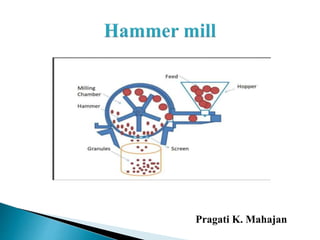
 Principle :-It works on the principle of impact i.e. material is
more or less stationary and is hit by an object moving at a high
speed
 Construction :-
• It consists of a stout metal casing with central shaft
• Shaft is rotated it own axis
• Four or more hammers are attached with central shaft.
• Hammers are mounted with swivel joints.
• Hammers are also rotates.
• Hammers may be square faced, tapered or stepped form
• Lower part of casing consist screen or mesh.
• Screen help in size separation of materials
• Feed inlet placed side of casing.
Pragati K. Mahajan
Pragati K. Mahajan
Working:-
 The material is put into the hopper which is connected with
the drum.
 The material is powdered to the desired size, due to fast
rotation of hammers and is collected under the screen.
 This mill has the advantage of continuous operation because
the chance of jamming is less as the hammers are not fixed.
 The mill can produce coarse to moderately fine powder,
 Due to high speed of operation, heat is generated which may
affect thermolabile drugs or materials.
 Moreover, high speed of operation also causes damage to
the mill if foreign objects such as stone or metal is present in
the feed.
Pragati K. Mahajan
Uses
1. Brittle material is best fractured by impact from blunt hammers.
2. Fibrous material is best reduced by cutting edges.
Advantages
1. It is rapid in action, and is capable of grinding many different types of
materials.
2. They are easy to install and operate, the operation is continuous.
3. There is little contamination of the product with metal abraded from the
mill as surface move against each other.
Disadvantages
1. Heat build-up during milling is more; therefore, product degradation is
possible.
2. Hammer mills cannot be employed to mill sticky, fibrous and hard
materials.
3. The screens may get clogged.
Pragati K. Mahajan
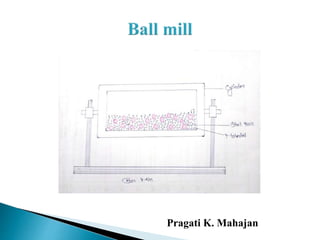
 Principle :-It works on the principle of impact and attrition.
 Construction:-
• It consists of a hollow cylinder which is mounted on a metallic
frame in such a way, that it can be rotated on its longitudinal axis.
• The cylinder contains balls that occupy 30-50% of the mill volume,
• The weight of the balls is kept constant.
• The ball size depends on the size of the feed and the diameter of the
mill.
• The cylinder and balls are made of metal and are usually lined with
chrome.
• In pharmaceutical industry, sometimes the cylinder of the ball mill is
lined with rubber or porcelain. The balls used in these mills are also
made of rubber or porcelain.
Pragati K. Mahajan
Pragati K. Mahajan
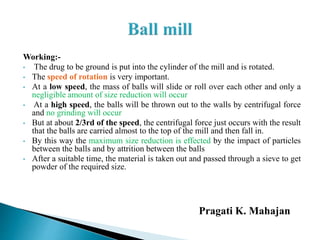
Working:-
• The drug to be ground is put into the cylinder of the mill and is rotated.
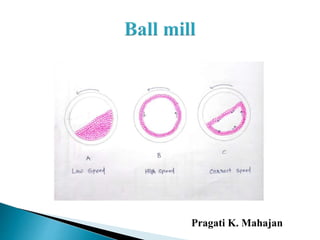
• The speed of rotation is very important.
• At a low speed, the mass of balls will slide or roll over each other and only a
negligible amount of size reduction will occur
• At a high speed, the balls will be thrown out to the walls by centrifugal force
and no grinding will occur
• But at about 2/3rd of the speed, the centrifugal force just occurs with the result
that the balls are carried almost to the top of the mill and then fall in.
• By this way the maximum size reduction is effected by the impact of particles
between the balls and by attrition between the balls
• After a suitable time, the material is taken out and passed through a sieve to get
powder of the required size.
Pragati K. Mahajan
Pragati K. Mahajan
Uses
• The mill is used to grind brittle drugs to fine powder.
Advantages .
• It can produce very fine powders.
• It can be used for continuous operation if sieve or classifier is attached to the
mill.
• It is capable of grinding a large variety of materials of different character and
of different degree of hardness
• It can be used to grind toxic materials as it can be used in completely enclosed
form
• It is suitable for both wet or dry grinding processes.
Disadvantages
• The ball mill is a very noisy machine.
• Wear occurs from the balls as well as from the casing, which may result in
contamination of the product.
Pragati K. Mahajan