Cryptography  An Introduction
Encryption and decryption Data that can be read and understood without any special measures is called  plaintext  or  cleartext . The method of disguising plaintext in such a way as to hide its substance is called  encryption.  Encrypting plaintext results in unreadable gibberish called  ciphertext . You use encryption to ensure that information is hidden from anyone for whom it is not intended, even those who can see the encrypted data. The process of reverting ciphertext to its original plaintext is called  decryption .
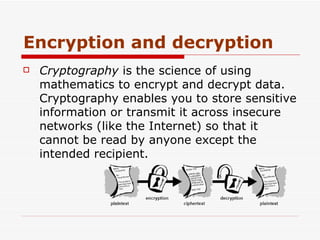
Encryption and decryption Cryptography  is the science of using mathematics to encrypt and decrypt data. Cryptography enables you to store sensitive information or transmit it across insecure networks (like the Internet) so that it cannot be read by anyone except the intended recipient.
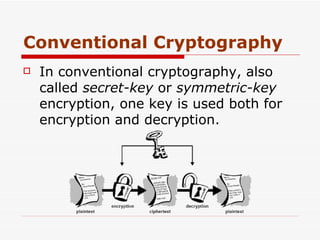
Conventional Cryptography In conventional cryptography, also called  secret-key  or  symmetric-key  encryption, one key is used both for encryption and decryption.
Conventional encryption has benefits. It is very fast. It is especially useful for encrypting data that is not  going  anywhere. However, conventional encryption alone as a means for transmitting secure data can be quite expensive simply due to the difficulty of secure key distribution.
Public Key Cryptography The problems of key distribution are solved by  public key cryptography , the concept of which was introduced by Whitfield Diffie and Martin Hellman in 1975. (There is now evidence that the British Secret Service invented it a few years before Diffie and Hellman, but kept it a military secret—and did nothing with it.)
Public key cryptography Public key cryptography is an asymmetric scheme that uses a  pair  of keys for encryption: a  public key , which encrypts data, and a corresponding  private,  or  secret key  for decryption. You publish your public key to the world while keeping your private key secret. Anyone with a copy of your public key can then encrypt information that only you can read. Even people you have never met.
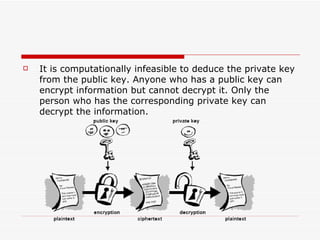
It is computationally infeasible to deduce the private key from the public key. Anyone who has a public key can encrypt information but cannot decrypt it. Only the person who has the corresponding private key can decrypt the information.
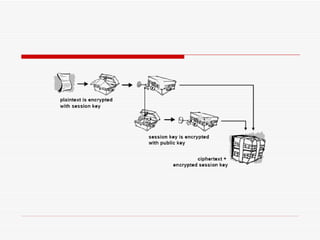
PGP (Pretty Good Privacy) PGP combines some of the best features of both conventional and public key cryptography. PGP is a  hybrid cryptosystem .
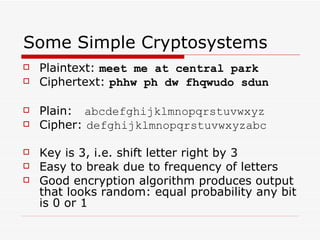
 
Conclusion! The combination of the two encryption methods combines the convenience of public key encryption with the speed of conventional encryption. Conventional encryption is about 1,000 times faster than public key encryption. Public key encryption in turn provides a solution to key distribution and data transmission issues. Used together, performance and key distribution are improved without any sacrifice in security.
Keys A key is a value that works with a cryptographic algorithm to produce a specific ciphertext.  Keys are basically really, really, really big numbers. Key size is measured in bits; the number  representing a 1024-bit key is darn huge. In public key cryptography, the bigger the key, the more secure the ciphertext.
However, public key size and conventional cryptography’s secret key size are totally unrelated.  A conventional 80-bit key has the equivalent strength of a 1024-bit public key. A conventional 128-bit key is equivalent to a 3000-bit public key. Again, the bigger the key, the more secure, but the algorithms used for each type of cryptography are very different and thus comparison is like that of apples to oranges.
Some Simple Cryptosystems Plaintext:  meet me at central park   Ciphertext:  phhw ph dw fhqwudo sdun Plain:  abcdefghijklmnopqrstuvwxyz Cipher:  defghijklmnopqrstuvwxyzabc Key is 3, i.e. shift letter right by 3 Easy to break due to frequency of letters Good encryption algorithm produces output that looks random: equal probability any bit is 0 or 1
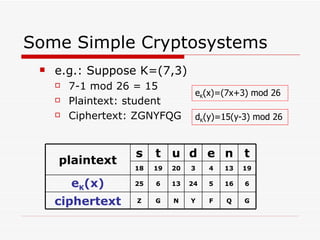
Some Simple Cryptosystems e.g.: Suppose K=(7,3) 7-1 mod 26 = 15 Plaintext: student Ciphertext: ZGNYFQG e K (x)=(7x+3) mod 26 d K (y)=15(y-3) mod 26 G Q F Y N G Z ciphertext 6 16 5 24 13 6 25 e K (x) 19 13 4 3 20 19 18 t n e d u t s plaintext

Cryptography intro

  • 1.
    Cryptography AnIntroduction
  • 2.
    Encryption and decryptionData that can be read and understood without any special measures is called plaintext or cleartext . The method of disguising plaintext in such a way as to hide its substance is called encryption. Encrypting plaintext results in unreadable gibberish called ciphertext . You use encryption to ensure that information is hidden from anyone for whom it is not intended, even those who can see the encrypted data. The process of reverting ciphertext to its original plaintext is called decryption .
  • 3.
    Encryption and decryptionCryptography is the science of using mathematics to encrypt and decrypt data. Cryptography enables you to store sensitive information or transmit it across insecure networks (like the Internet) so that it cannot be read by anyone except the intended recipient.
  • 4.
    Conventional Cryptography Inconventional cryptography, also called secret-key or symmetric-key encryption, one key is used both for encryption and decryption.
  • 5.
    Conventional encryption hasbenefits. It is very fast. It is especially useful for encrypting data that is not going anywhere. However, conventional encryption alone as a means for transmitting secure data can be quite expensive simply due to the difficulty of secure key distribution.
  • 6.
    Public Key CryptographyThe problems of key distribution are solved by public key cryptography , the concept of which was introduced by Whitfield Diffie and Martin Hellman in 1975. (There is now evidence that the British Secret Service invented it a few years before Diffie and Hellman, but kept it a military secret—and did nothing with it.)
  • 7.
    Public key cryptographyPublic key cryptography is an asymmetric scheme that uses a pair of keys for encryption: a public key , which encrypts data, and a corresponding private, or secret key for decryption. You publish your public key to the world while keeping your private key secret. Anyone with a copy of your public key can then encrypt information that only you can read. Even people you have never met.
  • 8.
    It is computationallyinfeasible to deduce the private key from the public key. Anyone who has a public key can encrypt information but cannot decrypt it. Only the person who has the corresponding private key can decrypt the information.
  • 9.
    PGP (Pretty GoodPrivacy) PGP combines some of the best features of both conventional and public key cryptography. PGP is a hybrid cryptosystem .
  • 10.
  • 11.
    Conclusion! The combinationof the two encryption methods combines the convenience of public key encryption with the speed of conventional encryption. Conventional encryption is about 1,000 times faster than public key encryption. Public key encryption in turn provides a solution to key distribution and data transmission issues. Used together, performance and key distribution are improved without any sacrifice in security.
  • 12.
    Keys A keyis a value that works with a cryptographic algorithm to produce a specific ciphertext. Keys are basically really, really, really big numbers. Key size is measured in bits; the number representing a 1024-bit key is darn huge. In public key cryptography, the bigger the key, the more secure the ciphertext.
  • 13.
    However, public keysize and conventional cryptography’s secret key size are totally unrelated. A conventional 80-bit key has the equivalent strength of a 1024-bit public key. A conventional 128-bit key is equivalent to a 3000-bit public key. Again, the bigger the key, the more secure, but the algorithms used for each type of cryptography are very different and thus comparison is like that of apples to oranges.
  • 14.
    Some Simple CryptosystemsPlaintext: meet me at central park Ciphertext: phhw ph dw fhqwudo sdun Plain: abcdefghijklmnopqrstuvwxyz Cipher: defghijklmnopqrstuvwxyzabc Key is 3, i.e. shift letter right by 3 Easy to break due to frequency of letters Good encryption algorithm produces output that looks random: equal probability any bit is 0 or 1
  • 15.
    Some Simple Cryptosystemse.g.: Suppose K=(7,3) 7-1 mod 26 = 15 Plaintext: student Ciphertext: ZGNYFQG e K (x)=(7x+3) mod 26 d K (y)=15(y-3) mod 26 G Q F Y N G Z ciphertext 6 16 5 24 13 6 25 e K (x) 19 13 4 3 20 19 18 t n e d u t s plaintext