Presented By : Shibani Sarangi
IT Branch, Regd no. 1001289324
Guided By : Prof. X
1
2
Cryptography
Vocabulary
Encryption & Decryption
Transmission Technique
Symmetric Cryptography
Asymmetric Cryptography
Conclusion
References
3
Cryptography is the science of using mathematics to encrypt
and decrypt data.
Cryptography enables you to store sensitive information or
transmit it across insecure networks so that it cannot be read by
anyone except the intended recipient.
4
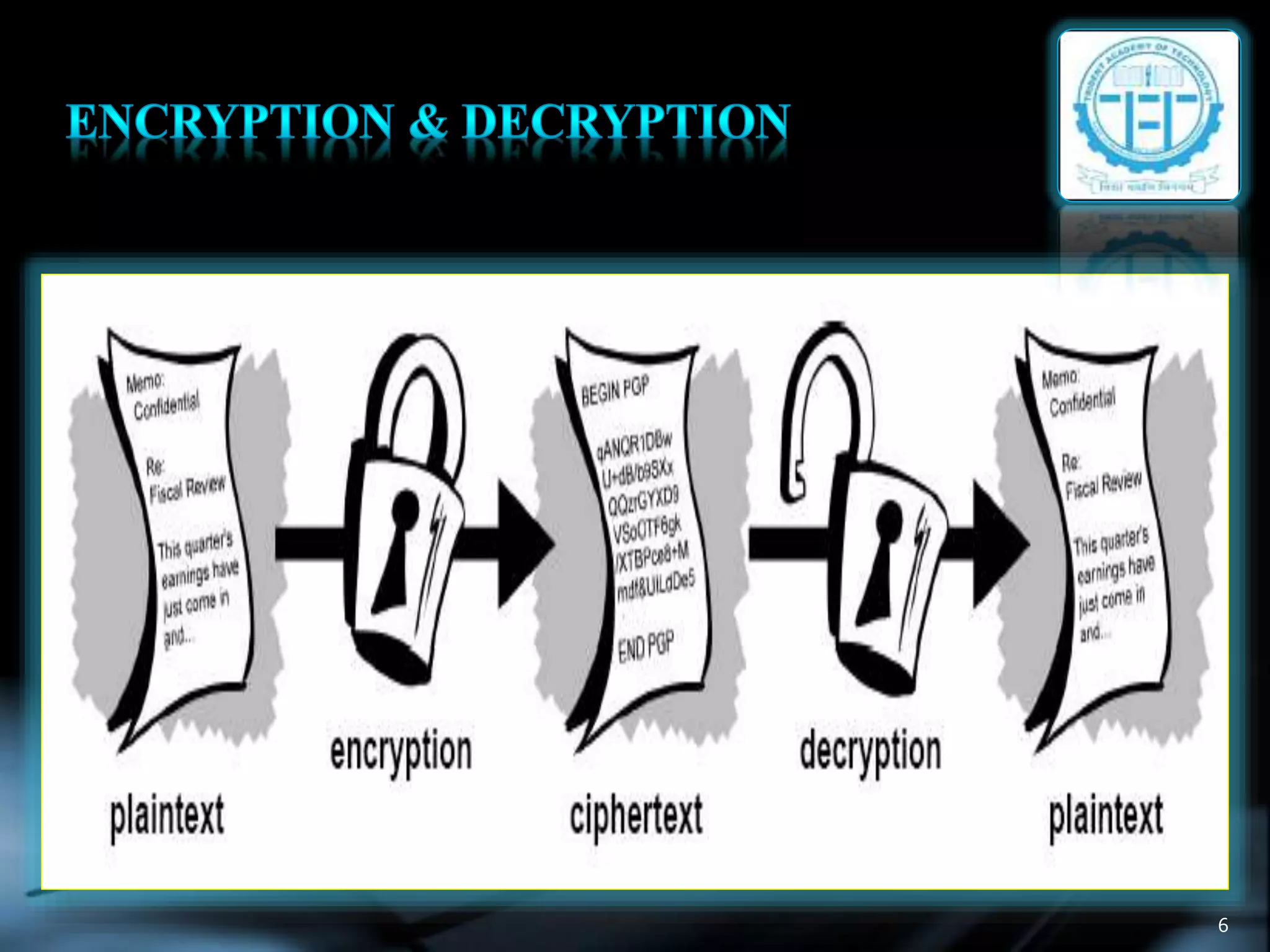
Plaintext: Data that can be read and understood without any
special measures.
Encryption: The method of disguising plaintext in such a way as
to hide its substance is called encryption.
Cipher text: Encrypting plaintext results in unreadable gibberish
called cipher text.
Decryption: The process of reverting cipher text to its original
plaintext is called decryption.
Key: some secret piece of information that customizes how the
cipher text is produced.
5
Cryptanalysis: The art of breaking ciphers, i.e. retrieving the
plaintext without knowing the proper key.
Cryptographers: People who do cryptography
Cryptanalysts: Practitioners of cryptanalysis.
Cryptology: The branch of mathematics that studies the
mathematical foundations of cryptographic methods.
Cipher: The Encoder, i.e., the encryption/decryption scheme
6
7
For “secret writing”
To establish a shared secret when other people
(eavesdroppers/hacker) are listening.
TYPES
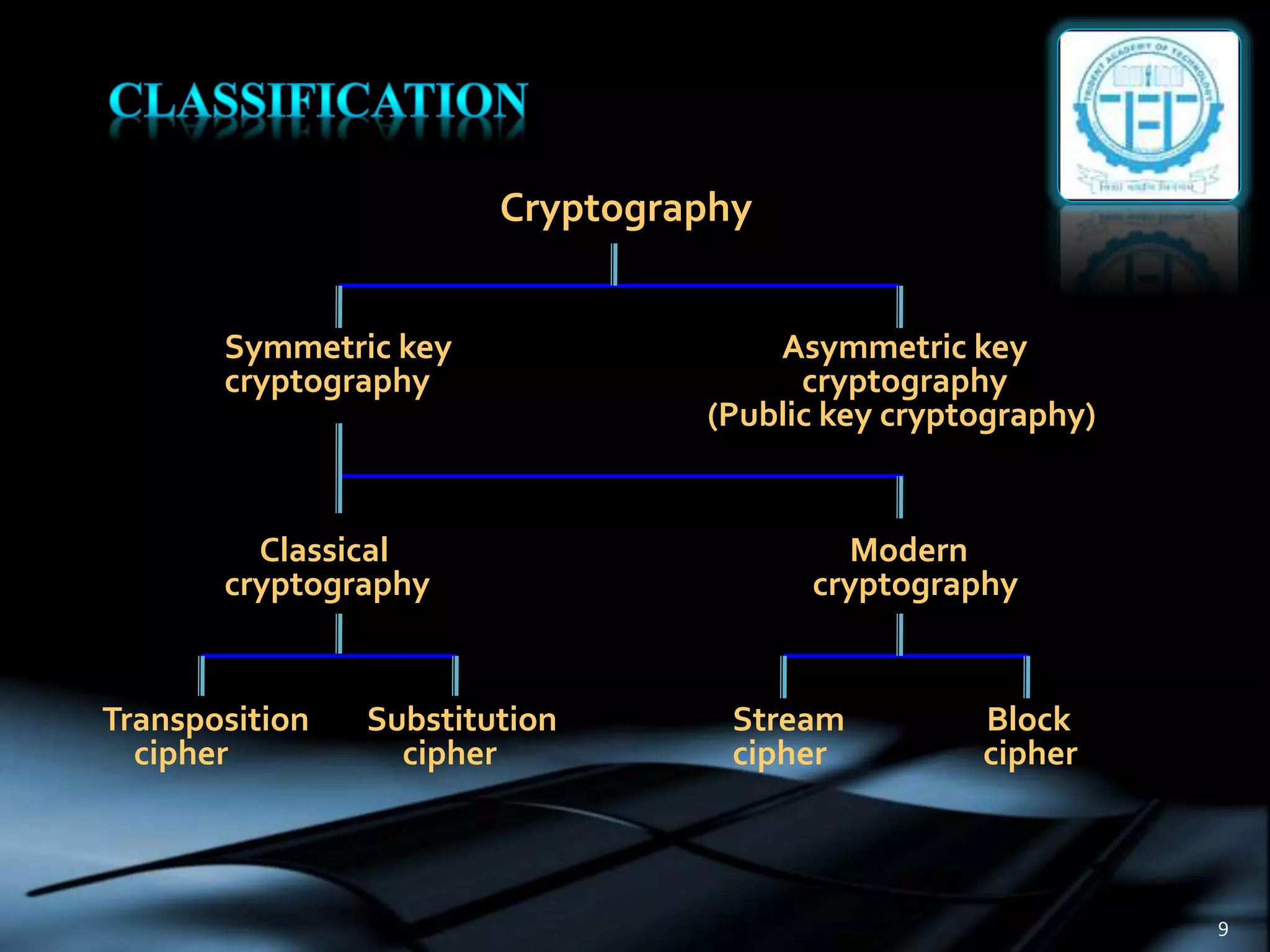
Mainly classified into two types :
1. Symmetric key cryptography
2. Asymmetric key cryptography
8
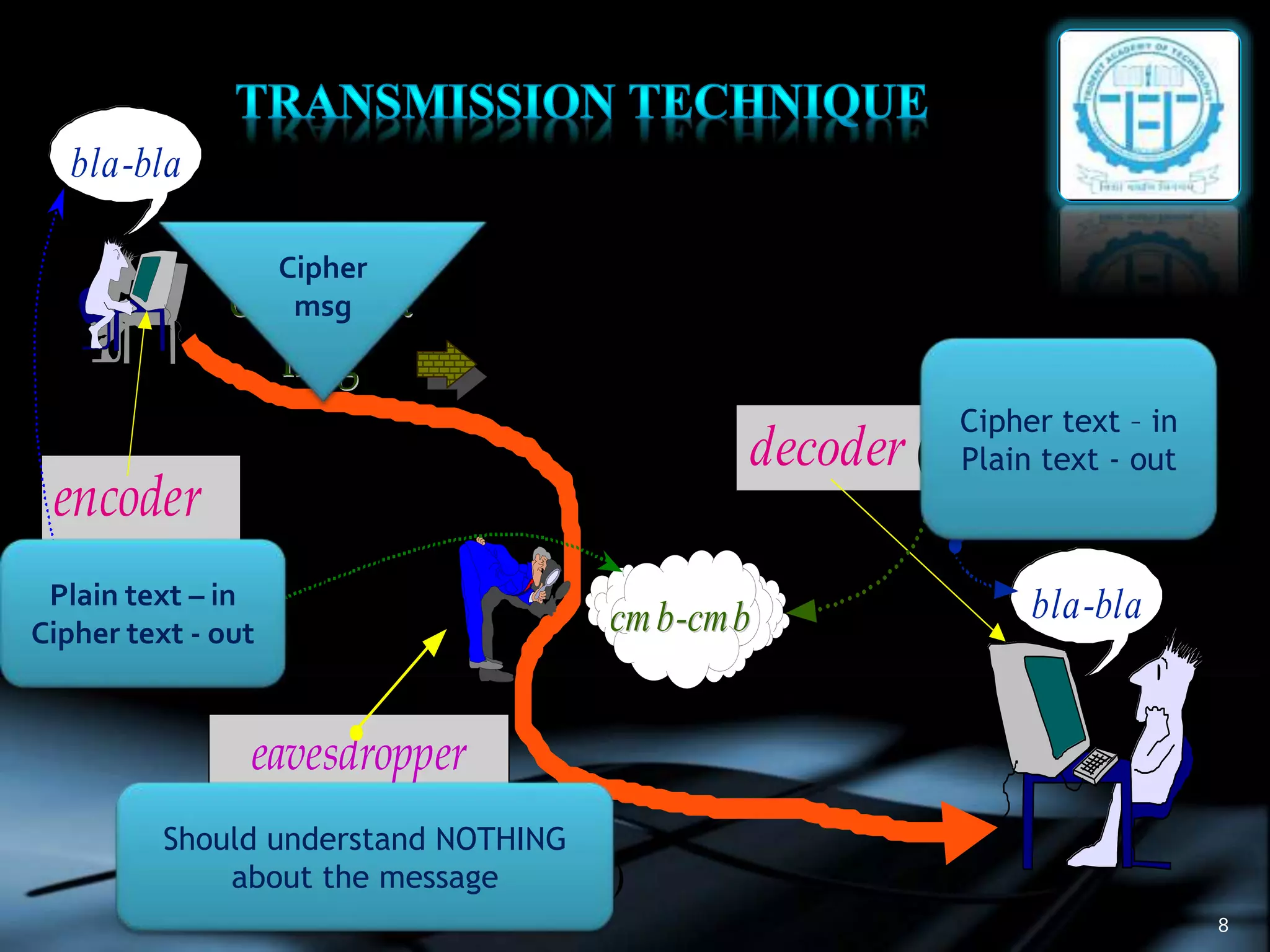
encoder
decoder
(plaintext in -
ciphertext out)
ciphertextciphertext
msgmsg
(ciphertext in
- plaintext out)
(should understand
nothingnothing about the msg)
eavesdropper
bla-blabla-bla
cmbcmb--cmbcmb bla-blabla-bla
Cipher
msg
Plain text – in
Cipher text - out
Should understand NOTHING
about the message
Cipher text – in
Plain text - out
Cryptography
Symmetric key Asymmetric key
cryptography cryptography
(Public key cryptography)
Classical Modern
cryptography cryptography
Transposition Substitution Stream Block
cipher cipher cipher cipher
9
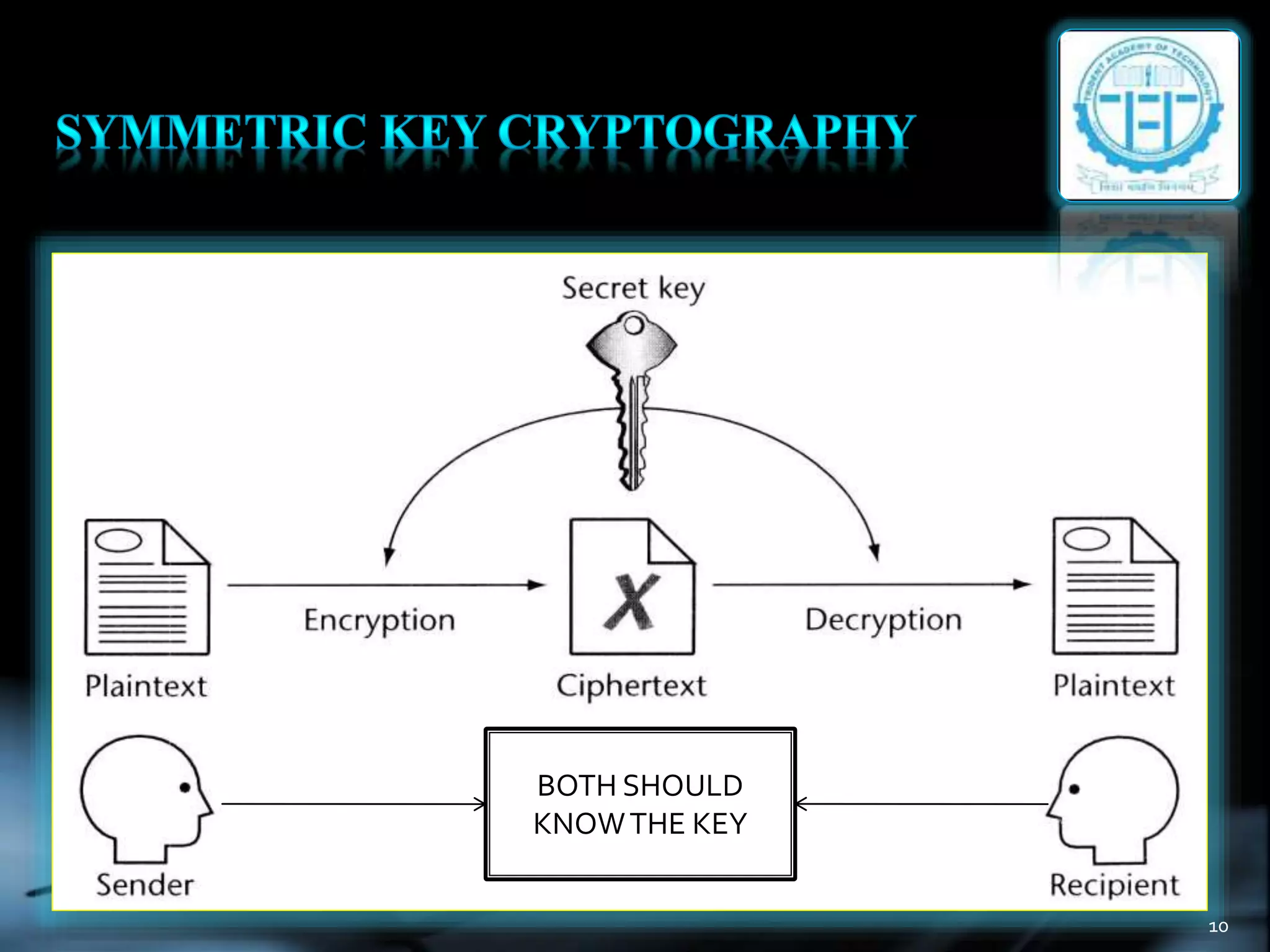
BOTH SHOULD
KNOWTHE KEY
10
11
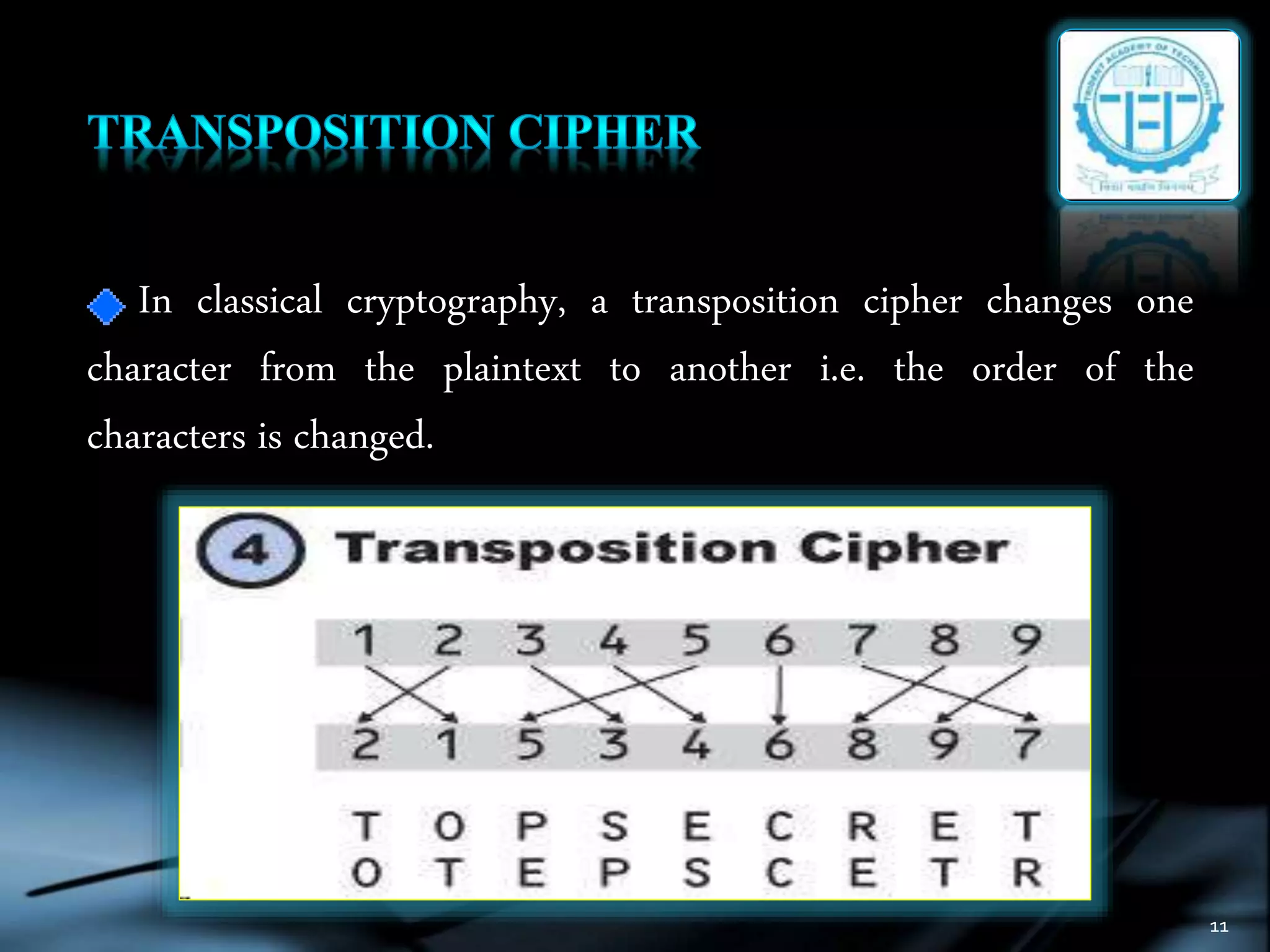
In classical cryptography, a transposition cipher changes one
character from the plaintext to another i.e. the order of the
characters is changed.
12
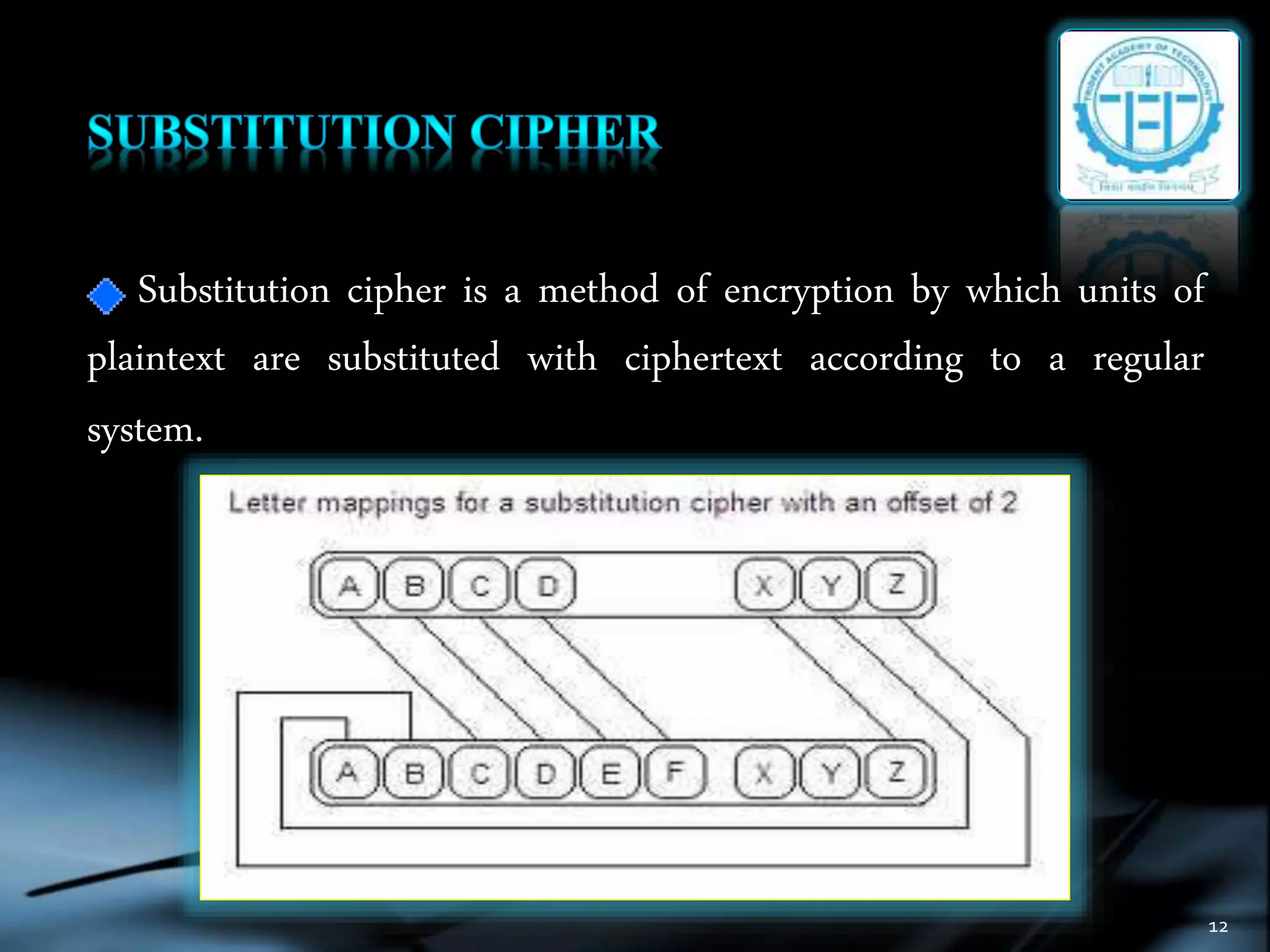
Substitution cipher is a method of encryption by which units of
plaintext are substituted with ciphertext according to a regular
system.
13
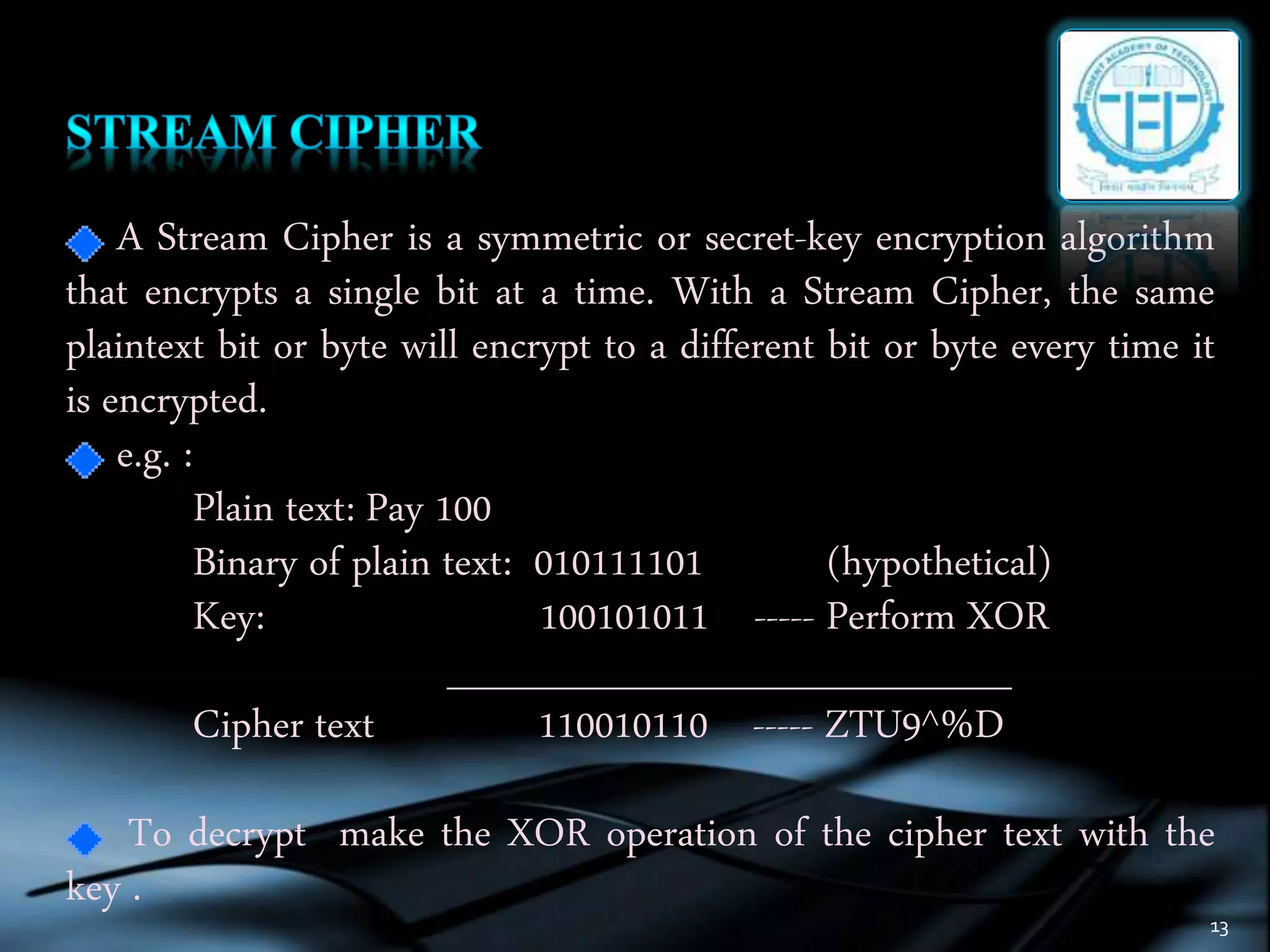
A Stream Cipher is a symmetric or secret-key encryption algorithm
that encrypts a single bit at a time. With a Stream Cipher, the same
plaintext bit or byte will encrypt to a different bit or byte every time it
is encrypted.
e.g. :
Plain text: Pay 100
Binary of plain text: 010111101 (hypothetical)
Key: 100101011 ----- Perform XOR
____________________
Cipher text 110010110 ----- ZTU9^%D
To decrypt make the XOR operation of the cipher text with the
key .
14
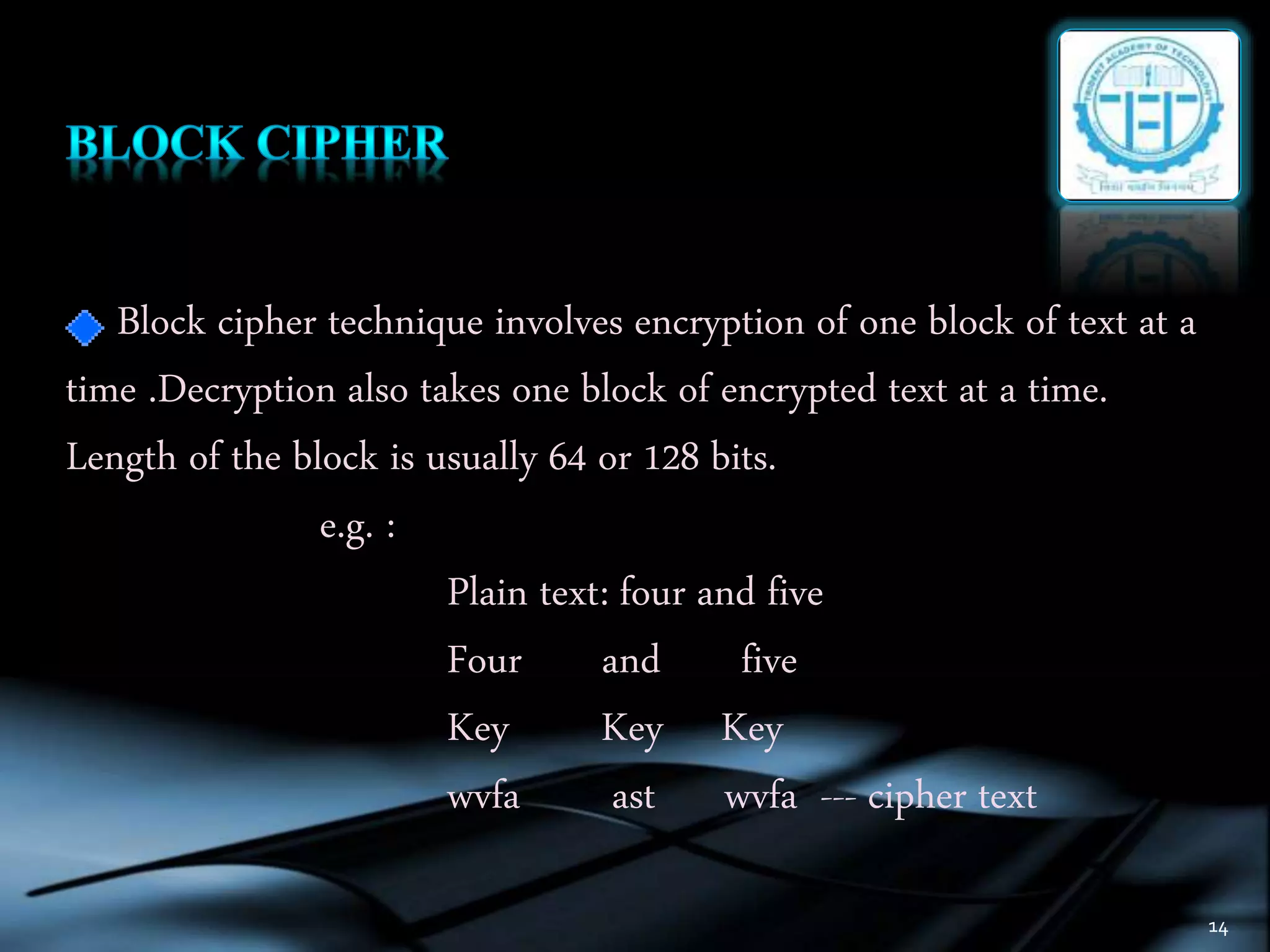
Block cipher technique involves encryption of one block of text at a
time .Decryption also takes one block of encrypted text at a time.
Length of the block is usually 64 or 128 bits.
e.g. :
Plain text: four and five
Four and five
Key Key Key
wvfa ast wvfa --- cipher text
15
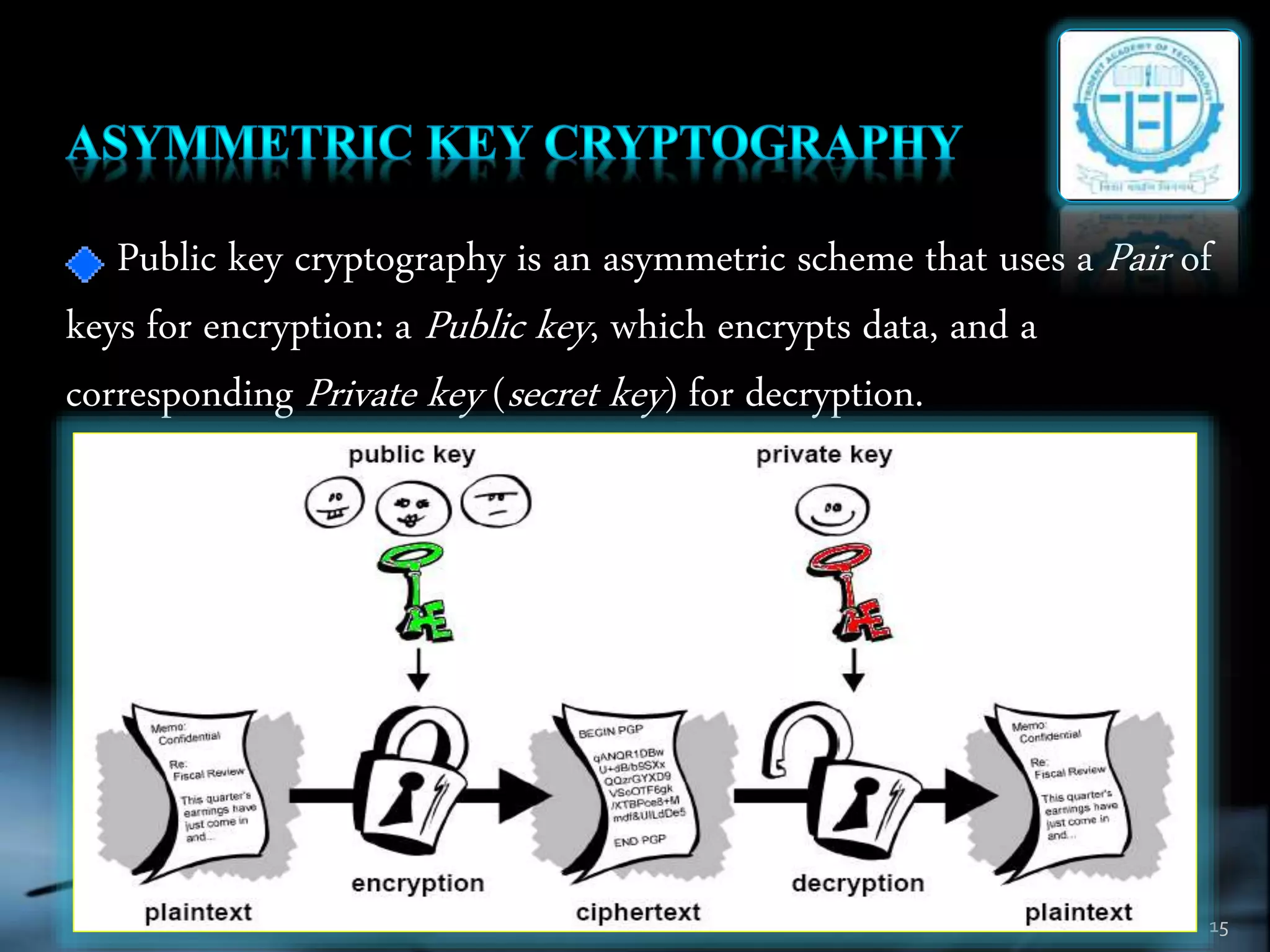
Public key cryptography is an asymmetric scheme that uses a Pair of
keys for encryption: a Public key, which encrypts data, and a
corresponding Private key (secret key) for decryption.
16
Cryptanalysis refers to the study of ciphers, cipher text, or
cryptosystems (that is, to secret code systems) with a view to
finding weaknesses in them that will permit retrieval of the plain
text from the cipher text, without necessarily knowing the key or
the algorithm. This is known as breaking the cipher, cipher text, or
cryptosystem.
Unlike cryptography which is a clearly defined science,
Cryptanalysis is as much an art as it is a science.
17
Known - plain text analysis
Chosen – plain text analysis (Differential cryptanalysis)
Cipher text - only analysis
Man – in – the - middle attack
18
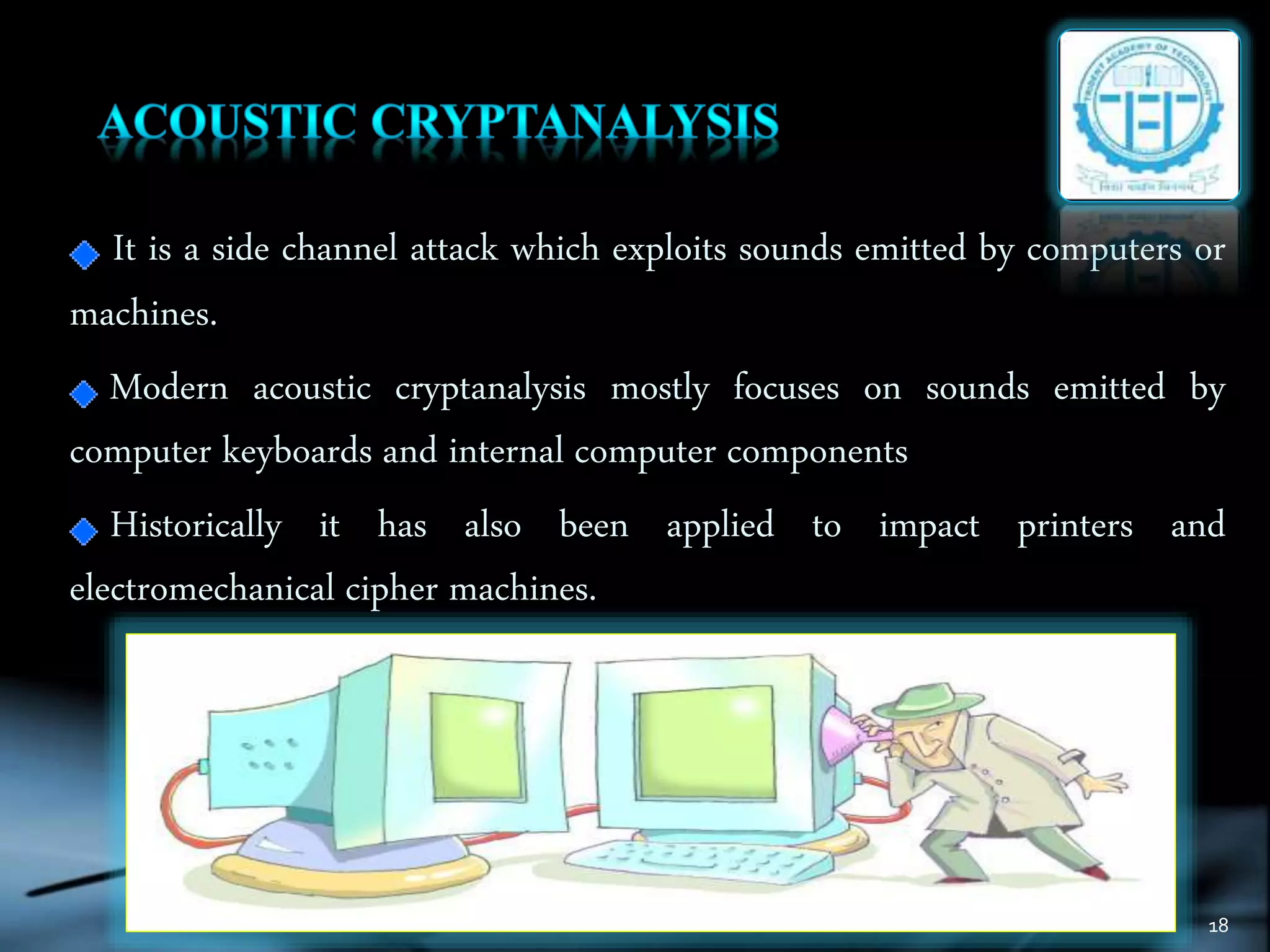
It is a side channel attack which exploits sounds emitted by computers or
machines.
Modern acoustic cryptanalysis mostly focuses on sounds emitted by
computer keyboards and internal computer components
Historically it has also been applied to impact printers and
electromechanical cipher machines.
19
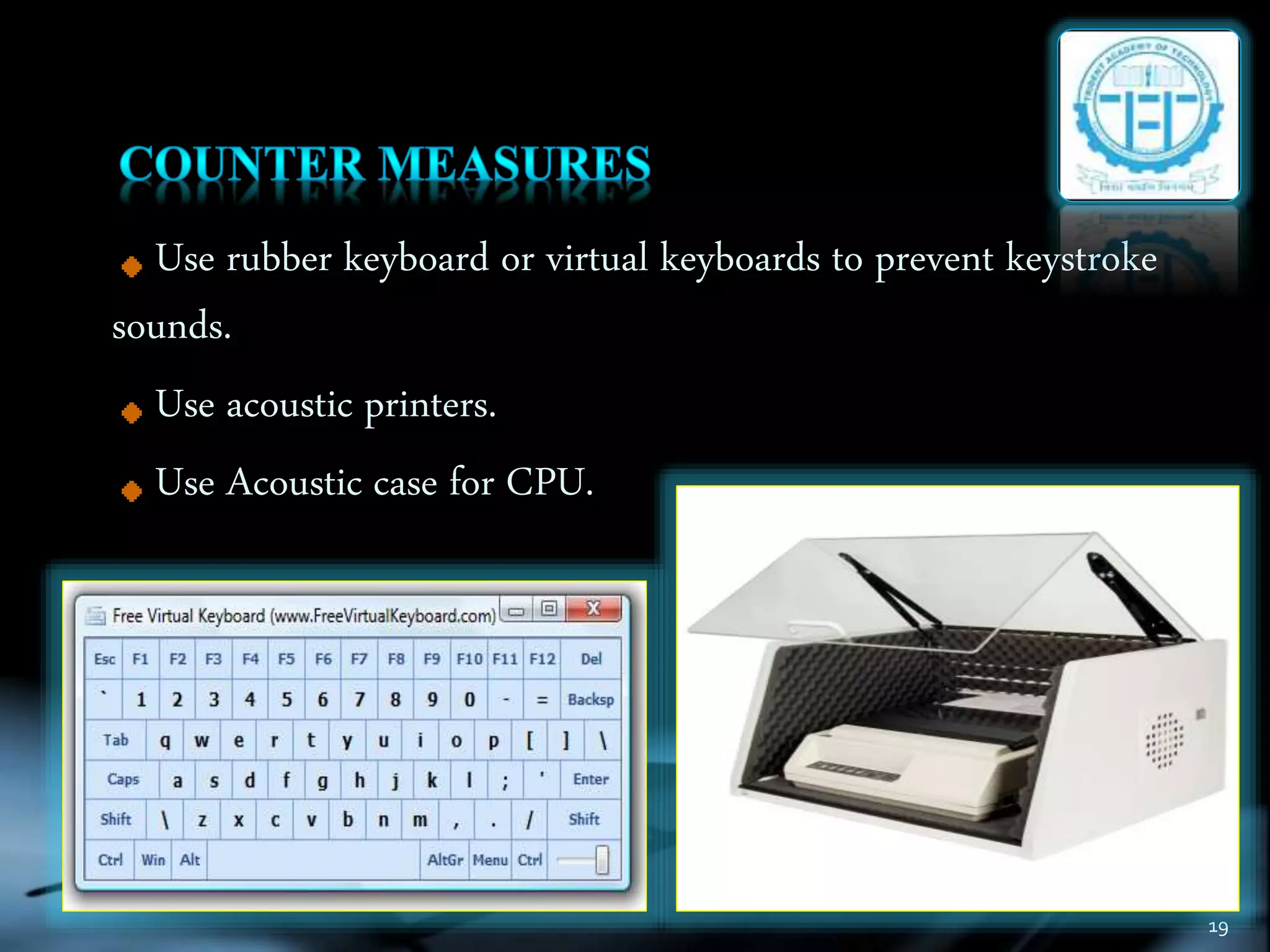
Use rubber keyboard or virtual keyboards to prevent keystroke
sounds.
Use acoustic printers.
Use Acoustic case for CPU.
20
Cryptography, being an art of encrypting and decrypting
confidential information and private messages, should be implemented
in the network security to prevent any leakage and threat.
It can be done by using any of these techniques discussed above for
fortifying the personal data transmission as well as for secure
transaction.
Acoustic cryptanalysis, being an art of decrypting or leaking
confidential information from the sound generated from the CPU,
Keyboard, printers, etc may be used in both constructive as well as
destructive ways.
Yang, Sarah (14 September 2005), "Researchers recover typed text
using audio recording of keystrokes", UC Berkeley News.
Adi Shamir & Eran Tromer. "Acoustic cryptanalysis". Blavatnik
School of Computer Science, Tel Aviv University. Retrieved 1
November 2011.
http://en.wikipedia.org/wiki/Cryptography
https://www.coursera.org/course/crypto
21
22

Cryptography

  • 1.
    Presented By :Shibani Sarangi IT Branch, Regd no. 1001289324 Guided By : Prof. X 1
  • 2.
    2 Cryptography Vocabulary Encryption & Decryption TransmissionTechnique Symmetric Cryptography Asymmetric Cryptography Conclusion References
  • 3.
    3 Cryptography is thescience of using mathematics to encrypt and decrypt data. Cryptography enables you to store sensitive information or transmit it across insecure networks so that it cannot be read by anyone except the intended recipient.
  • 4.
    4 Plaintext: Data thatcan be read and understood without any special measures. Encryption: The method of disguising plaintext in such a way as to hide its substance is called encryption. Cipher text: Encrypting plaintext results in unreadable gibberish called cipher text. Decryption: The process of reverting cipher text to its original plaintext is called decryption. Key: some secret piece of information that customizes how the cipher text is produced.
  • 5.
    5 Cryptanalysis: The artof breaking ciphers, i.e. retrieving the plaintext without knowing the proper key. Cryptographers: People who do cryptography Cryptanalysts: Practitioners of cryptanalysis. Cryptology: The branch of mathematics that studies the mathematical foundations of cryptographic methods. Cipher: The Encoder, i.e., the encryption/decryption scheme
  • 6.
  • 7.
    7 For “secret writing” Toestablish a shared secret when other people (eavesdroppers/hacker) are listening. TYPES Mainly classified into two types : 1. Symmetric key cryptography 2. Asymmetric key cryptography
  • 8.
    8 encoder decoder (plaintext in - ciphertextout) ciphertextciphertext msgmsg (ciphertext in - plaintext out) (should understand nothingnothing about the msg) eavesdropper bla-blabla-bla cmbcmb--cmbcmb bla-blabla-bla Cipher msg Plain text – in Cipher text - out Should understand NOTHING about the message Cipher text – in Plain text - out
  • 9.
    Cryptography Symmetric key Asymmetrickey cryptography cryptography (Public key cryptography) Classical Modern cryptography cryptography Transposition Substitution Stream Block cipher cipher cipher cipher 9
  • 10.
  • 11.
    11 In classical cryptography,a transposition cipher changes one character from the plaintext to another i.e. the order of the characters is changed.
  • 12.
    12 Substitution cipher isa method of encryption by which units of plaintext are substituted with ciphertext according to a regular system.
  • 13.
    13 A Stream Cipheris a symmetric or secret-key encryption algorithm that encrypts a single bit at a time. With a Stream Cipher, the same plaintext bit or byte will encrypt to a different bit or byte every time it is encrypted. e.g. : Plain text: Pay 100 Binary of plain text: 010111101 (hypothetical) Key: 100101011 ----- Perform XOR ____________________ Cipher text 110010110 ----- ZTU9^%D To decrypt make the XOR operation of the cipher text with the key .
  • 14.
    14 Block cipher techniqueinvolves encryption of one block of text at a time .Decryption also takes one block of encrypted text at a time. Length of the block is usually 64 or 128 bits. e.g. : Plain text: four and five Four and five Key Key Key wvfa ast wvfa --- cipher text
  • 15.
    15 Public key cryptographyis an asymmetric scheme that uses a Pair of keys for encryption: a Public key, which encrypts data, and a corresponding Private key (secret key) for decryption.
  • 16.
    16 Cryptanalysis refers tothe study of ciphers, cipher text, or cryptosystems (that is, to secret code systems) with a view to finding weaknesses in them that will permit retrieval of the plain text from the cipher text, without necessarily knowing the key or the algorithm. This is known as breaking the cipher, cipher text, or cryptosystem. Unlike cryptography which is a clearly defined science, Cryptanalysis is as much an art as it is a science.
  • 17.
    17 Known - plaintext analysis Chosen – plain text analysis (Differential cryptanalysis) Cipher text - only analysis Man – in – the - middle attack
  • 18.
    18 It is aside channel attack which exploits sounds emitted by computers or machines. Modern acoustic cryptanalysis mostly focuses on sounds emitted by computer keyboards and internal computer components Historically it has also been applied to impact printers and electromechanical cipher machines.
  • 19.
    19 Use rubber keyboardor virtual keyboards to prevent keystroke sounds. Use acoustic printers. Use Acoustic case for CPU.
  • 20.
    20 Cryptography, being anart of encrypting and decrypting confidential information and private messages, should be implemented in the network security to prevent any leakage and threat. It can be done by using any of these techniques discussed above for fortifying the personal data transmission as well as for secure transaction. Acoustic cryptanalysis, being an art of decrypting or leaking confidential information from the sound generated from the CPU, Keyboard, printers, etc may be used in both constructive as well as destructive ways.
  • 21.
    Yang, Sarah (14September 2005), "Researchers recover typed text using audio recording of keystrokes", UC Berkeley News. Adi Shamir & Eran Tromer. "Acoustic cryptanalysis". Blavatnik School of Computer Science, Tel Aviv University. Retrieved 1 November 2011. http://en.wikipedia.org/wiki/Cryptography https://www.coursera.org/course/crypto 21
  • 22.