



Cryptography
                              By
Nastypradeep@gmail.com
                          Pradeep…
Nastypradeep@gmail.com
₰     The art of protecting information by transforming it
    (encrypting it) into an unreadable format, called cipher text.
    Only those who possess a secret key can decipher (or decrypt)
    the message into plain text.

    ₰      Cryptanalysis is the study of how to crack encryption
    algorithms or their implementations.


Nastypradeep@gmail.com
Why do we need Cryptography
       Security often require that data be kept safe from
unauthorized access. This problem can be broken down into five
requirements that must be addressed:

※ Confidentiality: assuring that private data remains private.
※ Authentication: assuring the identity of all parties attempting
access.
※ Authorization: assuring that a certain party attempting to
perform a function has the permissions to do so.
※ Data Integrity: assuring that an object is not altered illegally.
※ Non-Repudiation: assuring against a party denying a data or a
communication that was initiated by them.
Nastypradeep@gmail.com
Basic Concept of Cryptography


Nastypradeep@gmail.com
Major Categories
Classic cryptography
        Classic cryptography details cryptography styles used in the
olden age. It includes simple methods which was used superiorly during
war times etc. this was before the invention of computers.

modern cryptography
       The development of digital computers and electronics after
WWII made possible much more complex ciphers. Furthermore,
computers allowed for the encryption of any kind of data representable
in any binary format, unlike classical ciphers which only encrypted
written language texts; this was new and significant. This was the
beginning of computer age.

Nastypradeep@gmail.com
Classic Cryptography


 (Crypting techniques of olden age)
Nastypradeep@gmail.com
The main classical cipher types are


    Transposition ciphers


                         Substitution ciphers

Nastypradeep@gmail.com
Transposition ciphers

      Transposition ciphers are rearranging the
       order of letters in a message .

      • e.g.,
            hello world' becomes 'ehlol owrdl' in a
        trivially simple rearrangement scheme

Nastypradeep@gmail.com
Substitution ciphers
       Substitution ciphers, which systematically replace
       letters or groups of letters with other letters or
       groups.

      e.g.,
               ‘Fly at once' becomes 'gmz bu podf' by replacing
           each letter with the one following it in the Latin
           alphabet.

Nastypradeep@gmail.com
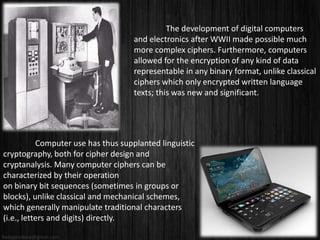
The development of digital computers
                                    and electronics after WWII made possible much
                                    more complex ciphers. Furthermore, computers
                                    allowed for the encryption of any kind of data
                                    representable in any binary format, unlike classical
                                    ciphers which only encrypted written language
                                    texts; this was new and significant.


           Computer use has thus supplanted linguistic
cryptography, both for cipher design and
cryptanalysis. Many computer ciphers can be
characterized by their operation
on binary bit sequences (sometimes in groups or
blocks), unlike classical and mechanical schemes,
which generally manipulate traditional characters
(i.e., letters and digits) directly.

Nastypradeep@gmail.com
The main Modern cipher types are


    Symmetric-key cryptography


                         Public-key cryptography
Nastypradeep@gmail.com
Symmetric-key cryptography
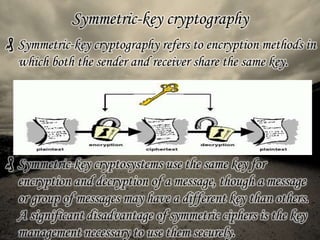
 ₰ Symmetric-key cryptography refers to encryption methods in
   which both the sender and receiver share the same key.


 ₰ Symmetric-key cryptosystems use the same key for
   encryption and decryption of a message, though a message
   or group of messages may have a different key than others.
   A significant disadvantage of symmetric ciphers is the key
   management necessary to use them securely.
Nastypradeep@gmail.com
Public-key cryptography
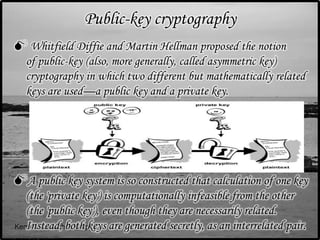
     Whitfield Diffie and Martin Hellman proposed the notion
     of public-key (also, more generally, called asymmetric key)
     cryptography in which two different but mathematically related
     keys are used—a public key and a private key.


    A public key system is so constructed that calculation of one key
     (the 'private key') is computationally infeasible from the other
     (the 'public key'), even though they are necessarily related.
     Instead, both keys are generated secretly, as an interrelated pair.
Nastypradeep@gmail.com
Cryptanalysis

Nastypradeep@gmail.com
Cryptanalysis
     Definition
                    Cryptanalysis is the study of methods
          for obtaining the meaning of encrypted
          information, without access to
          the secret information that is normally required
          to do so. Typically, this involves knowing how
          the system works and finding a secret key. In
          non-technical language, this is the practice
          of codebreaking or cracking the code,
Nastypradeep@gmail.com
As the cryptography plays an important role
in today’s computer security. The cryptography
algorithms are highly confidential. And so We
cannot discuss the latest encrypting and
decrypting techniques used my mail servers, social
networks and etc..

     Though we have several hackers and other
forces were seriously trying to encrypt and decrypt
the network servers.
Nastypradeep@gmail.com
Applications
       Used for security issues.
       Used by social networks to provide security
       Used to pass messages secretly
       Used during war times
       Even we can try to pass messages without other’s
       knowledge about the message


Nastypradeep@gmail.com

Cryptography

  • 1.
    Cryptography By Nastypradeep@gmail.com Pradeep…
  • 2.
  • 3.
    The art of protecting information by transforming it (encrypting it) into an unreadable format, called cipher text. Only those who possess a secret key can decipher (or decrypt) the message into plain text. ₰ Cryptanalysis is the study of how to crack encryption algorithms or their implementations. Nastypradeep@gmail.com
  • 4.
  • 5.
    Why do weneed Cryptography Security often require that data be kept safe from unauthorized access. This problem can be broken down into five requirements that must be addressed: ※ Confidentiality: assuring that private data remains private. ※ Authentication: assuring the identity of all parties attempting access. ※ Authorization: assuring that a certain party attempting to perform a function has the permissions to do so. ※ Data Integrity: assuring that an object is not altered illegally. ※ Non-Repudiation: assuring against a party denying a data or a communication that was initiated by them. Nastypradeep@gmail.com
  • 6.
    Basic Concept ofCryptography Nastypradeep@gmail.com
  • 7.
    Major Categories Classic cryptography Classic cryptography details cryptography styles used in the olden age. It includes simple methods which was used superiorly during war times etc. this was before the invention of computers. modern cryptography The development of digital computers and electronics after WWII made possible much more complex ciphers. Furthermore, computers allowed for the encryption of any kind of data representable in any binary format, unlike classical ciphers which only encrypted written language texts; this was new and significant. This was the beginning of computer age. Nastypradeep@gmail.com
  • 8.
    Classic Cryptography (Cryptingtechniques of olden age) Nastypradeep@gmail.com
  • 9.
    The main classicalcipher types are Transposition ciphers Substitution ciphers Nastypradeep@gmail.com
  • 10.
    Transposition ciphers Transposition ciphers are rearranging the order of letters in a message . • e.g., hello world' becomes 'ehlol owrdl' in a trivially simple rearrangement scheme Nastypradeep@gmail.com
  • 11.
    Substitution ciphers  Substitution ciphers, which systematically replace letters or groups of letters with other letters or groups. e.g., ‘Fly at once' becomes 'gmz bu podf' by replacing each letter with the one following it in the Latin alphabet. Nastypradeep@gmail.com
  • 12.
  • 13.
    The development ofdigital computers and electronics after WWII made possible much more complex ciphers. Furthermore, computers allowed for the encryption of any kind of data representable in any binary format, unlike classical ciphers which only encrypted written language texts; this was new and significant. Computer use has thus supplanted linguistic cryptography, both for cipher design and cryptanalysis. Many computer ciphers can be characterized by their operation on binary bit sequences (sometimes in groups or blocks), unlike classical and mechanical schemes, which generally manipulate traditional characters (i.e., letters and digits) directly. Nastypradeep@gmail.com
  • 14.
    The main Moderncipher types are Symmetric-key cryptography Public-key cryptography Nastypradeep@gmail.com
  • 15.
    Symmetric-key cryptography ₰Symmetric-key cryptography refers to encryption methods in which both the sender and receiver share the same key. ₰ Symmetric-key cryptosystems use the same key for encryption and decryption of a message, though a message or group of messages may have a different key than others. A significant disadvantage of symmetric ciphers is the key management necessary to use them securely. Nastypradeep@gmail.com
  • 16.
    Public-key cryptography  Whitfield Diffie and Martin Hellman proposed the notion of public-key (also, more generally, called asymmetric key) cryptography in which two different but mathematically related keys are used—a public key and a private key. A public key system is so constructed that calculation of one key (the 'private key') is computationally infeasible from the other (the 'public key'), even though they are necessarily related. Instead, both keys are generated secretly, as an interrelated pair. Nastypradeep@gmail.com
  • 17.
  • 18.
    Cryptanalysis Definition Cryptanalysis is the study of methods for obtaining the meaning of encrypted information, without access to the secret information that is normally required to do so. Typically, this involves knowing how the system works and finding a secret key. In non-technical language, this is the practice of codebreaking or cracking the code, Nastypradeep@gmail.com
  • 19.
    As the cryptographyplays an important role in today’s computer security. The cryptography algorithms are highly confidential. And so We cannot discuss the latest encrypting and decrypting techniques used my mail servers, social networks and etc.. Though we have several hackers and other forces were seriously trying to encrypt and decrypt the network servers. Nastypradeep@gmail.com
  • 20.
  • 21.
    Applications  Used for security issues.  Used by social networks to provide security  Used to pass messages secretly  Used during war times  Even we can try to pass messages without other’s knowledge about the message Nastypradeep@gmail.com
  • 22.