Presented by:
Guided by:
Laiba Rehman
Mrs. Neelam
Roll No.-
INDEX
 Introduction
 What is cryptography?
 Purpose of cryptography
 Architecture of cryptography
 Characteristics of cryptography
 Types of cryptography
 Process of cryptography
 Types of cryptography algorithms
 Attacks of cryptography
 Conclusion
Introduction
 The internet or the global internet is the internationally
connected network of computer networks with addresses
that are administrated IANA(Internet address and Naming
Authority).
 There are many aspects to security and many applications
,ranging from secure commerce and payments to private
communication and protecting passwords. One essential
aspect for secure communications is that of cryptography.
What is cryptography?
 Cryptography derived its name from a Greek word
called “krypto’s” which means “Hidden Secrets”.
 Cryptography is the practice and study of hiding
information. It is the Art and Science of converting a
plain intelligible data into an unintelligible data and
again retransforming that message into its original
form.
 It provides Confidentiality , Integrity and Accuracy.
Important terms in
cryptography
 Plaintext:
 Encryption:
 Cipher text
 Decryption
 key
 Cryptanalysis:
 Cryptographers:
 Cryptanalysts:
 Cryptology
Caesar Cipher Technique
1. Simple Substitution Technique
2. Working – Encryption
1. Each alphabet in the message is replaced by another alphabet 3
places DOWN the line
3. Working – Decryption
1. Each alphabet in the message
is replaced by another
alphabet 3 places up the line.
A B C D
E
R
Y
P
T
N
C
D E F G
D
E
C
R
Y
P
T
Purpose Of Cryptography
 Authentication: The process of proving one’s identity.
(The primary forms of host-to-host authentication on
the Internet today are name-based or address-based ,
both of which are notoriously weak.)
 Privacy/Confidentiality: Ensuing that no one can read
the message except the intended receiver.
 Integrity: Assuring the receiver that the received
message has not been altered in any way from the
original.
 Non-repudiation: A mechanism to prove that the
sender really sent this message.
Working of encryption and
decryption
Alice
Plain Text
ABC
Cipher Text
DEF
Internet
Cipher Text
DEF
Plain Text
ABC
Bob
Tom
What is
DEF?
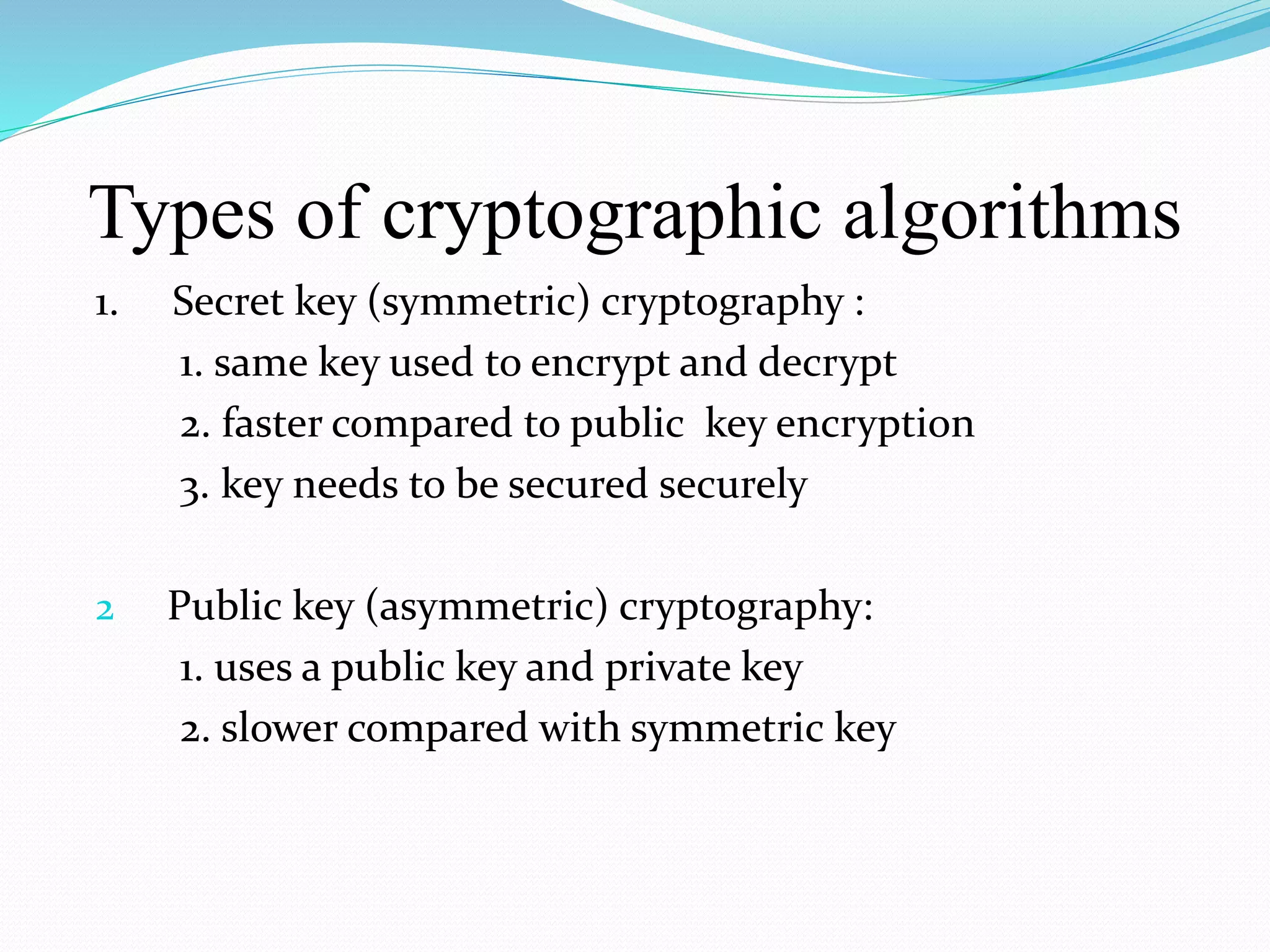
Types of cryptographic algorithms
1. Secret key (symmetric) cryptography :
1. same key used to encrypt and decrypt
2. faster compared to public key encryption
3. key needs to be secured securely
2 Public key (asymmetric) cryptography:
1. uses a public key and private key
2. slower compared with symmetric key
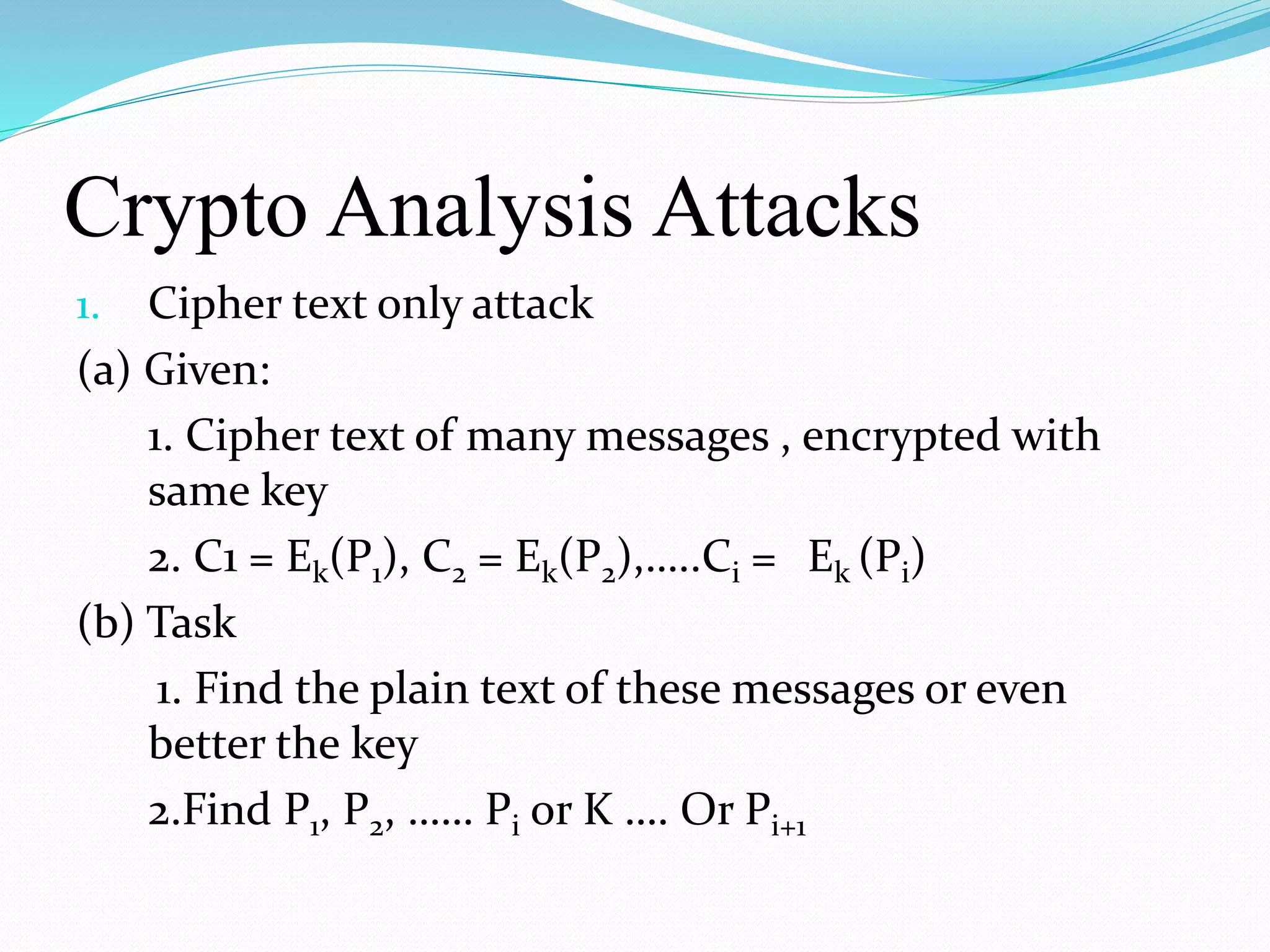
Crypto Analysis Attacks
1. Cipher text only attack
(a) Given:
1. Cipher text of many messages , encrypted with
same key
2. C1 = Ek(P1), C2 = Ek(P2),…..Ci = Ek (Pi)
(b) Task
1. Find the plain text of these messages or even
better the key
2.Find P1, P2, …… Pi or K …. Or Pi+1
 Known plain text attack
(a) Given:
1. Cipher text and plain text of the corresponding
messages.
2. P1,C1 = Ek(P1), P2,C2 = Ek(P2) , … Pi,Ci = Ek(Pi)
(b) Task:
1. Find k
2. Or algorithm to infer Pi+1 from CI+!
Conclusion
 Cryptography, being an art of encrypting and
decrypting confidential information and private
messages, should be implemented in the network
security to prevent any leakage and threat.
THANK YOU.

Cryptography

  • 1.
    Presented by: Guided by: LaibaRehman Mrs. Neelam Roll No.-
  • 2.
    INDEX  Introduction  Whatis cryptography?  Purpose of cryptography  Architecture of cryptography  Characteristics of cryptography  Types of cryptography  Process of cryptography  Types of cryptography algorithms  Attacks of cryptography  Conclusion
  • 3.
    Introduction  The internetor the global internet is the internationally connected network of computer networks with addresses that are administrated IANA(Internet address and Naming Authority).  There are many aspects to security and many applications ,ranging from secure commerce and payments to private communication and protecting passwords. One essential aspect for secure communications is that of cryptography.
  • 4.
    What is cryptography? Cryptography derived its name from a Greek word called “krypto’s” which means “Hidden Secrets”.  Cryptography is the practice and study of hiding information. It is the Art and Science of converting a plain intelligible data into an unintelligible data and again retransforming that message into its original form.  It provides Confidentiality , Integrity and Accuracy.
  • 5.
    Important terms in cryptography Plaintext:  Encryption:  Cipher text  Decryption  key
  • 6.
     Cryptanalysis:  Cryptographers: Cryptanalysts:  Cryptology
  • 7.
    Caesar Cipher Technique 1.Simple Substitution Technique 2. Working – Encryption 1. Each alphabet in the message is replaced by another alphabet 3 places DOWN the line 3. Working – Decryption 1. Each alphabet in the message is replaced by another alphabet 3 places up the line. A B C D E R Y P T N C D E F G D E C R Y P T
  • 8.
    Purpose Of Cryptography Authentication: The process of proving one’s identity. (The primary forms of host-to-host authentication on the Internet today are name-based or address-based , both of which are notoriously weak.)  Privacy/Confidentiality: Ensuing that no one can read the message except the intended receiver.
  • 9.
     Integrity: Assuringthe receiver that the received message has not been altered in any way from the original.  Non-repudiation: A mechanism to prove that the sender really sent this message.
  • 10.
    Working of encryptionand decryption Alice Plain Text ABC Cipher Text DEF Internet Cipher Text DEF Plain Text ABC Bob Tom What is DEF?
  • 11.
    Types of cryptographicalgorithms 1. Secret key (symmetric) cryptography : 1. same key used to encrypt and decrypt 2. faster compared to public key encryption 3. key needs to be secured securely 2 Public key (asymmetric) cryptography: 1. uses a public key and private key 2. slower compared with symmetric key
  • 12.
    Crypto Analysis Attacks 1.Cipher text only attack (a) Given: 1. Cipher text of many messages , encrypted with same key 2. C1 = Ek(P1), C2 = Ek(P2),…..Ci = Ek (Pi) (b) Task 1. Find the plain text of these messages or even better the key 2.Find P1, P2, …… Pi or K …. Or Pi+1
  • 13.
     Known plaintext attack (a) Given: 1. Cipher text and plain text of the corresponding messages. 2. P1,C1 = Ek(P1), P2,C2 = Ek(P2) , … Pi,Ci = Ek(Pi) (b) Task: 1. Find k 2. Or algorithm to infer Pi+1 from CI+!
  • 14.
    Conclusion  Cryptography, beingan art of encrypting and decrypting confidential information and private messages, should be implemented in the network security to prevent any leakage and threat.
  • 15.