Cryptography
A way of Texting Secretly
2
Cryptography
Cryptography
The field of study related to encoded information
(comes from Greek word for "secret writing")
Encryption
The process of converting plaintext into ciphertext
Decryption
The process of converting ciphertext into plaintext
3
Cryptography
plaintext
message
ciphertext
message
Encryption
Decryption
Encrypted(Information) cannot be read
Decrypted(Encrypted(Information)) can be
4
Cryptography
Cipher
An algorithm used to encrypt and decrypt text
Key
The set of parameters that guide a cipher
Neither is any good without the other
5
Encryption / Decryption
• Encryption: A process of encoding a message,
so that its meaning is not obvious. (=
encoding, enciphering)
• Decryption: A process of decoding an
encrypted message back into its original form.
(= decoding, deciphering)
• A cryptosystem is a system for encryption and
decryption.
6
Plaintext / ciphertext
• P: plaintext
• C: ciphertext
• E: encryption
• D: decryption
• C = E (P)
• P = D (C)
• P = D ( E(P) )
7
Terminology
• Cryptography: The practice of using
encryption to conceal text. (cryptographer)
• Cryptanalysis: The study of encryption and
encrypted messages, with the goal of
finding the hidden meanings of the
messages. (cryptanalyst)
• Cryptology = cryptography + cryptanalysis
csci5233 computer security & integrity 8
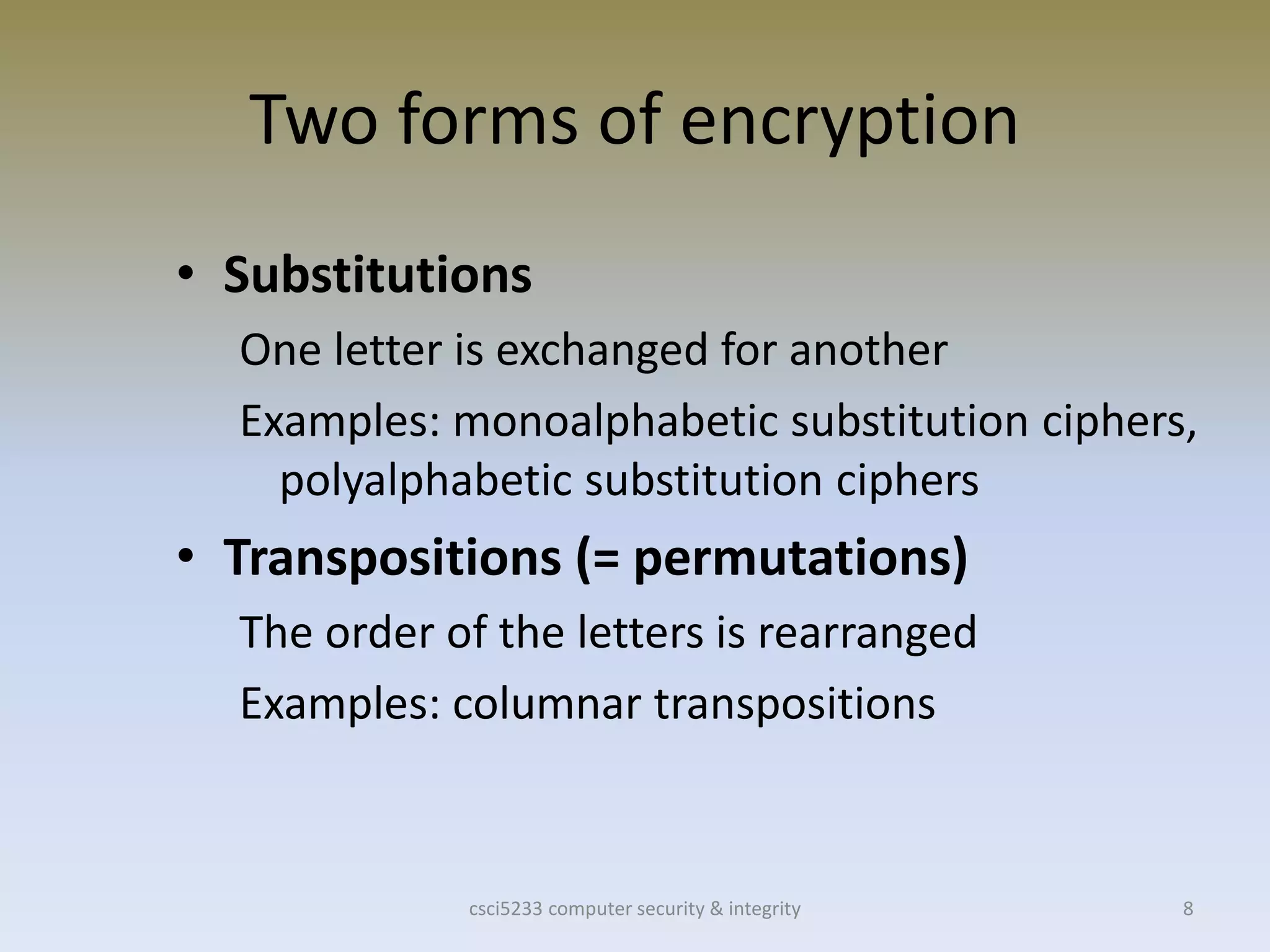
Two forms of encryption
• Substitutions
One letter is exchanged for another
Examples: monoalphabetic substitution ciphers,
polyalphabetic substitution ciphers
• Transpositions (= permutations)
The order of the letters is rearranged
Examples: columnar transpositions
9
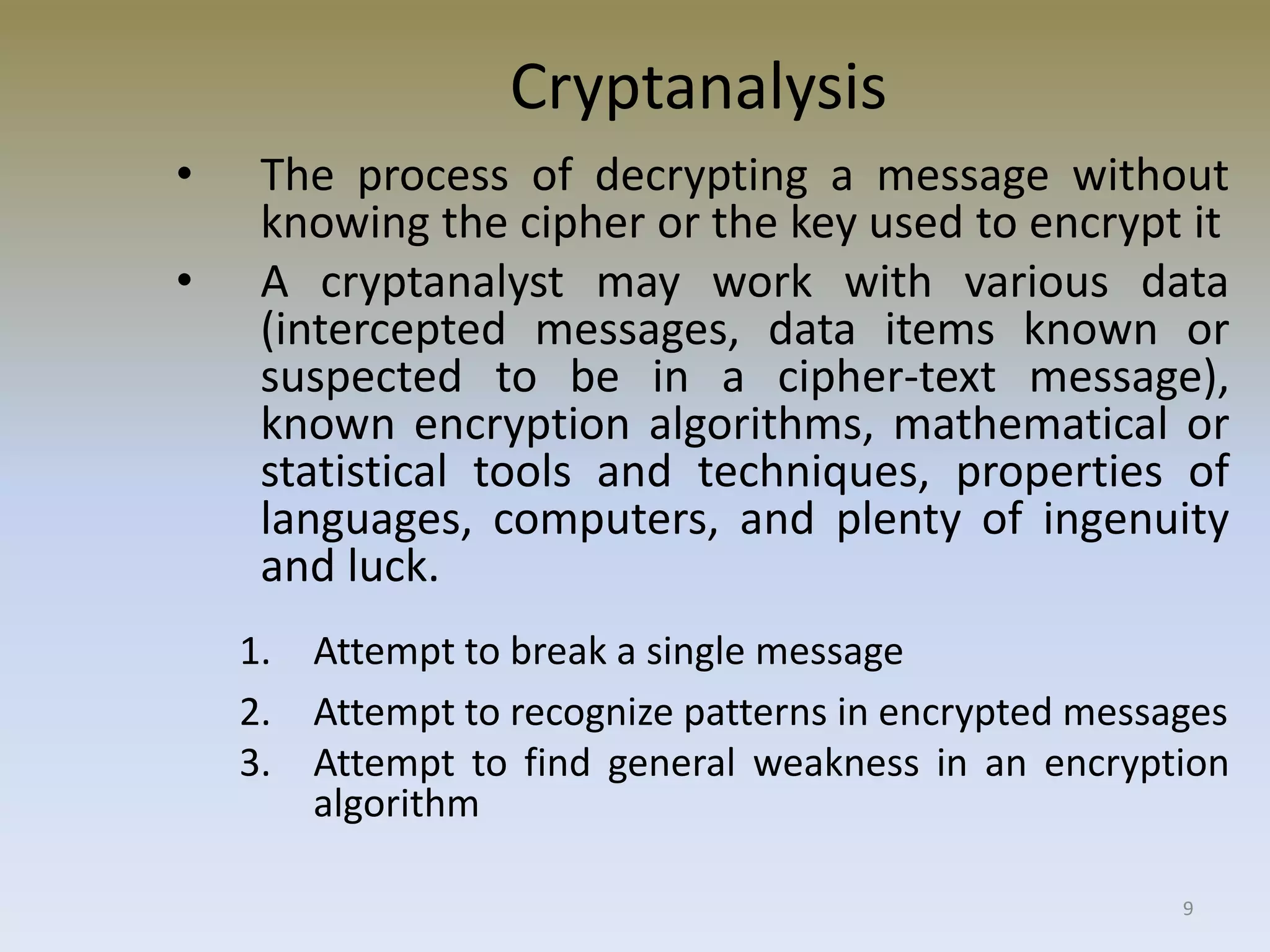
Cryptanalysis
• The process of decrypting a message without
knowing the cipher or the key used to encrypt it
• A cryptanalyst may work with various data
(intercepted messages, data items known or
suspected to be in a cipher-text message),
known encryption algorithms, mathematical or
statistical tools and techniques, properties of
languages, computers, and plenty of ingenuity
and luck.
1. Attempt to break a single message
2. Attempt to recognize patterns in encrypted messages
3. Attempt to find general weakness in an encryption
algorithm
Substitution Ciphers
• A cipher that substitutes one character with
another.
• These can be as simple as swapping a list, or
can be based on more complex rules.
• These are NOT secure anymore, but they used
to be quite common.
11
Caesar ciphers
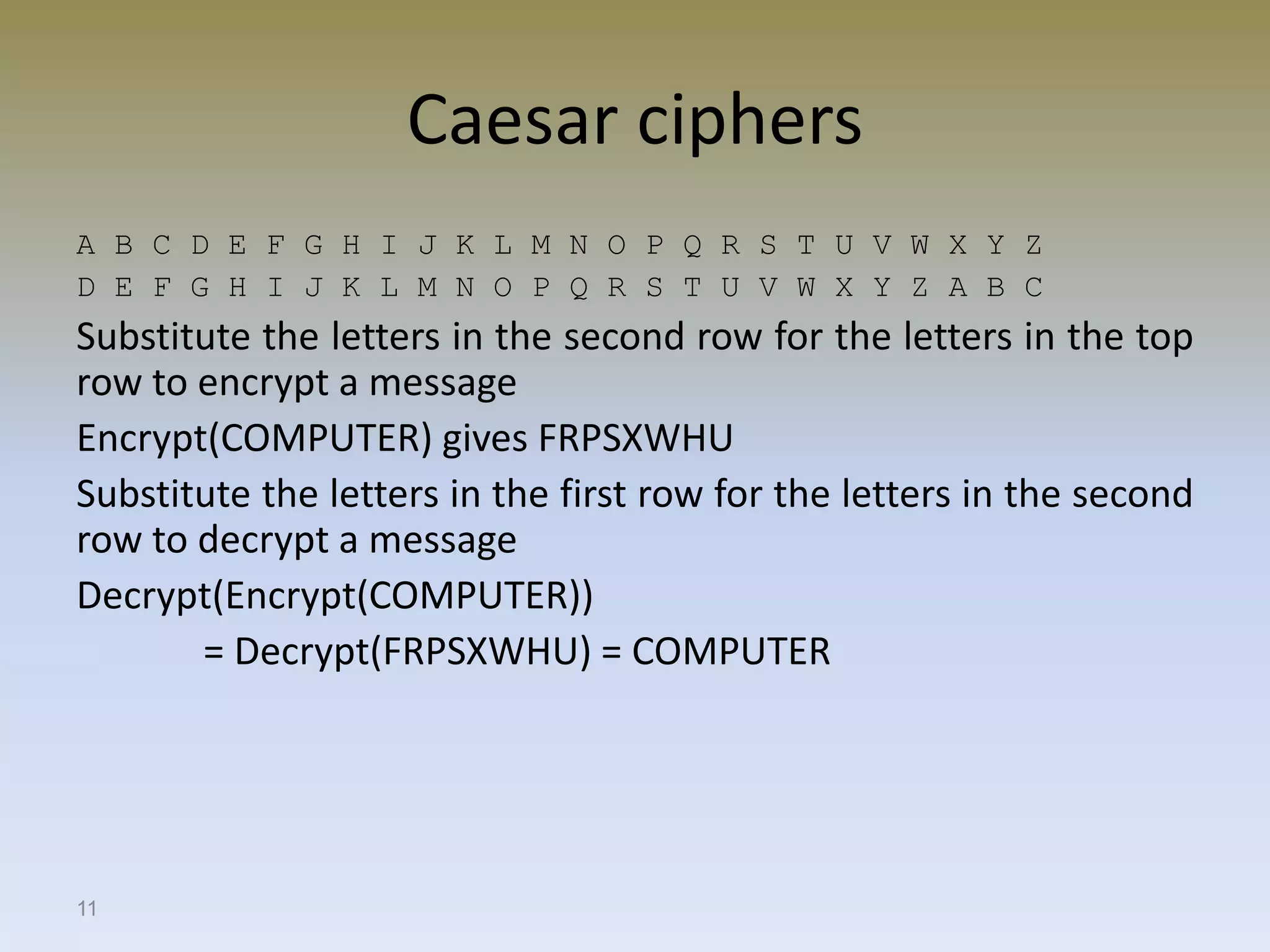
A B C D E F G H I J K L M N O P Q R S T U V W X Y Z
D E F G H I J K L M N O P Q R S T U V W X Y Z A B C
Substitute the letters in the second row for the letters in the top
row to encrypt a message
Encrypt(COMPUTER) gives FRPSXWHU
Substitute the letters in the first row for the letters in the second
row to decrypt a message
Decrypt(Encrypt(COMPUTER))
= Decrypt(FRPSXWHU) = COMPUTER
12
Transposition Cipher
T O D A Y
+ I S + M
O N D A Y
Write the letters in a row of five, using '+' as a blank. Encrypt by starting
spiraling inward from the top left moving counter clockwise
Encrypt(TODAY IS MONDAY) gives T+ONDAYMYADOIS+
Decrypt by recreating the grid and reading the letters across the row
The key are the dimension of the grid and the route used to encrypt the data
13
Cryptosystems
• Symmetric encryption:
P = D (Key, E(Key,P) )
• Asymmetric encryption:
P = D (KeyD, E(KeyE,P) )
• Symmetric cryptosystem: A cryptosystem
that uses symmetric encryption.
• Asymmetric cryptosystem: A cryptosystem
that uses Asymmetric encryption.
Encryption on computers
• Roughly speaking, there are two different broad
types of encryption that are used on computers
today
– Symmetric encryption relies on keeping keys totally secret
– Asymmetric encryption actually publicizes one key, but
keeps some information private also
• Neither is really “better” - they just use different
principles.
• In reality, both are vulnerable to attacks.
Secret Key Encryption
• Secret-key ciphers generally fall into one of
two categories:
– Stream Ciphers: A stream cipher applies the key
and algorithm one bit at a time.
– Block Ciphers: A block cipher applies a private key
and algorithm to a block of data simultaneously.
Symmetric Cryptography
• In cryptography, a private key (secret key) is a
variable that is used with an algorithm to
encrypt and decrypt code.
• It is also known as private key encryption, uses
the same private key for both encryption and
decryption. The risk in this system is that if
either party loses the key or the key is
intercepted, the system is broken and
messages cannot be exchanged securely.
Asymmetric Cryptography
• It is also known as public key encryption, uses
two different but mathematically linked keys.
The complexity and length of the private key
determine how feasible it is for an interloper
to carry out a brute force attack and try out
different keys until the right one is found. The
challenge for this system is that significant
computing resources are required to create
long, strong private keys.
Secret Key Algorithm
• A secret key algorithm (sometimes called
a symmetric algorithm) is a cryptographic
algorithm that uses the same key to encrypt
and decrypt data. The best known algorithm is
the U.S. Department of Defense's Data
Encryption Standard (DES). DES, which was
developed at IBM in 1977, was thought to be
so difficult to break that the U.S. government
restricted its exportation.
RSA
• In 1977, Rivest, Shamir, and Adleman came up
with another way to use public key
cryptography
• Rather than secure key exchanges, this one
actually lets you encrypt whole messages
• Today, this is the most commonly used public
key cryptosystem on the market
Query Session
Wirtu Drddopm

Cryptography

  • 1.
    Cryptography A way ofTexting Secretly
  • 2.
    2 Cryptography Cryptography The field ofstudy related to encoded information (comes from Greek word for "secret writing") Encryption The process of converting plaintext into ciphertext Decryption The process of converting ciphertext into plaintext
  • 3.
  • 4.
    4 Cryptography Cipher An algorithm usedto encrypt and decrypt text Key The set of parameters that guide a cipher Neither is any good without the other
  • 5.
    5 Encryption / Decryption •Encryption: A process of encoding a message, so that its meaning is not obvious. (= encoding, enciphering) • Decryption: A process of decoding an encrypted message back into its original form. (= decoding, deciphering) • A cryptosystem is a system for encryption and decryption.
  • 6.
    6 Plaintext / ciphertext •P: plaintext • C: ciphertext • E: encryption • D: decryption • C = E (P) • P = D (C) • P = D ( E(P) )
  • 7.
    7 Terminology • Cryptography: Thepractice of using encryption to conceal text. (cryptographer) • Cryptanalysis: The study of encryption and encrypted messages, with the goal of finding the hidden meanings of the messages. (cryptanalyst) • Cryptology = cryptography + cryptanalysis
  • 8.
    csci5233 computer security& integrity 8 Two forms of encryption • Substitutions One letter is exchanged for another Examples: monoalphabetic substitution ciphers, polyalphabetic substitution ciphers • Transpositions (= permutations) The order of the letters is rearranged Examples: columnar transpositions
  • 9.
    9 Cryptanalysis • The processof decrypting a message without knowing the cipher or the key used to encrypt it • A cryptanalyst may work with various data (intercepted messages, data items known or suspected to be in a cipher-text message), known encryption algorithms, mathematical or statistical tools and techniques, properties of languages, computers, and plenty of ingenuity and luck. 1. Attempt to break a single message 2. Attempt to recognize patterns in encrypted messages 3. Attempt to find general weakness in an encryption algorithm
  • 10.
    Substitution Ciphers • Acipher that substitutes one character with another. • These can be as simple as swapping a list, or can be based on more complex rules. • These are NOT secure anymore, but they used to be quite common.
  • 11.
    11 Caesar ciphers A BC D E F G H I J K L M N O P Q R S T U V W X Y Z D E F G H I J K L M N O P Q R S T U V W X Y Z A B C Substitute the letters in the second row for the letters in the top row to encrypt a message Encrypt(COMPUTER) gives FRPSXWHU Substitute the letters in the first row for the letters in the second row to decrypt a message Decrypt(Encrypt(COMPUTER)) = Decrypt(FRPSXWHU) = COMPUTER
  • 12.
    12 Transposition Cipher T OD A Y + I S + M O N D A Y Write the letters in a row of five, using '+' as a blank. Encrypt by starting spiraling inward from the top left moving counter clockwise Encrypt(TODAY IS MONDAY) gives T+ONDAYMYADOIS+ Decrypt by recreating the grid and reading the letters across the row The key are the dimension of the grid and the route used to encrypt the data
  • 13.
    13 Cryptosystems • Symmetric encryption: P= D (Key, E(Key,P) ) • Asymmetric encryption: P = D (KeyD, E(KeyE,P) ) • Symmetric cryptosystem: A cryptosystem that uses symmetric encryption. • Asymmetric cryptosystem: A cryptosystem that uses Asymmetric encryption.
  • 14.
    Encryption on computers •Roughly speaking, there are two different broad types of encryption that are used on computers today – Symmetric encryption relies on keeping keys totally secret – Asymmetric encryption actually publicizes one key, but keeps some information private also • Neither is really “better” - they just use different principles. • In reality, both are vulnerable to attacks.
  • 15.
    Secret Key Encryption •Secret-key ciphers generally fall into one of two categories: – Stream Ciphers: A stream cipher applies the key and algorithm one bit at a time. – Block Ciphers: A block cipher applies a private key and algorithm to a block of data simultaneously.
  • 16.
    Symmetric Cryptography • Incryptography, a private key (secret key) is a variable that is used with an algorithm to encrypt and decrypt code. • It is also known as private key encryption, uses the same private key for both encryption and decryption. The risk in this system is that if either party loses the key or the key is intercepted, the system is broken and messages cannot be exchanged securely.
  • 17.
    Asymmetric Cryptography • Itis also known as public key encryption, uses two different but mathematically linked keys. The complexity and length of the private key determine how feasible it is for an interloper to carry out a brute force attack and try out different keys until the right one is found. The challenge for this system is that significant computing resources are required to create long, strong private keys.
  • 18.
    Secret Key Algorithm •A secret key algorithm (sometimes called a symmetric algorithm) is a cryptographic algorithm that uses the same key to encrypt and decrypt data. The best known algorithm is the U.S. Department of Defense's Data Encryption Standard (DES). DES, which was developed at IBM in 1977, was thought to be so difficult to break that the U.S. government restricted its exportation.
  • 19.
    RSA • In 1977,Rivest, Shamir, and Adleman came up with another way to use public key cryptography • Rather than secure key exchanges, this one actually lets you encrypt whole messages • Today, this is the most commonly used public key cryptosystem on the market
  • 20.