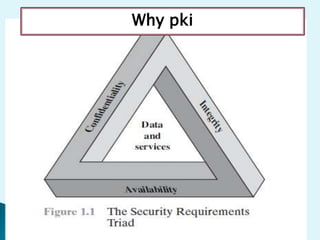
Why pki
 Preserving authorized restrictions on
information access and disclosure, including
means for protecting personal privacy and
proprietary information. A loss of
confidentiality is the unauthorized disclosure
of information.
 Guarding against improper information
modification or destruction, including
ensuring information nonrepudiation and
authenticity. A loss of integrity is the
unauthorized modification or destruction of
information.
 Ensuring timely and reliable access to and use
of information. A loss of availability is the
disruption of access to or use of information
or an information system.
CIA triad to define security objectives.
 Cryptography is the science of writing in secret
code.
 The first documented use of cryptography in
writing dates back to circa 1900 B.C.
 New forms of cryptography came soon after the
widespread development of computer
communications.
 In data and telecommunications, cryptography is
necessary when communicating over any
untrusted medium, which includes just about any
network, particularly the Internet.
 Authentication: The process of proving one's
identity. (The primary forms of host-to-host
authentication on the Internet today are name-
based or address-based, both of which are
notoriously weak.)
 Privacy/confidentiality: Ensuring that no one can
read the message except the intended receiver.
 Integrity: Assuring the receiver that the received
message has not been altered in any way from
the original.
 Non-repudiation: A mechanism to prove that the
sender really sent this message.
 We will discussed three type of Cryptographic
algorithms
1 Secret key cryptographic
2 Public key cryptographic
3 Hash function
 objective to recover key not just message
 general approaches:
◦ cryptanalytic attack
◦ brute-force attack
 if either succeed all key use compromised
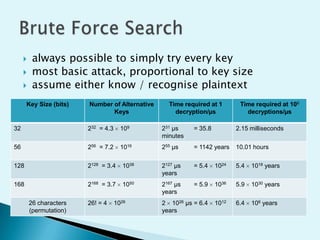
 always possible to simply try every key
 most basic attack, proportional to key size
 assume either know / recognise plaintext
Key Size (bits) Number of Alternative
Keys
Time required at 1
decryption/µs
Time required at 106
decryptions/µs
32 232 = 4.3 109 231 µs = 35.8
minutes
2.15 milliseconds
56 256 = 7.2 1016 255 µs = 1142 years 10.01 hours
128 2128 = 3.4 1038 2127 µs = 5.4 1024
years
5.4 1018 years
168 2168 = 3.7 1050 2167 µs = 5.9 1036
years
5.9 1030 years
26 characters
(permutation)
26! = 4 1026 2 1026 µs = 6.4 1012
years
6.4 106 years
Basic concept of pki

Basic concept of pki

  • 2.
  • 3.
     Preserving authorizedrestrictions on information access and disclosure, including means for protecting personal privacy and proprietary information. A loss of confidentiality is the unauthorized disclosure of information.
  • 4.
     Guarding againstimproper information modification or destruction, including ensuring information nonrepudiation and authenticity. A loss of integrity is the unauthorized modification or destruction of information.
  • 5.
     Ensuring timelyand reliable access to and use of information. A loss of availability is the disruption of access to or use of information or an information system. CIA triad to define security objectives.
  • 7.
     Cryptography isthe science of writing in secret code.  The first documented use of cryptography in writing dates back to circa 1900 B.C.  New forms of cryptography came soon after the widespread development of computer communications.  In data and telecommunications, cryptography is necessary when communicating over any untrusted medium, which includes just about any network, particularly the Internet.
  • 8.
     Authentication: Theprocess of proving one's identity. (The primary forms of host-to-host authentication on the Internet today are name- based or address-based, both of which are notoriously weak.)  Privacy/confidentiality: Ensuring that no one can read the message except the intended receiver.  Integrity: Assuring the receiver that the received message has not been altered in any way from the original.  Non-repudiation: A mechanism to prove that the sender really sent this message.
  • 9.
     We willdiscussed three type of Cryptographic algorithms 1 Secret key cryptographic 2 Public key cryptographic 3 Hash function
  • 11.
     objective torecover key not just message  general approaches: ◦ cryptanalytic attack ◦ brute-force attack  if either succeed all key use compromised
  • 12.
     always possibleto simply try every key  most basic attack, proportional to key size  assume either know / recognise plaintext Key Size (bits) Number of Alternative Keys Time required at 1 decryption/µs Time required at 106 decryptions/µs 32 232 = 4.3 109 231 µs = 35.8 minutes 2.15 milliseconds 56 256 = 7.2 1016 255 µs = 1142 years 10.01 hours 128 2128 = 3.4 1038 2127 µs = 5.4 1024 years 5.4 1018 years 168 2168 = 3.7 1050 2167 µs = 5.9 1036 years 5.9 1030 years 26 characters (permutation) 26! = 4 1026 2 1026 µs = 6.4 1012 years 6.4 106 years