Good Morning!Today we will:conduct an investigationtake some notescomplete a success criteria checkPlease do before the bell:get your lab notebookget out something to write withget a textbook and open to page 321
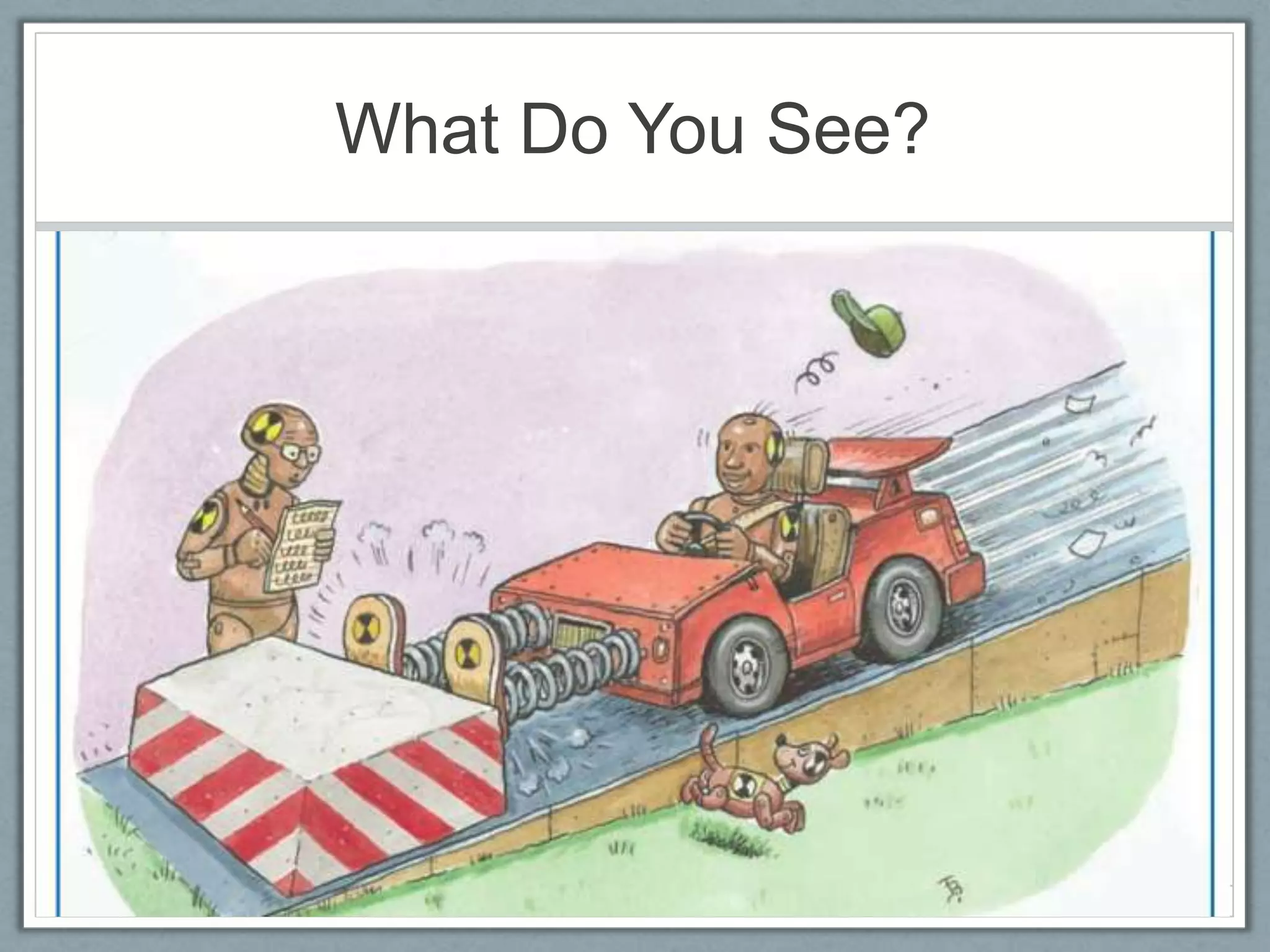
What Do You See?
Lab: Crumple ZonesMake a new entry in your lab book. Title it, “Impulse and Changes in Momentum: Crumple Zone”Be sure to make the corresponding entry in your Table of Contents
Read pages 321 - 322We will be doing Part A of the lab today. While reading about it, pay special attention to:materials you will usewhat you will be doing/investigating3 minutes
Crumple ZonesWhat are some of the factors that automobile designers and engineers must consider when designing a crumple zone as a safety feature?1:2:4: Copy this question down in your lab book and jot down your ideas2 minutes
Crumple ZonesShare your ideas with your table partner; add anything to your list that you think of while discussing with your partner2 minNow share with the table behind/in front of you2 min
Lab: Crumple ZonesIn this lab, your group will design what it thinks will be the best crumple zone – you will be given one sheet of paper, 30 cm of tape, 2 rubber bands, and 30 cm of string with which to do so.
Lab: Crumple ZonesSet up your ramp, cart, block and books (you can also use the wall) as shown in the picture. Test your set-up to be sure that the car will successfully roll down the ramp and crash into the books/wall.5 minutes
Lab: Crumple ZonesIn your lab group, discuss, design, and attach your crumple zone to the cart. Your goal: design a crumple zone that will keep the block from tipping over from ramp heights greater than 15 cm.Diagram your design in your lab notebook. Be sure to label your design!12 minutes
Lab Debrief: What works, what doesn’t?The tape doesn’t help hold the block in place when the cart crashes. Why?
Forces Affecting CollisionsThe goal of a crumple zone is to add “cushioning.” How can we describe cushioning in scientific language?cushioning = increased stopping distance
cushioning = increased stopping timeThe Math of Increased Stopping DistanceWe already know:work done = force x distancework done = ΔKEFrom these relationships, we get:ΔKE = force x distanceWe call this the Kinetic Energy – Work Theorem
ΔKE = force x distanceLooking at that relationship between the change in kinetic energy, force and distance, keep something in mind:An object in motion has a “set” kinetic energy: it is a factor of its mass and its velocity. To change that kinetic energy, work (force x distance) must be done.
ΔKE = force x distanceSo, for a given kinetic energy, what happens to force as distance is increased?as distance increases, force decreases
The Math of Increased Stopping TimeInstead of focusing on the distance over which a force acts, we can focus on the amount of time over which a force acts.We already know:Ft = ΔmomentumAnd just like with kinetic energy, the momentum an object has is “set” for a given situation.
Ft = ΔmvSo if the Δmv is set (say from 1000 kgm/s to zero kgm/s), what happens to force as time is increased?as time in increased, force is decreased
Impulse = Change in MomentumWhat would this relationship look like in a formula?Ft = ΔmvThe change in momentum is called impulse
Work & Energy? Or Impulse & Momentum?EITHER!The work-energy theorem and the impulse-momentum theorem both describe the effect of “cushioning.”As a student, it is you job to figure out which relationship is more appropriate to use given what you know about a situation.
Designing a Safer VehicleDesigning a safety device for a vehicle is often centered around finding ways to decrease the force and increase the time/distance of an impact.

Crumple Zones: Impulse and Momentum

  • 2.
    Good Morning!Today wewill:conduct an investigationtake some notescomplete a success criteria checkPlease do before the bell:get your lab notebookget out something to write withget a textbook and open to page 321
  • 3.
  • 4.
    Lab: Crumple ZonesMakea new entry in your lab book. Title it, “Impulse and Changes in Momentum: Crumple Zone”Be sure to make the corresponding entry in your Table of Contents
  • 5.
    Read pages 321- 322We will be doing Part A of the lab today. While reading about it, pay special attention to:materials you will usewhat you will be doing/investigating3 minutes
  • 6.
    Crumple ZonesWhat aresome of the factors that automobile designers and engineers must consider when designing a crumple zone as a safety feature?1:2:4: Copy this question down in your lab book and jot down your ideas2 minutes
  • 7.
    Crumple ZonesShare yourideas with your table partner; add anything to your list that you think of while discussing with your partner2 minNow share with the table behind/in front of you2 min
  • 8.
    Lab: Crumple ZonesInthis lab, your group will design what it thinks will be the best crumple zone – you will be given one sheet of paper, 30 cm of tape, 2 rubber bands, and 30 cm of string with which to do so.
  • 9.
    Lab: Crumple ZonesSetup your ramp, cart, block and books (you can also use the wall) as shown in the picture. Test your set-up to be sure that the car will successfully roll down the ramp and crash into the books/wall.5 minutes
  • 10.
    Lab: Crumple ZonesInyour lab group, discuss, design, and attach your crumple zone to the cart. Your goal: design a crumple zone that will keep the block from tipping over from ramp heights greater than 15 cm.Diagram your design in your lab notebook. Be sure to label your design!12 minutes
  • 11.
    Lab Debrief: Whatworks, what doesn’t?The tape doesn’t help hold the block in place when the cart crashes. Why?
  • 12.
    Forces Affecting CollisionsThegoal of a crumple zone is to add “cushioning.” How can we describe cushioning in scientific language?cushioning = increased stopping distance
  • 13.
    cushioning = increasedstopping timeThe Math of Increased Stopping DistanceWe already know:work done = force x distancework done = ΔKEFrom these relationships, we get:ΔKE = force x distanceWe call this the Kinetic Energy – Work Theorem
  • 14.
    ΔKE = forcex distanceLooking at that relationship between the change in kinetic energy, force and distance, keep something in mind:An object in motion has a “set” kinetic energy: it is a factor of its mass and its velocity. To change that kinetic energy, work (force x distance) must be done.
  • 15.
    ΔKE = forcex distanceSo, for a given kinetic energy, what happens to force as distance is increased?as distance increases, force decreases
  • 16.
    The Math ofIncreased Stopping TimeInstead of focusing on the distance over which a force acts, we can focus on the amount of time over which a force acts.We already know:Ft = ΔmomentumAnd just like with kinetic energy, the momentum an object has is “set” for a given situation.
  • 17.
    Ft = ΔmvSoif the Δmv is set (say from 1000 kgm/s to zero kgm/s), what happens to force as time is increased?as time in increased, force is decreased
  • 18.
    Impulse = Changein MomentumWhat would this relationship look like in a formula?Ft = ΔmvThe change in momentum is called impulse
  • 19.
    Work & Energy?Or Impulse & Momentum?EITHER!The work-energy theorem and the impulse-momentum theorem both describe the effect of “cushioning.”As a student, it is you job to figure out which relationship is more appropriate to use given what you know about a situation.
  • 20.
    Designing a SaferVehicleDesigning a safety device for a vehicle is often centered around finding ways to decrease the force and increase the time/distance of an impact.