Force and
 Motion
   6.7.1
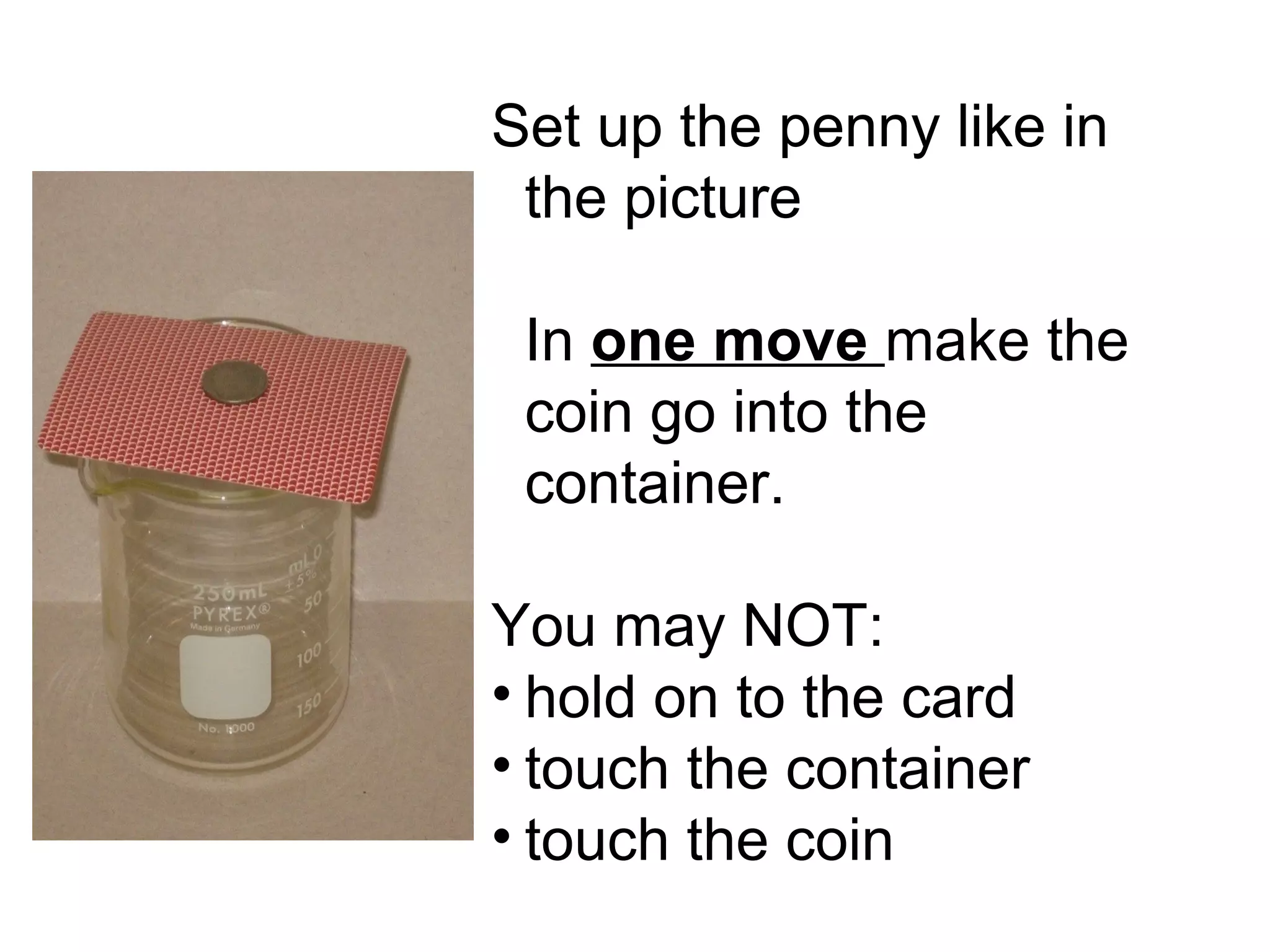
Set up the penny as you see it in the picture
                    In one move make the
                     coin go into the
                     container.

                    You may:
                    • touch the card

                    You may NOT:
                    • hold the card
                    • touch the container
                    • touch the coin
1.What was the force in
  your demonstration?

2.What was the resulting
     motion in your
    demonstration?
Target
I will be able to
  explain how
forces affect an
object’s motion.
Words we use when we speak about
        force and motion

• Look at the words in the Break Down
 Definitions
• These are words we use when we talk
 about force and motion
• As we go through each words, think
 about a picture you may draw to
 represent the word
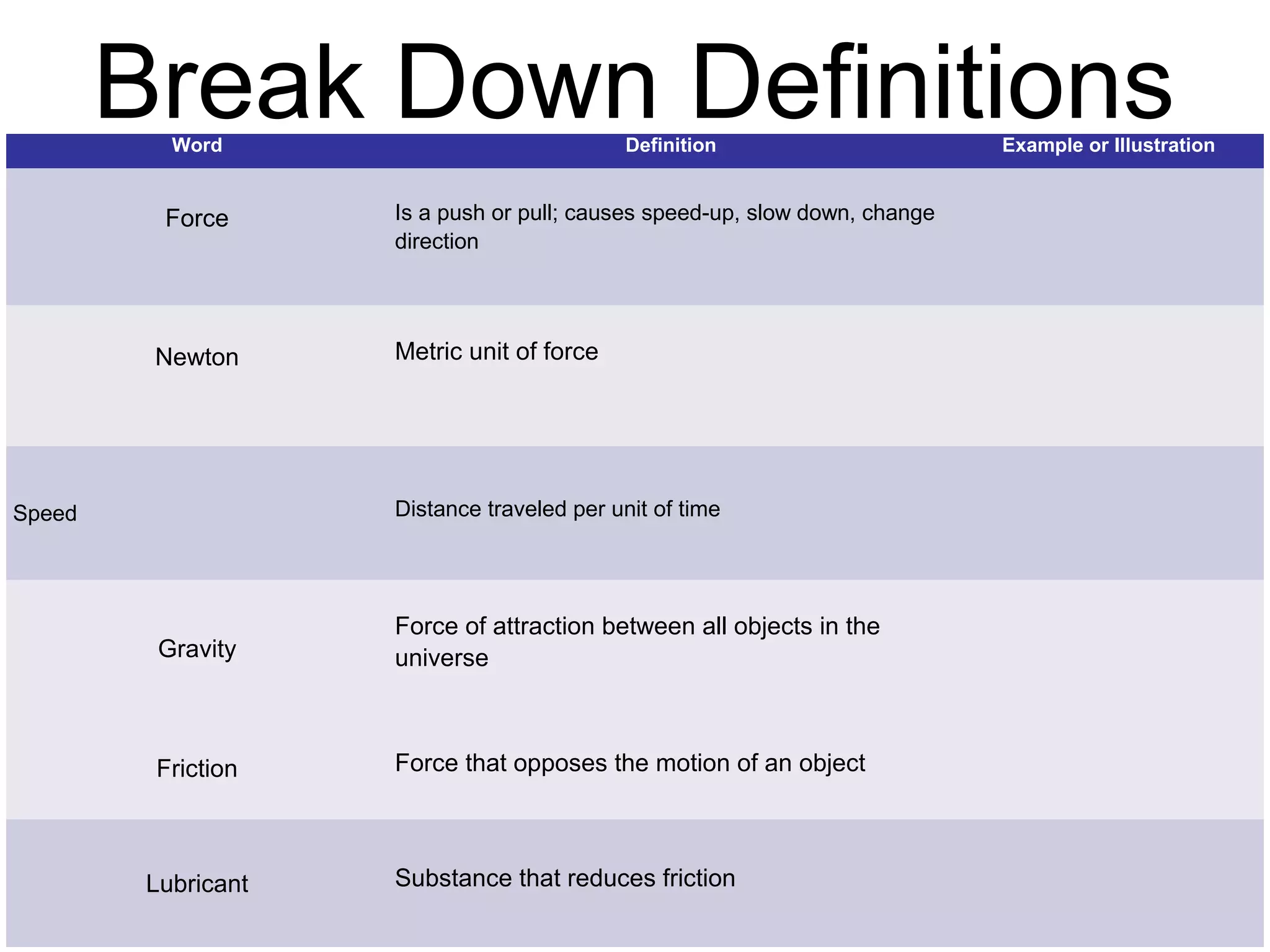
Break Down Definitions
 Word                        Definition                  Example or
                                                         Illustration

            Is a push or pull; causes speed-up, slow
 Force
            down, change direction


Newton      Metric unit of force


            Distance traveled per unit of time
 Speed

            Force of attraction between all objects in
 Gravity    the universe

            Force that opposes the motion of an
Friction
            object

Lubricant   Substance that reduces friction
Break Down Definitions
                                                       Example or
      Word                     Definition
                                                       Illustration

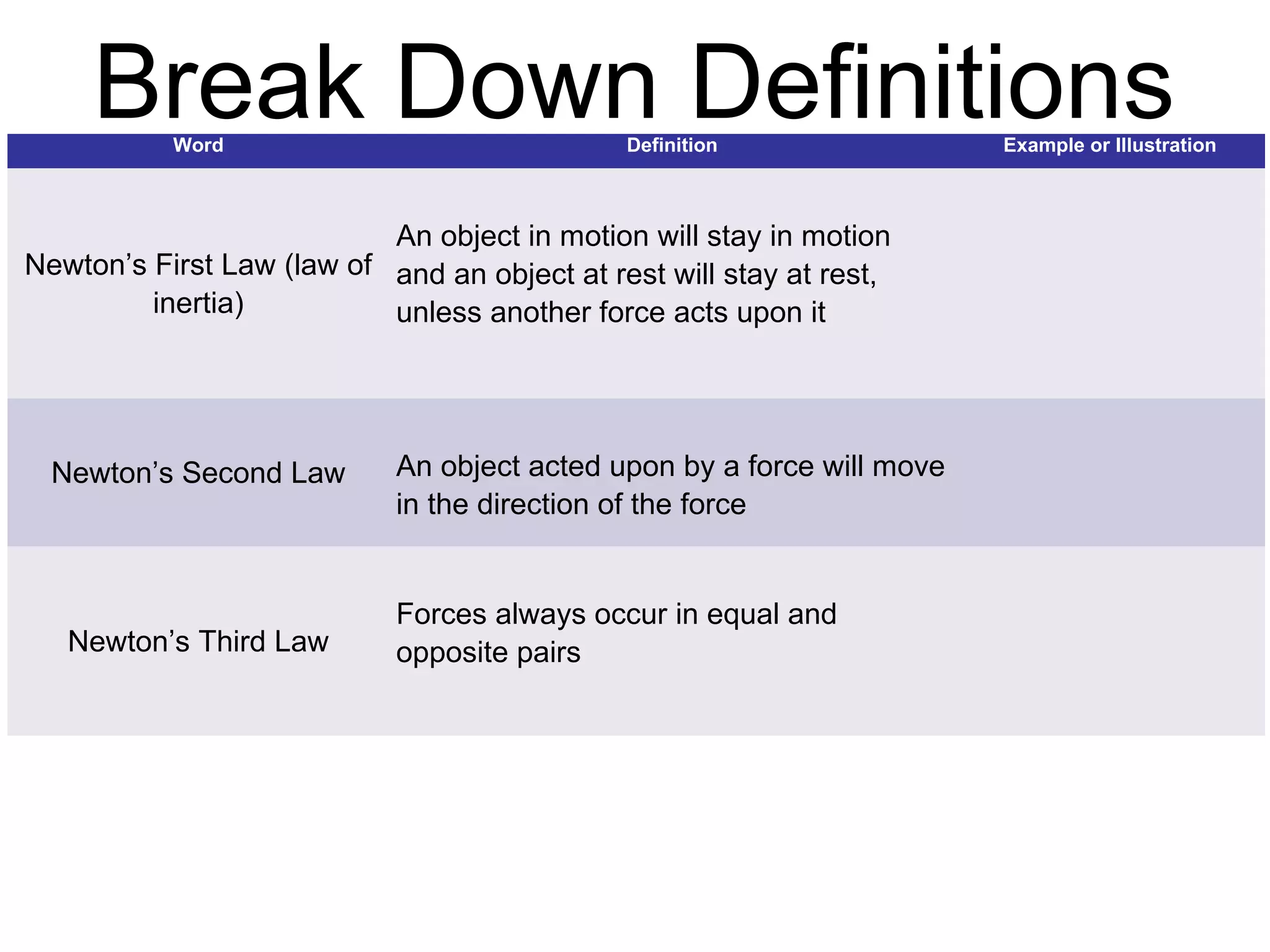
                   An object in motion will stay in
Newton’s First Law motion and an object at rest
  (law of inertia) will stay at rest, unless another
                   force acts upon it

 Newton’s Second    An object acted upon by a
      Law           force will move in the direction
                    of the force


Newton’s Third Law Forces always occur in equal
                   and opposite pairs
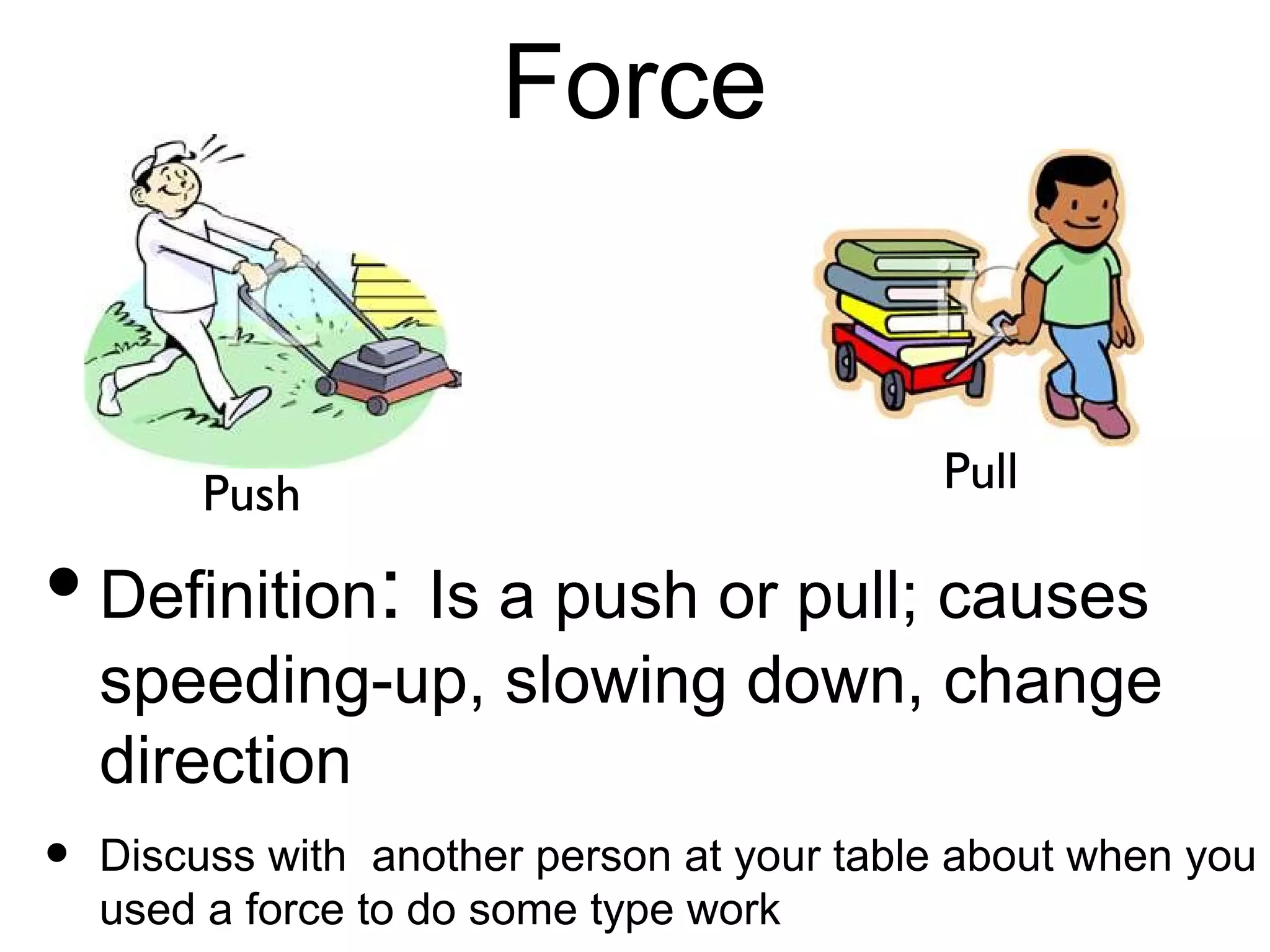
Force


      Push                         Pull
• Definition: Is a push or pull; causes
  speeding-up, slowing down, change
  direction
• Discuss withanother person at your table
  about when you used a force to do some
  type work
Force Station
•   Challenge: arrange the blocks so that if one block is
    pushed it will make the rest of the blocks move or fall
    (domino effect)
     •   What is the force?
     •   What motion occurred because of the force?
     •   Did the force cause a speeding-up, slowing down or a
         change in direction? (explain)
•   Pull the chair away from the table.
     •   What was the force?
     •   What motion occurred because of the force?
     •   Did the force cause speeding-up, slowing down or a
         change in direction? (explain)
Draw a picture for force


On p.2 of your handout draw
a picture next to the
definition of force that will
remind you of what force is.
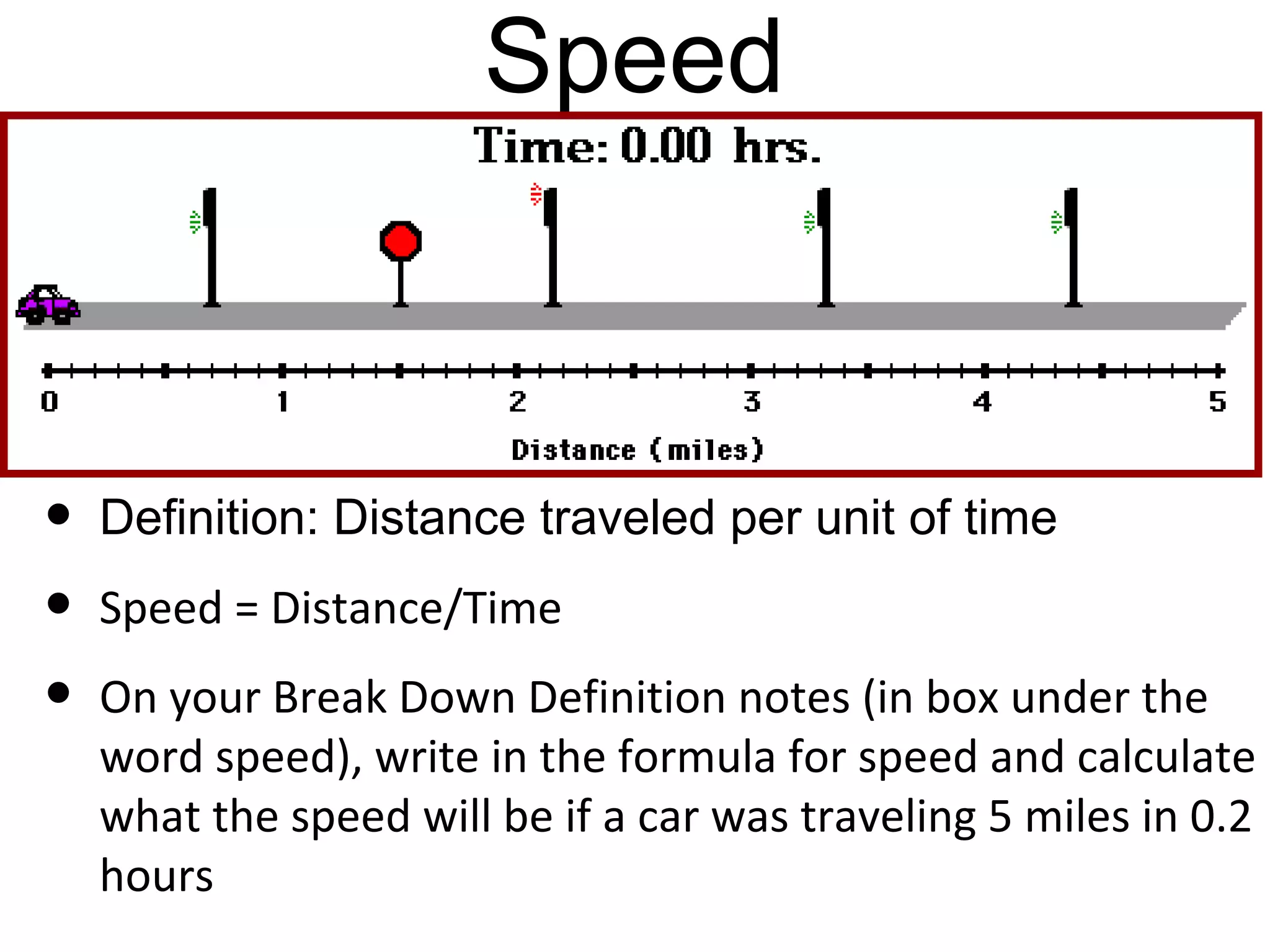
Speed


•   Definition: Distance traveled per unit of time
•   Speed = Distance/Time
•   On your Break Down Definition notes (in box under the
    word speed), write in the formula for speed and calculate
    what the speed will be if a car was traveling 5 miles in 0.2
    hours
Speed Station:
Marbles on a ramp
• Speed= Distance traveled per unit of time
• Challenge: Calculate speed (Speed = Distance/Time)
1. Time how long it takes the marble to travel a distance of one
   meter with an incline of 2 blocks.
2. Predict: What would happen to the speed if the ramp’s incline
   was increased to 4 blocks?
3. Increase the incline to 4 blocks then calculate the marbles
   speed for a distance of one meter.
4. Explain what happened by comparing the speed of the marble
   on the first incline to the speed of the marble on the second
   incline.
Speed Station:
Marbles on a ramp
• Speed= Distance traveled per unit of time
• Challenge: Calculate speed (Speed =
   Distance/Time)
5. Predict: What would happen to the speed of the
   marble if the incline was decreased by one block?
6. Decrease the incline by one block then calculate the
   speed of the marble for a distance of one meter.
7. Explain what happened by comparing the speed of
   the last marble to the speed of the first two
   marbles.
Draw a picture for Speed

On p.2 of your handout draw a
picture next to the definition of
speed that will remind you of
what speed is, and how to
calculate it.
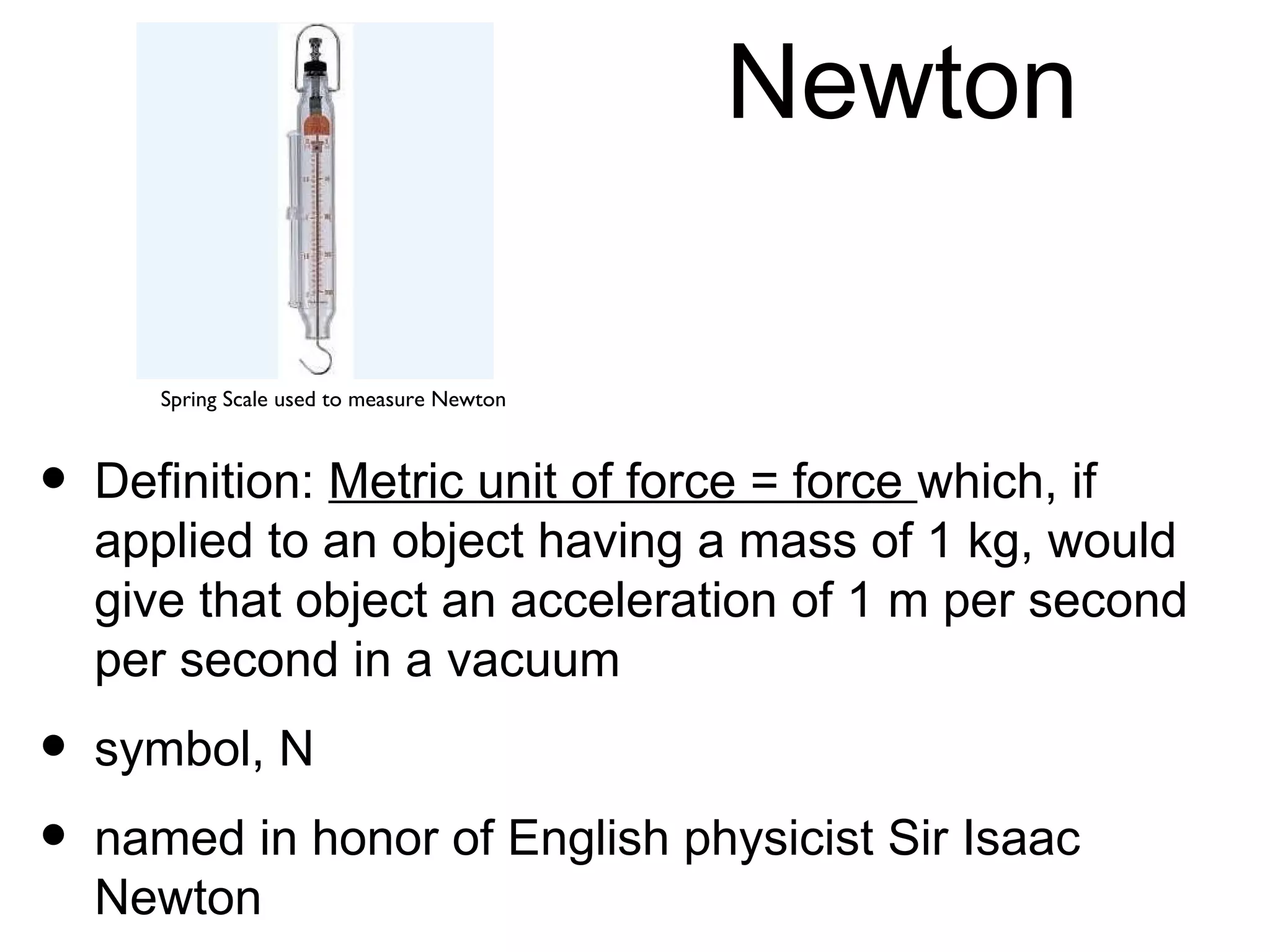
Newton

       Spring Scale used to measure Newton


•   Definition: Metric unit of force = force which, if
    applied to an object having a mass of 1 kg, would
    give that object an acceleration of 1 m per second
    per second in a vacuum
•   symbol, N
•   named in honor of English physicist Sir Isaac
    Newton
Friction Station
• Materials: Towel, Sandpaper, Wax paper, Table,
  Rubber
• Predict:  In your table write the types of surfaces
  in order from greatest amount of friction to least
  amount of friction.
• Using a spring scale drag a wood block over each
  surface and measure the amount of force (in
  Newtons) and write it on your table. Was your
  predictions correct? Explain.
• In your own words what is friction?
Friction
  The reason object slow down and
           eventually stop
• There are four main types of friction:
 • Sliding friction: sliding a book on a desk
 • Rolling friction: bicycle tires rolling
 • Fluid friction (gases or liquid): gases or water
    resistance
 • Static friction: initial friction when moving an
    object
Friction
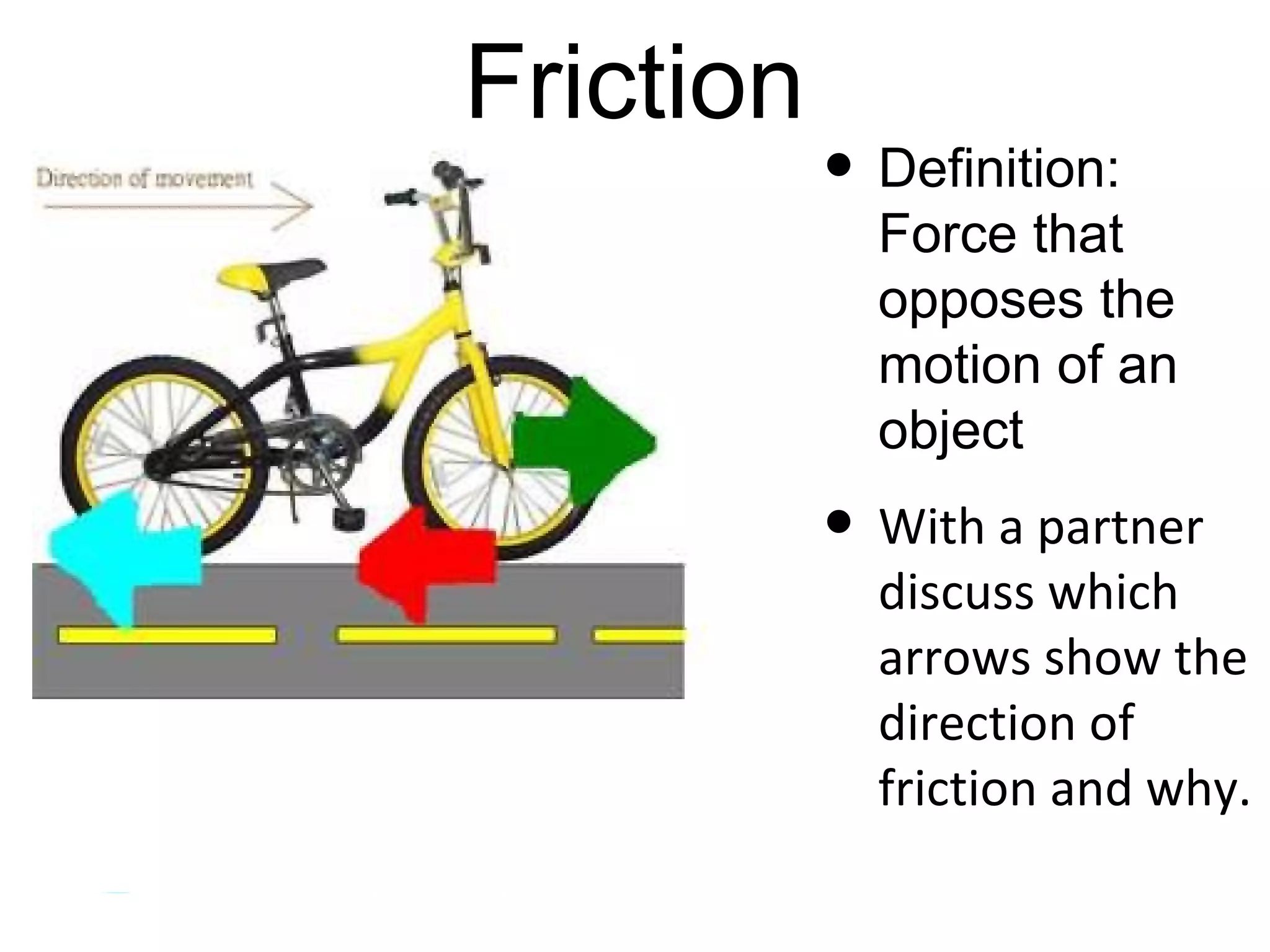
           • Definition:
             Force that
             opposes the
             motion of an
             object
           • With a partner
             discuss which
             arrows show the
             direction of
             friction and why.
Draw a picture for Newton


  On p.2 of your handout draw a
  picture next to the definition of
  Newton that will remind you of
        what a Newton is.
Draw a picture for Friction


On p.2 of your handout draw a
picture next to the definition of
friction that will remind you of
        what friction is.
Setup p.5 in your booklet
    for Cornell Notes
Drawing a picture for force, motion,
           and friction
1. Play gently with a car
2. Illustrate the car
3. Put arrows () and label the
   following:
 1. Direction of force
 2. Direction of motion
 3. Direction of friction
Gravity


• Read the article on gravity to
 yourself as we read it out loud
• Highlight the important words in
 the text
Watch video on Gravity
  on your teacher’s
      computer
Gravity


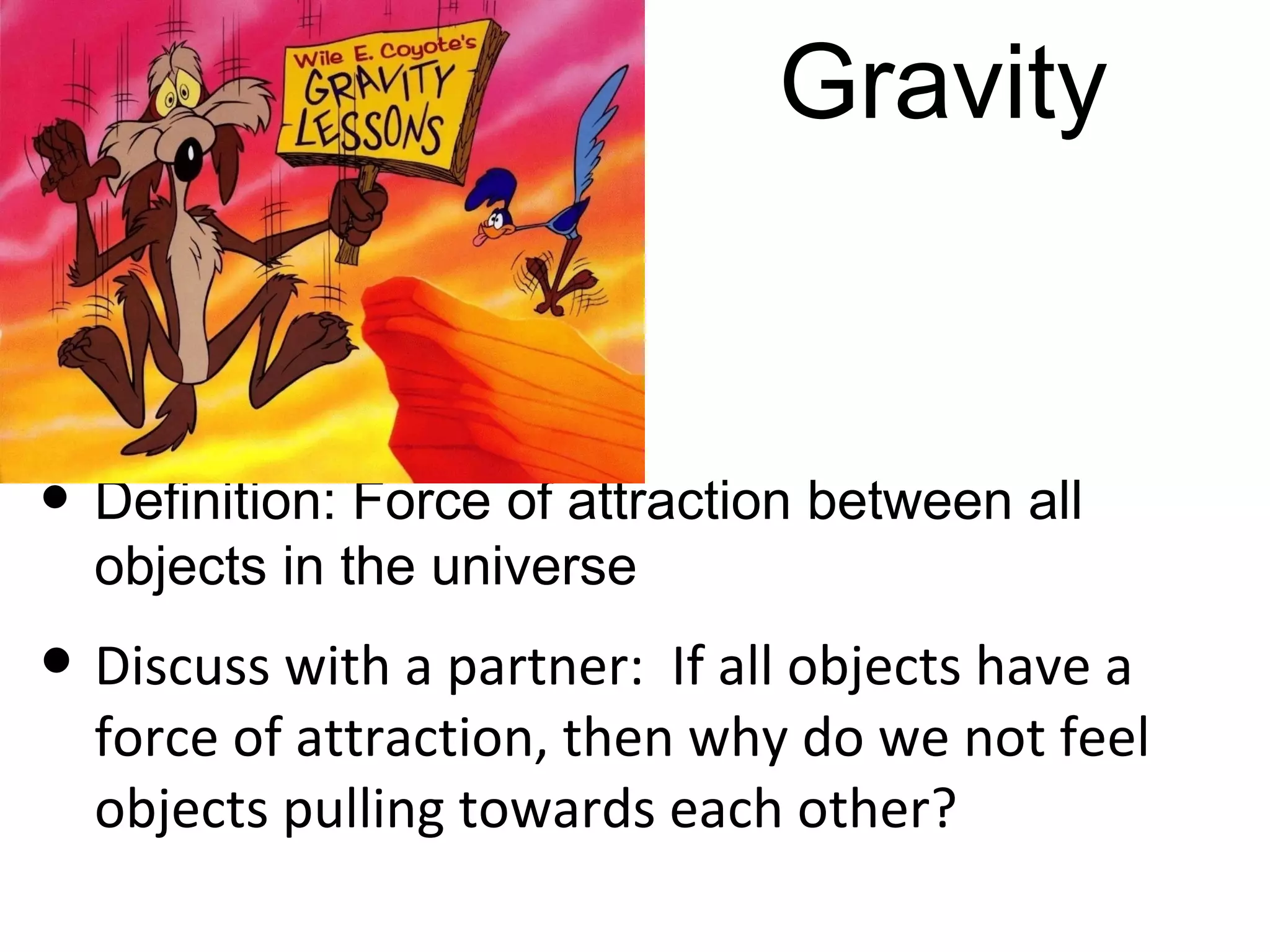
• Definition: Force of attraction between all
  objects in the universe

• Discuss with a partner: If all objects have a
  force of attraction, then why do we not feel
  objects pulling towards each other?
Draw a picture for Gravity


 On p.2 of your handout draw a
 picture next to the definition of
 gravity that will remind you of
        what a gravity is.
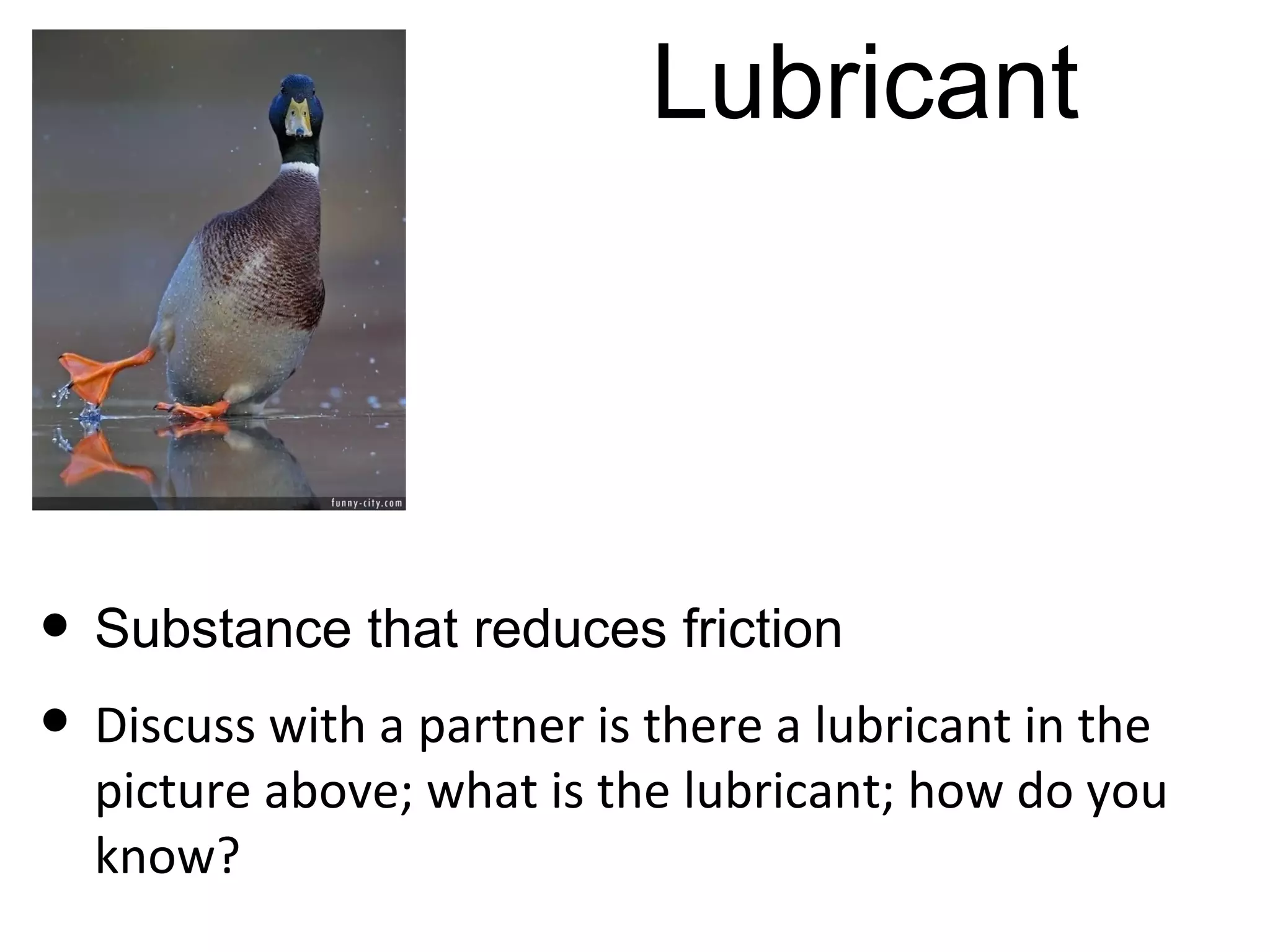
Lubricant


• Substance that reduces friction
• Discuss with a partner is there a lubricant in the
  picture above; what is the lubricant; how do you
  know?
Draw a picture for Lubricant


 On p.2 of your handout draw a
 picture next to the definition of
 lubricant that will remind you
     of what a lubricant is.
Newton’s Laws of Motion

• I. Law of Inertia
• II. Force and direction of
    motion
•   III. Action-Reaction
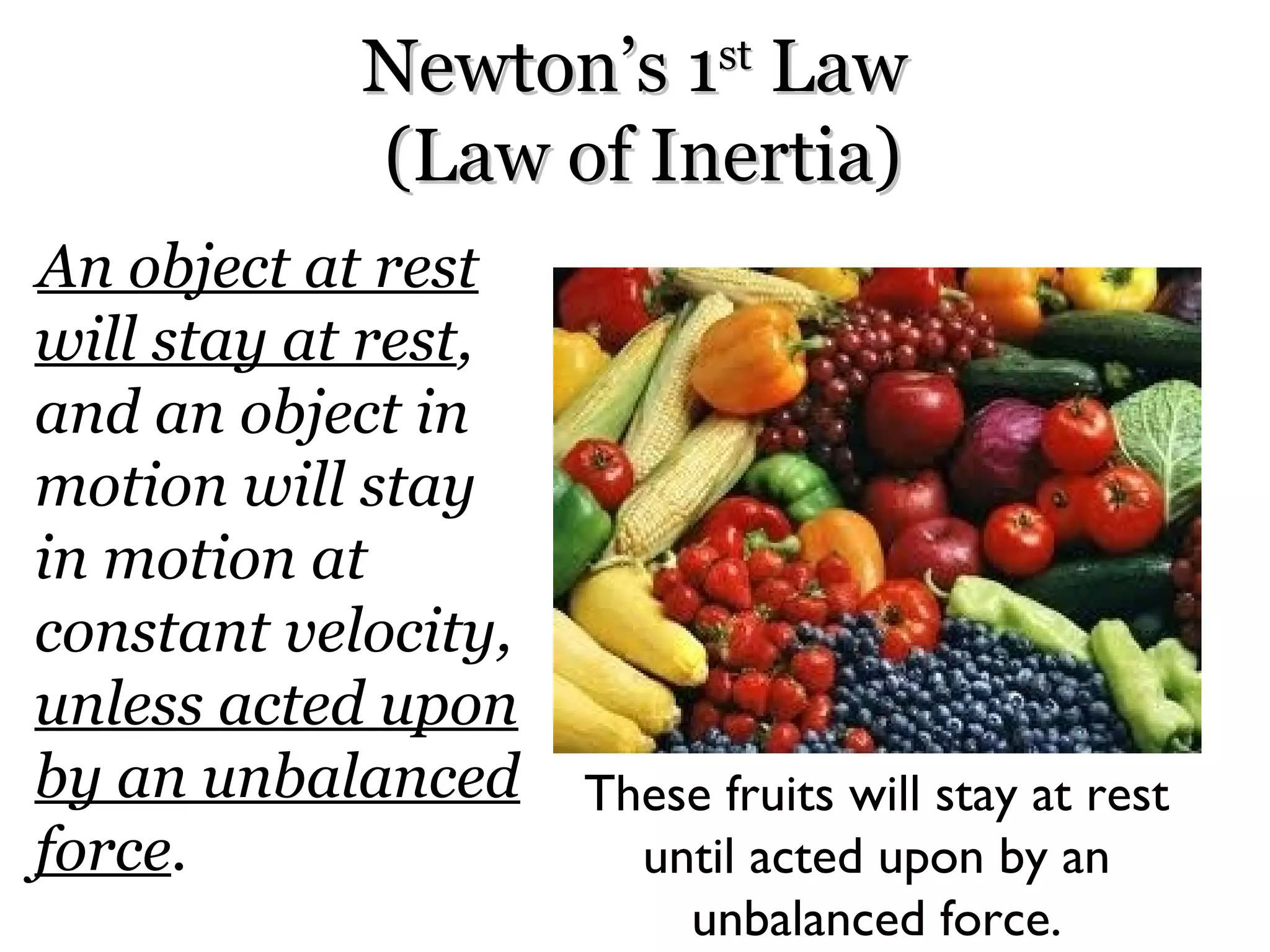
Newton’s 1 Law st

            (Law of Inertia)
An object at rest
will stay at rest,
and an object in
motion will stay
in motion at
constant velocity,
unless acted upon
by an unbalanced     These fruits will stay at rest
force.                 until acted upon by an
                         unbalanced force.
Pencil Example

• Put your pencil down on your table.
• Sit back, don’t touch the pencil or the table
  and observe it for 1 minute.
• What did the pencil do in that 1 minute?
• Now blow on the pencil or touch it with your
  finger… what did the pencil do?
Turn to p. 9 in your booklet
• Using Newton’s 1st law, explain what happened to
the pencil (both in the 1 minute observation and
the observations you had after you either blew or
touched the pencil)
•Sentence starter:  The pencil activity shows
Newton’s 1st law because…
•The force in the pencil example was _________
•The motion caused by the force was _________
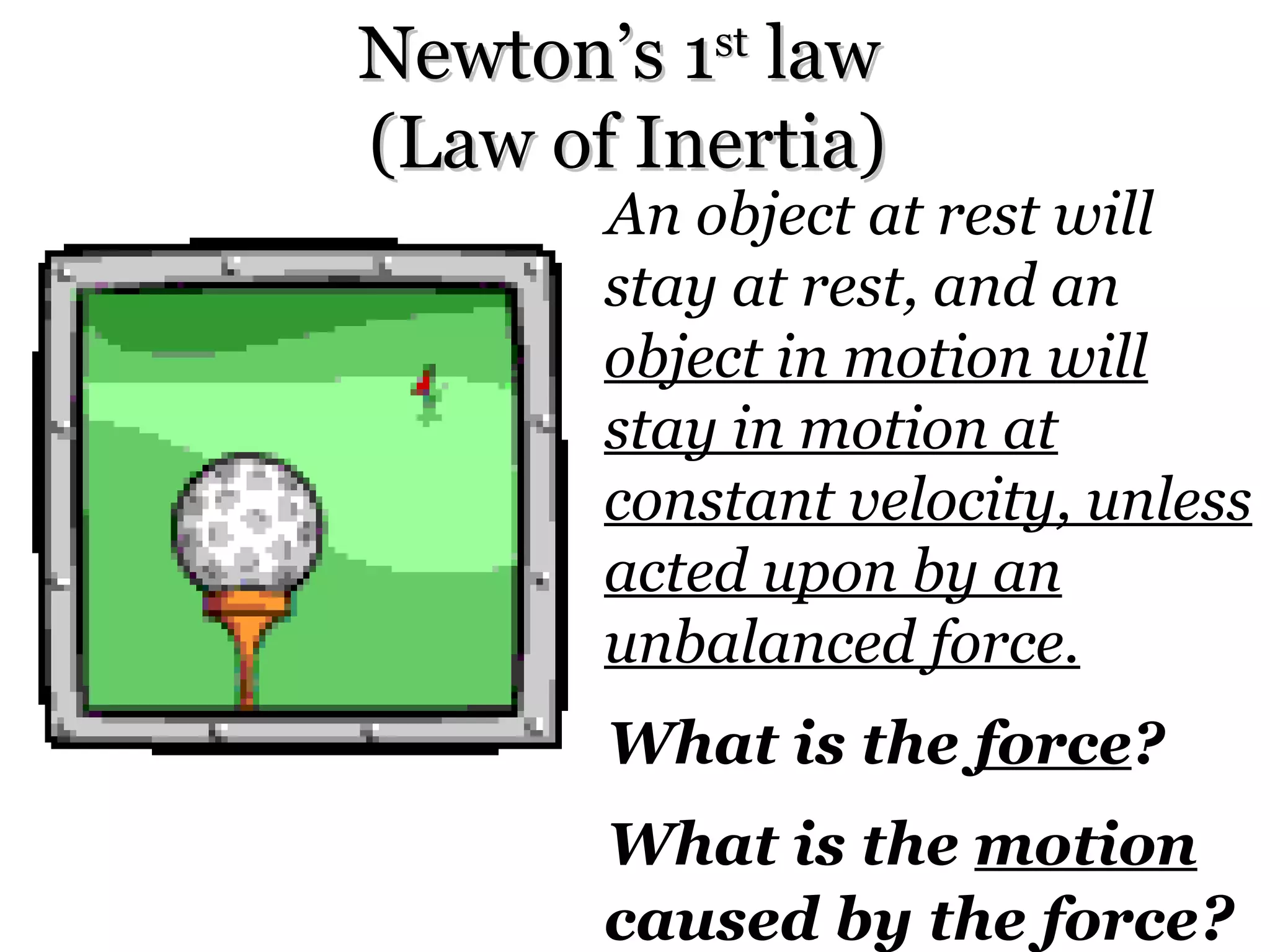
Newton’s 1 law
           st

(Law of Inertia)
       An object at rest will
       stay at rest, and an
       object in motion will
       stay in motion at
       constant velocity, unless
       acted upon by an
       unbalanced force.
       What is the force?
       What is the motion
       caused by the force?
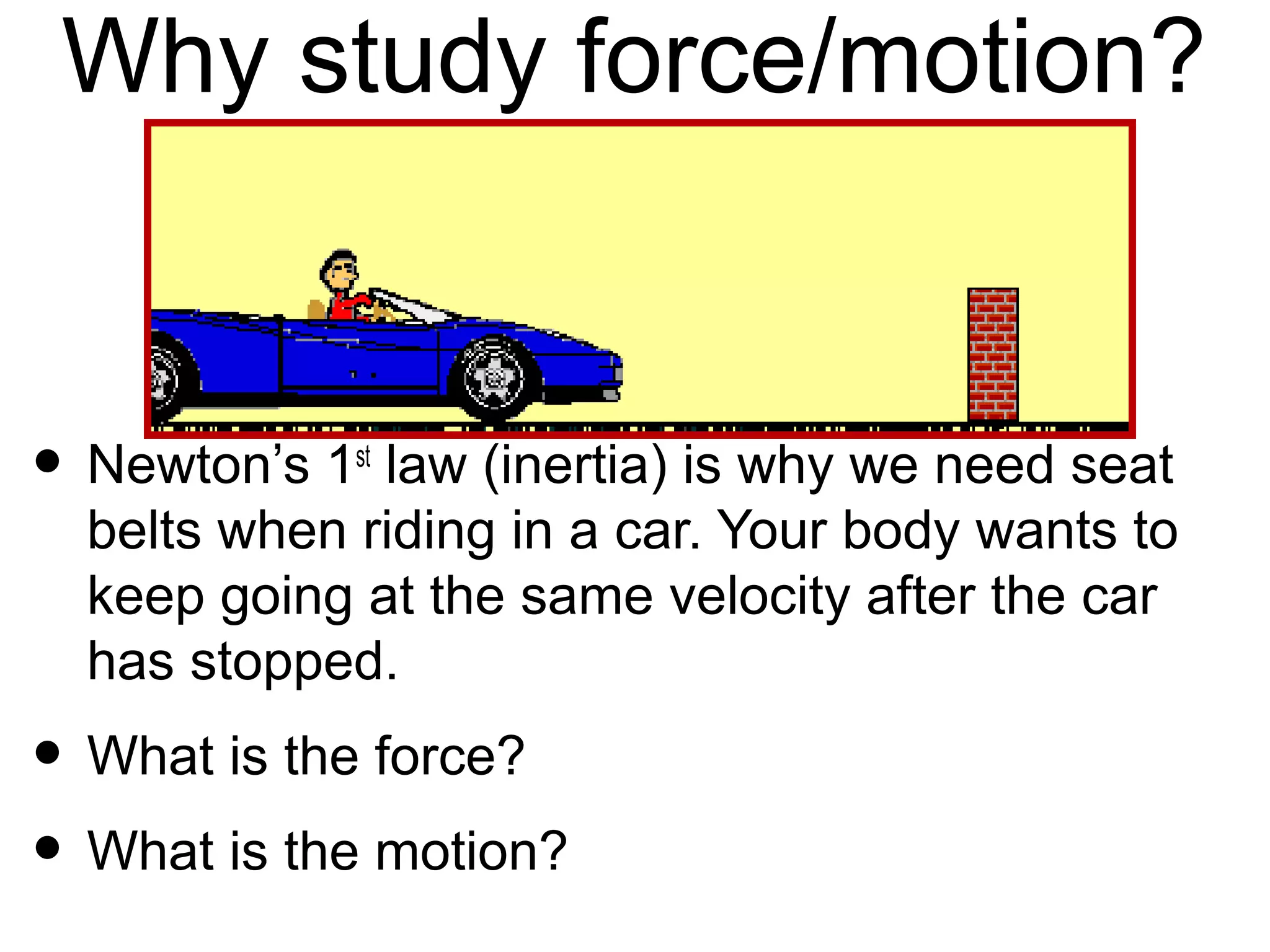
Why study force/motion?


•   Newton’s 1st law (inertia) is why we need seat
    belts when riding in a car. Your body wants to
    keep going at the same velocity after the car
    has stopped.
• What is the force?
• What is the resulting motion?
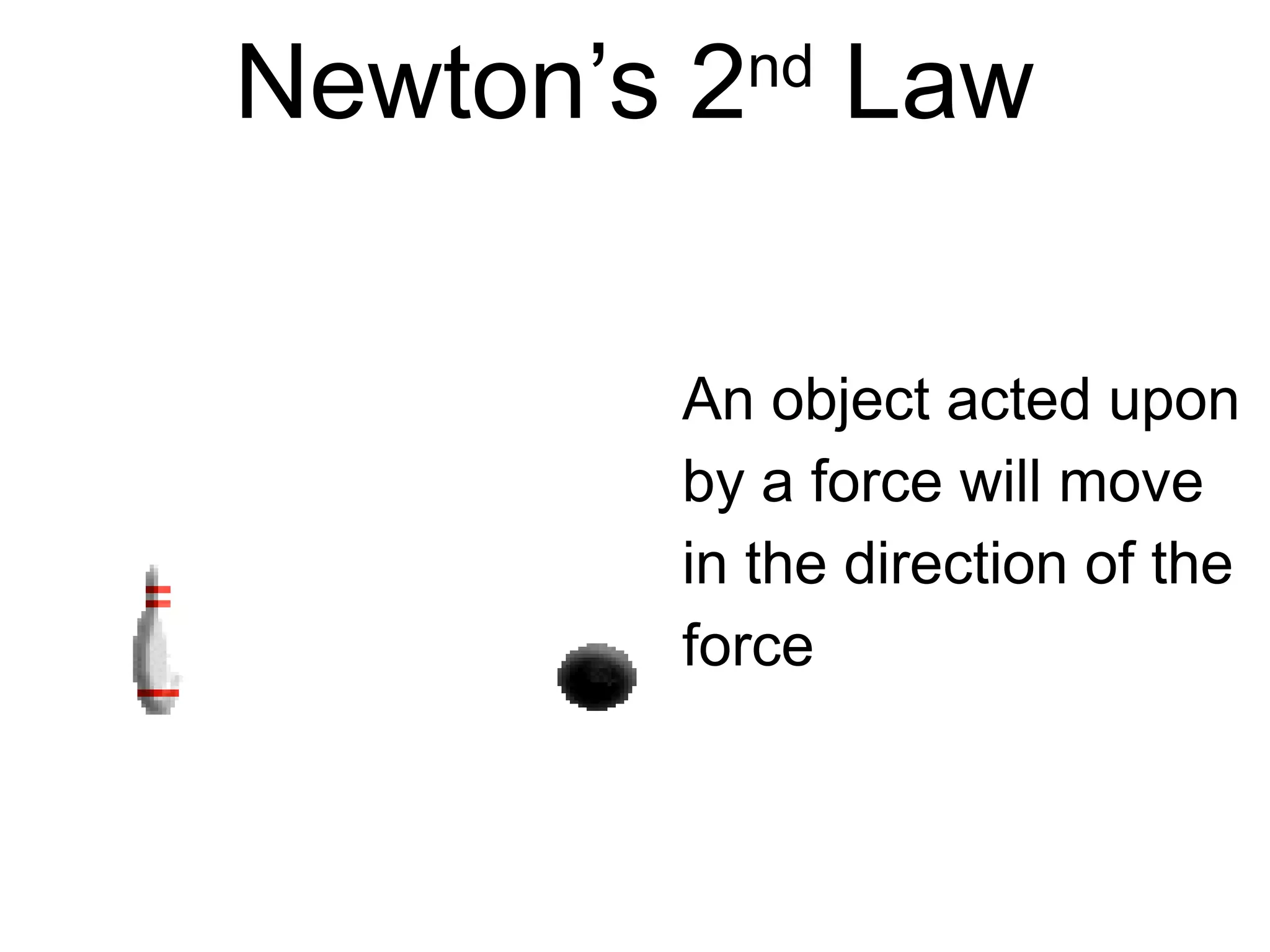
Newton’s 2 Law
         nd


       An object acted upon
       by a force will move
       in the direction of the
       force
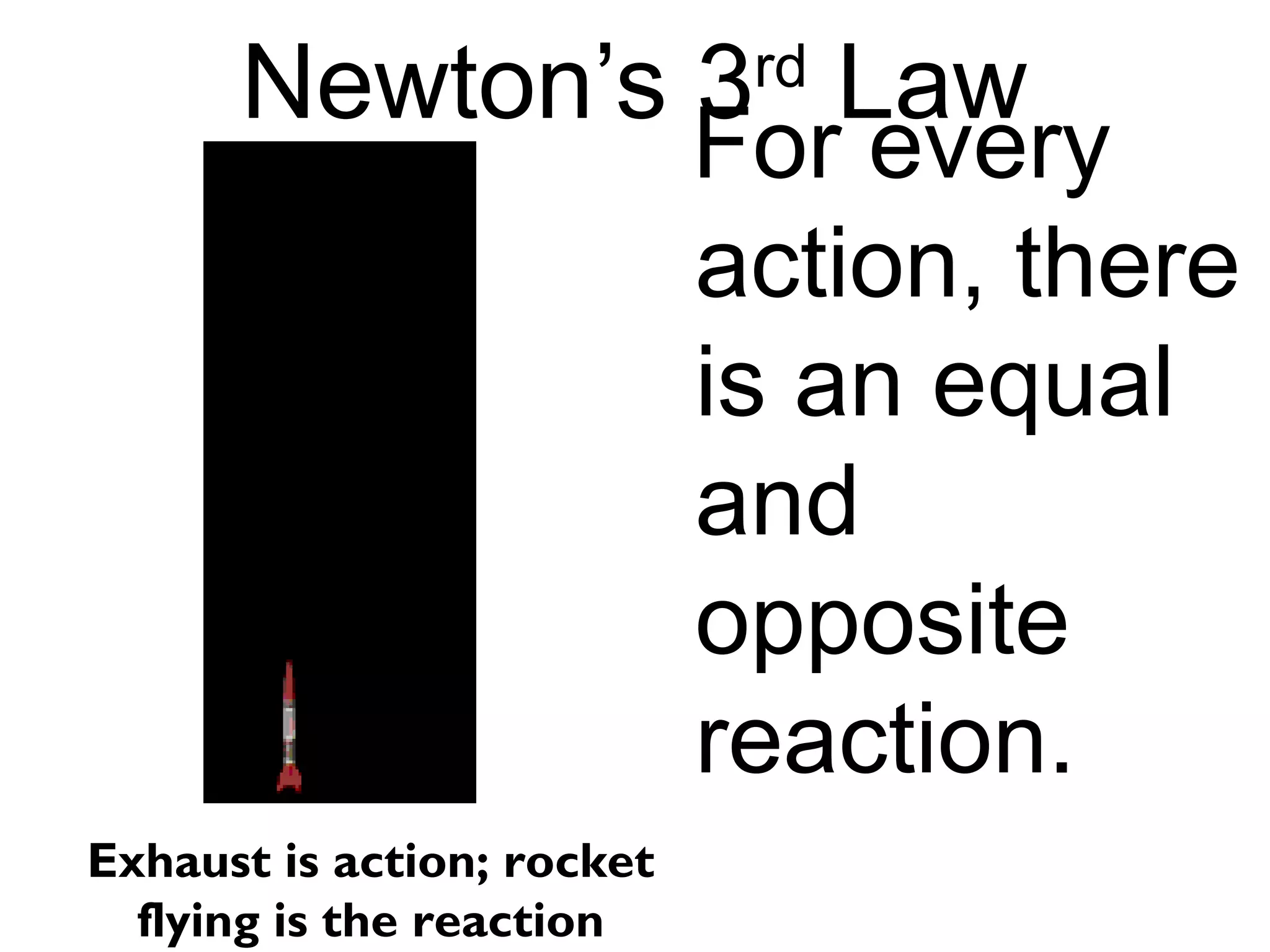
Newton’s 3 Law        rd
               For every
               action, there
               is an equal
               and
               opposite
               reaction.
Exhaust is action; rocket
  flying is the reaction
Newton’s 3 Law         rd

                             • For every action,
                               there is an equal and
                               opposite reaction.
                             • According to Newton,
                               whenever two objects
                               interact with each
                               other, they exert
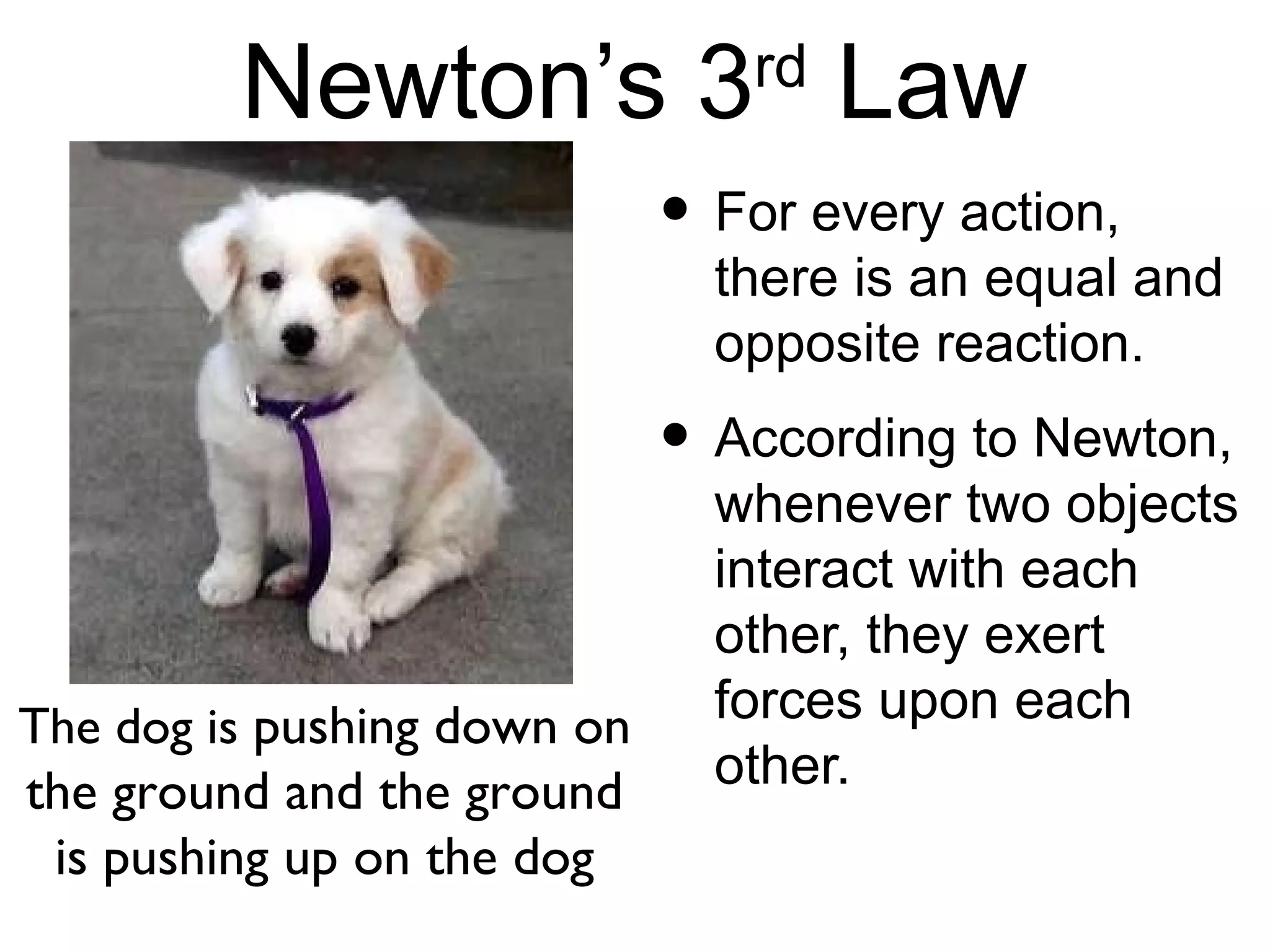
The dog is pushing down on     forces upon each
the ground and the ground      other.
 is pushing up on the dog
Balloon on rubber band
•   Predict: As you hit the balloon what will you feel when the
    balloon comes back and you again hit the balloon?

•   Observe: Step into a clear area near your table and hit the
    balloon into the air and when the balloon comes back hit
    the balloon once again. Did you feel the push of the
    balloon against your hand?

•   Discuss with your group members what each of you
    observed; Did you feel the push of the balloon against your
    hand?

•   What was the force?

•   What was the motion caused by the force?
Target:
In your study
question area     S.Q’s       Notes


write a level 3
question
about force
and motion
and a level 3
question
about
Newton’s laws
of motion           Summary

Wahiawa MS force and motion

  • 1.
  • 2.
    Set up thepenny as you see it in the picture In one move make the coin go into the container. You may: • touch the card You may NOT: • hold the card • touch the container • touch the coin
  • 3.
    1.What was theforce in your demonstration? 2.What was the resulting motion in your demonstration?
  • 4.
    Target I will beable to explain how forces affect an object’s motion.
  • 5.
    Words we usewhen we speak about force and motion • Look at the words in the Break Down Definitions • These are words we use when we talk about force and motion • As we go through each words, think about a picture you may draw to represent the word
  • 6.
    Break Down Definitions Word Definition Example or Illustration Is a push or pull; causes speed-up, slow Force down, change direction Newton Metric unit of force Distance traveled per unit of time Speed Force of attraction between all objects in Gravity the universe Force that opposes the motion of an Friction object Lubricant Substance that reduces friction
  • 7.
    Break Down Definitions Example or Word Definition Illustration An object in motion will stay in Newton’s First Law motion and an object at rest (law of inertia) will stay at rest, unless another force acts upon it Newton’s Second An object acted upon by a Law force will move in the direction of the force Newton’s Third Law Forces always occur in equal and opposite pairs
  • 8.
    Force Push Pull • Definition: Is a push or pull; causes speeding-up, slowing down, change direction • Discuss withanother person at your table about when you used a force to do some type work
  • 9.
    Force Station • Challenge: arrange the blocks so that if one block is pushed it will make the rest of the blocks move or fall (domino effect) • What is the force? • What motion occurred because of the force? • Did the force cause a speeding-up, slowing down or a change in direction? (explain) • Pull the chair away from the table. • What was the force? • What motion occurred because of the force? • Did the force cause speeding-up, slowing down or a change in direction? (explain)
  • 10.
    Draw a picturefor force On p.2 of your handout draw a picture next to the definition of force that will remind you of what force is.
  • 11.
    Speed • Definition: Distance traveled per unit of time • Speed = Distance/Time • On your Break Down Definition notes (in box under the word speed), write in the formula for speed and calculate what the speed will be if a car was traveling 5 miles in 0.2 hours
  • 12.
    Speed Station: Marbles ona ramp • Speed= Distance traveled per unit of time • Challenge: Calculate speed (Speed = Distance/Time) 1. Time how long it takes the marble to travel a distance of one meter with an incline of 2 blocks. 2. Predict: What would happen to the speed if the ramp’s incline was increased to 4 blocks? 3. Increase the incline to 4 blocks then calculate the marbles speed for a distance of one meter. 4. Explain what happened by comparing the speed of the marble on the first incline to the speed of the marble on the second incline.
  • 13.
    Speed Station: Marbles ona ramp • Speed= Distance traveled per unit of time • Challenge: Calculate speed (Speed = Distance/Time) 5. Predict: What would happen to the speed of the marble if the incline was decreased by one block? 6. Decrease the incline by one block then calculate the speed of the marble for a distance of one meter. 7. Explain what happened by comparing the speed of the last marble to the speed of the first two marbles.
  • 14.
    Draw a picturefor Speed On p.2 of your handout draw a picture next to the definition of speed that will remind you of what speed is, and how to calculate it.
  • 15.
    Newton Spring Scale used to measure Newton • Definition: Metric unit of force = force which, if applied to an object having a mass of 1 kg, would give that object an acceleration of 1 m per second per second in a vacuum • symbol, N • named in honor of English physicist Sir Isaac Newton
  • 16.
    Friction Station • Materials:Towel, Sandpaper, Wax paper, Table, Rubber • Predict: In your table write the types of surfaces in order from greatest amount of friction to least amount of friction. • Using a spring scale drag a wood block over each surface and measure the amount of force (in Newtons) and write it on your table. Was your predictions correct? Explain. • In your own words what is friction?
  • 17.
    Friction Thereason object slow down and eventually stop • There are four main types of friction: • Sliding friction: sliding a book on a desk • Rolling friction: bicycle tires rolling • Fluid friction (gases or liquid): gases or water resistance • Static friction: initial friction when moving an object
  • 18.
    Friction • Definition: Force that opposes the motion of an object • With a partner discuss which arrows show the direction of friction and why.
  • 19.
    Draw a picturefor Newton On p.2 of your handout draw a picture next to the definition of Newton that will remind you of what a Newton is.
  • 20.
    Draw a picturefor Friction On p.2 of your handout draw a picture next to the definition of friction that will remind you of what friction is.
  • 21.
    Setup p.5 inyour booklet for Cornell Notes
  • 22.
    Drawing a picturefor force, motion, and friction 1. Play gently with a car 2. Illustrate the car 3. Put arrows () and label the following: 1. Direction of force 2. Direction of motion 3. Direction of friction
  • 23.
    Gravity • Read thearticle on gravity to yourself as we read it out loud • Highlight the important words in the text
  • 24.
    Watch video onGravity on your teacher’s computer
  • 25.
    Gravity • Definition: Forceof attraction between all objects in the universe • Discuss with a partner: If all objects have a force of attraction, then why do we not feel objects pulling towards each other?
  • 26.
    Draw a picturefor Gravity On p.2 of your handout draw a picture next to the definition of gravity that will remind you of what a gravity is.
  • 27.
    Lubricant • Substance thatreduces friction • Discuss with a partner is there a lubricant in the picture above; what is the lubricant; how do you know?
  • 28.
    Draw a picturefor Lubricant On p.2 of your handout draw a picture next to the definition of lubricant that will remind you of what a lubricant is.
  • 29.
    Newton’s Laws ofMotion • I. Law of Inertia • II. Force and direction of motion • III. Action-Reaction
  • 30.
    Newton’s 1 Lawst (Law of Inertia) An object at rest will stay at rest, and an object in motion will stay in motion at constant velocity, unless acted upon by an unbalanced These fruits will stay at rest force. until acted upon by an unbalanced force.
  • 31.
    Pencil Example • Putyour pencil down on your table. • Sit back, don’t touch the pencil or the table and observe it for 1 minute. • What did the pencil do in that 1 minute? • Now blow on the pencil or touch it with your finger… what did the pencil do?
  • 32.
    Turn to p.9 in your booklet • Using Newton’s 1st law, explain what happened to the pencil (both in the 1 minute observation and the observations you had after you either blew or touched the pencil) •Sentence starter: The pencil activity shows Newton’s 1st law because… •The force in the pencil example was _________ •The motion caused by the force was _________
  • 33.
    Newton’s 1 law st (Law of Inertia) An object at rest will stay at rest, and an object in motion will stay in motion at constant velocity, unless acted upon by an unbalanced force. What is the force? What is the motion caused by the force?
  • 34.
    Why study force/motion? • Newton’s 1st law (inertia) is why we need seat belts when riding in a car. Your body wants to keep going at the same velocity after the car has stopped. • What is the force? • What is the resulting motion?
  • 35.
    Newton’s 2 Law nd An object acted upon by a force will move in the direction of the force
  • 36.
    Newton’s 3 Law rd For every action, there is an equal and opposite reaction. Exhaust is action; rocket flying is the reaction
  • 37.
    Newton’s 3 Law rd • For every action, there is an equal and opposite reaction. • According to Newton, whenever two objects interact with each other, they exert The dog is pushing down on forces upon each the ground and the ground other. is pushing up on the dog
  • 38.
    Balloon on rubberband • Predict: As you hit the balloon what will you feel when the balloon comes back and you again hit the balloon? • Observe: Step into a clear area near your table and hit the balloon into the air and when the balloon comes back hit the balloon once again. Did you feel the push of the balloon against your hand? • Discuss with your group members what each of you observed; Did you feel the push of the balloon against your hand? • What was the force? • What was the motion caused by the force?
  • 39.
    Target: In your study questionarea S.Q’s Notes write a level 3 question about force and motion and a level 3 question about Newton’s laws of motion Summary

Editor's Notes

  • #3 Hook
  • #7 Speak about the first 4 vocabulary word have them draw pictures then show the Disney Friction video.
  • #8 Speak about the first 4 vocabulary word have them draw pictures then show the Disney Friction video.
  • #9 Watch Brainpop on Force. Have student talk to each other about when they used a push or a pull to do some type of work; share with the class
  • #12 Answer the average speed is 25 miles per hour
  • #19 Students discuss then share their thoughts with the class; Show the 27 minute video on Friction
  • #20 Show the 27 minute video on Friction
  • #21 Show the 27 minute video on Friction
  • #26 Watch Brainpop on Gravity. Students discuss then share
  • #27 Show the 27 minute video on Friction
  • #28 Discuss and share
  • #29 Show the 27 minute video on Friction
  • #31 Write in the title “Newton’s 1 st law”
  • #32 Select students to share what they wrote.
  • #35 Gives a real life example of uses of studying force and motion
  • #36 Write in you notes the title “Newton’s 2 nd Law”; if one of the values is missing cover the value in the magic triangle to get the equation to figure out the missing value.
  • #38 Write the title “Newton’s 3 rd law”
  • #39 Before passing out the balloons, have them predict and read what they are to observe. The balloon is also exerting a force on your hand (reaction) as the hand hits it (action)
  • #40 1 minute